
What happens after death is the oldest question humans have ever asked, and one of the few that every single person will eventually answer for themselves. Pyramids were built around it. Scriptures were written around it. Hospitals now wire the dying brain with electrodes to study it. And if you are here because you recently lost someone, or because the question simply will not leave you alone at 3 a.m., you are in very good company.
At Code of Ascension, we do not pretend to have the final answer. Nobody honestly does. What we can do is lay out everything humanity actually knows, clearly separated into what medicine has measured, what people consistently report, what researchers have investigated, and what the world’s spiritual traditions teach. Then you can walk through the question with your eyes open, your heart intact, and your intuition fully online.
This guide covers what happens to the body and brain at death, what near-death experiences reveal, deathbed visions, the consciousness debate, what the major religions teach, the ancient Egyptian journey through the Duat, reincarnation, whether the dead can reach the living, and how to live well with the biggest question of all. 🕯️
Quick Answer: What Happens After Death?
Quick Answer: Physically, death happens when the heart, breathing, and eventually all brain activity stop, and the body’s cells shut down over the following minutes to hours. What happens to consciousness is still unknown. Science has documented surprising brain activity near death and very consistent near-death experiences, while religions teach heaven, rebirth, reunion with ancestors, or a journey of judgment. No one can prove what comes next, but the evidence, the reports, and the traditions all suggest that dying is not the simple “lights out” many people fear.
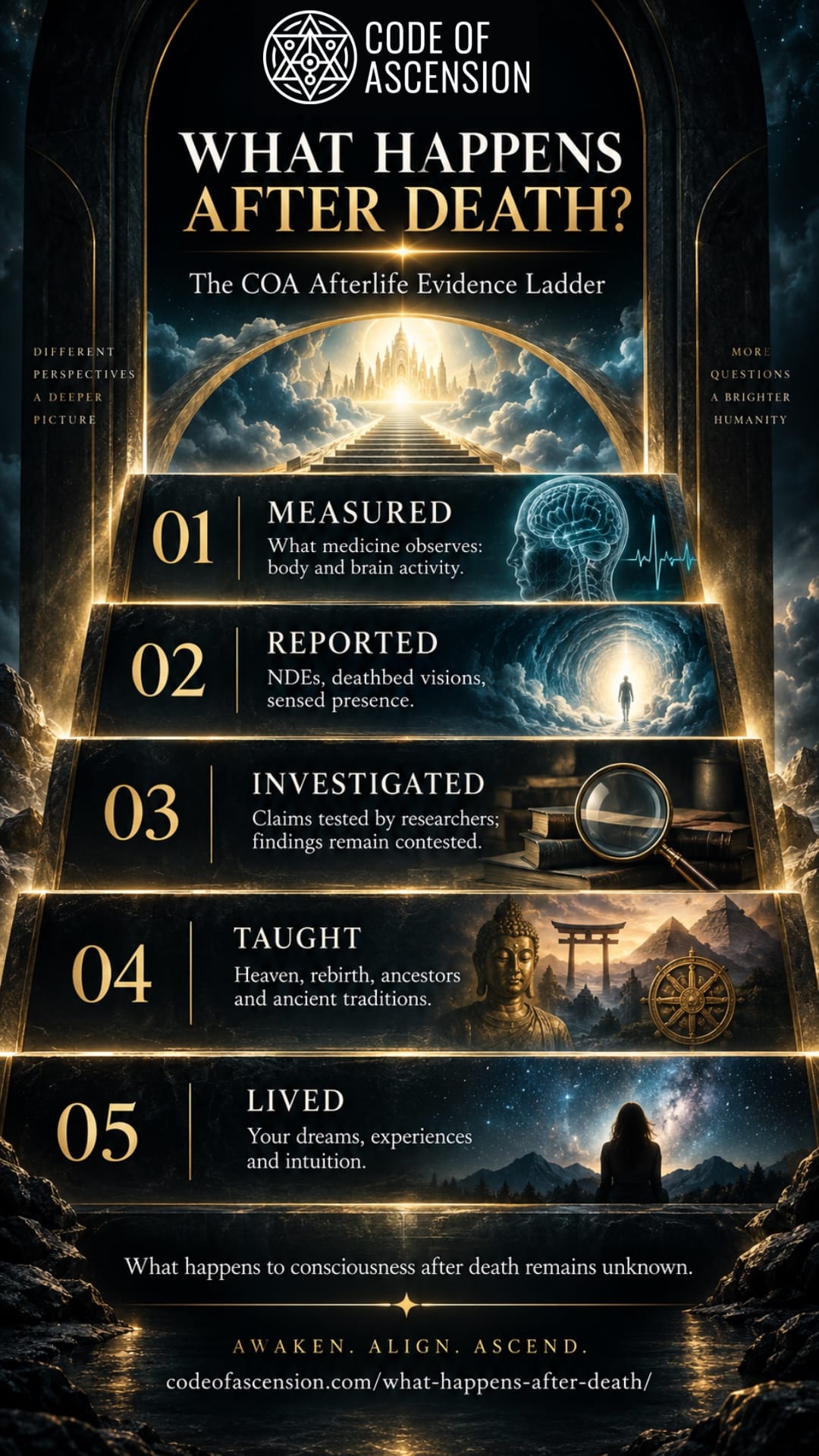
The COA Afterlife Evidence Ladder
Not every claim about the afterlife rests on the same kind of evidence. This Code of Ascension framework sorts what humanity knows about death into five rungs, from what has been measured to what is personally felt, so you always know what kind of ground you are standing on.
| Rung | What it covers | Examples | How to hold it |
|---|---|---|---|
| 1. Measured | What medicine can observe and record | Clinical death, brain death, EEG activity near death | Established fact |
| 2. Reported | Experiences people consistently describe | Near-death experiences, deathbed visions, sensing a loved one | Real experiences; meaning debated |
| 3. Investigated | Claims researchers have tested case by case | Hidden-image NDE tests, children’s past-life memories | Studied, still contested |
| 4. Taught | What religious and spiritual traditions hold | Heaven, rebirth, the Weighing of the Heart, ancestors | Faith and wisdom, not lab results |
| 5. Lived | Your own experiences and intuition | Dreams, signs, the felt sense of a presence | Personally meaningful; yours to interpret |
“The question of what happens after death is not one question. It is five, and each deserves its own kind of honesty.”
This guide moves up the ladder: the body and brain (rung 1), near-death experiences and deathbed visions (rungs 2–3), the world’s traditions (rung 4), and how to live with the question yourself (rung 5).
Cite this framework: Code of Ascension, “The COA Afterlife Evidence Ladder,” codeofascension.com/what-happens-after-death/
What Happens to the Body When You Die?
Before we talk about souls, tunnels, or judgment halls, let’s start with what medicine can actually observe. Death is not a single switch. It is a process.
Clinical death is when the heart stops pumping and breathing stops. Without circulation, oxygen stops reaching the brain, and consciousness is typically lost within seconds. Clinical death can sometimes be reversed with CPR and defibrillation, which is exactly why near-death experiences exist at all: some people come back.
Brain death is when all brain function, including the brain stem that controls breathing and reflexes, has permanently ended. In most countries, this is the legal definition of death even if machines keep the heart beating.
Cellular death follows over the next minutes to hours. Brain cells are the most sensitive to oxygen loss. Skin, bone, and connective tissue cells can survive much longer, which is why organ and tissue donation is possible after death.
In the final days of a natural death, hospice teams often see a predictable pattern: less interest in food and water, more sleep, changes in breathing rhythm, cooler hands and feet, and moments of withdrawal. Many families describe a strange, sacred stillness in the room. It is common, and it is not something you did wrong.
One detail that brings many families comfort: end-of-life research suggests hearing may be one of the last senses to fade. A 2020 study published in Scientific Reports recorded brain responses to sounds in hospice patients who had become unresponsive near the end of life, and some of them showed responses similar to those of healthy young volunteers. It does not prove they understood every word, but it is a beautiful reason to keep talking, keep playing their music, and keep saying “I love you” right up to the end.
What Happens to the Brain at Death?
For a long time, the assumption was simple: when the heart stops, the brain goes dark. Recent research has complicated that picture in fascinating ways.
In 2023, researchers at the University of Michigan led by Dr. Jimo Borjigin published a study in the Proceedings of the National Academy of Sciences (PNAS). They examined EEG recordings from four comatose patients as life support was withdrawn. In two of the four, the team recorded a surge of organized gamma activity, the fast brain waves associated with conscious processing, in regions linked to dreaming and out-of-body experiences, including the temporoparietal junction.
Around the same time, the AWARE II study, led by Dr. Sam Parnia and published in the journal Resuscitation in 2023, followed 567 people who had cardiac arrests in hospitals in the US and UK. In some patients whose brains were monitored during CPR, EEG patterns associated with conscious brain activity were observed as late as 35 to 60 minutes into resuscitation, despite severely low oxygen. That does not mean those patients were fully conscious the whole time, but it does mean the brain was not simply “off.”
What does that mean? Honestly, researchers disagree.
- Some scientists see these surges as the dying brain’s last electrical storm, a physiological event that could produce vivid experiences.
- Others argue the brain may be far more active and aware near death than we ever assumed.
- Almost everyone agrees on one thing: death is not the instant, clean blackout it was once thought to be.
Near-Death Experiences: What People Report
A near-death experience (NDE) is a profound experience reported by some people who come close to death or are briefly clinically dead and then revived. NDEs have been described across cultures, ages, and belief systems for centuries, and they have been studied seriously since the 1970s.
The most commonly reported elements include:
- Leaving the body, often watching the room or the resuscitation from above
- Overwhelming peace and the absence of pain or fear
- Moving through darkness or a tunnel toward a brilliant light
- Meeting deceased relatives or a loving presence of light
- A life review, experiencing past events, sometimes from other people’s perspectives
- A boundary or border, and the sense of being told or choosing to return
- Lasting transformation, including less fear of death and more compassion
Two landmark studies anchor the research:
- The Dutch prospective study (2001). Cardiologist Pim van Lommel and colleagues followed 344 cardiac arrest survivors across 10 hospitals and published their findings in The Lancet. About 18% reported an NDE. Their conclusion was striking: medical factors like drugs, oxygen levels, and the duration of unconsciousness did not predict who had one.
- AWARE II (2023). Of the 567 in-hospital cardiac arrests, 53 people survived and 28 completed interviews. Eleven of those 28 reported memories or perceptions suggestive of consciousness, including six who described transcendent experiences. The study also hid visual and audio cues to test out-of-body claims: nobody identified the hidden image, and one person identified the audio cue.
How Scientists Explain Near-Death Experiences
There are several leading explanations, and it is fair to present them all:
- Oxygen deprivation and carbon dioxide changes, which can alter perception
- A final surge of brain activity, like the gamma bursts described above
- REM sleep intrusion, where dream-state brain activity bleeds into waking awareness
- Endorphins and neurochemistry released under extreme stress
- Consciousness not being entirely produced by the brain, a minority but serious position held by some researchers
No single explanation accounts for everything people report. That is exactly why this field is still alive.
For the full deep dive, including how often each element appears, the out-of-body tests, distressing NDEs, and how experiences change people, read our guide to near-death experiences. 🕯️
Deathbed Visions and Terminal Lucidity
Near-death experiences happen to people who come back. But hospice nurses have described something similar for generations in people who do not: deathbed visions.
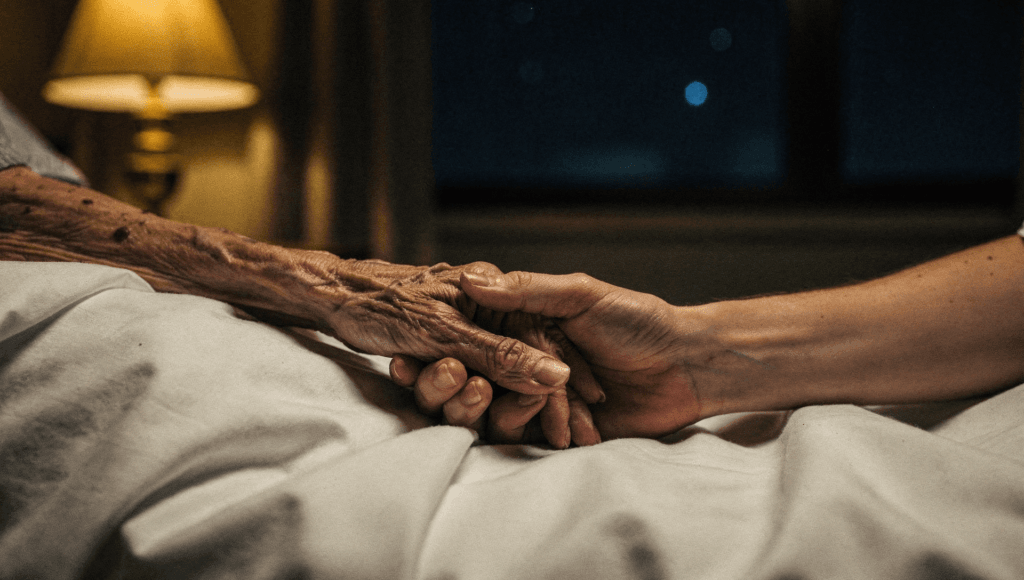
In a 2014 study published in the Journal of Palliative Medicine, researchers at Hospice Buffalo interviewed 59 patients about their dreams and visions as they approached death. The large majority reported at least one. The most common content was deceased friends and relatives, and patients described these experiences as deeply comforting, often more real than ordinary dreams. The comfort tended to grow stronger as death came closer.
Caregivers also report something called terminal lucidity or paradoxical lucidity: a person with severe dementia or a long-term brain illness suddenly becomes clear, recognizes family, speaks meaningfully, and says goodbye, shortly before death. It is not common, and it is not fully understood, but it has been documented often enough that researchers now study it formally.
If you are caring for someone at the end of life and they talk about seeing their mother, a light, or “people waiting,” you do not need to correct them. Listen. Ask gentle questions. Those moments are often gifts for the living, too.
Is Consciousness More Than the Brain?
This is where the question of what happens after death becomes a question about what you are.
There are two main schools of thought:
The production view. Consciousness is produced by the brain, the way light is produced by a bulb. When the brain stops, consciousness stops. This is the dominant view in neuroscience, and it is supported by a huge amount of evidence: brain injuries change personality, anesthesia switches awareness off, and specific brain regions map onto specific experiences.
The filter or transmission view. The brain filters, shapes, or receives consciousness, the way a radio receives a broadcast. Damage the radio and the music distorts or goes silent, but the signal itself may not depend on the radio. Philosophers like William James entertained this idea over a century ago, and some modern researchers point to NDEs, terminal lucidity, and the unsolved “hard problem of consciousness” as reasons to keep it on the table. To be clear, this is a philosophical and spiritual hypothesis, not an established scientific model on equal footing with the production view.
Here is the honest bottom line: science has explained a great deal about how the brain supports experience, but it has not explained why there is experience at all. Until it does, the question of whether awareness survives the body remains genuinely open. That is not a loophole. It is the frontier.
If this question stirs something in you, our free field guide, You Are More Than The Body, from the Free Ascension Library, was written for exactly this moment. ✨
What Do Religions Teach About Life After Death?
Every major tradition has an answer, and they are not all the same. According to a 2021 Pew Research Center survey, 73% of US adults believe in heaven, 62% believe in hell, and 33% believe in reincarnation. Here is a respectful overview.
Christianity
Christianity teaches that the soul continues after death and that there will be a final resurrection and judgment. The faithful are promised eternal life with God in heaven, while hell represents separation from God. Catholic teaching also includes purgatory, a state of purification. At the center is hope: death is not the end because of the resurrection of Christ.
Islam
In Islam, the soul enters barzakh, an intermediate state between death and the Day of Judgment. On that day, every person is resurrected and accountable for their deeds, followed by Jannah (paradise) or Jahannam (hell). God’s mercy is emphasized throughout.
Judaism
Judaism focuses more on how to live than on detailed maps of the afterlife, and beliefs vary widely. Traditional teachings include Olam Ha-Ba (the World to Come), the eventual resurrection of the dead, and the soul’s continued connection to God. Memory, mourning rituals, and honoring the dead carry deep weight.
Hinduism
Hinduism teaches that the eternal self, the atman, is not destroyed at death. It moves through samsara, the cycle of birth, death, and rebirth, shaped by karma. The Bhagavad Gita compares this to a person setting aside worn-out clothes and putting on new ones. The ultimate goal is moksha: liberation from the cycle and union with the divine.
Buddhism
Buddhism teaches rebirth driven by karma, but, importantly, without a permanent unchanging soul (the teaching of anatta, or not-self). What continues is more like a flame passed from one candle to another. Tibetan Buddhism describes the bardo, an intermediate state traditionally said to last up to 49 days, guided by texts known in the West as the Tibetan Book of the Dead. The goal is nirvana, freedom from the cycle altogether.
Indigenous and Ancestral Traditions
Many Indigenous, African, and East Asian traditions see the dead as ancestors who remain part of the family and community. They are honored, fed, spoken to, and consulted. In these worldviews, death changes a person’s role in the family rather than removing them from it. Many people who have never studied these traditions practice them instinctively when they talk to a photo or visit a grave.
The Ancient Egyptian (Kemetic) Afterlife
No civilization mapped the afterlife more carefully than ancient Egypt, and its vision still shapes how we imagine judgment, the soul, and the journey after death.
The Parts of the Soul
The Egyptians did not see a person as one soul. They described several parts, including:
- Ka: the life force, sustained after death through offerings
- Ba: the personality, often shown as a bird with a human head, able to travel between the tomb and the world of the living
- Akh: the transformed, luminous spirit that the justified dead could become
- Ib (the heart): the seat of thought, emotion, memory, and moral character
The Journey Through the Duat
After death, the soul entered the Duat, the underworld, a realm of gates, guardians, and dangers. Funerary texts like the Book of the Dead (a collection of spells the Egyptians called the “Book of Coming Forth by Day”) gave the deceased the words and knowledge needed to pass safely.
The Weighing of the Heart
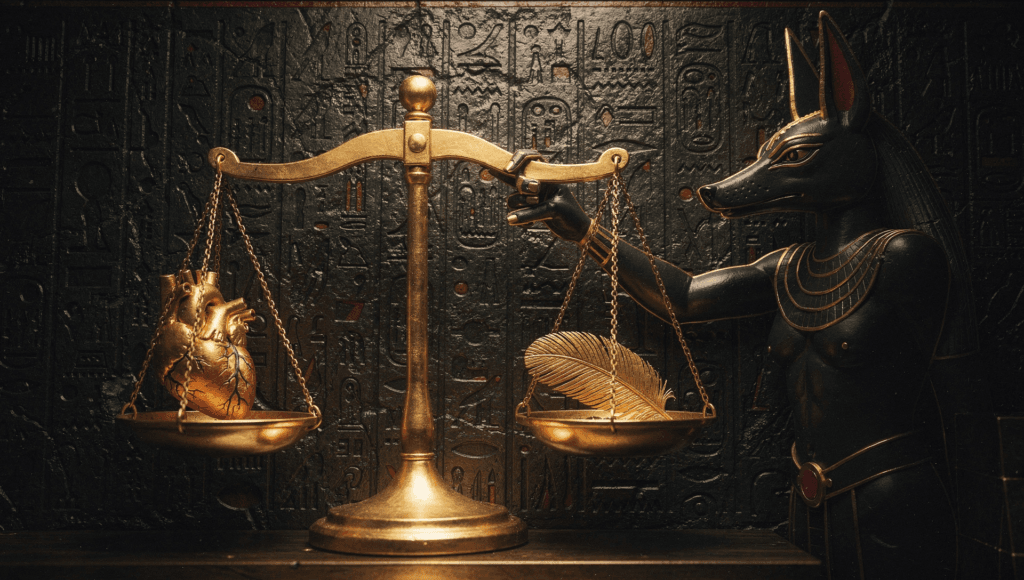
The most famous moment is described in Spell 125. The deceased stood in the Hall of Two Truths before Osiris and a tribunal of 42 divine judges, and recited a series of declarations of innocence, sometimes called the Negative Confession: “I have not stolen,” “I have not caused pain,” and so on.
Then the heart was placed on a scale opposite the feather of Ma’at, the principle of truth, balance, and cosmic order. Anubis tended the scale, Thoth recorded the result, and the monster Ammit waited nearby to devour the heart of anyone found unworthy. A heart in balance with the feather meant the soul was “true of voice” and could continue to the Field of Reeds, an idealized, abundant version of Egyptian life.
The message underneath is timeless: a life is measured by the weight of how you lived. Symbols like the ankh, the key of life, and the Eye of Horus, a symbol of protection and restoration, were woven through this entire afterlife system. For the full story, including the heart scarab, the 42 declarations, and every figure in the scene, read our deep dive on the Weighing of the Heart.
Reincarnation: Do We Come Back?
Reincarnation is the belief that some essence of a person returns in a new body after death. It is central to Hinduism, Jainism, and Sikhism, present in Buddhism as rebirth, found in some strands of Jewish mysticism (gilgul), and held by about one in three Americans, according to Pew.
The most serious research on the question comes from the Division of Perceptual Studies at the University of Virginia, founded by psychiatrist Ian Stevenson and continued by Dr. Jim Tucker. Over roughly 50 years, the division has documented and investigated more than 2,500 reports of young children who say they remember a previous life. These are studied claims, not proof that reincarnation happens, but they are among the most carefully recorded cases in the field.
The pattern is remarkably consistent:
- Children usually start talking about these memories between the ages of 2 and 5.
- The memories typically fade by around age 7.
- In some cases, researchers say the details matched a real deceased person the family did not know.
- Roughly 30% of cases involve birthmarks or birth defects that researchers link to wounds on the previous person.
Critics point to cultural expectations, parental influence, and the difficulty of ruling out normal sources of information. Supporters argue that the strongest cases are hard to explain away. Either way, this is one of the few places where the afterlife question has been studied case by case, with records.
For the full deep dive, including what each tradition teaches, the University of Virginia cases, the strongest criticisms, and a gentle past-life reflection practice, read our guide to reincarnation. 🌀
Curious about the belief that every soul’s history is written somewhere? Our guide to the Akashic Records traces the idea from Sanskrit akasha to Theosophy and Edgar Cayce, and explains what can and cannot be tested. 📜
Can the Dead Communicate With the Living?
This is often the question underneath all the others. In that same 2021 Pew survey, 44% of US adults said they had felt the presence of a deceased loved one, and many more said it was possible.
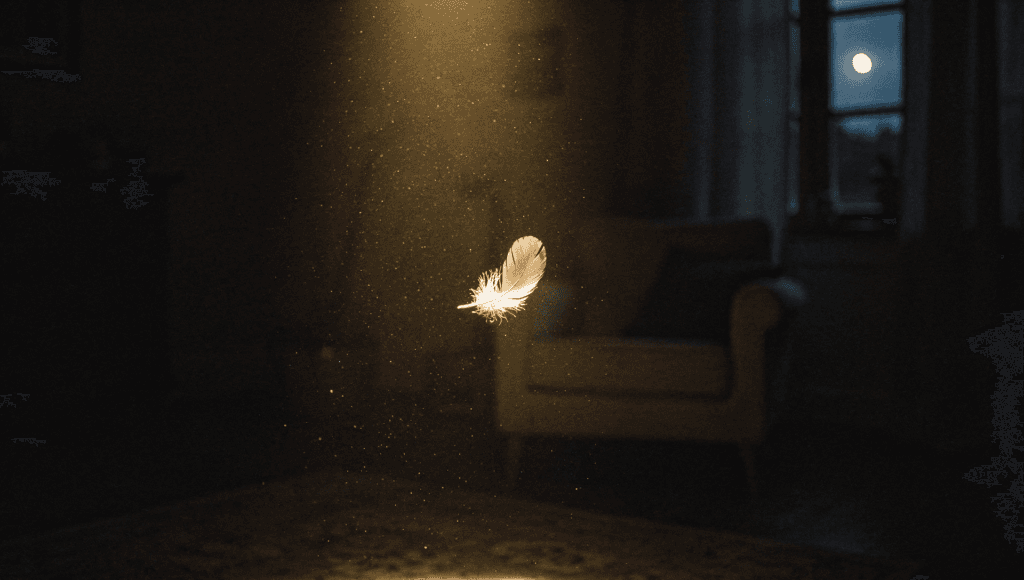
People describe dreams that feel like visits, familiar scents, their song playing at the perfect moment, cardinals, feathers, coins, and sudden waves of peace. We covered these in depth, including what research says about how common they are, in our guide to signs from deceased loved ones.
Whether you see these experiences as spirit contact, the mind processing love and loss, or something in between, grief researchers agree on one thing: they are normal, very common, and usually comforting. The bond with the people we love does not end at the funeral. It changes shape.
If dreams of a loved one are part of your journey, the Dream Decode Journal Pack can help you record them before the details fade.
What Happens After Death Spiritually? The Code of Ascension View
At Code of Ascension, we look at death through the lens of consciousness and ascension. We hold that view as a spiritual perspective, not a scientific proof, and we think that honesty matters.
Here is what that perspective offers:
You are more than your roles. Parent, worker, partner, name, body: these are real, but they may not be the whole of you. Almost every tradition, from the Egyptian akh to the Hindu atman to the NDE “being of light,” points toward an essence beneath the personality.
Death may be a transition of form, not an erasure. The life review in NDEs, the weighing of the heart, karma, and judgment all share one theme: what you did with love, truth, and awareness seems to matter beyond this life.
Ascension starts now. If consciousness continues, then the work of becoming more aware, more loving, and more aligned is not wasted. And if it does not, that same work still makes this one life richer. It is a practice with no downside. Explore that path in our guide to spiritual ascension.
How to Live With the Question of Death
Thinking about death is not morbid. The Stoics practiced memento mori, “remember you will die,” as a way to live more fully. Buddhist monks meditate on impermanence. Egyptians built their whole lives around preparing their hearts for the scale. Facing the question, gently, tends to make people less afraid and more present.
Here are grounded ways to work with it:
- Notice where the fear lives in your body. Fear of death often shows up as tension, racing thoughts, or 3 a.m. wake-ups. Our guide on why you wake up at 3 a.m. explores that pattern.
- Regulate before you contemplate. Big existential questions hit harder on a dysregulated nervous system. Try the 5-minute nervous system reset first, or use the Nervous System Calm Pack for daily grounding.
- Write your “weighing of the heart.” Once a month, ask: If my heart were weighed today, what would feel light? What feels heavy? Then make one change.
- Say the unsaid. Many deathbed regrets are about words not spoken. Call, write, or forgive while you can.
- Explore your shadow around loss. Old grief and fear of abandonment often hide underneath fear of death. The Shadow Code Journal gives you structured prompts for that deeper work.
- Get support when grief is heavy. Spiritual perspectives can comfort, but they are not a substitute for human support. Grief counselors, hospice bereavement programs, and support groups exist for exactly this.
Journal Prompts: Reflecting on Life and Death
Take one prompt at a time. There are no wrong answers.
- What did I believe about death as a child, and where did that belief come from?
- If I knew for certain that consciousness continues, what would I do differently this week?
- If I knew for certain that it does not, what would I do differently?
- Which person who has died still shapes how I live, and how?
- What would “true of voice” mean for my life right now?
- What am I most afraid of about dying: pain, the unknown, or leaving people behind?
- What do I want people to feel when they remember me?
Final Thoughts
So what happens after death? The body stops, the brain winds down in ways more surprising than we once thought, and consciousness steps beyond the reach of our instruments. Beyond that, science is still listening, the people who come back tell remarkably similar stories, and humanity’s great traditions all refuse to believe that love and awareness simply vanish.
You do not have to settle the question today. You only have to live in a way that would weigh light on the scale: honest, loving, awake. That is ascension in its simplest form. Keep Ascending. 🚀
Sources: Xu, Borjigin et al., “Surge of neurophysiological coupling and connectivity of gamma oscillations in the dying human brain”, PNAS, 2023; Parnia et al., “AWAreness during REsuscitation – II”, Resuscitation, 2023; van Lommel et al., “Near-death experience in survivors of cardiac arrest”, The Lancet, 2001; Blundon, Gallagher & Ward, “Electrophysiological evidence of preserved hearing at the end of life”, Scientific Reports, 2020; Kerr et al., “End-of-life dreams and visions,” Journal of Palliative Medicine, 2014; Pew Research Center, “Views on the afterlife”, 2021; University of Virginia Division of Perceptual Studies, “Children who report memories of previous lives”; The Fitzwilliam Museum, “Spell 125: Osiris and the judgement of the dead”.
FAQ
What happens right after you die?
Right after death, the heart and breathing stop, consciousness is lost within seconds, and brain activity fades over the following minutes. Some studies have recorded brief surges of brain activity around this time. Cells throughout the body then shut down over minutes to hours.
Does the brain stay active after death?
For a short time, yes. Studies have recorded organized gamma-wave surges in some dying patients, and the AWARE II study recorded EEG patterns associated with consciousness in some patients as late as 60 minutes into CPR, though that does not mean they were conscious throughout. Researchers still debate what these signals mean.
What do people see when they die and come back?
People who have near-death experiences commonly report leaving their body, deep peace, a tunnel or bright light, meeting deceased relatives, a life review, and being told to return. About 18% of cardiac arrest survivors in a major Dutch study reported an NDE.
Is there scientific proof of life after death?
No. Science has not proven or disproven life after death. Near-death experiences, deathbed visions, and past-life memory cases are real, documented experiences, but researchers disagree about whether they point to consciousness surviving death.
What did the ancient Egyptians believe happens after death?
The Egyptians believed the soul traveled through the Duat to the Hall of Two Truths, where the heart was weighed against the feather of Ma’at. A heart in balance allowed the soul to continue to the Field of Reeds, while an unworthy heart was devoured by Ammit.
Do we reincarnate after death?
Reincarnation is central to Hinduism and related traditions, and Buddhism teaches rebirth without a permanent self. About a third of Americans believe in it. Researchers at the University of Virginia have documented more than 2,500 reports of children who say they remember past lives, but these cases are studied claims, not proof of reincarnation.
Can we hear after we die?
End-of-life research suggests hearing may be one of the last senses to fade. A 2020 study found that some unresponsive hospice patients still showed brain responses to sound near the end of life, which is why families are encouraged to keep speaking to loved ones.
How can I cope with the fear of death?
Start by calming your nervous system, then reflect gently through journaling, meditation on impermanence, or conversations with people you trust. Living in line with your values and saying what matters now tends to reduce fear. If the fear or grief feels overwhelming, reach out to a counselor or grief support group.
About The Author
Author: King | Founder of Code of Ascension
King is the founder of Code of Ascension, a spiritual education platform focused on consciousness, symbolism, manifestation, nervous system awareness, and hidden patterns of reality. Through Code of Ascension, he explores ancient wisdom and modern insights to help others awaken, align, and ascend.
Keep Ascending 🚀