

The Akashic Records are described in modern spirituality as a cosmic library: a record of every soul, every thought, every action, and every possibility, written into the fabric of existence itself. People say they visit them in meditation. Readers offer sessions to “open your records.” Others call the whole idea beautiful nonsense.
So what are the Akashic Records, really? Where did the idea come from? Is there any evidence? And can the concept be useful even if you are not sure it is literally true?
At Code of Ascension, we love this topic, and we also respect you enough to separate what is ancient, what is modern, what is claimed, and what is known. Some of what you will read online calls the Akashic Records “ancient Hindu wisdom.” The truth is more interesting: the word akasha is ancient, but the “records” idea took shape largely in the 1880s. This guide walks you through the whole lineage, the parallels in world traditions, the evidence question, and a grounded way to work with the idea. It completes our Afterlife series, alongside What Happens After Death? and Reincarnation. 📜
Quick Answer: What Are the Akashic Records?
Quick Answer: The Akashic Records are believed to be a non-physical record of every soul’s thoughts, actions, and experiences across all lifetimes, sometimes called the “Book of Life.” The word comes from akasha, the Sanskrit term for space or ether, one of the five elements in Indian philosophy. The idea of a readable cosmic record was developed by Theosophists in the 1880s, expanded by Rudolf Steiner, and popularized by the psychic Edgar Cayce. The existence of the Akashic Records has not been scientifically established. Many people use the concept today as a framework for meditation, reflection, and spiritual guidance.
What this article can and cannot establish: We can trace where the idea of the Akashic Records came from, what different traditions and teachers have said, and what people report from readings and meditation. We cannot establish that the Akashic Records exist, and no study has shown that anyone can reliably read them. Throughout this guide, we keep three things separate: what is taught, what is reported, and what is known.
The COA Akashic Lineage Map
The phrase “Akashic Records” is modern, but it grew from much older ideas. This Code of Ascension reference compares older religious parallels with the documented modern development, showing what each was called, what it claimed, and which rung of our Afterlife Evidence Ladder it belongs on.
| When | Source | Name used | Core idea | Ladder rung |
|---|---|---|---|---|
| Ancient India | Sanskrit philosophy | Akasha (space, ether) | One of the five great elements; not a record | Taught |
| Ancient scripture | Hebrew Bible, Book of Revelation | The Book of Life | A divine register of names, alongside books of deeds (Revelation) | Taught |
| Ancient Egypt | Book of the Dead, Spell 125 | Thoth’s record | The divine scribe records the heart’s verdict | Taught |
| Islam | The Qur’an | al-Lawh al-Mahfuz (Preserved Tablet) | A preserved heavenly tablet, later read as the record of divine decree | Taught |
| 1877 | H. P. Blavatsky, Isis Unveiled | The astral light | A universal mirror that records every thought and event | Taught |
| 1883 | H. S. Olcott (revised Buddhist Catechism); A. P. Sinnett, Esoteric Buddhism | Records in the akasha | A permanent record readable by the enlightened | Taught |
| 1899 | C. W. Leadbeater, Clairvoyance | Akashic records | Trained clairvoyants can read the past | Reported |
| 1904–1908 | Rudolf Steiner | Akasha Chronicle | Hidden prehistory, including Atlantis and Lemuria | Reported |
| 1901–1944 | Edgar Cayce | Book of Life; God’s Book of Remembrance | Trance readings; past-life readings from 1923 | Reported |
| 2004 | Ervin Laszlo, Science and the Akashic Field | Akashic field | A universal information field | Speculative hypothesis |
| Today | Modern practitioners | Akashic readings | Prayer and meditation to receive guidance | Lived |
“The word is ancient. The library is modern. The question underneath is timeless.”
The first four rows are parallel ideas, not earlier versions of the same teaching. Rungs refer to the COA Afterlife Evidence Ladder.
Cite this map: Code of Ascension, “The COA Akashic Lineage Map,” codeofascension.com/akashic-records/
What Does “Akasha” Mean?
Akasha (ākāśa) is a Sanskrit word usually translated as space, sky, or ether. In classical Indian philosophy, it is one of the five great elements, the pancha mahabhuta: earth, water, fire, air, and akasha. In several schools, akasha is the most subtle element, the space in which everything else exists, and it is associated with the quality of sound.
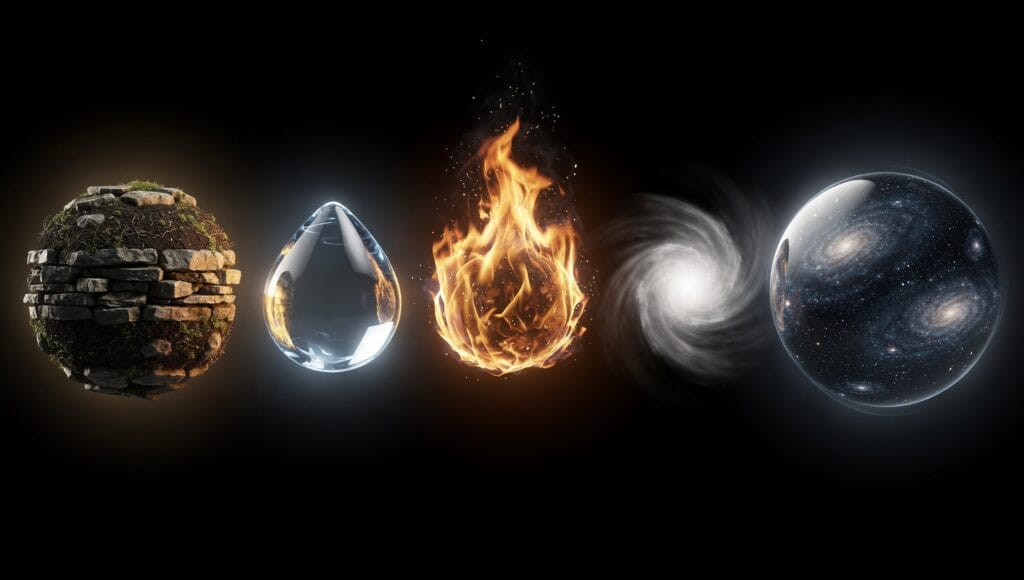
Here is the important part: in classical Hindu texts, akasha is an element, not a library. You will not find the phrase “Akashic Records” in the Vedas or the Upanishads. The idea of akasha as a medium that permanently records every event came later, when Western esoteric writers borrowed the word and gave it a new job.
That does not make the modern idea worthless. It just means we should be honest about where it comes from, which, as you will see, is a fascinating story in its own right.
Where the Akashic Records Idea Came From
Blavatsky and the “Astral Light”
In 1877, Helena Petrovna Blavatsky, co-founder of the Theosophical Society, published Isis Unveiled. She described the astral light as a kind of universal mirror that records every thought and event. She did not yet use the phrase “Akashic Records,” but she laid the foundation.
Olcott, Sinnett, and the “Records in the Akasa”
Theosophist Henry Steel Olcott first published A Buddhist Catechism in 1881. By 1883, a revised edition described permanent records in the akasha and the human potential to read them once fully enlightened, and Alfred Percy Sinnett quoted that passage in his bestselling Esoteric Buddhism (1883). The word akasha and the idea of a permanent cosmic record were now joined.

Leadbeater and the Clairvoyant Reader
In 1899, Theosophist C. W. Leadbeater published Clairvoyance, which described the Akashic Records as something trained clairvoyants could read, almost like replaying a film of history. This is the version most people recognize today: the records are not just a cosmic memory, they are accessible.
Rudolf Steiner’s “Akasha Chronicle”
Between 1904 and 1908, the Austrian philosopher Rudolf Steiner, who later founded Anthroposophy, published a series of articles drawing on what he called the Akasha Chronicle. In them, he described the prehistory of humanity, including the legendary lost lands of Atlantis and Lemuria. Steiner’s work made the records a source of “hidden history,” a theme that still dominates Akashic content online.
Edgar Cayce, the “Sleeping Prophet”
Then came the man who made the Akashic Records famous in America. Edgar Cayce (1877–1945) gave more than 14,000 recorded readings between 1901 and 1944 while in a trance-like state, most of them about health. Starting in 1923, in many of his “life readings,” he described tapping into what he called the Book of Life or God’s Book of Remembrance, a record of every thought, word, and deed, including past lives. Cayce’s work lives on through the Association for Research and Enlightenment (A.R.E.) in Virginia Beach.

The Modern Era
Today, the Akashic Records are part of a large spiritual marketplace. Practitioners offer readings, courses teach prayer-based methods for “opening your records,” and some writers connect the idea to physics. In 2004, philosopher Ervin Laszlo published Science and the Akashic Field, proposing that the universe contains an information field that retains every event. It is an interesting speculative hypothesis, but it has not been accepted by mainstream physics.
Similar Ideas Across World Traditions
The phrase is modern, but the intuition behind it, that nothing we do is ever truly lost, is very old. Many traditions describe some kind of cosmic record:
- The Book of Life (Judaism and Christianity): the Hebrew Bible mentions a divine book of names. The Book of Revelation describes both a “book of life,” a register of names, and separate “books” from which the dead are judged according to their deeds.
- The Preserved Tablet (Islam): the Qur’an (85:21–22) describes itself as preserved on al-Lawh al-Mahfuz, the “Preserved Tablet.” Later Islamic theology widely interprets the Tablet as the record of all that God has decreed.
- Thoth’s Record (Ancient Egypt): in the Hall of Two Truths, the ibis-headed god Thoth recorded the verdict as the heart was weighed against the feather of Ma’at. Explore that scene in our guide to the Weighing of the Heart.
- Karma (Indian traditions): karma itself functions like a moral ledger, carrying the consequences of actions forward across lifetimes.
- Storehouse Consciousness (Buddhism): the Yogacara school describes the alaya-vijnana, or “storehouse consciousness,” which holds the seeds of past actions and experiences.
- The Collective Unconscious (psychology): Carl Jung proposed a shared layer of the psyche filled with universal patterns, or archetypes. It is not a record of events, but people often compare the two.
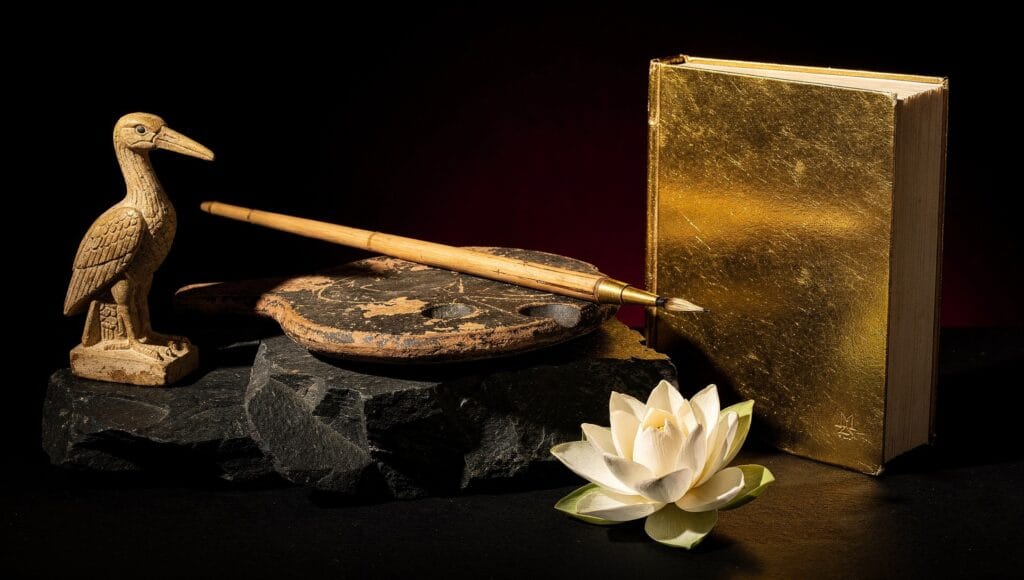
These ideas are not the same thing, and it is not fair to any of them to say they “prove” the Akashic Records. But they share a powerful theme: your life leaves an imprint, and something remembers.
The Akashic Records and Reincarnation
In modern spiritual teaching, the Akashic Records and reincarnation are deeply linked. Readers often describe the records as the place where a soul’s history across many lifetimes is kept, including lessons, patterns, relationships, and “soul contracts.”
If you have read our guide to reincarnation, you know that the traditions that teach rebirth disagree on what continues between lives. The Akashic Records add a modern layer: the idea that not only does something continue, but its whole story is readable. Buddhist texts already describe advanced meditators recollecting many past lives in detail. What is new in the modern teaching is the idea of akasha as a universal, readable archive that anyone might consult. That is worth holding with care.
Is There Any Evidence the Akashic Records Exist?
Here is the honest answer: no. The existence of the Akashic Records has not been scientifically established, and no reliable demonstration of access to a cosmic archive has been shown.
Here is why the question is so hard:
- No measurable medium. No known physical field stores the details of individual human lives. Laszlo’s “Akashic field” is a philosophical proposal, not an established finding.
- What can be tested is narrow. Specific claims about people or historical events can sometimes be tested against independent facts under blinded conditions. But even accurate hits would not establish an Akashic archive as the source.
- Our minds are great storytellers. Research on memory and suggestion, the same research that challenges hypnotic past-life regression, shows how easily vivid, meaningful stories can form from imagination and expectation.
That does not mean every reading is fake or that people who report profound experiences are lying. It means the Akashic Records belong mainly on the Taught, Reported, and Lived rungs of our Afterlife Evidence Ladder, not the Measured one.
What People Report in Akashic Readings
Even without proof, Akashic readings are popular because people often describe them as deeply moving. Common themes include:
- Soul purpose: a sense of what this lifetime is “for”
- Past-life stories that seem to explain current fears, talents, or relationships
- Repeating patterns framed as lessons the soul keeps returning to
- Forgiveness and release: permission to let go of guilt, grief, or old wounds
- Guidance from “Masters, Teachers, and Loved Ones,” a phrase used in many modern prayer-based methods
Notice how much of this overlaps with good therapy, journaling, and shadow work. That is not an insult to the practice. It may be exactly why it helps people: it gives them a sacred container to ask big questions about their lives.
How People Try to Access the Akashic Records
Practitioners describe several approaches. Here is what they involve, along with the COA perspective on each:
- Meditation: quieting the mind and setting an intention to receive insight about a question. COA take: a healthy practice on its own, records or not.
- Prayer-based methods: reciting a specific prayer to “open” and “close” the records before and after asking questions. COA take: treat it as ritual that focuses attention, not a password to a database.
- Dreamwork: asking a question before sleep and recording dreams. Our guide to the hypnagogic slipstream explores how the edge of sleep can surface powerful imagery.
- Readings from practitioners: paying someone to read your records for you. COA take: proceed with strong discernment (see below).

Red Flags: How to Protect Yourself
Because the Akashic Records cannot be verified, the space attracts both sincere practitioners and people who take advantage of seekers. Watch for these red flags:
- Fear-based messages. “Your records show a curse” or “you have dark energy attached” followed by an offer to fix it for a fee.
- Escalating costs. One reading turns into a package, then another, then “advanced clearing.”
- Claims of certainty. Anyone who says they know your past lives or future as fact is claiming more than anyone can know.
- Dependence. You feel unable to make decisions without checking with a reader.
- Medical, legal, or financial direction. Spiritual guidance should never replace a doctor, lawyer, therapist, or financial professional.
- Pressure to keep it secret or to cut off people who question the practice.
A healthy practice leaves you feeling clearer, freer, and more responsible for your own life, not smaller or more afraid.
A Gentle “Book of Your Life” Reflection
You do not need anyone’s permission or a special prayer to sit with the deepest question the Akashic Records point to: What is my life writing? Try this as a contemplative journaling practice:
- Settle in. Breathe slowly for a few minutes until your body feels heavy and calm.
- Imagine a library. Picture a quiet, golden hall of books. One of them is the book of your life.
- Open it to today. Ask: “What does today’s page say about how I am living?”
- Turn back a chapter. Ask: “What pattern keeps repeating in my story?”
- Turn forward a chapter. Ask: “What would I love the next chapter to say?”
- Write what comes. Let images and words flow without judging them.
- Close the book gently. Choose one small action this week that writes a better line.
- Hold it lightly. Treat what you received as reflection and inspiration, not prophecy.
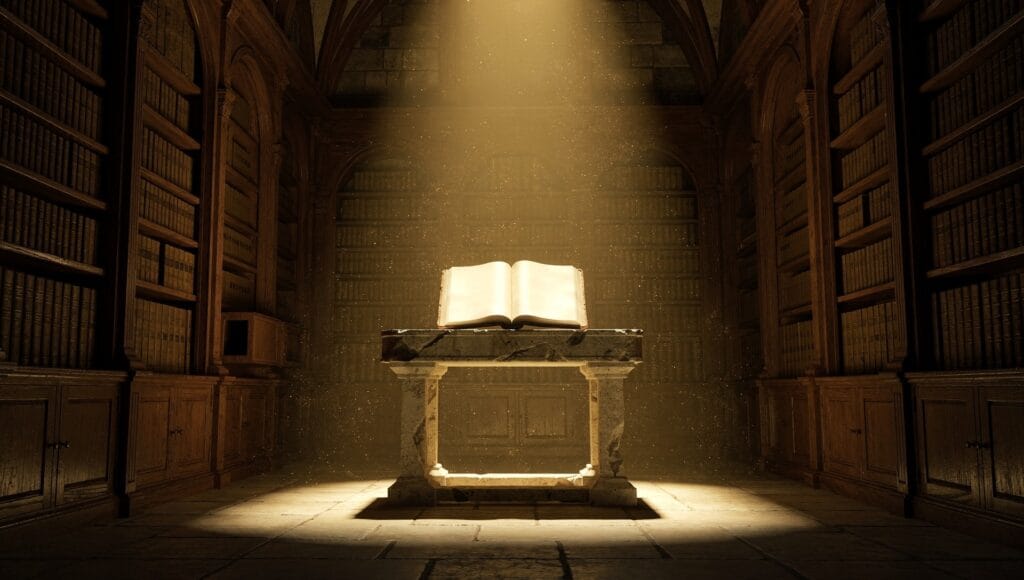
If this practice stirs up old patterns, our guide to shadow work is a great next step, and the Shadow Work Starter Pack gives you structured prompts to go deeper.
The Akashic Records and Spiritual Ascension
Here is the COA reflection, not a claim about how the universe works: whether or not a cosmic library exists, the idea of the Akashic Records carries a profound teaching. Every choice leaves an imprint. Every kindness, every lie, every act of courage becomes part of the story you are writing, in your own nervous system, in your relationships, and in the world.
That is the heart of what we explore in What Is Spiritual Ascension?: not escaping your story, but becoming a more conscious author of it. The Egyptians pictured Thoth recording the verdict at the end of a life. You get to pick up the pen today.
The Akashic Records on the Afterlife Evidence Ladder
Using the COA Afterlife Evidence Ladder, here is where the Akashic Records sit:
- Measured: nothing. No physical record of individual lives has been detected.
- Reported: people’s experiences during meditation, readings, and dreams
- Investigated: very little. A small registered pilot study has looked at participants’ self-reported outcomes after sessions, but it has no comparison group and no posted results, and it does not demonstrate access to an archive or therapeutic benefit. No reliable demonstration of access to a cosmic archive has been established, and Laszlo’s “Akashic field” remains a speculative proposal.
- Taught: Theosophy, Steiner, Cayce, and parallel ideas like the Book of Life and the Preserved Tablet
- Lived: what the practice means to you, and how it shapes the way you live

The Akashic Records may never be proven. But the question at their center is one of the most important you can ask: If every moment of my life were written down, would I be proud of the story? That question needs no proof to change your life.
If this topic is calling to you, our free field guide, You Are More Than The Body, from the Free Ascension Library, was written for exactly this kind of moment. ✨
Sources: H. P. Blavatsky, Isis Unveiled (1877); Henry Steel Olcott, A Buddhist Catechism (1881; revised editions by 1883); A. P. Sinnett, Esoteric Buddhism (1883); C. W. Leadbeater, Clairvoyance (1899); Rudolf Steiner, Cosmic Memory (articles from Lucifer-Gnosis, 1904–1908); Theosophy Wiki, “Akashic Records”; Edgar Cayce’s A.R.E., “Akashic Records”; Ervin Laszlo, Science and the Akashic Field (2004); The Qur’an, 85:21–22; The Book of Revelation, 20:12; Majjhima Nikaya 4, “Bhaya-bherava Sutta”; ClinicalTrials.gov, NCT07219914; The Fitzwilliam Museum, “Spell 125: Osiris and the judgement of the dead”.
FAQ
What are the Akashic Records in simple terms?
The Akashic Records are believed to be a non-physical library or record of every soul’s thoughts, actions, and experiences across all lifetimes. The idea comes from modern esoteric traditions, especially Theosophy, and its existence has not been scientifically established.
Where does the term “Akashic Records” come from?
The word akasha is Sanskrit for space or ether, one of the five elements in Indian philosophy. The idea of akasha as a permanent, readable record was developed by Theosophists in the 1880s, including Henry Steel Olcott and Alfred Percy Sinnett, and was later expanded by C. W. Leadbeater, Rudolf Steiner, and Edgar Cayce.
Are the Akashic Records mentioned in Hindu scriptures?
The word akasha appears in Hindu philosophy as one of the five great elements, but the phrase “Akashic Records” and the idea of a readable cosmic library do not appear in classical Hindu scriptures. They are a modern Western esoteric development.
Is there scientific proof of the Akashic Records?
No. The existence of the Akashic Records has not been scientifically established, and no reliable demonstration of access to a cosmic archive has been shown. Philosopher Ervin Laszlo proposed an “Akashic field” in 2004, but it remains a speculative hypothesis that mainstream physics has not accepted.
How do people access the Akashic Records?
Practitioners describe using meditation, specific prayers to “open” the records, dreamwork, or readings from other people. No reliable demonstration of access to a cosmic archive has been established, so many people treat these as contemplative practices for reflection and guidance.
What did Edgar Cayce say about the Akashic Records?
Edgar Cayce, who gave more than 14,000 recorded trance readings, described a “Book of Life” or “God’s Book of Remembrance” containing every thought, word, and deed. He said he drew on it in many of his life readings, including descriptions of past lives.
Are Akashic Record readings safe?
Reflective practices like meditation and journaling are generally safe. Be cautious with paid readers who use fear, demand escalating payments, claim certainty about your past or future, or encourage dependence. Spiritual guidance should never replace medical, legal, financial, or mental health professionals.
What is the connection between the Akashic Records and reincarnation?
Modern teachers often describe the Akashic Records as the place where a soul’s history across many lifetimes is stored, including lessons and patterns. Buddhist texts describe detailed past-life recollection by advanced meditators, but the idea of a universal, readable archive is a modern development.
About The Author
Author: King | Founder of Code of Ascension
King is the founder of Code of Ascension, a spiritual education platform focused on consciousness, symbolism, manifestation, nervous system awareness, and hidden patterns of reality. Through Code of Ascension, he explores ancient wisdom and modern insights to help others awaken, align, and ascend.
Keep Ascending 🚀