
Reincarnation is one of humanity’s most enduring beliefs about death. Hundreds of millions of people across Asia live inside a worldview where the soul, or something like it, returns again and again. Ancient Greek philosophers taught it. In parts of West Africa, families give children names that announce a grandparent has come back. And in the United States, about a third of adults say they believe in it too.
Then there are the children. A three-year-old in Louisiana describes being a fighter pilot shot down over the Pacific. A little boy in Oklahoma insists he used to dance on Broadway and lived on a street called “Rock.” Researchers at the University of Virginia have spent more than 50 years collecting cases like these, and they now hold over 2,500 of them.
So is reincarnation real? At Code of Ascension, we will not pretend to give you a final answer, because no one honestly can. What we can give you is the full map: what the world’s traditions actually teach (they disagree more than most people realize), what the research has found, what the strongest criticisms are, and how to think about past lives in a way that helps you grow in this one. This guide is part of our Afterlife series, alongside What Happens After Death? and our deep dive on near-death experiences. 🌀
Quick Answer: What Is Reincarnation?
Quick Answer: Reincarnation is the belief that a soul, consciousness, or stream of being is reborn into a new body after death. It is central to Hinduism, Jainism, and Sikhism, and Buddhism teaches a related idea of rebirth without a permanent self. Versions also appear in ancient Greek philosophy, Jewish mysticism, the Druze faith, and many Indigenous and African traditions. Scientifically, reincarnation is unproven. Researchers at the University of Virginia have documented more than 2,500 cases of young children who report memories of a previous life, some with details that were later checked, but critics argue that normal explanations have not been ruled out. The question remains open.
What this article can and cannot establish: Reincarnation research can document what traditions teach, what children and adults report, which details were later checked, and how memory and suggestion work. It cannot currently prove that a soul or consciousness survives death and returns in a new body. Throughout this guide, we keep three things separate: what is taught, what is reported, and what has been investigated.
The COA Rebirth Map
Every tradition that teaches return answers the same three questions differently: what continues, what shapes the next life, and what the goal is. This Code of Ascension reference compares them side by side, with ancient Egypt included as a contrast because it is often wrongly listed as a reincarnation tradition.
| Tradition | What continues | What shapes the next life | The goal |
|---|---|---|---|
| Hinduism | The atman, the eternal self | Karma | Moksha: liberation from samsara |
| Buddhism | A stream of karma and consciousness, with no permanent self | Karma and craving | Nirvana: the end of rebirth |
| Jainism | The jiva, a soul bound by karmic matter | Actions, especially harm to living beings | Moksha: the soul freed from karma |
| Sikhism | The soul | Karma and divine grace | Mukti: union with God |
| Kabbalah (gilgul) | The soul, or sparks of it | Unfinished spiritual work | Tikkun: repair and completion |
| Plato | The immortal soul | The soul’s choices and the life it has lived | For the most philosophical souls, release from the cycle |
| Druze | The soul, reborn immediately into a new human body | Divine justice | Final judgment |
| Yorùbá tradition (one West African example) | An ancestral spirit returning through descendants | Family bonds and destiny | Continuity of the lineage |
| Ancient Egypt (contrast) | The ba and ka, transformed into the akh | The weighing of the heart | Eternal life in the Field of Reeds, not rebirth on Earth |
“Almost every tradition that teaches return also teaches a way through.”
Simplified summaries; each tradition contains many schools and debates. On the COA Afterlife Evidence Ladder, these teachings sit on the Taught rung.
Cite this map: Code of Ascension, “The COA Rebirth Map,” codeofascension.com/reincarnation/
What Does Reincarnation Mean?
The word reincarnation comes from Latin and means “entering the flesh again.” The core idea is simple: something essential about you survives death and begins a new life in a new body. What that “something” is, how it travels, and why it returns are where the traditions split.
A few related terms are worth knowing:
- Reincarnation: a soul or self is reborn into a new body, usually human
- Transmigration: a soul can pass into many kinds of bodies, including animals
- Metempsychosis: the ancient Greek term for the soul’s migration into new bodies
- Rebirth: the Buddhist term for continuity between lives without a permanent, unchanging soul
- Samsara: the cycle of birth, death, and rebirth in Indian religions
- Karma: the principle that actions and intentions shape future experience, including future lives
- Moksha / Nirvana: liberation from the cycle altogether
Notice something important: in several Indian traditions, coming back is usually not the goal. It is the problem to be solved. The goal is to learn, purify, and eventually be free. That is very different from the popular Western idea of past lives as a fun mystery or a series of exciting identities.
How Many People Believe in Reincarnation?
Reincarnation is not a fringe belief. It is part of the everyday worldview of several of the world’s largest religions, which together include well over a billion people.
In the United States, a 2018 Pew Research Center survey found that 33% of adults believe in reincarnation, including many people who also identify as Christian. That number surprises a lot of people, but it reflects a long trend: more Americans are mixing beliefs, drawing on Eastern ideas, spiritual practice, and personal experience rather than one fixed doctrine.
Reincarnation Across World Religions and Traditions
Here is where things get interesting. “Reincarnation” is not one belief. It is a family of beliefs that agree on return but disagree on almost everything else.
Hinduism
In Hinduism, the eternal self, the atman, passes through many lives within samsara. The Bhagavad Gita compares this to a person taking off worn-out clothes and putting on new ones. Karma shapes the circumstances of each new life, and the ultimate goal is moksha: liberation from the cycle and union with, or realization of, the ultimate reality, Brahman.
Buddhism
Buddhism teaches rebirth, but with a radical twist. The Buddha taught anatta, “non-self”: there is no permanent, unchanging soul that hops from body to body. Instead, a stream of causes, habits, and karma continues, the way one candle flame can light another. Is it the same flame? Not exactly. Is it unrelated? Not that either. The goal is nirvana, the end of the cycle. Tibetan Buddhism also recognizes tulkus, teachers believed to be reborn intentionally to continue their work. The Dalai Lama is the best-known example.
Jainism and Sikhism
Jainism teaches that each soul, or jiva, is bound by karmic matter that drives rebirth, and that strict non-violence and discipline can free it. Sikhism also teaches a cycle of rebirth shaped by karma, with liberation coming through remembrance of God and living with honesty and service.
Ancient Greece
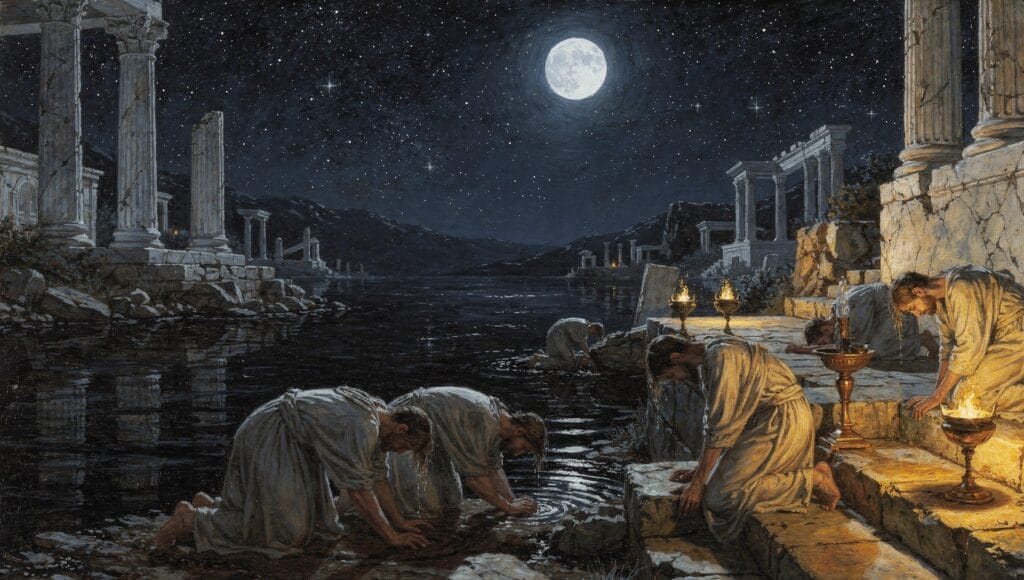
The philosopher Pythagoras taught that souls migrate between bodies, and Plato built reincarnation into his philosophy. At the end of Plato’s Republic, the Myth of Er describes souls choosing their next lives and then drinking from the River of Forgetfulness before being reborn, which, in the story, is why we do not remember. It is one of the oldest written explanations for why past lives are hidden from us.
Judaism and Kabbalah
Mainstream Jewish teaching focuses on this life and the world to come, but Jewish mysticism developed the idea of gilgul, the “rolling” or cycling of souls. In Kabbalistic teaching, souls may return to complete unfinished spiritual work.
The Druze
The Druze faith teaches that the soul is reborn immediately into a new human body at the moment of death. Druze communities have produced some of the case reports studied by reincarnation researchers.
African and Indigenous Traditions
In many West African communities, including the Yorùbá and Igbo, ancestors are believed to return through the family line. Among the Yorùbá, names like Babatunde (“father has returned”) and Yetunde (“mother has returned”) reflect this belief. The Igbo concept of ilo uwa describes a person returning to the world. Many Indigenous peoples of the Pacific Northwest, including the Tlingit, as well as Inuit communities, have traditions of ancestors being reborn within the family, sometimes recognized through birthmarks, behavior, or dreams.
Christianity and Islam
Mainstream Christianity and Islam do not teach reincarnation. Both describe one earthly life followed by resurrection and judgment. Some early Christian thinkers, like Origen, speculated about the pre-existence of souls, but those ideas were later rejected by the church. Even so, as the Pew data shows, many Christians personally hold some belief in reincarnation alongside their faith.
What About Ancient Egypt?
This one surprises people. The Greek historian Herodotus claimed the Egyptians were the first to teach reincarnation, but Egyptologists generally disagree. Egyptian religion focused on the soul’s journey through the Duat, judgment, and eternal life, not on returning in a new human body. What the Egyptians did believe is that the transformed soul could take many forms in the afterlife, and the Book of the Dead includes spells for transforming into a falcon, a lotus, and more. You can read how the soul was judged before that journey in our guide to the Weighing of the Heart.
The Research: Children Who Remember Past Lives
In 1961, psychiatrist Ian Stevenson began traveling the world to investigate young children who spoke about previous lives. He later founded what is now the Division of Perceptual Studies (DOPS) at the University of Virginia, and in 1966 he published Twenty Cases Suggestive of Reincarnation. His successor, child psychiatrist Jim Tucker, has continued the work, focusing especially on American cases.

After more than 50 years, the DOPS collection holds over 2,500 cases, coded across more than 200 variables. Jim Tucker’s 2008 review of the collection describes striking patterns. Keep in mind that these figures describe collected case reports, not a representative sample of the population:
- Age: children usually begin talking about a past life between ages 2 and 5, often around age 3, and the memories usually fade by around age 6 or 7.
- How the previous life ended: in Tucker’s 2008 review, about 70% of the previous personalities the children describe died by unnatural means, such as accidents, violence, or war.
- Timing: in the same review, the median interval between the previous person’s death and the child’s birth was about 16 months.
- Birthmarks: DOPS reports that about 30% of cases in its database involve a birthmark or birth defect. In some cases, researchers report correspondences with wounds or other marks on a deceased person. Stevenson documented more than 200 such cases in a 2,200-page work, Reincarnation and Biology.
- Behavior: many children show emotions, fears, play, or preferences that seem to match the previous life, such as a fear of water in a child who describes drowning.
- Everywhere: cases have been found in every culture where researchers have looked, though they are reported more often where reincarnation is already believed.
Two Famous American Cases
James Leininger. As a toddler in Louisiana, James had nightmares about a plane crash and later described being a World War II pilot who flew off a ship called Natoma and was shot down by the Japanese. Researchers and his family later connected his statements to James Huston Jr., a pilot from the escort carrier USS Natoma Bay who was killed near Iwo Jima in 1945. Tucker discusses the case in his book Return to Life and in a published case report, which also acknowledges discrepancies in some details and gaps in what was written down before the family began researching.
Ryan Hammons. A young boy in Oklahoma described a past life in Hollywood, including dancing on Broadway, working at an agency, and living on a street with “Rock” in the name. Using an old film still, researchers identified a man named Marty Martyn, a former extra and talent agent. Tucker reported that a number of Ryan’s statements matched details of Martyn’s life that were later confirmed, while others did not.
These are two of the most widely discussed American cases. They are also debated, which brings us to the most important part of this conversation.
The Strongest Criticisms of Past-Life Research
If you care about truth, you have to look at the skeptics’ best arguments, not their worst. Here are the main ones:

- Parental shaping. Parents who believe in reincarnation, or who become emotionally invested in a story, may unintentionally reward, guide, or embellish a child’s statements.
- Contamination before investigation. In many cases, the family has already identified a possible previous person before researchers arrive, which makes it hard to know which details were truly remembered and which were learned later.
- Selective memory. Families and researchers may remember the hits and forget the misses, especially when a child says many things.
- Cultural expectation. Cases are more common where reincarnation is already accepted, which skeptics see as a sign of social influence rather than true memory.
- Cryptomnesia. People can absorb information from books, TV, or conversations and later “remember” it without recalling the source. Researchers have documented this in hypnosis experiments.
- The interview problem. Most cases rely on interviews, sometimes years after the child’s statements, rather than written records made before any checking took place.
Researchers like Tucker acknowledge these problems and argue that the strongest cases, where the child’s statements were written down before the previous person was identified, are harder to explain. Critics reply that even those cases fall short of scientific proof. Both sides agree on one thing: the cases are real reports from real families. What they mean is the debate.
How to hold this: On our Afterlife Evidence Ladder, children’s past-life cases sit on the Investigated rung. They have been studied seriously and case by case, and they remain contested. They are documented reports, not proof.
How Researchers Test a Past-Life Claim
If you ever hear a past-life story, from a child, a friend, or your own intuition, these are the questions serious researchers ask. We think they are worth using yourself.
- Was it spontaneous? Did the memory come up on its own, especially in early childhood, rather than through suggestion or a leading question?
- Is it specific? Names, places, objects, and events that could be checked are far stronger than vague feelings.
- Was it recorded first? Were the statements written down before anyone tried to identify the previous person?
- Could it be checked? Did the details correspond to a real person who lived and died?
- Could the child have known normally? Is there any way the information came from family, media, or overheard conversations?
- Is there behavioral or physical matching? Fears, skills, play, or birthmarks that relate to the previous life add weight.
- Were the misses counted too? A fair case tracks everything that was said, not just the statements that turned out to be right.
What About Past-Life Regression?
Past-life regression usually means using hypnosis or guided meditation to “go back” to a previous life. It is popular, and many people find the experience emotional and meaningful. But it is very different from the children’s cases above, and it deserves an honest warning.
The University of Virginia’s Division of Perceptual Studies has never used hypnotic regression to investigate cases. Ian Stevenson cautioned that hypnosis is closer to a dream-like state in which suggestion strongly shapes what comes up. Studies, including work by psychologist Nicholas Spanos and colleagues in 1991, found that what people “remember” under regression is influenced by the hypnotist’s suggestions and their own expectations. Other researchers have shown that people unconsciously weave normally acquired information into convincing past-life stories.
A famous example is the 1950s case of Bridey Murphy, in which an American woman under hypnosis described a life in 19th-century Ireland. Investigators later suggested that many details may have come from her own childhood experiences, though the case is still argued about today.
The COA take: if you explore regression, treat it as symbolic inner work, not historical evidence. The images that come up may still reveal something true about your fears, longings, and patterns in this life. That can be valuable without needing to be literally true.
Past Lives as a Spiritual Practice
Whether or not you believe you have lived before, the idea of past lives can be a powerful lens for self-understanding. Many spiritual teachers use it this way:
- Unexplained fears (water, heights, fire) as invitations to explore and heal
- Instant connections or aversions to people as mirrors for unfinished emotional work
- Strong pulls toward certain places, eras, or cultures as clues to what nourishes your soul
- Repeating life patterns as “lessons” asking to be learned, which is how many people understand karma today
This last one connects deeply with shadow work. A pattern that keeps repeating, the same kind of relationship, the same money fear, the same self-sabotage, does not need a past life to be real. But naming it as a lesson rather than a life sentence can make it easier to face. Our guide to shadow work is a great next step if this resonates.

A Gentle Past-Life Reflection Practice
Try this as a journaling exercise, not as a memory-recovery technique:
- Settle your body. Sit comfortably, breathe slowly, and let your shoulders drop.
- Notice a pattern. Name one fear, attraction, or repeating situation in your life.
- Ask the question. Write: “If this pattern had a story older than this life, what would it be?”
- Write without judging. Let the story come as imagery, like a dream or a myth.
- Find the lesson. Ask: “What is this story trying to teach me now?”
- Bring it back to today. Choose one small action this week that honors that lesson.
- Hold it lightly. The meaning matters more than whether the story is literally true.
If dreams bring up past-life imagery for you, our Dream Decode Journal Pack gives you structured prompts to track symbols and patterns over time.
Many modern teachers say a soul’s past lives are stored in the Akashic Records. To see where that idea comes from (Theosophy, Edgar Cayce, and older religious parallels) and what the evidence does and does not show, read our guide to the Akashic Records. 📜
Reincarnation and Spiritual Ascension
Here is a Code of Ascension reflection, not a teaching shared by every tradition: we see reincarnation less as a loop and more as a curriculum. Each life is a chance to refine character, release attachment, and wake up a little more. That is the heart of what we explore in What Is Spiritual Ascension?: not escaping life, but growing through it.
Even if you do not believe in literal rebirth, this teaching carries a practical wisdom. You are always being shaped by what you repeat. Every habit, reaction, and choice is a kind of small rebirth into the person you are becoming. You do not need to wait for another life to start the next chapter.
Reincarnation on the Afterlife Evidence Ladder
Using the COA Afterlife Evidence Ladder, here is how the reincarnation question breaks down:
- Measured: belief rates (such as 33% of U.S. adults), birthmark descriptions, and the basic patterns in the case database
- Reported: children’s statements, adults’ spontaneous impressions, past-life dreams
- Investigated: case-by-case studies like Leininger and Hammons, and research on hypnotic regression and memory
- Taught: samsara and moksha, Buddhist rebirth, gilgul, ancestral return, Plato’s Myth of Er
- Lived: your own sense of déjà vu, connection, or recurring patterns, and what you choose to make of them
Reincarnation has not been proven, and it has not been disproven. What we can say is that the idea has guided human meaning-making for thousands of years, that a body of serious research has taken it seriously, and that its deepest teaching, that your choices shape who you become, is useful in this life no matter what comes next.
If this question is stirring something in you, our free field guide, You Are More Than The Body, from the Free Ascension Library, was written for exactly this kind of moment. And if you have ever felt a strange familiarity in a new place, our guide to déjà vu is a fun next read. ✨
Sources: University of Virginia Division of Perceptual Studies, “Children Who Report Memories of Previous Lives”; Jim B. Tucker, “Children’s Reports of Past-Life Memories: A Review”, Explore, 2008; Jim B. Tucker, Return to Life (2013); Ian Stevenson, Twenty Cases Suggestive of Reincarnation (1966) and Reincarnation and Biology (1997); University of Virginia Division of Perceptual Studies, “Concerns About Hypnotic Regression”; Spanos et al., “Secondary identity enactments during hypnotic past-life regression,” Journal of Personality and Social Psychology, 1991; Pew Research Center, “‘New Age’ beliefs common among both religious and nonreligious Americans”, 2018; Plato, Republic, Book X (Myth of Er); The Bhagavad Gita, 2.22; Herodotus, Histories, Book II.
FAQ
What is reincarnation in simple terms?
Reincarnation is the belief that after death, a soul or stream of consciousness is born again into a new body. Traditions differ on what returns, why, and whether the goal is to keep returning or to be freed from the cycle.
Which religions believe in reincarnation?
Hinduism, Jainism, and Sikhism teach reincarnation, and Buddhism teaches a related idea of rebirth without a permanent self. Forms of it also appear in Jewish mysticism (gilgul), the Druze faith, ancient Greek philosophy, and many African and Indigenous traditions. Mainstream Christianity and Islam do not teach it.
Is there scientific evidence for reincarnation?
There is no scientific proof. Researchers at the University of Virginia have documented over 2,500 cases of young children reporting past-life memories, some with details that were later checked. Critics argue that parental influence, contamination, and normal memory errors have not been ruled out, so the evidence remains contested.
At what age do children talk about past lives?
According to University of Virginia research, children usually begin talking about past-life memories between ages 2 and 5, often around age 3, and the memories typically fade by around age 6 or 7.
Is past-life regression real?
Past-life regression can feel powerful, but research shows that what people recall under hypnosis is strongly shaped by suggestion and expectation. The University of Virginia’s reincarnation researchers have never used hypnotic regression. It is best treated as symbolic inner work rather than evidence of a previous life.
What is the difference between reincarnation and rebirth?
Reincarnation usually means an enduring soul enters a new body. Rebirth, as taught in Buddhism, describes continuity between lives without a permanent, unchanging self, more like one flame lighting another.
How long does it take to reincarnate?
Traditions disagree. The Druze teach immediate rebirth, and Tibetan Buddhism describes an in-between state called the bardo. In Jim Tucker’s 2008 review of University of Virginia case reports, the median time between the previous person’s death and the child’s birth was about 16 months. That describes collected cases, not a representative population sample.
Did the ancient Egyptians believe in reincarnation?
Most Egyptologists say no. Although the Greek historian Herodotus claimed they did, Egyptian religion focused on judgment in the Hall of Two Truths and eternal life in the Field of Reeds. The soul could transform into many forms in the afterlife, but that is different from being reborn as a new person on Earth.
About The Author
Author: King | Founder of Code of Ascension
King is the founder of Code of Ascension, a spiritual education platform focused on consciousness, symbolism, manifestation, nervous system awareness, and hidden patterns of reality. Through Code of Ascension, he explores ancient wisdom and modern insights to help others awaken, align, and ascend.
Keep Ascending 🚀