
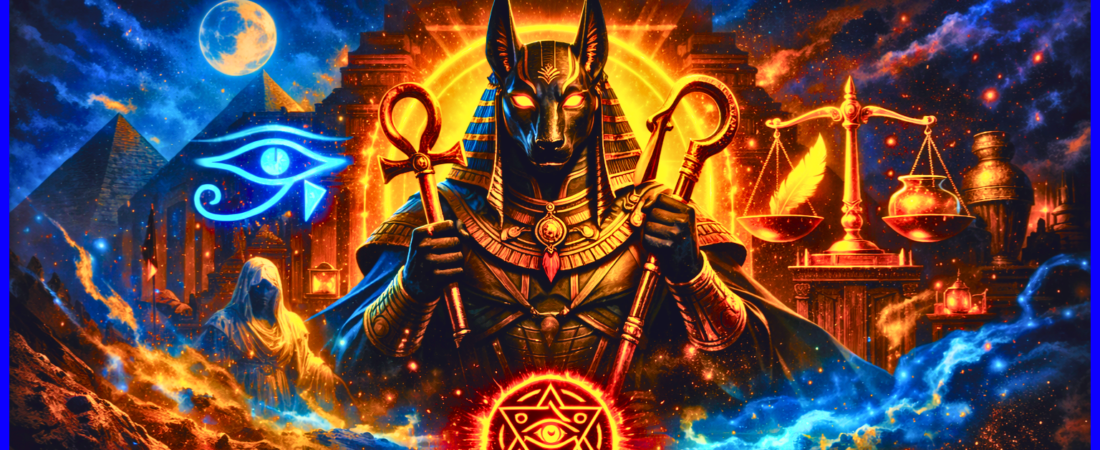
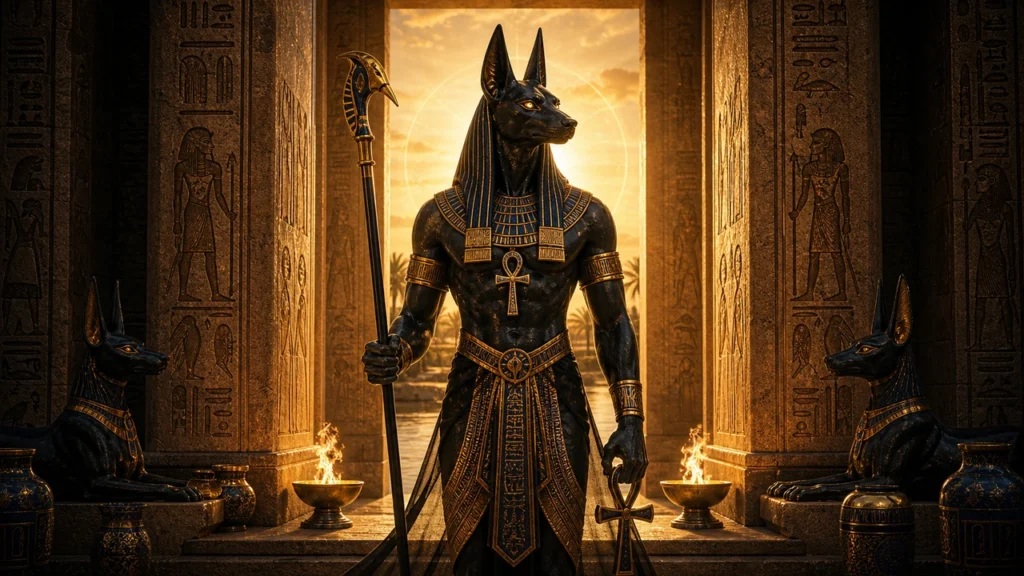
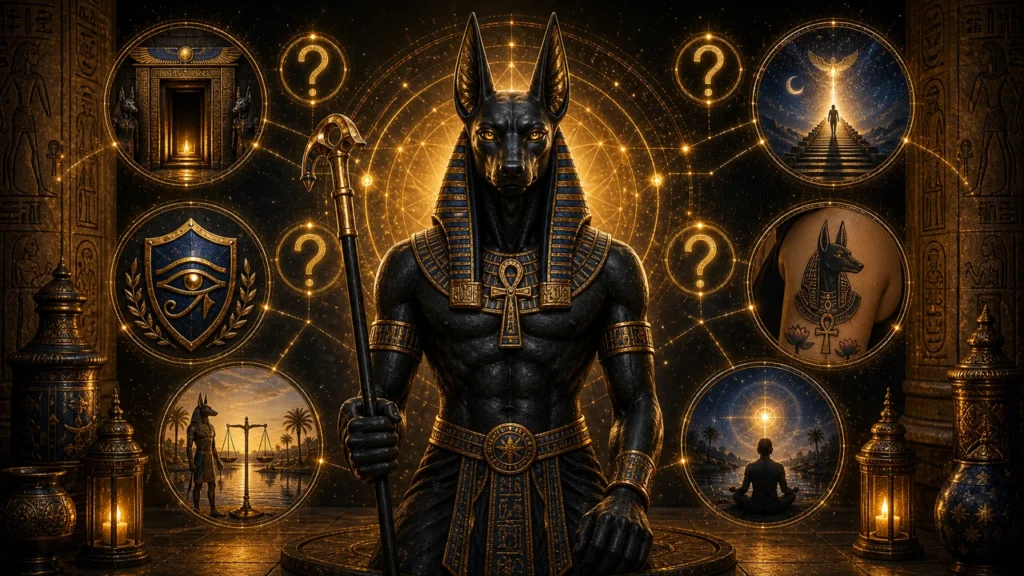
Anubis meaning is deeper than the modern image of a mysterious jackal-headed death god. In ancient Egypt, Anubis was connected to embalming, funerary rites, tomb protection, mummification, and the care of the dead. Spiritually, Anubis also represents protection during transition, guidance through the unknown, and the sacred intelligence that helps a soul cross thresholds without losing its center.
This symbol is not about darkness for its own sake. Anubis is about sacred order at the edge of change. He appears where endings, grief, shadow, death, rebirth, and transformation meet. He teaches that some doors can only be crossed with reverence.
Fast Answer: Anubis Meaning in One Sentence
Anubis is an ancient Egyptian god associated with embalming, funerary rites, tomb protection, mummification, the dead, and guidance into the afterlife. Spiritually, Anubis meaning points to protection during transformation, the courage to face endings, and guidance through shadow, grief, and major life transitions.
Britannica describes Anubis as an ancient Egyptian god of the dead, represented as a jackal or a man with a jackal head, with special concern for the funerary cult and care of the dead. In modern spiritual symbolism, he is often read as a guardian of thresholds.
Who Is Anubis? Anubis Meaning in Context
Anubis is one of the most recognizable figures in ancient Egyptian religion. He is usually shown as a jackal or as a human figure with a jackal head. The imagery can feel intense, but its purpose is not horror. It signals watchfulness, protection, instinct, and connection to the boundary between life and death.
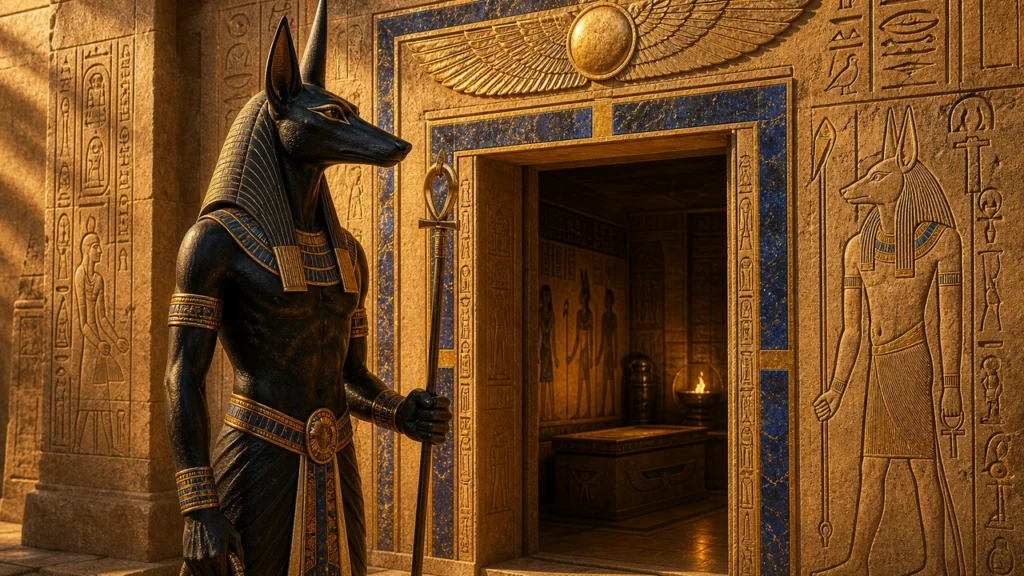
In Egyptian funerary belief, Anubis was linked to embalming, mummification, guarding tombs, and preparing the dead for the afterlife. The Metropolitan Museum of Art’s educational materials describe him as the god of embalming and protector of mummies, often shown as jackal-headed or fully jackal-like.
This role matters because death in ancient Egypt was not only disappearance. It was a sacred passage requiring ritual care, preservation, protection, and spiritual order.
Anubis Meaning in Ancient Egypt
In ancient Egypt, Anubis was not a villain. He was a guardian, embalmer, protector, and guide. His presence belonged to the funeral chamber, the tomb, the embalming process, and the journey beyond death.
Anubis meaning in this context includes:
- Care of the dead.
- Protection of tombs.
- Embalming and mummification.
- Guidance through the afterlife.
- Sacred preparation.
- Ritual order at the threshold of death.
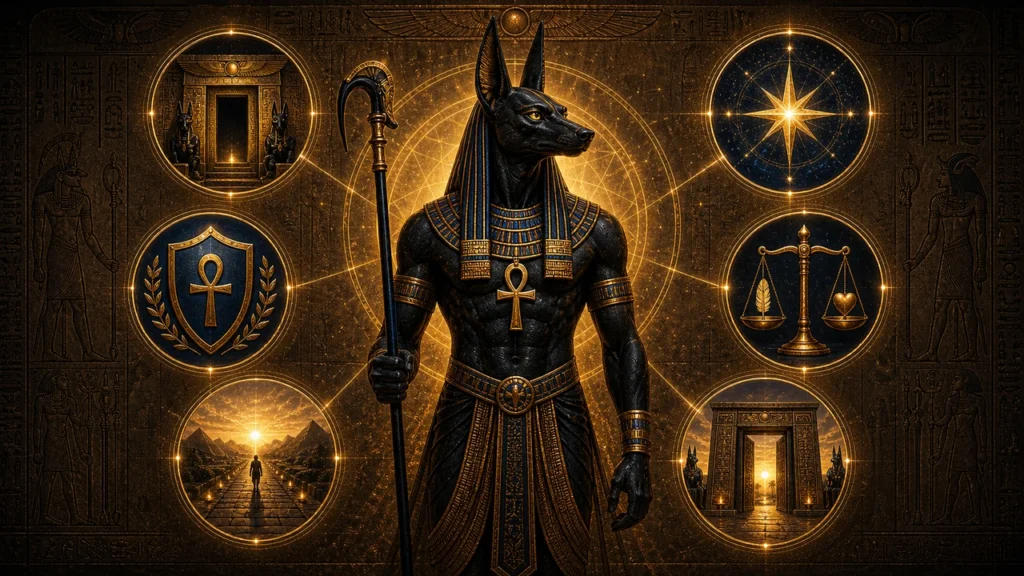
The ancient layer should be respected before modern symbolism is added. Anubis is not simply a gothic aesthetic or a shadow-work mascot. He belongs to a religious world where death, body, soul, name, ritual, and afterlife were deeply connected.
Anubis Meaning Spiritually
Spiritually, Anubis meaning points to the guardian who appears during transition. Not every death is literal. Sometimes what dies is an identity, relationship, belief system, role, illusion, or version of the self that can no longer carry the soul forward.
Anubis spiritual meaning can include:
- Protection during endings.
- Guidance through uncertainty.
- Shadow integration.
- Grief processing.
- Sacred transition.
- The courage to face what is hidden.
- Death as transformation.
This is why the symbol still resonates. Modern life is full of thresholds: breakups, awakenings, career changes, grief, spiritual disillusionment, identity shifts, and the collapse of old patterns. Anubis represents the part of consciousness that can walk through those thresholds without pretending they are easy.
Anubis Meaning and Symbolism
Anubis symbolism is built from several core images: the jackal, the black color often associated with his form, the embalming chamber, the tomb, the scales of judgment in later imagery, and the threshold between worlds.
The jackal suggests instinct, alertness, and the ability to move through liminal spaces. The black color can symbolize the fertile darkness of transformation, not merely death. In ancient Egypt, black could also point to regeneration, rich Nile soil, and the mystery from which new life emerges.
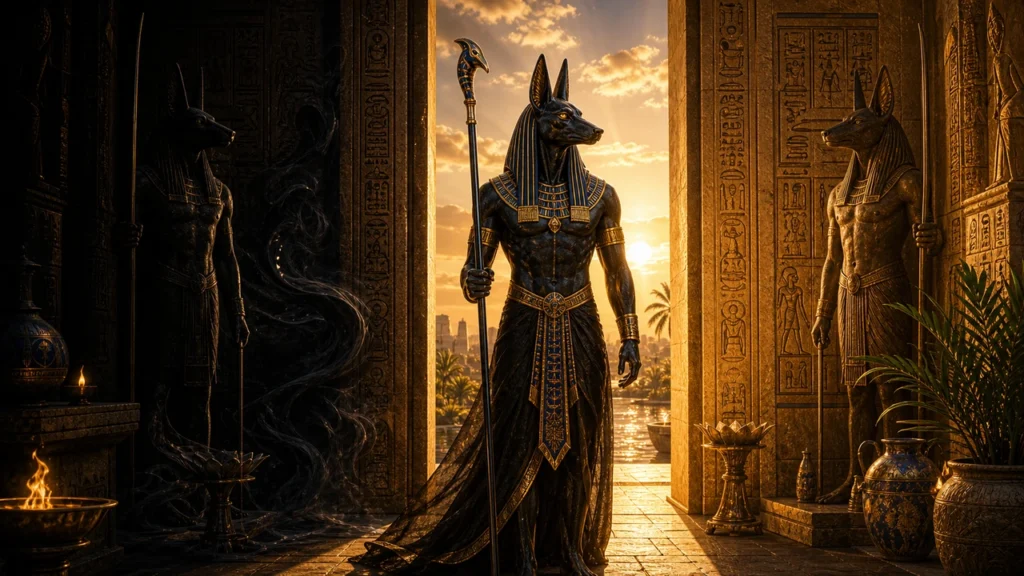
Anubis symbolism teaches that darkness is not automatically evil. Sometimes darkness is the place where the soul becomes honest.
The symbol asks:
- What ending am I resisting?
- What fear needs to be faced consciously?
- What part of me is ready for sacred preparation?
- What would protection look like during this transition?
Anubis Meaning in the Afterlife
Anubis and the afterlife are inseparable in Egyptian symbolism. In funerary contexts, he is connected with preparing the body, guarding the tomb, and guiding the deceased toward the next stage of existence.
In Egyptian religion, the afterlife was not a vague abstraction. It required preparation. Ritual mattered. The body mattered. The heart mattered. The soul’s journey mattered.
From a spiritual perspective, this becomes a teaching about transition. You do not cross every threshold by rushing. Some transitions require preparation, reverence, and protection. Some endings need to be honored before rebirth can begin.
This is the wisdom of Anubis: do not treat sacred endings casually.
Anubis Meaning as Protection
Anubis protection meaning is different from the protection of a shield or wall. It is threshold protection. It is the protection you need when old ground is gone and new ground has not fully appeared yet.
That kind of protection is subtle. It may look like:
- Stronger boundaries during grief.
- Fewer people having access to your transition.
- Discernment when your life is changing.
- Protection of your energy while old identities dissolve.
- Respect for silence, rest, and ritual closure.
For broader symbol support, see Spiritual Protection Symbols.
Anubis Meaning for Shadow Work
Anubis aligns naturally with shadow work because he stands near what people usually avoid: death, grief, endings, fear, shame, uncertainty, and the unknown.
Shadow work does not mean becoming obsessed with darkness. It means bringing awareness to the parts of yourself that operate unconsciously. Anubis symbolism can support that process because it does not flinch at what is hidden.
In this sense, the symbol becomes deeply practical. He asks you to stop running from the part of the self that is asking to be witnessed.
Shadow questions connected to Anubis:
- What ending am I refusing to accept?
- What grief have I spiritualized instead of feeling?
- What fear controls me because I will not look at it?
- What identity is already dead, but I keep performing it?
- What part of me needs protection while it transforms?
Anubis Meaning in Tattoos
Anubis tattoo meaning often centers on protection, death and rebirth, Egyptian spirituality, shadow work, transformation, and guidance through the unknown. Because Anubis is visually powerful, many people are drawn to the image before they understand the depth behind it.
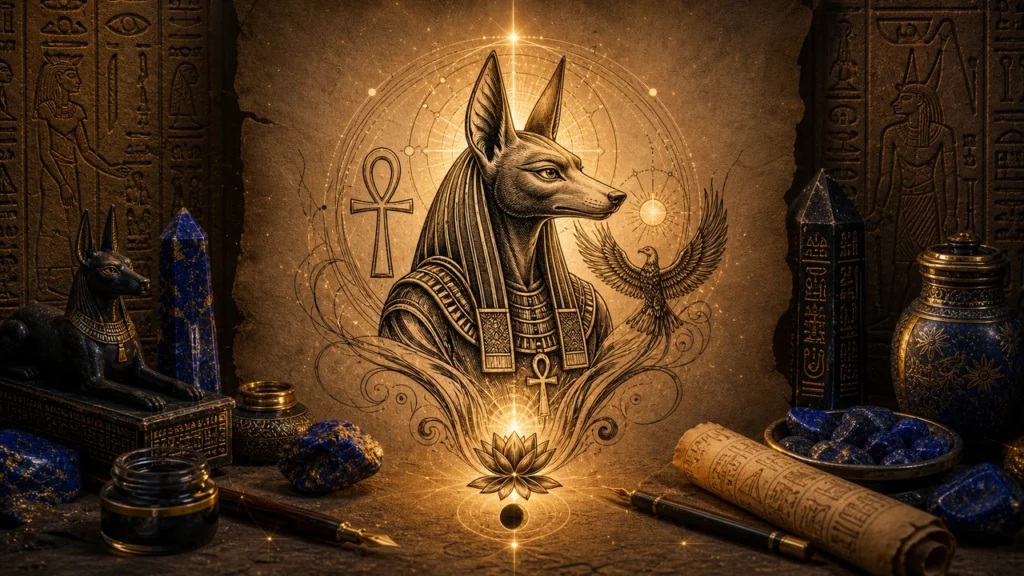
A tattoo may symbolize:
- Protection during transformation.
- Respect for death and the afterlife.
- Guardian energy.
- Shadow integration.
- Rebirth after loss.
- Ancestral or Egyptian spiritual connection.
- Courage to walk through darkness consciously.
Placement can shift the meaning. On the arm, it may feel like active protection. On the chest, it may symbolize guarded transformation of the heart. On the back, it may suggest unseen guardianship. In larger artwork, Anubis may appear with scales, pyramids, the ankh, or the Eye of Horus to deepen the afterlife symbolism.
Before using Anubis as body art, study the symbol respectfully. This is not just an edgy image. It is a sacred figure connected to death, ritual, and the care of souls.
Anubis Meaning for Love, Money, and Daily Life
Anubis symbolism can apply to ordinary life because endings happen everywhere.
In love, Anubis may appear symbolically when a relationship has ended, but your energy has not fully crossed the threshold. The lesson is not to harden. It is to honor the ending and protect the transition. If emotional cords are still active, the Cord Cutting Ritual guide can support that release.
In money and career, Anubis may represent the death of an old role, identity, or survival pattern. Sometimes a career transition feels like ego death because the old title, routine, or approval source disappears. Anubis teaches that sacred transition needs structure.
In daily spiritual life, Anubis asks you to treat endings with reverence. Do not rush past grief. Do not pretend old selves are still alive. Do not confuse transition with failure.
Anubis, Ankh, Eye of Horus, and Pyramids
Anubis becomes richer when placed beside other Egyptian symbols.
The ankh points to life force, breath, eternal life, and sacred continuity. The Eye of Horus points to protection, restored sight, and wholeness. The pyramids in Egypt point to sacred architecture, afterlife symbolism, initiation, and ascent.
Together, these symbols form a map of transformation: life force, sight, death, protection, architecture, and the journey beyond the visible.
Is Anubis Evil? Anubis Meaning Beyond Fear
No. Anubis is not evil in Egyptian symbolism. He is associated with death, but death does not equal evil. In his ancient role, he is a protector, embalmer, guardian of tombs, and guide connected to funerary care.
The fear often comes from modern discomfort with death imagery. A jackal-headed figure standing near tombs can feel unsettling if you read it through horror culture. But in context, Anubis represents sacred order around death, not chaos.
This is one of the most important corrections: Anubis does not glorify death. He protects the passage.
Anubis Meaning and Grief
Anubis meaning also speaks to grief because grief is a threshold. Something has ended, but the heart has not fully learned how to live in the new world yet. That in-between space can feel disorienting, heavy, and sacred all at once.
In that sense, Anubis symbolism can remind you to move slowly. Not every feeling needs to be solved immediately. Not every ending needs to be explained before it is honored. Some grief needs protection from noise, advice, performance, and spiritual bypassing.
The jackal-headed guardian teaches a quiet kind of strength: stand near the doorway, keep watch, and let the soul adjust to what has changed.
Anubis Meaning in Dreams and Synchronicity
Some people begin searching for Anubis meaning after seeing the figure in dreams, art, jewelry, tattoos, documentaries, or repeated symbolic references. In a grounded spiritual reading, that does not automatically mean a deity is contacting you. It may mean the archetype is active in your inner world.
Anubis appearing symbolically can point to a threshold season. Something may be ending, being buried, being prepared, or asking to be honored properly. The image may also appear when you are avoiding grief, refusing closure, or sensing that an old identity has already completed its purpose.
Ask yourself:
- What transition am I currently in?
- What am I afraid to face?
- What part of my life needs a proper ending?
- Where do I need more protection and less exposure?
- What would it mean to walk through this season with reverence?
This is not about superstition. It is about listening to the language of symbols without abandoning discernment. If the image keeps appearing, let it become a mirror for the threshold you are crossing.
Anubis Meaning and Death as Transformation
One of the strongest spiritual layers of Anubis meaning is death as transformation. This does not minimize literal grief or physical death. It simply recognizes that death is also an archetype: the end of a form so another form can emerge.
A false self can die. A pattern can die. A relationship identity can die. A fear-based version of success can die. A spiritual mask can die. These endings may feel uncomfortable because the old self was familiar, even if it was no longer true.
Anubis symbolism helps hold that discomfort. It says that endings need care. They need ritual, honesty, and protection. They need witnesses who do not rush the process.
When something in your life is dying, ask what wants to be preserved and what must be released. Ancient embalming preserved the body for sacred reasons. Spiritually, you may need to preserve the wisdom of a chapter while allowing the attachment to end.
That is mature transformation: keep the lesson, release the form.
How To Work With Anubis Symbolically
You do not need to worship Anubis to learn from the symbolism. You can approach the figure as a sacred archetype of transition, protection, and shadow-facing.
Try these reflection prompts:
- 1. What is ending in my life right now?
- 2. What am I afraid to let die?
- 3. What needs protection during this transition?
- 4. What grief needs to be honored instead of bypassed?
- 5. What part of me is ready to cross a threshold?
This is not about forcing an ending. It is about respecting the ones already unfolding.
Go Deeper With Code of Ascension
If Egyptian symbolism speaks to you, continue with Ankh Meaning, Eye of Horus Meaning, and Pyramids in Egypt.
For a softer next step into alignment and conscious creation, download the free Manifesting Your Dreams ebook. You can also explore more guides on the Code of Ascension blog.
Anubis FAQ
What does Anubis mean spiritually?
Spiritually, Anubis means protection during transition, guidance through the unknown, shadow integration, death as transformation, and sacred care during endings. He represents the guardian energy that appears when one phase of life is ending and another has not fully begun.
What is Anubis the god of?
Anubis is an ancient Egyptian god associated with embalming, mummification, funerary rites, tomb protection, the dead, and guidance into the afterlife. He is often shown as a jackal or a human figure with a jackal head, reflecting watchfulness and threshold guardianship.
Is Anubis evil?
No, Anubis is not evil. He is connected to death, but in ancient Egyptian symbolism death was a sacred passage requiring protection, ritual, and care. Anubis is better understood as a guardian, embalmer, protector of tombs, and guide through the afterlife.
What does Anubis symbolize?
Anubis symbolizes sacred transition, protection, embalming, tomb guardianship, instinct, shadow work, and the passage between life and death. Spiritually, he can represent the courage to face endings consciously and the wisdom to move through transformation with reverence.
Why does Anubis have a jackal head?
Anubis is shown with a jackal head because jackals were associated with cemeteries, desert edges, tombs, and the boundary between life and death. Symbolically, the jackal suggests watchfulness, instinct, protection, and the ability to move through liminal spaces.
What is Anubis protection meaning?
Anubis protection meaning is threshold protection. It is the kind of spiritual protection needed during grief, endings, shadow work, identity shifts, and major transitions. Rather than blocking everything, Anubis protects the sacred passage between what has ended and what is being reborn.
What does an Anubis tattoo mean?
An Anubis tattoo can mean protection, death and rebirth, Egyptian spirituality, shadow work, transformation, and guidance through darkness. It may represent courage during transition or respect for the afterlife. Because Anubis is sacred, the tattoo should be chosen with study and reverence.
How can I work with Anubis symbolism?
You can work with Anubis symbolism by journaling about endings, honoring grief, protecting your energy during transition, meditating on threshold moments, and asking what old identity is ready to be released. The goal is not fear. It is conscious transformation.
Final Thoughts
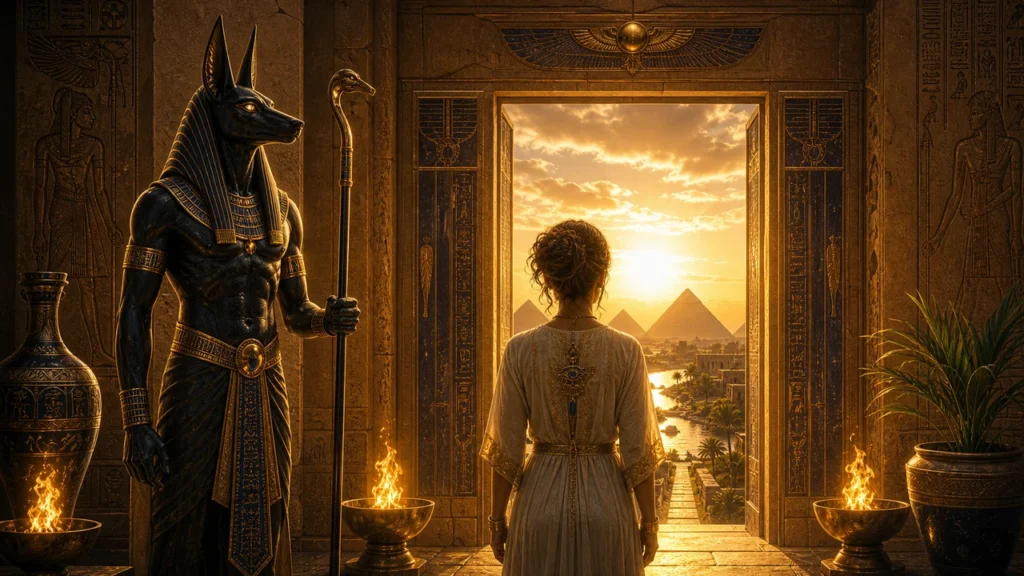
Anubis meaning is ultimately about sacred transition.
He reminds you that darkness is not always evil, endings are not always defeat, and the unknown is not always punishment. Sometimes the soul grows by learning how to cross the threshold consciously.
Anubis does not remove the mystery.
He teaches you how to walk through it with reverence.
About The Author
Author: King | Founder of Code of Ascension
King is the founder of Code of Ascension, a spiritual education platform exploring angel numbers, manifestation, consciousness, symbolism, energetic protection, nervous system alignment, and practical ascension work. His writing blends grounded spiritual insight with clear, usable guidance for readers who want meaning, discernment, and transformation without losing their center.
Keep Ascending 🚀