
Quick Answer: What Are the Main Sacred Geometry Symbols?
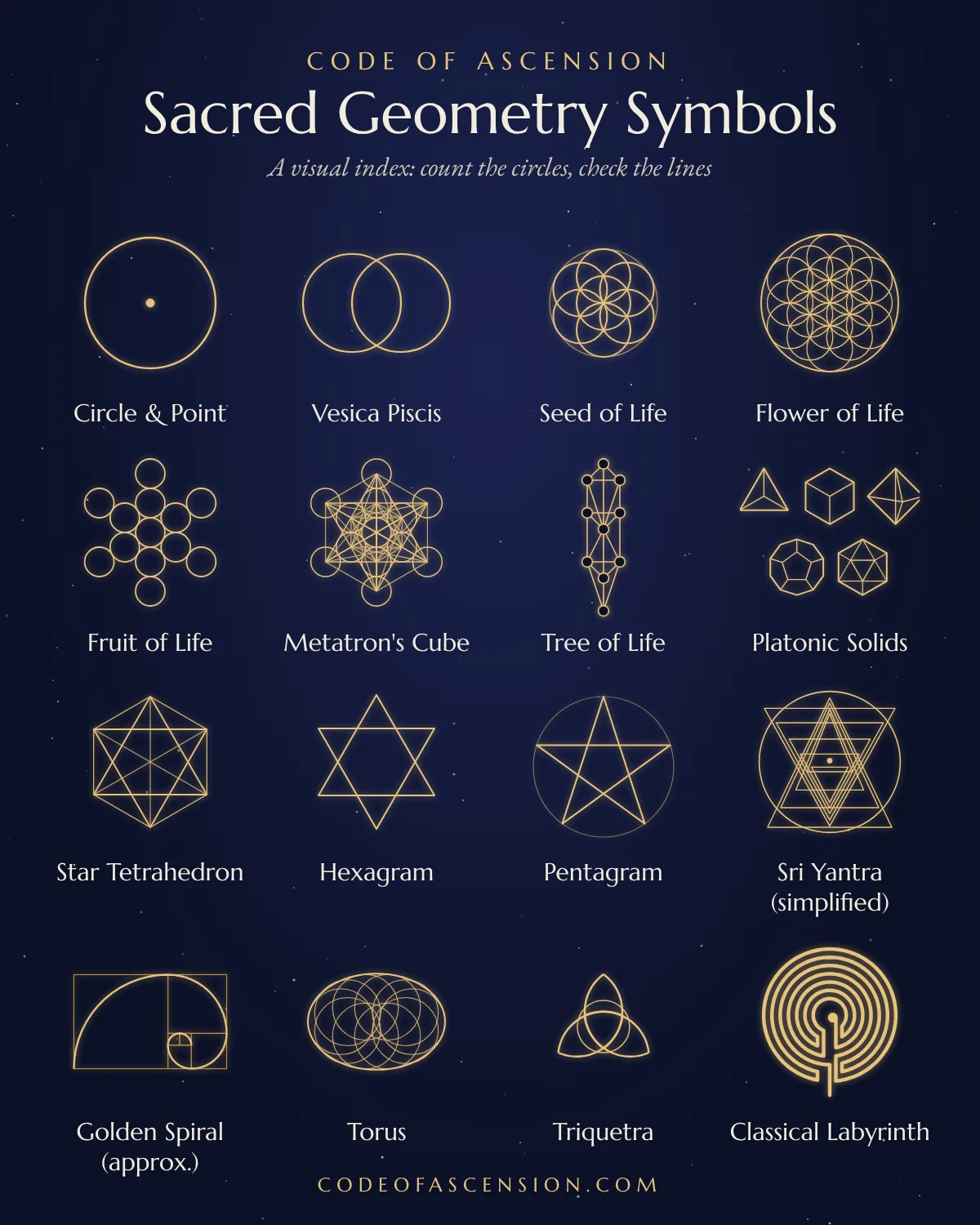
Sacred geometry symbols are shapes and proportions that people treat as spiritually meaningful. The best known are the circle and point, vesica piscis, Seed of Life, Flower of Life, Fruit of Life, Metatron’s Cube, the Kabbalistic Tree of Life, the five Platonic solids, the star tetrahedron (often called the merkaba), the hexagram, the pentagram, the Sri Yantra, the golden and Fibonacci spirals, the torus, the triquetra and the labyrinth.
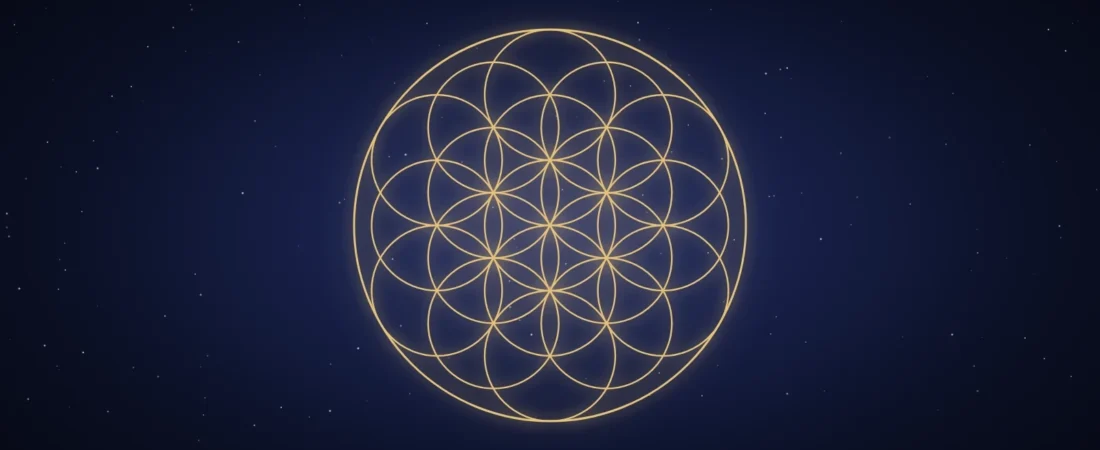
Many of these, especially the circle family, can be drawn with nothing more than a compass and a straightedge, and several grow out of each other: one circle becomes the vesica piscis, seven circles become the Seed of Life, nineteen become the Flower of Life, and joining thirteen centres with straight lines gives you Metatron’s Cube.
What to keep in mind as you read:
- The shapes are real mathematics. You can construct and measure every one of them.
- Some histories are well documented, such as the Platonic solids in Plato’s Timaeus and the pentagram on Sumerian pottery.
- Several popular names are modern. “Flower of Life,” “Seed of Life,” “Fruit of Life” and “Metatron’s Cube” as a diagram come from late-20th-century spiritual writing, even when the underlying pattern is much older.
- Spiritual meanings are interpretation, not proof. Code of Ascension labels them that way, so you can enjoy the symbolism without being sold a myth.
Use the identification index below to put a name to the diagram you saw, then follow the link to the deeper guide.
Table of Contents
What Is Sacred Geometry?
Sacred geometry is the practice of giving symbolic and sacred meaning to particular shapes and proportions. That is close to how Wikipedia’s sacred geometry overview defines it, and it’s a useful definition because it puts the meaning where it belongs: in what people ascribe to the shapes.
The idea that the cosmos follows a geometric plan is ancient. Plutarch credited Plato with the saying that “God geometrizes continually,” and Johannes Kepler later built his first model of the universe out of the five Platonic solids (see Britannica on Platonic solids).
But “sacred geometry” as most people meet it today, a fixed set of named diagrams on posters, jewelry, tattoos and meditation apps, is largely modern. Wolfram MathWorld notes plainly that “the name ‘flower of life’ is modern”, and that “seed of life” follows Drunvalo Melchizedek’s terminology from The Ancient Secret of the Flower of Life (1999). The overlapping-circles pattern is ancient. The name and the spiritual system wrapped around it are recent.
Even sympathetic writers urge caution. Wikipedia summarises author Stephen Skinner’s criticism of “unanchored geometry”: laying a diagram over almost any image and declaring the result sacred.
So this guide treats sacred geometry in three layers, the same way our Hamsa guide treats protection symbols:
- The geometry: what the shape is and how you construct it.
- The documented history: where it actually appears, with sources.
- The modern spiritual reading: what teachers and practitioners say it means today, clearly labelled as interpretation.
The Sacred Geometry Symbol Index: Identify Any Diagram
Find the row that matches what you’re looking at. Each row gives the name, what it looks like, how it’s built, what the documented history shows, and the modern spiritual reading.
| Symbol | What it looks like | How it’s built | Documented history | Modern spiritual reading |
|---|---|---|---|---|
| Circle and point (circumpunct) | A circle with a dot at its centre | One compass setting: the needle hole is the point | The Egyptian hieroglyph for the sun, used in writing the name of Ra; the astronomical sign for the Sun ☉; linked to the Pythagorean “monad” (Wikipedia: Circled dot) | Source and unity; the “one” that every other shape grows from |
| Vesica piscis | A pointed lens where two equal circles overlap | Two circles of equal radius, each centred on the other’s rim | Latin for “fish bladder”; the same figure appears in Old Babylonian mathematics as the “ox-eye” (MathWorld); it underlies Euclid’s first proposition (Euclid I.1) | Union of opposites, the “womb” of form, a doorway between worlds |
| Seed of Life | Seven equal circles: one centre, six around it, making a six-petal rosette | Central circle plus six circles centred around its rim, 60° apart | The rosette is old; the name follows Melchizedek’s 1999 terminology (MathWorld) | The seven “days” of creation, new beginnings |
| Flower of Life | Nineteen overlapping circles in a hexagonal patch, usually framed by a larger circle | Keep adding circles on every new crossing point until you have 19 | Overlapping-circle grids go back at least to an Assyrian palace threshold of the 7th or 6th century BCE; the name is modern (Wikipedia: Overlapping circles grid) | Interconnection, creation unfolding from one centre. Deep dive: Flower of Life Meaning |
| Fruit of Life | Thirteen separate circles: one centre and two rings of six | Pick 13 centres from an extended Flower grid, along six spokes | A modern selection from the circle grid, defined in Melchizedek’s system (MathWorld) | The “blueprint” stage between the Flower and Metatron’s Cube |
| Metatron’s Cube | Thirteen circles with every centre joined to every other by straight lines | Connect all 13 Fruit of Life centres: 78 lines in total | Metatron is an angel of Talmudic and Kabbalistic lore (Britannica: Metatron); the diagram and its name are modern (MathWorld) | Divine order, structure, protection. Deep dive: Metatron’s Cube Meaning |
| Tree of Life (Kabbalah) | Ten circles (sefirot) in three columns, joined by 22 paths | Ten nodes stacked in three pillars, connected by lines | Kabbalistic diagrams appear in late-13th-century manuscripts; first printed in 1516; the 22-path version used by later occultists traces to Kircher, 1652 (Wikipedia) | A map of consciousness and the soul’s ascent |
| Platonic solids | Five 3D shapes with identical regular faces | Tetrahedron (4 triangles), cube (6 squares), octahedron (8 triangles), dodecahedron (12 pentagons), icosahedron (20 triangles) | Plato’s Timaeus linked them to fire, earth, air, water and the heavens; Euclid proved there are exactly five (Britannica) | The building blocks of matter and the elements |
| Star tetrahedron / merkaba | Two interlocking triangular pyramids forming an eight-pointed star | One tetrahedron plus a second turned to point the opposite way | Pacioli knew it in 1509; Kepler named it the stella octangula in 1611 (MathWorld) | A “light body” or vehicle of ascension (a modern New Age reading) |
| Hexagram | A six-pointed star of two overlapping triangles | Mark six points around a circle; join every second point | Ancient and used by many cultures; Prague’s Jewish community was the first to adopt it officially (Britannica: Star of David) | Balance of above and below, spirit and matter |
| Pentagram | A five-pointed star drawn in one unbroken line | Mark five points around a circle; join every second point | Found on Sumerian pottery from Ur, c. 3500 BCE; used by the Pythagoreans (Wikipedia: Pentagram) | The five elements, the human figure, protection. Deep dive: Pentagram Meaning |
| Sri Yantra | Nine interlocking triangles around a central dot, often framed by petals and a square border | Four upward and five downward triangles around a bindu | A Tantric Hindu diagram used in the worship of the goddess Shakti (Britannica: yantra) | Union of masculine and feminine; meditation focus |
| Golden and Fibonacci spirals | A widening spiral drawn through ever-larger squares | Quarter-circle arcs inside squares of a golden rectangle, or of sides 1, 1, 2, 3, 5, 8 | Euclid’s “extreme and mean ratio” (Euclid VI, Def. 3); Fibonacci’s Liber abaci (1202) (Britannica: Fibonacci) | Natural growth, harmony, “divine proportion” |
| Torus | A ring doughnut, often drawn as swirling lines folding through a centre | A circle swept around an axis that doesn’t cross it (MathWorld: Torus) | A standard object in geometry; no single ancient symbol | Self-sustaining flow; a picture of energy circulating (modern) |
| Triquetra | Three interlaced pointed loops forming a triangle | Three overlapping vesicae, interwoven | Common in Insular art from about the 7th century, including the Book of Kells (Wikipedia: Triquetra) | Trinity, triple goddess, mind-body-spirit |
| Labyrinth | A single winding path folding in to a centre | Classical: a seed of a cross, four angles and four dots, joined into seven circuits; medieval designs use eleven | The classical pattern appears from roughly 2000 BCE; the Chartres pavement was laid c. 1201 (University of Edinburgh) | A walking meditation; the journey inward and back out |
A quick rule for using the table: the “How it’s built” column is the fastest way to identify a diagram. Count the circles, count the points, check whether lines are straight or curved, and you’ll usually have your answer in seconds.
The Circle Family: From One Circle to Metatron’s Cube
Six of the sixteen symbols in the index are really one construction caught at different moments. That’s the most useful thing to understand about sacred geometry symbols, and it’s why people confuse their names so often.
Circle and point: the starting place
Every compass drawing begins with a point and a circle. The circled dot has served as the Egyptian sign for the sun and as the astronomical symbol ☉, and Wikipedia notes the Pythagoreans used it for the first metaphysical being, the monad. In modern spiritual writing it stands for source: the one that becomes many.
Vesica piscis: two circles meet
Draw a second circle of the same size, centred on the rim of the first. The almond-shaped overlap is the vesica piscis. Its height is √3 times its width, and it contains two equilateral triangles, which is exactly how Euclid opens the Elements: his very first proposition constructs an equilateral triangle using two such circles. Renaissance artists often framed images of Christ inside the shape, as MathWorld notes.
Seed, Flower and Fruit of Life
Keep stepping the same compass setting around the rim and you get six petals: the Seed of Life. Keep adding circles at every new crossing and you reach the 19-circle Flower of Life, which MathWorld defines as “a 19-circle patch of a triangular overlapping circles grid.” Choose thirteen centres from a larger grid, along the six spokes, and you have the Fruit of Life.
Metatron’s Cube: from circles to lines
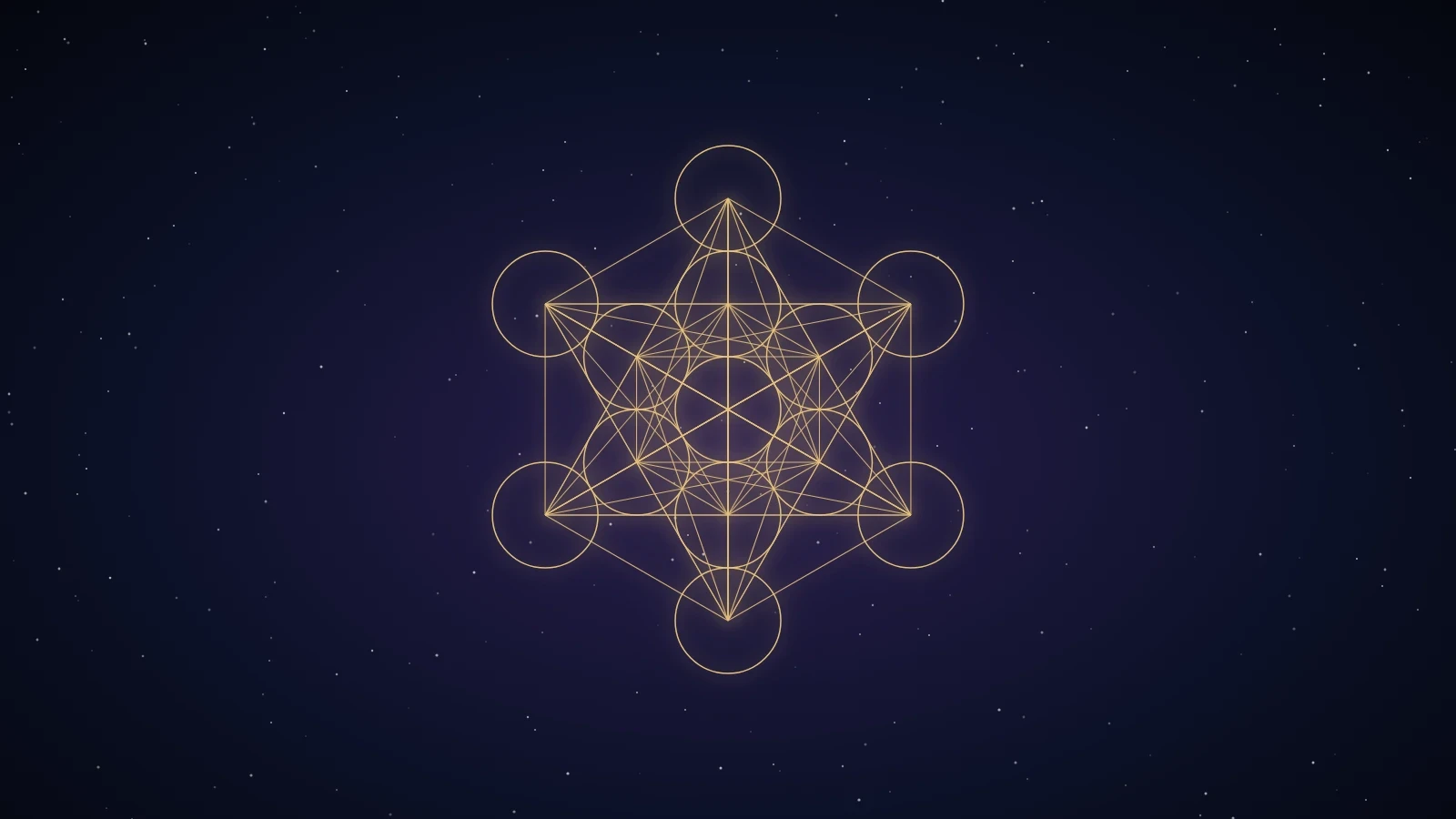
Join every one of those thirteen centres to every other with a straight line and you get Metatron’s Cube: 78 line segments with six-fold symmetry. Hidden inside are flat projections of a cube, an octahedron and a tetrahedron. MathWorld adds a useful caution: claims that the figure contains all five Platonic solids depend on which lines you choose to count, so they aren’t part of the definition.
COA reflection: the circle family is a lovely image of how one simple rule, the same radius each time, produces complexity. That is a teaching metaphor, not a claim about how the universe was made. For the full symbolic reading, see our guides to the Flower of Life and Metatron’s Cube.
Stars, Solids and Spirals: The Other Families
The Platonic solids
The five Platonic solids are the only 3D shapes whose faces are all the same regular polygon and whose corners all match. Britannica notes that Pythagoras probably knew the tetrahedron, cube and dodecahedron; the octahedron and icosahedron were first discussed by Theaetetus; Plato’s Timaeus matched four of them to fire, earth, air and water and gave the dodecahedron to the heavens; and Euclid’s Elements closes with the first known proof that exactly five exist.
That’s one of the best-documented stories in all of sacred geometry. Modern teachers add that each solid carries an elemental “energy.” That part is interpretation built on Plato’s idea, not something Plato demonstrated.
The star tetrahedron, or merkaba
Push one tetrahedron through another, pointing the opposite way, and you get an eight-pointed star. Luca Pacioli described it in 1509, and Kepler named it the stella octangula in 1611. MathWorld records that a wireframe version is “sometimes known as the merkaba and imbued with mystic properties.”
The word merkabah itself is much older. It means “chariot” and refers to the throne-chariot of God in visions linked to Ezekiel 1; the main body of Jewish Merkabah literature was composed between about 200 and 700 CE (Wikipedia: Merkabah mysticism). Treating the star solid as a personal “light body” that you spin up through meditation is a modern New Age teaching, layered onto both the old word and Kepler’s geometry.
The hexagram and the pentagram
Both stars come from points spaced evenly around a circle. Join every second point of six and you get the hexagram; join every second point of five and you get the pentagram, drawn in one continuous line.
The hexagram is ancient and, as Britannica stresses, “was not limited to use by Jews.” It became the official symbol of Prague’s Jewish community first, and from the 17th century the seal of many communities. The pentagram appears on Sumerian pottery from Ur around 3500 BCE, was a sign of recognition among the Pythagoreans, decorates Sir Gawain’s shield in the medieval romance, and was called a symbol of evil when drawn point-down by the 19th-century occultist Éliphas Lévi. Its lines also cut each other in the golden ratio, which ties it neatly to the next family. Our Pentagram Meaning guide covers its protective and elemental readings, and Protection Symbols and Their Meanings compares the pentagram, triquetra and hexagram side by side.
The golden ratio and its spirals
The golden ratio (φ, about 1.618) is Euclid’s “extreme and mean ratio”: cut a line so that “as the whole line is to the greater segment, so is the greater to the less.” To draw a golden spiral, start with a golden rectangle, cut off a square, and keep cutting squares from the leftover rectangle, drawing a quarter-circle in each. Strictly, that quarter-circle version is an approximation: the true golden spiral is a smooth logarithmic spiral that widens by a factor of φ every quarter turn, and the square-and-arc drawing (including the one in our symbol grid) only follows it closely.
A Fibonacci spiral looks almost the same but is built from squares with sides of 1, 1, 2, 3, 5, 8 and so on. The ratio between neighbouring Fibonacci numbers gets closer and closer to φ, something Robert Simson noticed in 1753, according to Britannica. Fibonacci himself never called it a “Fibonacci sequence”: Édouard Lucas coined that name in the 19th century.
This is the family where myths multiply. Astrophysicist Mario Livio, writing for Plus Magazine, points out that no documentation shows Leonardo consciously used the golden ratio in the Mona Lisa, and concludes that “we should abandon its application as some sort of universal standard for ‘beauty.’” Enjoy the spiral. Be sceptical of anyone who finds it in every building and face.
The torus
A torus is the doughnut shape made by sweeping a circle around an axis that sits beside it. Mathematically it’s a surface with a single hole. In modern spiritual art it’s drawn as swirling lines flowing out of a centre and back in, a picture of a self-sustaining cycle. There’s no single ancient “torus symbol.” Treat the meaning as a contemporary metaphor for flow and renewal.
The Sri Yantra, triquetra and labyrinth
The Sri Yantra is a living sacred diagram, not a museum curiosity. Britannica describes it as nine triangles, five pointing down and four pointing up, around a central dot, the bindu, used in the ritual worship of the goddess Shakti. If you use it, it’s respectful to know that it belongs to a practising tradition. The tile in our symbol grid is a simplified sketch for identification only: traditional Sri Yantras are drawn to exacting proportions, usually with rings of lotus petals and a square gateway frame.
The triquetra is three interlaced arcs, equivalent to three overlapping vesicae. It’s common in Insular art from about the 7th century and appears in the Book of Kells. Wikipedia, citing Abramson, notes that reading it as the Holy Trinity became popular “especially since the Celtic revival of the 19th century,” and that “the original intention by the early medieval artists is unknown.”
The labyrinth has one path, no dead ends, which is what separates it from a maze. The University of Edinburgh’s labyrinth project traces the classical seven-circuit pattern to roughly 2000 BCE and dates the Chartres Cathedral pavement labyrinth to about 1201. Britannica adds a humbling note: “No satisfactory explanation of the purpose of these medieval mazes has yet been given.”
Documented vs Modern: Separating History From Interpretation
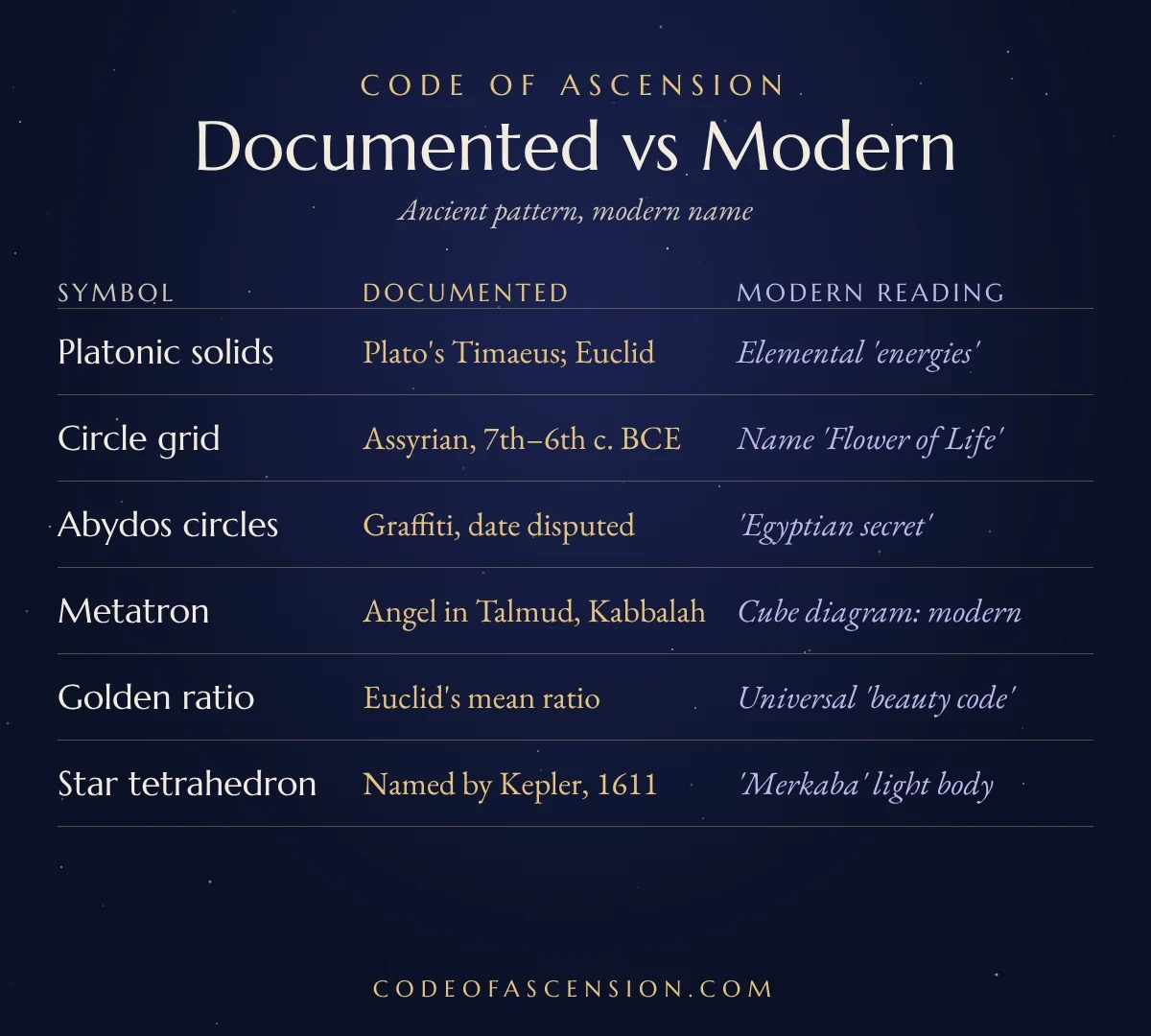
This is the section most sacred geometry articles skip. It’s also the one that protects you from repeating claims that don’t hold up.
| Claim you’ll see online | What the sources actually show | Status |
|---|---|---|
| “The Platonic solids come from Plato.” | Plato’s Timaeus matched them to the elements; Pythagoreans and Theaetetus knew them earlier; Euclid proved there are only five (Britannica) | Documented |
| “The Flower of Life is carved in an ancient Egyptian temple.” | At the Temple of Osiris at Abydos the circles are drawn in red ochre on granite columns, described as graffiti “not found in natively Egyptian ornaments,” dated no earlier than 535 BCE and probably to the 2nd–4th centuries CE, and a medieval or even early-20th-century origin “cannot be ruled out with certainty” (Wikipedia: Overlapping circles grid) | Disputed / later date |
| “The overlapping circle pattern is ancient.” | The oldest known example is on a 7th–6th century BCE Assyrian palace threshold now in the Louvre; Leonardo da Vinci studied its proportions (same source) | Documented |
| “The name Flower of Life is ancient.” | “The name ‘flower of life’ is modern” (MathWorld); commonly attributed to Melchizedek’s 1999 book | Modern |
| “Metatron’s Cube comes from Kabbalah.” | Metatron is an angel of Talmudic and Kabbalistic lore (Britannica), but the 13-centre line diagram is defined in modern sacred-geometry writing (MathWorld) | Old name, modern diagram |
| “Metatron’s Cube contains all five Platonic solids.” | It contains projections of the cube, octahedron and tetrahedron; “all five” depends on which segments you choose (MathWorld) | Partly true |
| “The Parthenon and the Mona Lisa use the golden ratio.” | No documentation shows Leonardo used it deliberately; claims of a universal beauty standard don’t hold up (Livio, Plus Magazine) | Unproven |
| “The merkaba is an ancient Jewish light body.” | Merkabah means chariot and refers to visions of God’s throne (Wikipedia); the star solid was named by Kepler in 1611 (MathWorld) | Modern combination |
| “The triquetra is an ancient Trinity symbol.” | Common in Insular art from about the 7th century; the Trinity reading grew especially after the 19th-century Celtic revival; original intention unknown (Wikipedia) | Later reinterpretation |
Two takeaways matter more than any single row.
First, “modern” doesn’t mean “meaningless.” A symbol named in 1999 can still be a powerful focus for reflection. It just shouldn’t be sold to you as a secret of the pharaohs.
Second, there’s no evidence of one “ancient universal code” behind all of these shapes. Different cultures found circles, stars and spirals because they’re what compasses, rulers, weaving and nature produce. The overlap is in the geometry, not in a hidden shared doctrine. Our article on Saturn’s hexagon makes the same point about hexagons in nature: shared shape, different cause.
How to Draw the Seed of Life and Flower of Life With a Compass
The best way to understand these symbols is to draw one. You need a compass, a sharp pencil, an eraser and a sheet of paper. For this construction, keep the compass set to one radius the whole time; that’s the entire secret.
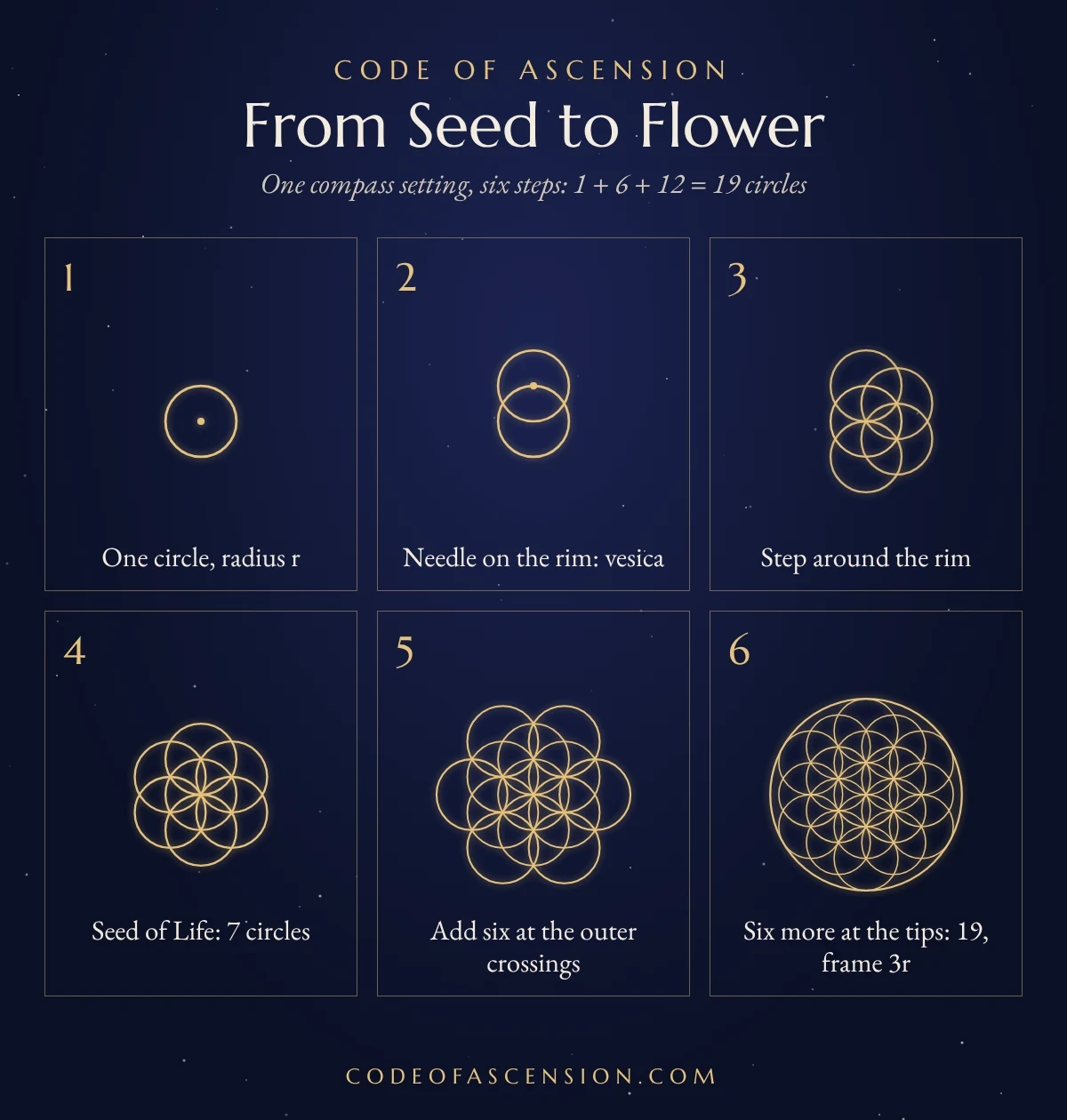
- Draw the first circle. Set your compass to a comfortable radius, say 3 cm. Mark a point in the middle of the page and draw a circle. Call the radius r.
- Make a vesica piscis. Put the compass needle anywhere on the circle’s rim and draw a second circle. It will pass exactly through the first circle’s centre. You’ve just drawn Euclid’s first construction.
- Step around the rim. Put the needle where the second circle crosses the first and draw another circle. Repeat around the rim. Because the chord equals the radius, you’ll get six evenly spaced circles, 60° apart, and the sixth closes perfectly on the start.
- Stop here for the Seed of Life. One central circle plus six around it: seven circles, with a six-petal flower inside the middle circle.
- Grow the Flower. Look at the outer edge of your drawing. Each pair of neighbouring outer circles crosses at a point on the outside of the design: six points in all. Put the needle on each one and draw a circle. Now six more crossing points appear at the tip of each petal’s spoke, where the new circles meet the Seed’s outer circles. Draw a circle on each of those too. That’s twelve new circles, completing a hexagonal patch.
- Frame and tidy. Count your circles: 1 + 6 + 12 = 19. Draw one large circle around the whole design with a radius of 3*r* (three times your original setting), then erase any arcs that spill outside it. That’s the Flower of Life as it usually appears.
Want to keep going? Extend the grid one more ring, then pick the centre and the twelve circles that sit along the six straight spokes: that’s the Fruit of Life. Join all thirteen centres with a ruler and you have Metatron’s Cube.
COA reflection: many people find slow compass work calming, and that’s the honest benefit. You’re giving your hands a repetitive, precise task and your attention a single point of focus. Our guide to coloring benefits explores the same idea with pattern colouring.
How to Use This Sacred Geometry Index
Think of the index as a field guide. Here’s a simple routine for any unfamiliar diagram you meet on a tattoo, a pendant, a building or a social post:
- Count first. Seven circles is the Seed of Life. Nineteen is the Flower of Life. Thirteen separate circles is the Fruit of Life. Thirteen with straight lines is Metatron’s Cube. Ten spheres in three columns is the Tree of Life.
- Check the lines. Curves only point to the circle family, spirals or the triquetra. Straight lines only point to stars, solids or the Sri Yantra. Both usually means Metatron’s Cube.
- Check the dimension. If it looks 3D, it’s probably a Platonic solid, a star tetrahedron or a torus.
- Ask who made it. A Sri Yantra in a Hindu temple is a devotional object. The same design on a T-shirt is decoration. Context changes meaning, and respect follows context.
- Check the claim. If someone says a symbol is “thousands of years old,” look at its row in the provenance table above. If the claim isn’t there, ask for a source.
- Then go deeper. Follow the link in the table to the full Code of Ascension guide.
If you’re choosing a symbol for jewelry, art or a meditation practice, start with the one you can draw yourself. Construction builds understanding in a way scrolling never does.
For a printable reference you can keep next to your compass, request The Sacred Geometry Starter free by email from our Free Ascension Library. Email signup required.
Sacred Geometry Symbols: FAQ
What is sacred geometry in simple terms?
Sacred geometry is the practice of giving spiritual meaning to particular shapes and proportions, such as circles, stars, spirals and the Platonic solids. The shapes themselves are ordinary geometry. The “sacred” part is the meaning people attach to them.
What is the most famous sacred geometry symbol?
The Flower of Life is probably the most widely recognised today, followed by Metatron’s Cube, the Seed of Life and the golden spiral. The pattern is old, but the name “Flower of Life” is modern.
What is the difference between the Seed of Life and the Flower of Life?
The Seed of Life has seven circles: one in the centre and six around it. The Flower of Life continues the same construction to nineteen circles, usually inside a larger framing circle. The Seed is the first stage of the Flower.
Is Metatron’s Cube actually in the Bible or Kabbalah?
Metatron is not a figure of the Hebrew Bible, but the name appears in the Talmud and in Kabbalistic texts. The geometric figure called Metatron’s Cube, thirteen circles joined by 78 lines, comes from modern sacred-geometry writing, not from those older sources.
Is the Flower of Life really ancient Egyptian?
Not in the way it’s usually claimed. The circles at the Temple of Osiris at Abydos are red-ochre graffiti whose date is disputed. Researchers place them no earlier than 535 BCE and probably in the early centuries CE, and a much later origin hasn’t been ruled out.
Where do the Platonic solids come from?
They’re named after Plato, whose Timaeus linked four of them to the classical elements and the fifth, the dodecahedron, to the heavens. Earlier Greek mathematicians already knew them, and Euclid proved there are exactly five.
Do sacred geometry symbols have special powers?
There’s no scientific evidence that a shape has power on its own. What a symbol can do is focus attention, give your reflection a structure and remind you of an intention. Code of Ascension treats sacred geometry as a symbolic language and a contemplative practice, not as established science.
Can I draw sacred geometry myself?
Yes, and it’s the best way to learn it. Most of the flat symbols in this index can be drawn with a compass and a ruler. The Platonic solids, star tetrahedron and torus are three-dimensional forms, so on paper you draw them in perspective, and a traditional Sri Yantra needs careful measured construction. Start with the Seed of Life using the steps above, then grow it into the Flower of Life.
Your next step: pick the symbol that brought you here and draw it once with a compass, then read its full guide. Start with our Flower of Life Meaning for the circle family, or Metatron’s Cube Meaning if you’re drawn to structure and straight lines.
Explore Next
- The circle family in depth: Flower of Life Meaning
- From circles to structure: Metatron’s Cube Meaning
- The five-pointed star: Pentagram Meaning
- Shapes used for protection, side by side: Protection Symbols and Their Meanings
- Number patterns and the Tesla myth: 369 Meaning
- Geometry in the sky: Saturn’s Hexagon
- A different kind of cube: Black Cube of Saturn
- Builders’ tools as symbols: Freemasonry Meaning
- Free printable: The Sacred Geometry Starter
Sources and Further Reading
- Wikipedia, “Sacred geometry” (definition; Plutarch on Plato; Skinner’s “unanchored geometry”).
- Wikipedia, “Overlapping circles grid” (Abydos dating, citing Furlong and Murray 1904; Assyrian threshold; Leonardo’s Codex Atlanticus; Flower of Life name).
- Wolfram MathWorld, “Flower of Life,” “Metatron’s Cube,” “Vesica Piscis,” “Stella Octangula,” “Torus.”
- Euclid, Elements, ed. D. E. Joyce, Clark University: Book I, Proposition 1; Book VI, Definition 3.
- Encyclopaedia Britannica: “Platonic solid,” “Metatron,” “Star of David,” “yantra,” “Fibonacci,” “labyrinth.”
- Mario Livio, “The golden ratio and aesthetics,” Plus Magazine, University of Cambridge, 2002.
- University of Edinburgh, “Labyrinth origins.”
- Wikipedia: “Tree of life (Kabbalah),” “Pentagram,” “Triquetra,” “Merkabah mysticism,” “Circled dot.”
Final Thoughts: The Pattern Is Real, the Meaning Is Yours
Sacred geometry symbols are worth knowing precisely because they’re real. A circle really does become six petals when you step the same radius around it. Five points really do become a star whose lines divide in the golden ratio. You don’t need an invented ancient lineage to find that remarkable.
Learn the name. Learn the construction. Know which parts are history and which are interpretation. Then let the symbol do what symbols do best: focus your attention on the pattern you’re ready to see.
About the Author
Author: King | Founder of Code of Ascension
King is the founder of Code of Ascension, a spiritual education platform focused on consciousness, symbolism, manifestation, nervous system awareness, and hidden patterns of reality. Through Code of Ascension, he explores ancient wisdom and modern insights to help others awaken, align, and ascend. Symbolic readings on Code of Ascension are interpretation and reflection, not established science.
Keep Ascending 🚀