
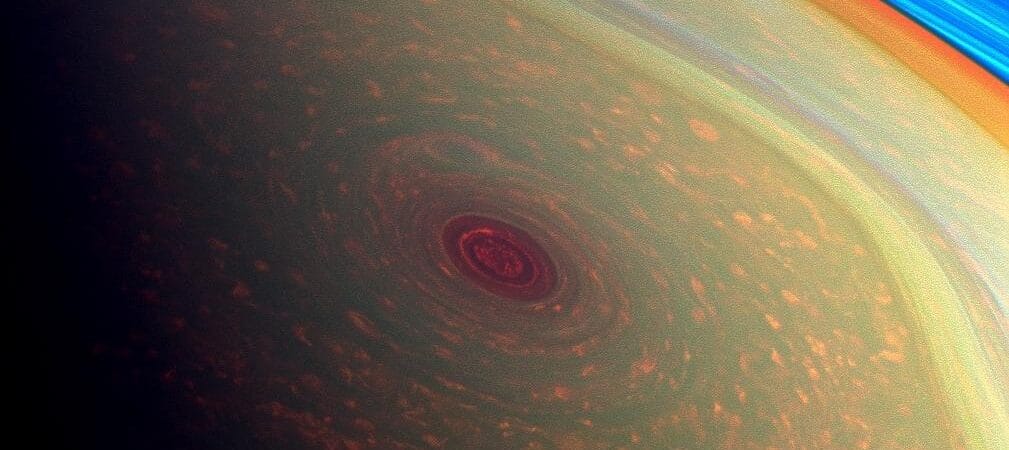
At the top of Saturn, about 75 degrees north of its equator, there is a shape that looks like it was drawn with a ruler. It has six straight sides. It is wider than two Earths. It has been spinning in place since at least 1980, and in September 2026 astronomers reported that Saturn’s south pole has a newly reported ten-sided atmospheric wave.
This is Saturn’s hexagon, one of the strangest weather systems in the solar system. Planets are round. Storms are round. Fluids are supposed to swirl, not form corners. So why does the sixth planet from the Sun wear a geometric crown?
This guide walks you through what the hexagon is, how it was found, what Cassini saw up close, the leading scientific explanations, the brand-new decagon at the south pole, and why hexagons keep showing up everywhere from beehives to basalt cliffs. As always at Code of Ascension’s Science & Discovery hub, we keep three things separate: what has been observed, what has been modelled, and what is still open. 🪐
Quick Answer: What Is Saturn’s Hexagon?
Quick Answer: Saturn’s hexagon is a six-sided jet stream circling the planet’s north pole at about 75°N in planetocentric coordinates (about 78°N in planetographic coordinates). Each side is roughly 14,500 km (9,000 miles) long, and the whole shape is about 30,000 km (20,000 miles) across, wider than two Earths. Winds inside the jet blow at around 320 km/h (200 mph). It was first seen in Voyager images from 1980 and 1981 and has persisted for more than 40 years. Scientists think it is a wave pattern locked into a meandering jet stream, but exactly why it settles into six sides is still debated.
What this article can and cannot establish: We can describe what Voyager, Hubble and Cassini observed, the measurements scientists have published, and the main models that try to explain the hexagon. We cannot tell you exactly why it has six sides, because researchers have not agreed on that yet. Where a point is a model or an open question, we say so. Any sacred-geometry discussion is labeled as reflection, not science.
The COA Saturn Hexagon Evidence Map
Most articles about the hexagon mix facts, models and myths together. This Code of Ascension reference sorts the ten biggest questions by how solid the answer is, from what spacecraft have measured to what is still open.
| Question | What we know | Status | Key source |
|---|---|---|---|
| Does the hexagon exist, and does it last? | Seen in Voyager images (1980–81), by Hubble (1990–91) and by Cassini (2006–2017); more than 45 years | Observed | Godfrey 1988; Cassini |
| How big and how fast? | Sides about 14,500 km; about 30,000 km across; jet around 320 km/h, peaking near 120 m/s | Measured | NASA/Cassini; Sánchez-Lavega 2014 |
| How steady is it? | Rotated every 10 h 39 min 23.01 s during 2008–2014; its slow drift has varied between observing periods; it survived a 14-year polar night | Measured | Sánchez-Lavega 2014; Hueso 2020 |
| Why did it change color? | Seasonal photochemical haze after the 2009 equinox; the jet acts as a barrier | Observed; haze explanation supported by models | NASA 2013, 2016; Sromovsky 2021 |
| How tall is it? | A hexagonal edge also appears in the stratosphere, hundreds of km higher | Observed; interpretation debated | Fletcher 2018 |
| Why six sides? | A wave in an unstable jet; laboratory flows produce several different polygonal patterns | Modelled; still open | Barbosa Aguiar 2010; Morales-Juberías 2015; Rostami 2017 |
| How deep does it go? | Shallow-jet and deep-convection models disagree | Open | Morales-Juberías 2015; Yadav & Bloxham 2020 |
| Is it a clock for Saturn’s day? | About 6 minutes slower than the ring-seismology day | Open | Mankovich 2019 |
| Is there one at the south pole? | No southern hexagon has been identified; a ten-sided wave appears in 2023–2025 observations at roughly 58°S–63°S | Observed; origin and longevity open | Sánchez-Lavega et al. 2026 |
| Is it artificial or a portal? | No evidence supports this | Not supported | — |
“Saturn’s hexagon is not one mystery. It is a measured shape wrapped around an unanswered question.”
Status key: Observed = seen directly; Measured = quantified by instruments; Modelled = reproduced in labs or simulations; Open = no agreed answer yet.
Cite this framework: Code of Ascension, “The COA Saturn Hexagon Evidence Map,” codeofascension.com/saturn-hexagon/
What Is Saturn’s Hexagon?
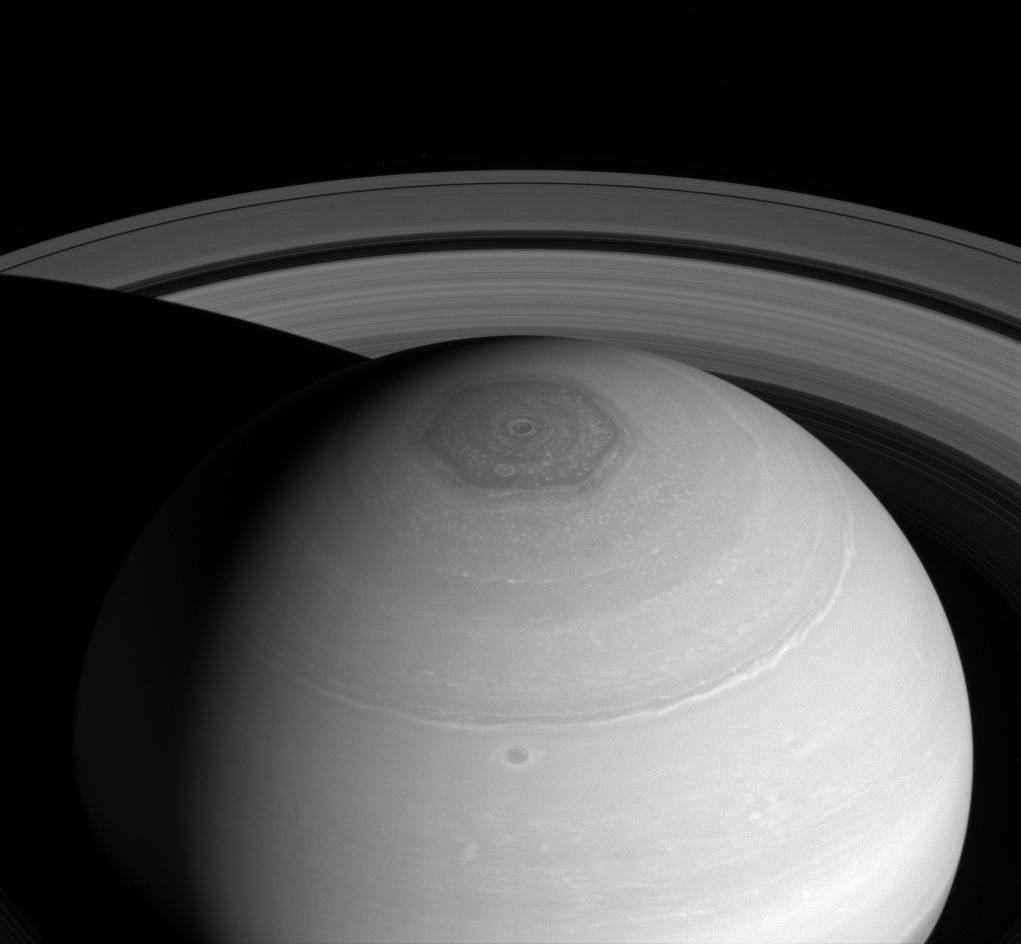
Saturn’s hexagon is not a solid object, a crater, or a structure. It is weather: a narrow, fast river of wind, called a jet stream, that flows eastward around the north pole. Instead of tracing a smooth circle, the jet bends into six nearly straight sides with six corners, like a giant hexagonal racetrack.
Here is the scale. Each side is about 14,500 kilometers long, a little longer than Earth’s diameter of about 12,700 km. The full hexagon spans roughly 30,000 kilometers, so you could line up two Earths across it with room to spare. NASA describes it as wider than two Earths, and that is not an exaggeration.
The wind speeds are just as impressive. NASA reports the jet blowing at around 200 mph (320 km/h), and detailed measurements of its core have found peak speeds near 120 meters per second, roughly 270 mph. Those peak speeds would beat the strongest sustained winds ever measured in a hurricane on Earth.
The hexagon has retained its distinctive shape for decades, although its slow longitudinal drift has varied between observing periods. Its rotation was exceptionally steady during the 2008–2014 measurements: a team led by planetary scientist Agustín Sánchez-Lavega measured its rotation period at 10 hours, 39 minutes, and 23.01 seconds, with an uncertainty of about one hundredth of a second.
How the Hexagon Was Discovered
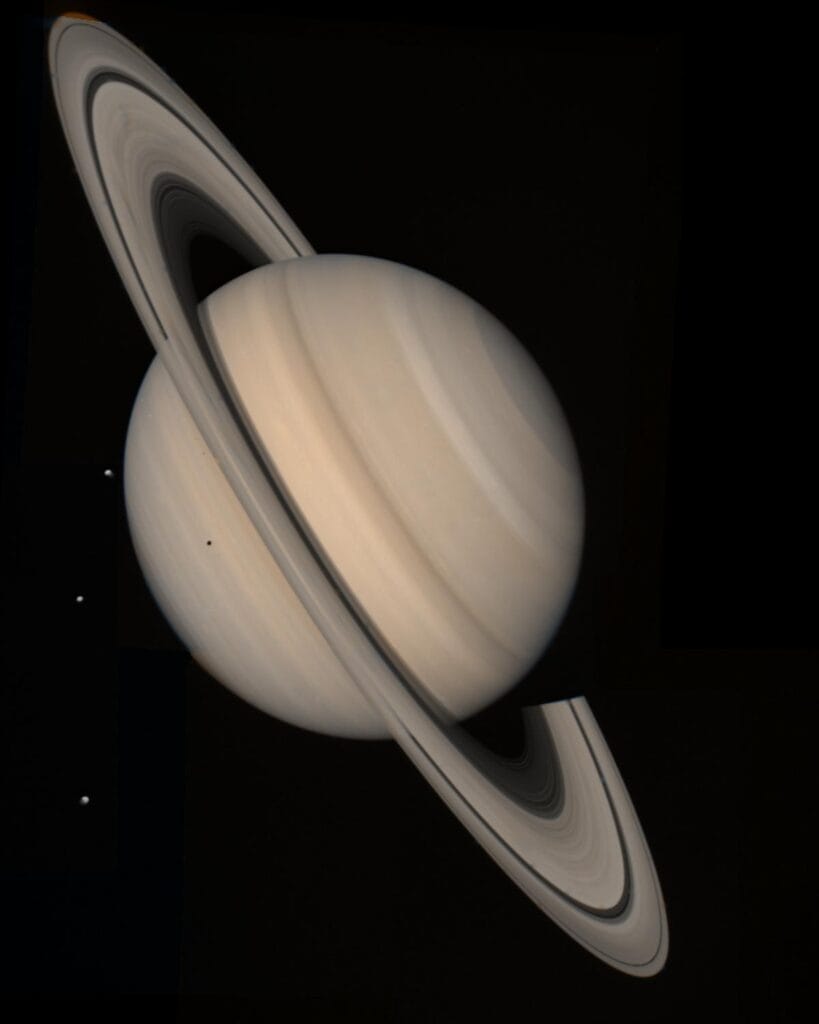
The story starts with NASA’s twin Voyager spacecraft. Voyager 1 flew past Saturn in November 1980, and Voyager 2 followed in August 1981. Their cameras captured the north polar region at an angle, and buried in those images was something nobody expected.
In 1988, astronomer David Godfrey published a paper in the journal Icarus titled “A hexagonal feature around Saturn’s north pole.” By stitching together Voyager views, he showed that the clouds at high northern latitudes traced a six-sided pattern. At the time, it was a curiosity: a single snapshot of an odd shape on a distant world.
Then the hexagon refused to go away. Hubble Space Telescope images from 1990 and 1991 showed it again. When the Cassini spacecraft arrived at Saturn in 2004, the north pole was in the middle of a years-long winter darkness, so Cassini’s first good looks came in thermal infrared starting around 2006, sensing heat instead of sunlight. As spring sunlight returned after Saturn’s August 2009 equinox, Cassini’s cameras finally saw the hexagon in full visible light.
What had looked like a fluke became one of the most stable weather patterns known anywhere. As Caltech’s Andrew Ingersoll put it in 2013: “This has been here for decades — and who knows — maybe centuries.”
Inside the Hexagon: The Polar Hurricane
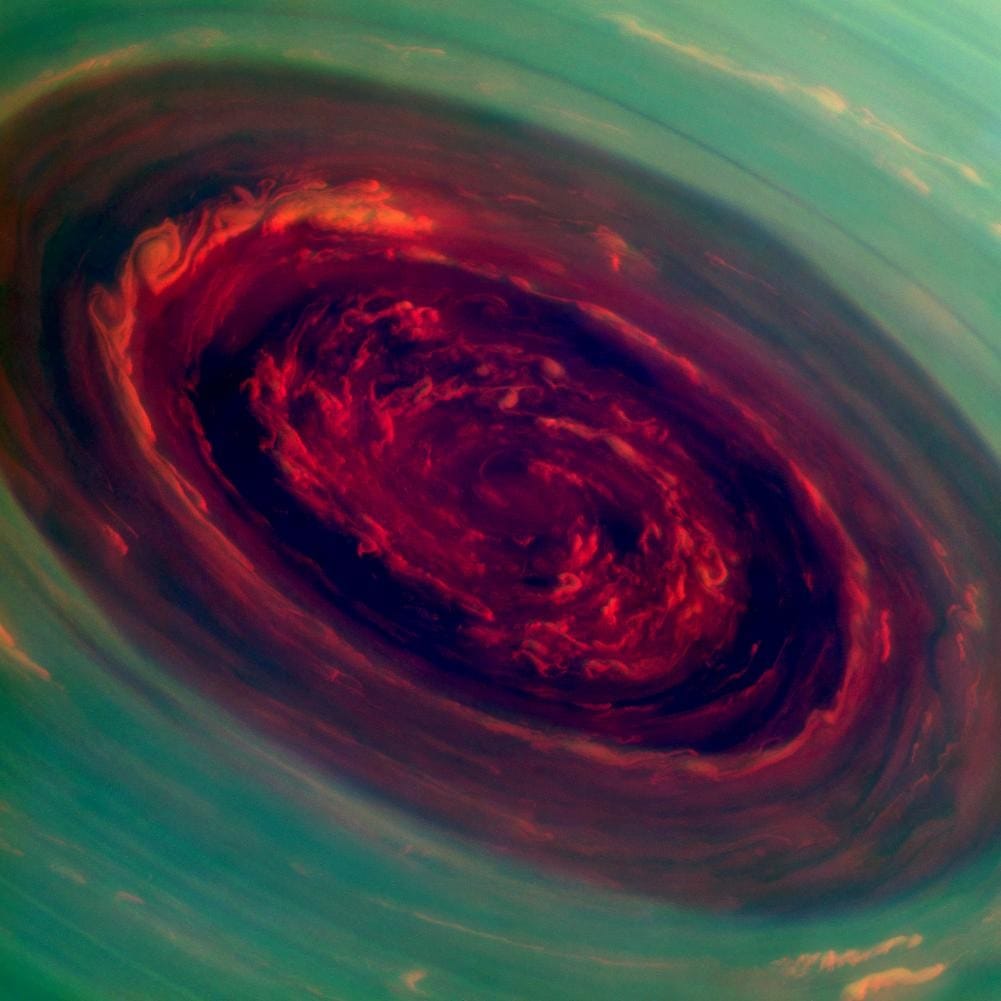
At the center of the hexagon sits something just as dramatic: a giant hurricane-like storm parked directly over the pole. Cassini photographed it in November 2012, and NASA nicknamed the image “The Rose” because, in false color, the swirling clouds look like a blooming flower.
The storm’s eye is about 2,000 kilometers (1,250 miles) across, and clouds at its outer edge race at up to 150 meters per second (330 mph).
Unlike hurricanes on Earth, which drift across oceans and die over land, this one stays put. Saturn has no continents, no mountains, and no cold landmass to steal its energy. That is one reason scientists think Saturn’s polar weather can last so long.
The hexagon is not empty around the hurricane, either. Cassini found other vortices spinning between the central storm and the hexagonal jet. Elsewhere inside the hexagon, Cassini imaged a separate vortex about 3,500 kilometers across, roughly twice the diameter of the largest hurricane recorded on Earth. Some of them interact with the jet itself, and that interaction turns out to matter for the leading explanations of the six sides.
Why Is Saturn’s Hexagon Six-Sided?
This is the big question, and the honest answer is: scientists have strong partial explanations, but no single model has explained everything. Here is what the main lines of research show.
1. It is a wave trapped in the jet stream
Most researchers agree on the basic picture. The hexagon is a standing wave in a meandering jet stream. Imagine a river that wiggles back and forth as it flows in a circle. If the wiggles settle into exactly six evenly spaced bends, a circle becomes a hexagon. On Earth, our own polar jet stream meanders too, which is part of why weather systems loop and stall. The difference is that Earth’s meanders are messy and constantly changing, while Saturn’s has locked into six clean bends for decades.
2. Polygons can be made in a laboratory
In 2010, a team at the University of Oxford led by Ana Barbosa Aguiar and Peter Read published a laboratory model in Icarus. They filled a cylindrical tank with water, spun it, and made an inner ring rotate at a different speed to create a sharp jet. Under different flow conditions, the experiment produced wave patterns with different numbers of bends, including a hexagon. The lesson: when a jet in a spinning fluid becomes unstable, it can naturally form straight-sided shapes. The number of sides depends on the conditions.
3. A shallow, meandering jet can reproduce the shape
In 2015, Raúl Morales-Juberías and colleagues published computer simulations in The Astrophysical Journal Letters showing that a shallow, meandering jet near the cloud tops could reproduce the hexagon’s shape and its very slow drift. In this view, the hexagon is mostly a feature of Saturn’s upper weather layer.
4. Vortices may hold it in place
In 2017, Rostami, Zeitlin, and Spiga, writing in Icarus, modelled how an instability in the jet, combined with the polar vortex, could produce a stable hexagon. The central storm and the jet may effectively lock each other into place.
5. It may go thousands of kilometers deep
In 2020, Harvard geophysicists Rakesh Yadav and Jeremy Bloxham published a 3D model in PNAS suggesting the opposite of the shallow view: that the hexagon could be powered by deep convection reaching thousands of kilometers below the clouds. In their simulation, smaller storms pinched a large eastward jet into a polygon. But their model produced a nine-sided shape, not six, and it moved faster than the real hexagon. The authors were clear that the model is a step, not the final answer.
So the scientific picture is this: a jet stream, an instability, and interacting vortices can make polygons. What is still debated is how deep the hexagon goes, and why Saturn’s version chose exactly six sides and has kept them for over 40 years.
Why Doesn’t the Hexagon Fall Apart?
On Earth, even giant storms last days or weeks. Saturn’s hexagon has lasted at least 45 years. Several factors help explain that staying power:
- No land. Saturn is a gas giant with no solid surface near the clouds, so there are no continents or mountains to break up the flow through friction.
- A very stable jet. Measurements over decades show the jet’s speed and position barely changing, even as Saturn moved through its roughly 29-year orbit and its long seasons.
- It survived darkness and summer. The hexagon persisted through a polar night that lasted from about 1995 to 2009, and then through years of strong summer sunlight. Sánchez-Lavega’s team proposed that their seasonal stability points to deeply rooted structures, though how deep the hexagon extends remains uncertain.
- Self-reinforcing structure. If the central vortex and the jet help hold each other in place, as some models suggest, the system can maintain itself for a very long time.
None of these alone explains the hexagon, but together they show why Saturn can keep a weather pattern that Earth never could.
The Hexagon Changed Color
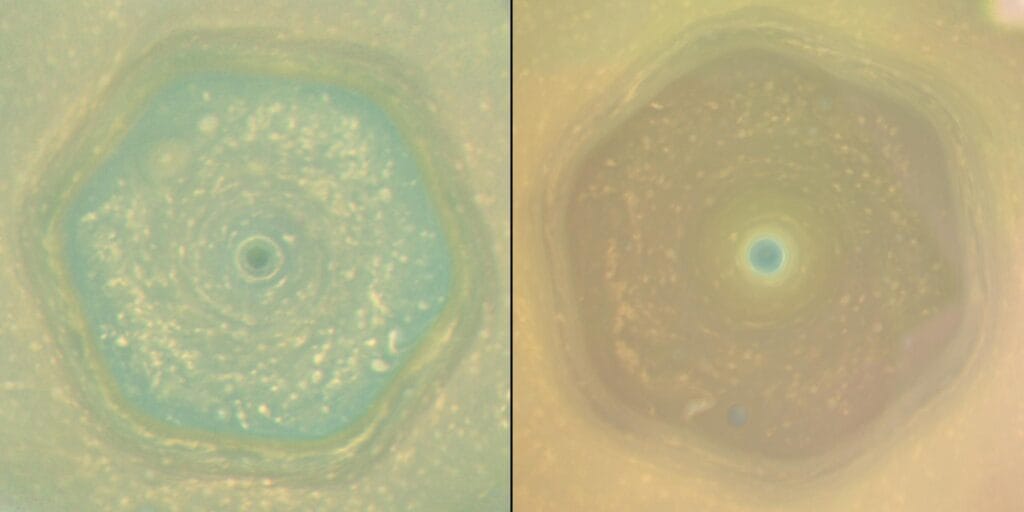
One of Cassini’s most striking discoveries was that the hexagon changed color. In images from 2012, the region inside the hexagon looked mostly blue. By 2016, it had turned a warm gold.
Seasonally increasing photochemical haze is the leading explanation, supported by later modeling of Cassini observations. During the long polar winter, from 1995 to 2009, the air inside the hexagon cleared of aerosols, the tiny particles that make haze. After the August 2009 equinox, continuous sunlight returned to the pole. Sunlight drives chemical reactions that produce photochemical haze, and as northern summer approached its May 2017 solstice, that haze built up and tinted the region gold.
The hexagon also acts like a fence. Hampton University scientist Kunio Sayanagi explained that the hexagonal jet works as a barrier, keeping smaller haze particles concentrated inside while larger particles gather outside. NASA compared it to the way winds around Antarctica help isolate the ozone hole. So the hexagon is not just a shape; it is a boundary that separates two different atmospheres.
A Hexagon That Towers Above the Clouds
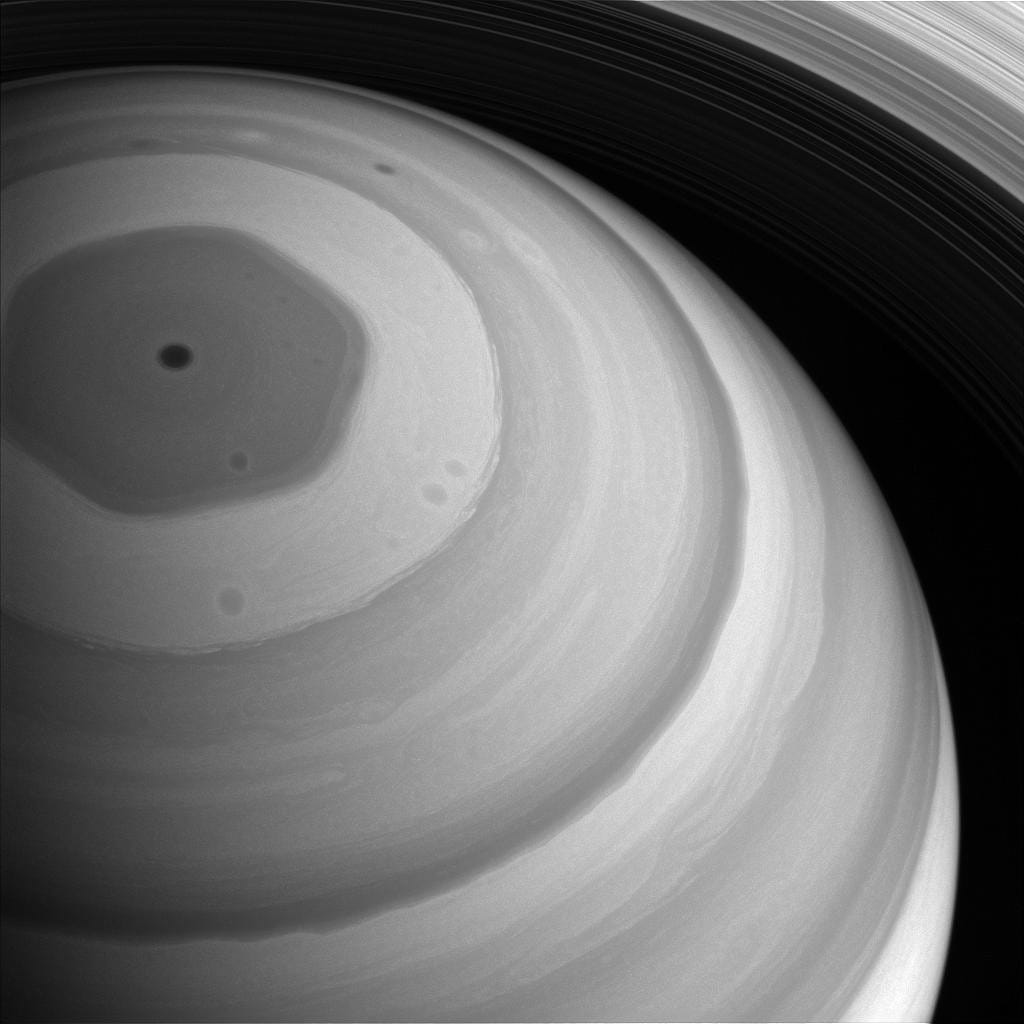
In 2018, Leigh Fletcher of the University of Leicester and colleagues reported another surprise in Nature Communications. Using Cassini’s Composite Infrared Spectrometer (CIRS), which measures heat, they studied Saturn’s northern stratosphere, the layer far above the cloud tops, as summer arrived between 2014 and 2017.
They expected to see a warm summer vortex forming over the pole. They did. But its edge was hexagonal too, matching the hexagon in the clouds below.
Fletcher summed up the puzzle: “Either a hexagon has spawned spontaneously and identically at two different altitudes, or the hexagon is in fact a towering structure spanning a vertical range of several hundred kilometres.”
Either answer is remarkable. If it is one structure, the hexagon is not a flat pattern painted on the clouds. It is a tall column of wind stretching hundreds of kilometers up through Saturn’s atmosphere.
Is the Hexagon a Clock for Saturn’s Day?
Here is a twist most articles skip. For a long time, scientists did not know exactly how long a day on Saturn is. You cannot time it by watching surface landmarks, because there is no solid surface to watch, and Saturn’s radio signals gave confusing, shifting answers.
In 2014, Sánchez-Lavega’s team proposed that the hexagon’s exceptionally steady rotation during 2008–2014, 10 h 39 min 23.01 s, might reflect the rotation of Saturn’s deep interior. If so, the hexagon would be a kind of planetary clock hand.
In 2019, Christopher Mankovich and colleagues used a completely different method: waves in Saturn’s rings that are shaped by vibrations inside the planet. They calculated a day of about 10 hours, 33 minutes, and 38 seconds, about six minutes shorter than the hexagon’s period.
So which is right? The ring-seismology result is now widely used as the best estimate of Saturn’s interior rotation. That means the hexagon is probably drifting slowly relative to the deep interior, which is exactly what you would expect from a wave in a jet stream. This is still an active area of research, and it is a good example of how one strange shape can connect to some of the deepest questions about a planet.
Saturn’s New Decagon: A Ten-Sided Pattern at the South Pole
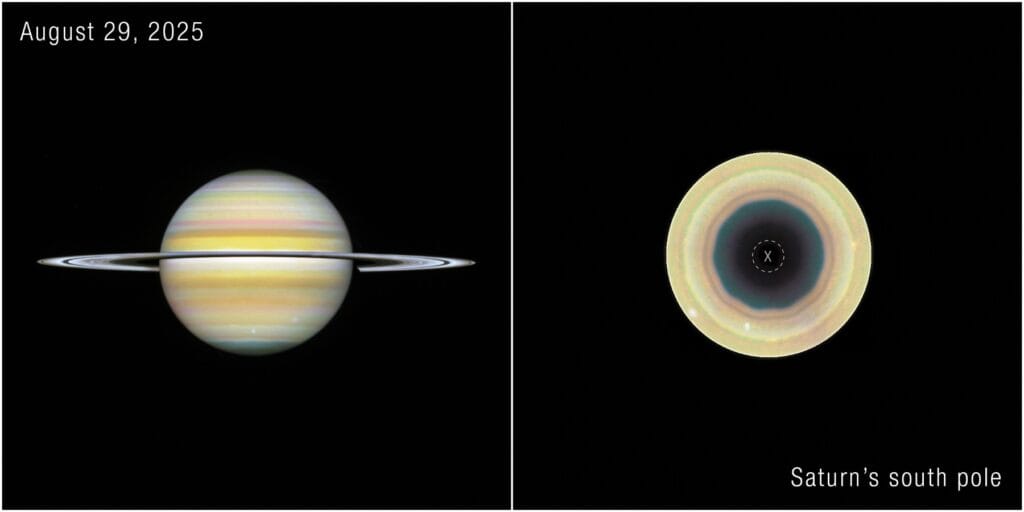
For decades, Saturn’s northern hexagon had no known persistent southern counterpart. In September 2026, researchers reported a different polygon around the south polar region: a ten-sided atmospheric wave.
Agustín Sánchez-Lavega of the University of the Basque Country and colleagues, including NASA Goddard’s Amy Simon and UC Berkeley’s Michael Wong, published “A decagon wave around Saturn’s south pole” online in Science Advances on September 2, 2026. Ground-based observations and Hubble images, including those from Hubble’s Outer Planet Atmospheres Legacy (OPAL) program, showed the pattern clearly in 2025. Examination of Hubble images from 2023 and 2024 revealed earlier, less distinct signs. The wave sits at roughly 58 to 63 degrees south, along a jet stream that peaks near 60.5 degrees south.
The observations trace its development, but they do not establish when it first formed. Some corners remain less distinct than others, and the pattern appears to be evolving. Amateur astronomers, including Trevor Barry and Jean-Paul Oger, contributed ground-based observations.
Both key comments came from NASA’s Amy Simon. “The northern hexagon has been there every time we’ve looked for more than 40 years,” she said, while the decagon “is different — it appears to be strengthening.”
The decagon is a wave within a jet stream. Images at different wavelengths reveal its structure across atmospheric layers, but that does not establish how deeply it extends beneath the visible clouds.
Its discovery gives researchers another polygonal jet pattern to compare with the northern hexagon. Continued observations can test proposed mechanisms and reveal whether the decagon persists, changes shape, or disappears. Scientists did not observe its formation from the beginning, and what triggered it is still unknown.
Polygons on Other Planets
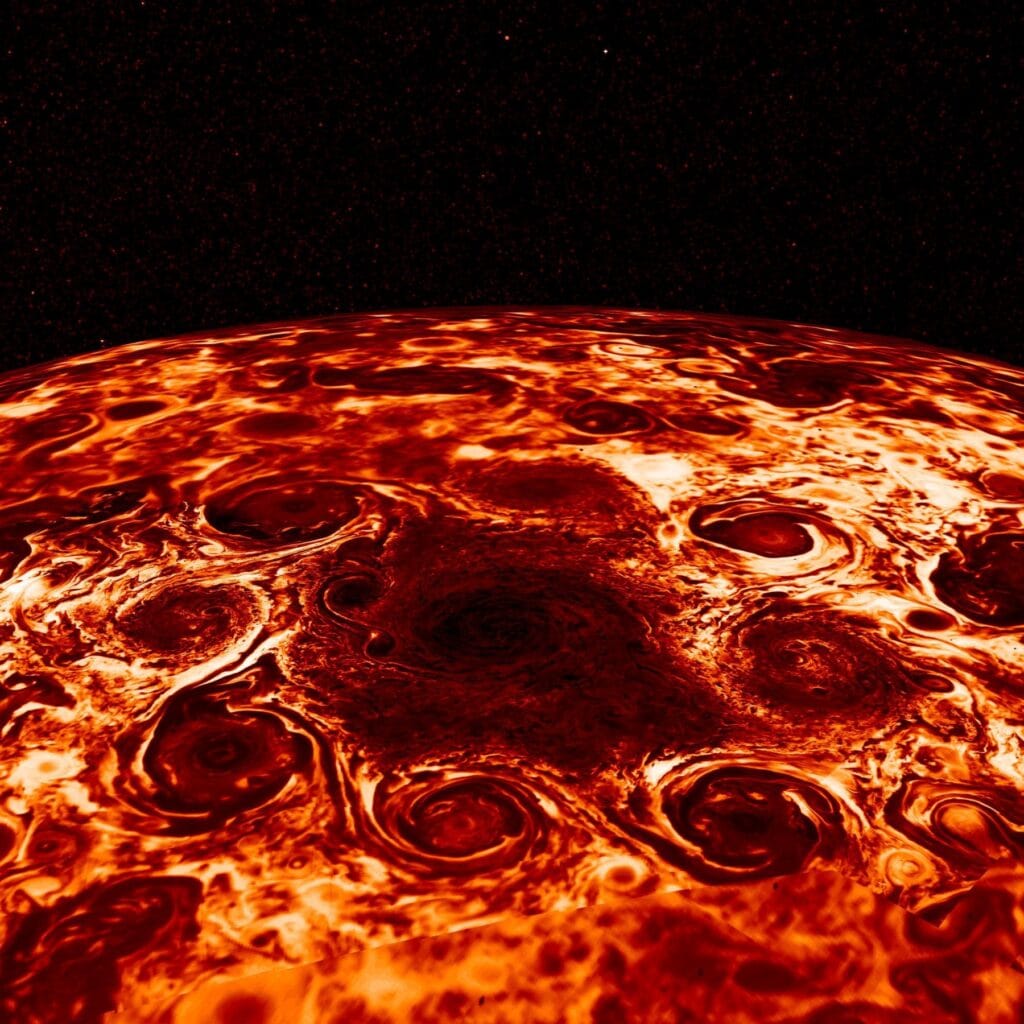
Saturn is not the only giant planet doing geometry. When NASA’s Juno spacecraft first looked down on Jupiter’s poles, it found something no one predicted: clusters of cyclones arranged in near-perfect polygons.
In 2018, Alberto Adriani and colleagues reported in Nature that Jupiter’s north pole has one central cyclone surrounded by eight others in an octagon-like ring, while the south pole had one central cyclone surrounded by five in a pentagon. In 2019, Juno observed a sixth cyclone temporarily joining the southern ring, but it subsequently moved away and disappeared. Each of these storms is thousands of kilometers wide.
Jupiter’s polygons are built differently from Saturn’s. Jupiter’s are made of separate cyclones packed together, while Saturn’s is a single continuous jet stream bent into six sides. But both show the same deeper lesson: on fast-spinning giant planets, polar weather can organize itself into regular geometric patterns that last for years.
Hexagons in Nature and Sacred Geometry
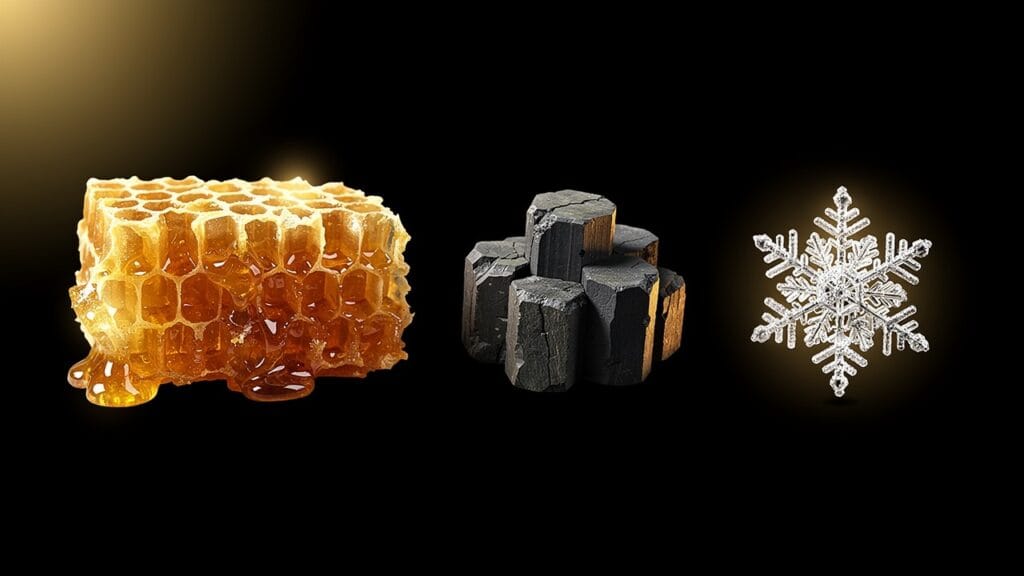
Hexagons are everywhere once you start looking:
- Honeycomb: bees build hexagonal cells, the shape that encloses the most space with the least wax.
- Basalt columns: cooling lava cracks into six-sided pillars at places like the Giant’s Causeway in Northern Ireland.
- Snowflakes: ice crystals grow with sixfold symmetry because of how water molecules bond.
- Bénard cells: heat a thin layer of fluid from below and it can organize into hexagonal convection cells.
- Carbon: graphene, a single layer of carbon atoms, is a flat sheet of hexagons.
It is tempting to say Saturn’s hexagon belongs in the same family, and in a poetic sense it does. Scientifically, though, the physics are different: honeycomb is about efficient packing, snowflakes are about molecular bonds, and Saturn’s hexagon is a wave in a spinning jet stream. The shape is shared. The cause is not.
That distinction matters, especially in spiritual spaces. You will find videos online claiming the hexagon is an artificial structure, a portal, or proof of a hidden code. There is no evidence for any of that, and the real science is stranger and more beautiful than the myths.
COA reflection: In sacred geometry, the hexagon sits at the heart of symbols like the Flower of Life and Metatron’s Cube, where it represents balance, harmony, and the way simple rules create complex beauty. Saturn’s hexagon is a reminder that nature does build geometry on its own, through motion, rotation, and balance, without needing a designer to draw it. For many people, that is exactly what makes it awe-inspiring. This is a Code of Ascension reflection, not a scientific claim.
Saturn has long carried symbolic weight, too, from the Roman god of time to modern ideas like the Black Cube of Saturn. Those are cultural and esoteric ideas. The hexagon is physical weather that spacecraft have measured. Both can be interesting. They are simply different kinds of knowledge, and we label them that way.
Can You See Saturn’s Hexagon With a Telescope?
Not really. From Earth, Saturn’s north pole is a tiny region at the edge of a planet that already looks small in a backyard telescope. The hexagon has been photographed mainly by spacecraft (Voyager and Cassini) and by the Hubble Space Telescope.
That said, very skilled amateur astronomers with large telescopes and advanced image processing have captured hints of Saturn’s polar features when the pole is tilted toward Earth, and amateurs contributed observations to the 2026 decagon study. If you have a telescope, Saturn’s rings and its largest moon, Titan, are easy and unforgettable targets. Just do not expect to see the hexagon itself with your own eyes.
What Comes Next for the Hexagon?
Cassini ended its mission on September 15, 2017, diving into Saturn’s atmosphere. Since then, no spacecraft has orbited Saturn, and there is currently no dedicated Saturn orbiter in development. NASA’s Dragonfly mission will travel to Saturn’s moon Titan, but it is a rotorcraft built to explore Titan’s surface, not Saturn’s poles.
For now, the hexagon and the new decagon will be studied from afar:
- Hubble’s OPAL program will keep photographing Saturn every year, which is how the decagon was caught.
- The James Webb Space Telescope can study Saturn’s atmosphere in infrared detail, and the researchers call for further Hubble and Webb observations to investigate the decagon’s origin and evolution.
- Computer models will keep testing which explanation, shallow jet, deep convection, or vortex interaction, best matches both the six-sided north and the ten-sided south.
The biggest open questions are clear: Why six sides in the north and ten in the south? How deep do these patterns go? What triggered the decagon, and will it last as long as the hexagon? For the first time, the answers may arrive in real time.
Saturn’s Hexagon by the Numbers
- Shape: six-sided jet stream around the north pole
- Latitude: about 75°N in planetocentric coordinates, or about 78°N in planetographic coordinates
- Side length: about 14,500 km (9,000 miles)
- Width: about 30,000 km (20,000 miles), wider than two Earths
- Jet speed: around 320 km/h (200 mph), peaking near 120 m/s
- Rotation period: 10 h 39 min 23.01 s (measured 2008 to 2014; the drift has varied between observing periods)
- First seen: Voyager images, 1980 to 1981; described by David Godfrey in 1988
- Age: at least 45 years and counting
- Central storm eye: about 2,000 km (1,250 miles) across
- Southern counterpart: a ten-sided wave at roughly 58°S to 63°S, reported September 2026
If you love space puzzles, COA’s Space Code Activity Pack offers printable mazes, word searches, and sudoku for a screen-free break. It is an optional activity product, not a source for the science in this article.
Watch the DCI Video
Watch “Why Is There a Giant Hexagon on Saturn?” on YouTube from Dark Cosmic Insights. The video is the quick visual tour; the evidence map and sources in this article show what is measured, what is modelled, and what is still open.
Sources: D. A. Godfrey, “A hexagonal feature around Saturn’s north pole”, Icarus 76, 1988; NASA, “NASA’s Cassini Spacecraft Obtains Best Views of Saturn Hexagon”, December 4, 2013; NASA Photojournal, “The Rose” (PIA14944); NASA Photojournal, “Changing Colors in Saturn’s North” (PIA21049), 2016; A. Sánchez-Lavega et al., “The long-term steady motion of Saturn’s hexagon and the stability of its enclosed jet stream under seasonal changes”, Geophysical Research Letters, 2014; A. C. Barbosa Aguiar, P. L. Read et al., “A laboratory model of Saturn’s North Polar Hexagon”, Icarus, 2010; R. Morales-Juberías et al., “Meandering shallow atmospheric jet as a model of Saturn’s north-polar hexagon”, The Astrophysical Journal Letters, 2015; M. Rostami, V. Zeitlin & A. Spiga, “On the dynamical nature of Saturn’s North Polar hexagon,” Icarus 297, 2017; R. K. Yadav & J. Bloxham, “Deep rotating convection generates the polar hexagon on Saturn”, PNAS, 2020; L. N. Fletcher et al., “A hexagon in Saturn’s northern stratosphere surrounding the emerging summertime polar vortex”, Nature Communications, 2018; C. Mankovich et al., Saturn’s rotation from ring seismology, The Astrophysical Journal, 2019; A. Sánchez-Lavega et al., “A decagon wave around Saturn’s south pole”, Science Advances 12(36), eaee4251; published online September 2, 2026; NASA, “NASA’s Hubble Tracks New Decagon Encircling Saturn’s South Pole”, September 2026; R. Hueso et al., “Saturn atmospheric dynamics one year after Cassini: Long-lived features and time variations in the drift of the Hexagon”, Icarus, 2020; L. A. Sromovsky et al., “Evolution of Saturn’s north polar color and cloud structure between 2012 and 2017”, Icarus, 2021; NASA Scientific Visualization Studio, 2013 vs 2017 natural-color hexagon comparison; STScI, “NASA’s Hubble Tracks New Decagon Encircling Saturn’s South Pole”, September 2026; A. Adriani et al., “Clusters of cyclones encircling Jupiter’s poles”, Nature, 2018.
FAQ
What is Saturn’s hexagon?
Saturn’s hexagon is a six-sided jet stream that circles Saturn’s north pole at about 75°N in planetocentric coordinates (about 78°N planetographic). Each side is about 14,500 km long, the whole pattern is about 30,000 km across, and winds in the jet blow at around 320 km/h (200 mph). It has persisted since at least 1980.
Why is Saturn’s hexagon six-sided?
Scientists think the hexagon is a standing wave in a meandering jet stream, possibly stabilized by the polar vortex and smaller storms. Laboratory experiments and computer models can produce polygons with different numbers of sides, but no model has yet fully explained why Saturn’s settled on exactly six.
How big is Saturn’s hexagon?
Each side of the hexagon is roughly 14,500 km (9,000 miles) long, slightly longer than Earth’s diameter. The full shape spans about 30,000 km (20,000 miles), so it is wider than two Earths.
When was Saturn’s hexagon discovered?
The hexagon appears in images from the Voyager 1 and Voyager 2 flybys in 1980 and 1981. Astronomer David Godfrey described it in a 1988 paper in the journal Icarus. Hubble saw it in 1990 and 1991, and Cassini studied it in detail from 2006 to 2017.
Why did Saturn’s hexagon change color?
Between 2012 and 2016, the region inside the hexagon changed from mostly blue to gold. NASA attributes the change to seasons: as sunlight returned to the north pole after the 2009 equinox, it produced photochemical haze that built up as northern summer approached in 2017.
Does Saturn have a hexagon at its south pole?
No hexagon has been identified at Saturn’s south pole. In September 2026, researchers reported a ten-sided atmospheric wave, or decagon, around the southern polar region. Hubble observations show it in 2023–2025, but its formation date, cause and long-term stability remain uncertain.
Is Saturn’s hexagon a storm?
It is a weather system, but not a single storm. The hexagon is a jet stream, a fast-moving band of wind, bent into six sides. Inside it sits a separate hurricane-like storm directly over the pole, with an eye about 2,000 km across.
Can you see Saturn’s hexagon from Earth?
Not with a typical backyard telescope. The hexagon has been photographed mainly by the Voyager and Cassini spacecraft and by the Hubble Space Telescope. Skilled amateur astronomers with large telescopes have captured hints of Saturn’s polar features, but the hexagon is not visible to the eye.
Keep Exploring
Return to Science & Discovery, see why Mercury is still shrinking, or explore what surviving pigments reveal about ancient Egypt.
Editorial note: This article makes no scientific connection between Saturn’s hexagon and astrology, numerology, or the symbolic “Black Cube of Saturn.” Sacred-geometry passages are labeled as reflection.
About The Author
Author: King | Founder of Code of Ascension
King is the founder of Code of Ascension, a spiritual education platform focused on consciousness, symbolism, manifestation, nervous system awareness, and hidden patterns of reality. Through Code of Ascension, he explores ancient wisdom and modern insights to help others awaken, align, and ascend.
Keep Ascending 🚀