

Spiritual protection symbols have been used across cultures for centuries to represent safety, blessing, sacred order, energetic boundaries, and divine guidance. People wear them as jewelry, place them in homes, draw them in journals, meditate on them, and use them as reminders that their energy does not have to remain open to every influence.
The deeper point is not fear. Protection symbols are strongest when they return you to awareness. A symbol can focus intention, steady the mind, remind the body to ground, and help the spirit remember its own authority.
This guide explains 11 powerful protection symbols and meanings, including the hamsa, evil eye, Eye of Horus, ankh, cross, pentacle, triquetra, ouroboros, Metatron’s Cube, protective sigils, and black tourmaline as a modern symbolic field. You will also learn how to choose the right symbol without turning protection into paranoia.
Fast Answer: What Are Spiritual Protection Symbols?
Spiritual protection symbols are sacred signs, shapes, amulets, sigils, and emblems used to represent energetic safety, divine guidance, grounding, blessing, and boundaries. They do not replace discernment or real-world action. They work best as reminders that help you focus your intention, protect your peace, and stay aligned with what is true.
The most common symbols include the evil eye for protection from envy, the hamsa for blessing and watchfulness, the Eye of Horus for restored sight, the ankh for life force, the pentacle for elemental balance, and protective sigils for personal intention.
The COA Protection Symbol Index
A quick-reference comparison of the 11 protection symbols in this guide by tradition, core meaning, and common modern spiritual use. Origins vary widely: some are ancient, some are modern, and this index notes the difference.
| Symbol | Tradition / Origin | Core Meaning | Often Used For |
|---|---|---|---|
| Hamsa | Middle Eastern & North African; Jewish and Islamic traditions | Blessing, watchfulness | Peace in the home, warding off negativity |
| Evil Eye (Nazar) | Mediterranean & Middle Eastern folk traditions | Deflection, discernment | Envy, projection, unwanted attention |
| Eye of Horus (Wedjat) | Ancient Egyptian | Restoration, protection, sacred sight | Healing, clarity, safeguarding |
| Ankh | Ancient Egyptian | Life force, continuity | Vitality, sacred balance |
| Cross | Christian | Faith, sacrifice, divine covering | Prayer, resilience, trust |
| Pentacle / Pentagram | Ancient star symbol; pentacle-in-circle form from Western esoteric traditions | Elemental balance, containment | Ritual protection, boundaries |
| Triquetra | Early medieval Celtic & Germanic art; later a Christian Trinity symbol | Unity, continuity | Integration, harmony |
| Ouroboros | Earliest known in ancient Egypt; later Greek, Gnostic & alchemical | Renewal, cycles | Transformation, closing a cycle |
| Metatron’s Cube | Modern sacred geometry; name drawn from Jewish angelic lore | Order, structure | Alignment, energetic organization |
| Protective Sigil | Personal; Western magical practice | Focused intention | Personal boundaries, ritual commitment |
| Black Tourmaline | Modern metaphysical practice (a crystal, not a drawn symbol) | Grounding, steadiness | Emotional grounding, boundary reinforcement |
“Protection symbols differ in tradition and meaning, but they share one function: turning an invisible intention into something the mind can see, remember, and act on.”
Each symbol is covered in depth below, numbered 1–11 in the same order as this index.
Cite this index: Code of Ascension, “The COA Protection Symbol Index,” codeofascension.com/spiritual-protection-symbols/
Why Spiritual Protection Matters
Spiritual protection is not about hiding from the world. It is about staying awake inside your own energy.
When your field feels scattered, you may absorb other people’s moods, overgive, ignore intuition, or feel drained after ordinary interactions. A symbol will not magically fix that by itself, but it can become an anchor. It reminds you to pause, breathe, notice what is yours, and stop handing your attention to everything around you.

Good protection is not fear-based. It is grounded. It says:
- I can be open without being porous.
- I can be loving without absorbing everything.
- I can be intuitive without becoming overwhelmed.
- I can respect sacred symbols without expecting them to do my inner work for me.
If 444 keeps appearing while you are seeking steadiness, the pattern is often read as a reminder of grounding, structure, and spiritual safety. Explore the full 444 meaning guide for the wider symbolism.
Spiritual Protection Symbols and Meanings
The best way to understand protection symbols is to study what each one teaches. Some protect through watchfulness. Some protect through faith. Some protect through life force. Some protect through geometry, cycles, or personal intention.

Use this list as a meaning map, not a rigid rulebook. Symbols carry cultural, religious, historical, and personal layers. Respect the tradition first, then notice what the symbol awakens in you.
1. Hamsa for Spiritual Protection
The hamsa is a hand-shaped symbol widely associated with protection, blessing, strength, and warding off harmful energy. It appears across Middle Eastern, North African, Jewish, Islamic, and broader spiritual contexts, sometimes called the Hand of Fatima or Hand of Miriam depending on tradition.
Spiritually, the hamsa represents the protective hand. When an eye appears in the palm, it adds a layer of watchfulness. The hand blocks harm. The eye sees what is approaching.
The hamsa may symbolize:
- Blessing.
- Divine watchfulness.
- Protection from negativity.
- Peace in the home.
- Strength through faith.
Use the hamsa when you want a symbol that feels protective, maternal, watchful, and rooted in blessing. For its names across traditions, its documented history and how to read the eye and finger direction, see our full hamsa hand meaning guide.
2. Evil Eye for Spiritual Protection
The evil eye is one of the most recognized protection symbols in the world. It is commonly used to repel envy, ill intention, jealousy, harmful attention, or the energetic effect of being watched with resentment.
Its meaning is not paranoia. Its meaning is discernment. Not every gaze is neutral. Not every compliment is clean. Not every environment is spiritually nourishing.
For the full deep-dive, read Evil Eye Meaning.
The evil eye may symbolize:
- Protection from envy.
- Deflection of harmful attention.
- Awareness of projection.
- Energetic shielding.
- Returning negative intention to neutrality.
Choose this symbol when you want a reminder to protect your visibility, confidence, beauty, success, or peace from projection.
3. Eye of Horus for Spiritual Protection
The Eye of Horus is an ancient Egyptian symbol tied to protection, healing, restoration, and sacred sight. It is also called the wedjat eye. In Egyptian myth, Horus loses his eye in conflict with Seth, and the eye is restored. That restored eye becomes a symbol of wholeness after damage.
The Metropolitan Museum of Art connects wedjat eye amulets with healing power, rebirth, and protection. This is why the symbol carries such a strong restorative field.
Read the full article here: Eye of Horus Meaning.
The Eye of Horus may symbolize:
- Restored perception.
- Protection through clear sight.
- Healing after loss.
- Wholeness.
- Divine watchfulness.
Choose this symbol when you need to trust what you see and return to clarity after confusion.
4. Ankh for Spiritual Protection
The ankh is the ancient Egyptian sign of life. Britannica describes it as a hieroglyphic symbol meaning life, often called the crux ansata. Spiritually, the ankh is connected to breath, vitality, eternal life, sacred balance, and continuity.
As a protection symbol, the ankh does not feel defensive. It protects by strengthening connection to life force. Some symbols shield by blocking. The ankh shields by returning you to vitality.
Go deeper here: Ankh Meaning.
The ankh may symbolize:
- Life force.
- Breath.
- Sacred balance.
- Eternal wisdom.
- Spiritual endurance.
Choose the ankh when your protection need is less about fear and more about reconnecting to life, vitality, and sacred continuity.
5. Cross for Spiritual Protection
The cross is one of the most recognized religious symbols in the world. In Christian contexts, it is associated with faith, sacrifice, resurrection, divine covering, and victory through surrender. Britannica notes the cross has many forms and a long religious symbolic history.
For many people, the cross is not only a symbol of belief. It is a reminder that they are held by something greater than fear.
The cross may symbolize:
- Faith.
- Divine covering.
- Surrender of fear.
- Strength through devotion.
- Protection through trust.
Choose the cross when your path of protection is rooted in faith, prayer, resilience, and relationship with God.
6. Pentacle and Pentagram for Spiritual Protection
The pentacle is usually a five-pointed star enclosed in a circle. The pentagram is the star itself. In many spiritual traditions, the five points are linked with earth, air, fire, water, and spirit, while the circle represents wholeness, containment, and sacred boundary.
This symbol is often misunderstood because modern culture sometimes flattens it into fear. But in many contexts, it represents elemental balance and protection through spiritual order.
Read more here: Pentagram Meaning.
The pentacle may symbolize:
- Elemental balance.
- Sacred containment.
- Ritual protection.
- Spirit guiding matter.
- Wholeness.
Choose this symbol when you need balance, boundary, and the reminder that spirit should guide the elements of your life.
7. Triquetra Protection Meaning
The triquetra is an interwoven three-pointed symbol associated with sacred unity, eternal cycles, and trinities. It has appeared in Celtic, Christian, and modern spiritual contexts.
Because its design is woven, it can symbolize protection through integration. Nothing is isolated. Body, mind, and spirit are linked. Past, present, and future are connected. Life moves in cycles, but the center holds.
The triquetra may symbolize:
- Sacred unity.
- Mind-body-spirit harmony.
- Continuity.
- Interwoven protection.
- Cyclical wisdom.
Choose this symbol when you want protection through integration rather than separation.
8. Ouroboros Protection Meaning
The ouroboros is the serpent or dragon eating its own tail. Britannica describes it as a symbol expressing unity, material and spiritual continuity, and perpetual change through cycles of destruction and re-creation.
As a protective sign, the ouroboros represents self-contained power. What renews itself does not collapse easily under outside pressure. It reminds you that endings can become beginnings and that transformation can be part of protection.
The ouroboros may symbolize:
- Renewal.
- Cycles.
- Transformation.
- Self-contained power.
- Eternal consciousness.
Choose this symbol when you are protecting a rebirth, closing a cycle, or learning to stop leaking energy into old patterns.
9. Metatron’s Cube Protection Meaning
Metatron’s Cube is a sacred geometry symbol associated with divine structure, order, balance, and energetic alignment. It contains lines and shapes that many people read as a map of cosmic intelligence.
As a protection symbol, it is less about blocking and more about organizing. When your field feels chaotic, this symbol can remind you to return to structure. Geometry becomes a teaching: disorder is not the deepest truth.
This differs from the more Saturnian association of the Black Cube, which is often approached through themes of control, shadow, and grounded boundaries. Read the Black Cube meaning guide for that contrasting symbolic lens.
Metatron’s Cube may symbolize:
- Sacred order.
- Divine architecture.
- Energetic balance.
- Pattern recognition.
- Protection through structure.
Choose this symbol when you feel scattered, overstimulated, or in need of higher order. Check out more about Metatron’s Cube here.
10. Protective Sigils for Spiritual Protection
A sigil is a symbol created with intention. Unlike inherited sacred symbols, protective sigils are often personal. They may be drawn from a phrase, prayer, goal, or energetic boundary.
The power of a sigil is not that it is ancient. Its power is specificity. It lets you turn an intention into a visual mark.
Protective sigils may symbolize:
- Personal boundaries.
- Focused intention.
- Ritual commitment.
- Energetic shielding.
- Self-authored meaning.
Choose a sigil when you want a private symbol that belongs to your own practice. Keep it ethical. Do not use protection work to control others. Use it to clarify your own field.
11. Black Tourmaline Symbolic Field
Black tourmaline is a crystal, not a traditional drawn symbol. But in modern spiritual protection work, it has become symbolic of grounding, absorption, boundary reinforcement, and emotional steadiness.
It is often placed near doors, desks, beds, altars, or carried as a pocket stone. The spiritual meaning people attach to it is simple: dense energy does not get to take over my field.
Black tourmaline may symbolize:
- Grounding.
- Stability.
- Absorbing dense energy.
- Emotional steadiness.
- Boundary reinforcement.
Choose black tourmaline when your protection need is practical, earthy, and nervous-system supportive.
Best Symbols for Different Needs

For envy, visibility, and outside projection, choose the evil eye or hamsa.
For intuition, restored sight, and healing after confusion, choose the Eye of Horus.
For life force, vitality, and sacred continuity, choose the ankh.
For faith, surrender, and divine covering, choose the cross.
For elemental balance and ritual boundary, choose the pentacle or pentagram.
For cycles, rebirth, and self-contained power, choose the ouroboros.
For personal intention, choose a protective sigil.
For grounding, choose black tourmaline.
Protection Symbols by Tradition
The 11 symbols above are the ones people ask about most. But almost every culture developed its own signs of protection, and many readers arrive here looking for the symbol of their own lineage, faith, or practice. This section widens the map. Each entry notes where the symbol actually comes from, because honest origins are part of using a symbol with respect.
Treat everything here as interpretation and cultural context, not a guarantee. A symbol protects best when it returns you to awareness, boundaries, and your own center.
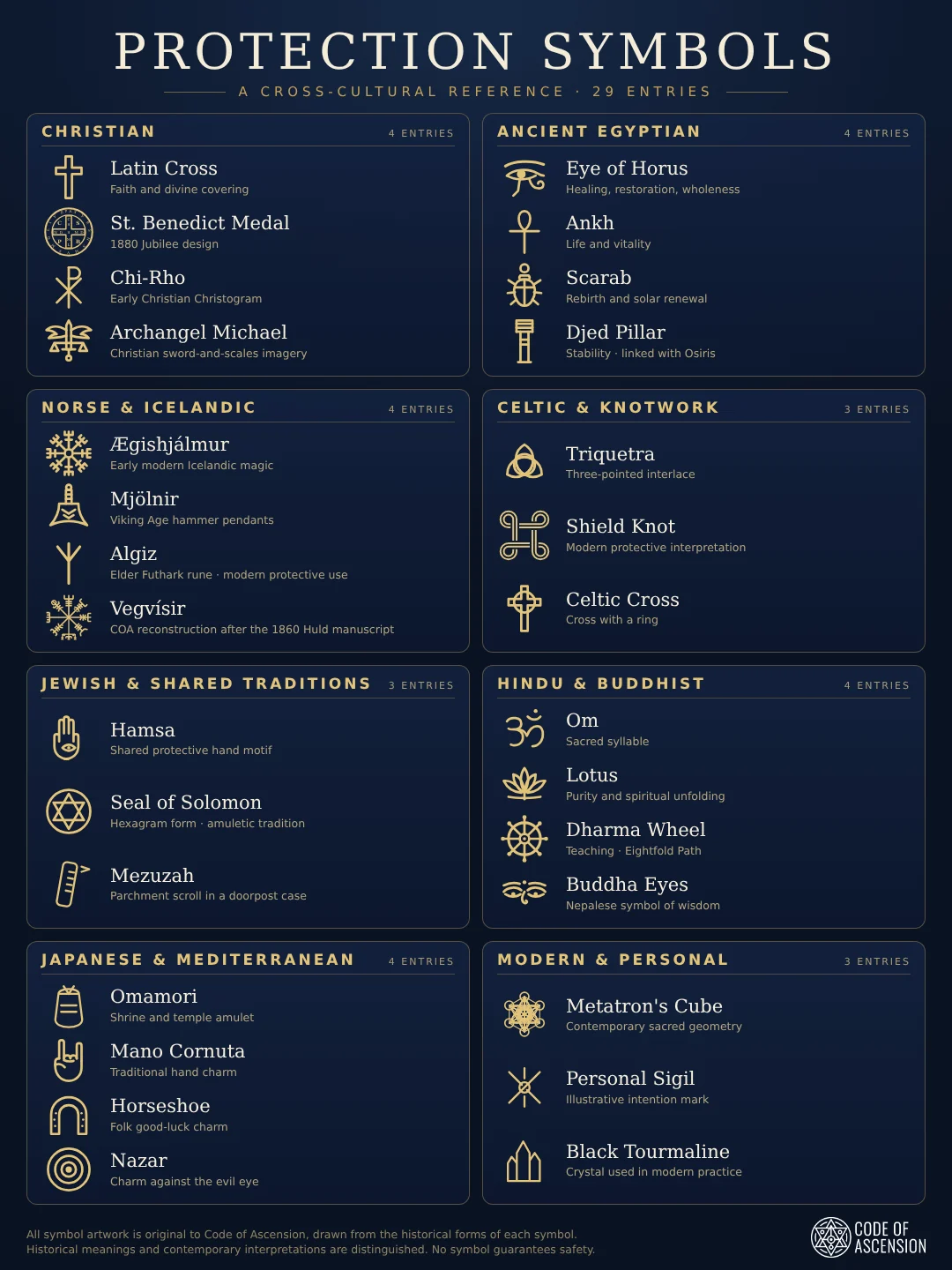
Christian Symbols of Protection
The Cross is covered above and remains the central Christian sign of divine covering. Beyond it, several other symbols carry a long history of protective use:
- St. Benedict Medal – A Catholic sacramental; the familiar form is the 1880 Jubilee design struck at Montecassino. The letters around its rim abbreviate a Latin prayer of protection against harm and temptation. Many people wear or keep it as a reminder to stay steady under pressure.
- Chi-Rho (☧) – The first two Greek letters of “Christ” layered together. Adopted as a protective standard by the Roman emperor Constantine in the early 4th century, it later appeared on shields, coins, and church walls.
- Archangel Michael – Not a glyph but an image. In Christian iconography, especially Catholic and Orthodox, Michael appears as the warrior angel with sword and scales, the defender who weighs souls and casts down the dragon. Judaism and Islam also honor Michael, but with their own roles and without this sword-and-scales imagery. His image is used for protection of homes, travelers, and anyone facing a fight.
- Ichthys (the fish) – A well-attested early Christian symbol, the Greek word for fish read as an acrostic for “Jesus Christ, Son of God, Savior.” The popular story that it was a secret recognition code under persecution is uncertain. Its protective meaning is belonging and identity rather than warding.
Angelic Protection Symbols
Protective angel imagery is old. Late-antique amulets, incantation bowls, and seals from the eastern Mediterranean invoke angelic names for protection, and medieval grimoires assigned written seals to specific angels. Scripture itself describes angels without giving them logos, so the oldest “angelic symbols” are names, prayers, and images rather than glyphs. Some contemporary angel sigils are new designs; others adapt older seals. Metatron’s Cube, covered above, is a contemporary geometric figure, even though the name comes from Jewish angelic lore.
If angelic imagery speaks to you, use it the way the tradition does: as a reminder that you are accompanied, and that asking for help is not weakness.
Ancient Egyptian Protection Symbols
Egypt gave the world two of the symbols above, the Eye of Horus and the Ankh. Three more are worth knowing:
- Scarab – The dung beetle rolling the sun across the sky. Scarab amulets were placed with the living and the dead as symbols of renewal and safe passage. Protection here means continuity: you will rise again.
- Eye of Ra – Often confused with the Eye of Horus. Where Horus’s eye restores and heals, Ra’s eye is the fierce, solar, defending power. It is the “do not cross this line” of Egyptian symbolism.
- Djed Pillar – The spine of Osiris, a symbol of stability and endurance. A good match for anyone whose protection need is “help me stay upright.”
Norse and Germanic Protection Symbols
- Aegishjalmur (Helm of Awe) – Eight radiating arms with trident-like ends. It appears in Icelandic magical manuscripts of the 17th century, described as a sign worn for victory and to inspire fear in opponents. Modern users read it as a symbol of inner fortitude.
- Mjölnir (Thor’s Hammer) – Hammer pendants have been found in Viking Age graves across Scandinavia. Thor was the protector of humanity against chaos, so the hammer became a personal amulet of safety and strength.
- Algiz (ᛉ) – An Elder Futhark rune; its protective use is modern. Many read its shape as a figure with arms raised or as an elk’s antlers. Rune “meanings” as used today are largely later reconstructions, not attested Viking Age practice.
- Vegvisir – Popular as a “Viking compass,” but its earliest known source is an Icelandic manuscript from 1860. It is a real folk-magic symbol for not losing one’s way; it is not a Viking Age artifact. The version in our chart is a COA reconstruction after the 1860 Huld manuscript; the angled arm details involve some interpretation. Worth knowing before you tattoo it.
Celtic Protection Symbols
- Triquetra – Covered above; the three-cornered knot of unity and continuity.
- Shield Knot – A square, four-cornered endless loop. The knot pattern is old; the “shield knot” name and protective meaning are modern. Readers use it to represent a boundary with no gaps.
- Celtic Cross – A cross with a ring around the intersection, found in early medieval Ireland and Britain. It joins the Christian cross with a circle many read as wholeness, eternity, or the sun.
Jewish Protection Symbols
- Hamsa – Covered above. A shared protective hand motif across Jewish, Islamic, and wider North African and Middle Eastern tradition; no single faith owns it.
- Seal of Solomon – In Jewish, Christian, and Islamic legend, the signet ring with which King Solomon commanded spirits. In medieval and early modern magical texts it is drawn as a hexagram or a pentagram and used on amulets. This is the amuletic, protective tradition.
- Star of David (✡) – The same six-pointed shape, but as an emblem of Jewish identity it developed along its own path and is not simply “the Seal of Solomon.” Treat the two as related forms with different meanings. As a protection symbol the hexagram is often read as two triangles held in balance.
- Mezuzah – The mezuzah is the parchment scroll itself, hand-written with passages from Deuteronomy including the Shema, fulfilling the instruction to write God’s words “on the doorposts of your house.” The decorative case only houses it. Fixed to the doorpost, it marks the threshold of a home under that word.
Hindu and Buddhist Protection Symbols
- Om (ॐ) – The sacred syllable described in the Upanishads, representing the whole of existence. COA reflection: chanting or wearing it is a way of aligning with that whole rather than fighting what is outside you.
- Lotus – Purity and spiritual unfolding; rooted in mud, flowering above the water. COA reflection: your environment does not determine your nature.
- Dharma Wheel (☸) – The eight-spoked wheel of the Buddha’s teaching and the Eightfold Path. COA reflection: protection through right action, ethics as a shield.
- Buddha Eyes – Painted on the four sides of Nepalese stupas such as Swayambhu and Boudhanath, the eyes of wisdom look in every direction. COA reflection: awareness itself is the protection.
Japanese and Mediterranean Folk Protection
- Omamori – Small brocade amulets sold at Shinto shrines and Buddhist temples in Japan, each for a specific protection: travel, exams, health, childbirth. They are traditionally kept closed, and many shrines and temples recommend returning an omamori and getting a new one about once a year, though practice varies by place and by amulet.
- Mano Cornuta and Mano Fico – Italian hand charms: the cornuta with index and little finger raised, and the fico, a fist with the thumb between two fingers. Both were worn in coral, silver, or bone against the evil eye, and museum collections hold examples going back centuries. The evil eye and these hand charms belong to the same Mediterranean family of deflection symbols.
- Horseshoe – Hung over doors across Europe and the Americas. Iron, the crescent shape, and the blacksmith’s craft were all considered protective; the “points up to hold the luck” rule is folk tradition, not law.
A Note on Indigenous Symbols
Readers often search for Native American or “Cherokee” protection symbols. The most famous example, the dreamcatcher, comes from the Ojibwe (Anishinaabe) people and spread to other nations and then to mainstream culture in the 1960s and 70s. Hundreds of distinct nations have their own living symbols, and many are not meant to be bought, worn, or shared outside the community.
The respectful move is simple: learn from the nation itself, buy from its artists, and don’t flatten a living tradition into décor. Protection that disrespects someone else’s sacred ground isn’t protection.
Symbols of Protection and Strength, Healing, and Guidance
Most people don’t want “protection” in the abstract. They want protection and something else: the strength to hold a boundary, healing after a hard season, or guidance when the way is unclear. Historical meanings vary by tradition, so the pairings below are Code of Ascension’s reading, grouped by the thread each symbol is most often associated with.
| You need protection and… | Symbols often associated | COA reading |
|---|---|---|
| Strength | Mjölnir, Aegishjalmur, Eye of Ra, Archangel Michael, Djed pillar | Each is a warrior or endurance symbol. Protection here is active: standing your ground, not hiding from it. |
| Healing | Eye of Horus, Lotus, Ankh, Scarab, Black Tourmaline | Restoration symbols. They frame protection as recovery: sealing what was torn and returning to wholeness. |
| Guidance | Vegvisir, Om, Dharma Wheel, Metatron’s Cube, Celtic Cross | Orientation symbols. Protection as not losing your way, staying aligned with a larger order while you move. |
| Peace at home | Hamsa, Mezuzah, Horseshoe, Omamori, Evil Eye | Threshold symbols. Placed at doors and entryways to mark where your space begins. |
How To Choose a Protection Symbol
The best symbol is not always the most popular one. It is the one that speaks to the protection you actually need.
Ask yourself:
- Do I need grounding or vision?
- Do I need faith or boundaries?
- Do I need protection from projection or protection from my own overgiving?
- Do I want an inherited sacred symbol or a personal sigil?
- Am I respecting the culture or tradition this symbol comes from?

If you are in an emotionally tangled season, symbolic protection may pair well with release work. The Cord Cutting Ritual guide can help you understand energetic attachments without turning this page into a full tutorial.
Another way to choose is by noticing where you feel unprotected. If your issue is outside attention, the evil eye may feel right. If your issue is emotional leakage, the hamsa or black tourmaline may feel steadier. If your issue is confusion, the Eye of Horus may speak more clearly. If your issue is low vitality, the ankh may be the better symbol because it points you back to life force.
Do not rush the choice. Sit with one symbol at a time. Read its history. Notice how your body responds. A true protection symbol should make you feel clearer, not more afraid.
The symbol-selection and boundary worksheets in The Protection Symbols Grimoire give these questions a place on the page, alongside a curated collection of 12 symbols and printable altar cards.
What People Get Wrong About Protection Symbols
The biggest mistake is expecting the object to do everything.
A symbol can support awareness, but it cannot replace boundaries. It can focus your intention, but it cannot make choices for you. It can remind you to protect your field, but it cannot heal every pattern you keep feeding.
Another mistake is using symbols only when afraid. Protection works best as a steady relationship with clarity, not a panic button.
The third mistake is mixing symbols without understanding them. More symbols do not automatically mean more protection. Sometimes one symbol worn with reverence is stronger than five symbols worn as spiritual decoration.
Build Your Personal Protection Practice
Want a reference you can return to? The Protection Symbols Grimoire explores a curated collection of 12 symbols, their origins, traditions and reflective practices. The $17 download includes a 33-page grimoire plus a separate seven-page ink-friendly printable companion.
Use the altar cards, symbol-selection worksheets and practice logs to explore what resonates with you and clarify your boundaries. These downloadable PDFs are for reading and printing; symbolic practices do not guarantee protection or replace practical safety.
Explore the Protection Symbols Grimoire →
Go Deeper With Code of Ascension
If you want to keep studying sacred signs, start with the deeper symbol guides: Evil Eye Meaning, Eye of Horus Meaning, Ankh Meaning, and Pentagram Meaning.

For a softer next step into alignment and conscious creation, download the free Manifesting Your Dreams ebook. You can also explore more guides on the Code of Ascension blog.
Spiritual Protection Symbols FAQ

What are spiritual protection symbols?
Spiritual protection symbols are sacred signs, amulets, sigils, and emblems used to represent energetic safety, divine guidance, grounding, and boundaries. They can help focus intention and remind you to protect your peace, but they work best when paired with discernment, emotional maturity, and real-world boundaries.
What is the most powerful spiritual protection symbol?
The most powerful spiritual protection symbol depends on the person, tradition, and need. The evil eye, hamsa, Eye of Horus, ankh, cross, pentacle, and protective sigils are all widely used. A symbol becomes more powerful when you understand its meaning and use it with clear intention.
Do protection symbols really work?
Protection symbols can work as spiritual anchors when they focus awareness, intention, and behavior. They should not be treated as guaranteed magical shields. Their real strength is that they remind you to stay grounded, discerning, and aligned with boundaries that protect your energy in daily life.
What does the evil eye protect against?
The evil eye is commonly used to protect against envy, jealousy, harmful attention, and negative projection. Spiritually, it reminds you that not every gaze is clean and not every environment supports your energy. It is a symbol of awareness, shielding, and deflecting harmful intention.
What is the best protection symbol for beginners?
The best beginner protection symbol is one you understand and feel connected to. The hamsa, evil eye, ankh, and Eye of Horus are common beginner-friendly choices because their meanings are clear: blessing, shielding, life force, restored sight, and spiritual protection through awareness.
Can I use more than one protection symbol?
Yes, you can use more than one protection symbol, but choose with intention. Combining symbols works best when their meanings support each other. For example, the hamsa and evil eye both emphasize watchfulness, while the ankh and Eye of Horus can combine life force with restored perception.
How do I choose a spiritual protection symbol?
Choose a spiritual protection symbol by asking what kind of support you need: grounding, clarity, faith, life force, energetic shielding, or emotional boundaries. Study the symbol’s cultural and spiritual context, then choose one that resonates with your intention rather than simply copying a trend.
Are protection symbols religious or spiritual?
Protection symbols can be religious, spiritual, cultural, magical, personal, or decorative depending on context. The cross is deeply Christian for many people, while the ankh and Eye of Horus come from ancient Egypt. Respect the origin of each symbol before using it in your own practice.
What is the Christian symbol of protection?
The cross is the primary Christian symbol of protection, understood as a sign of divine covering rather than a charm. The St. Benedict medal, the Chi-Rho, and images of Archangel Michael are also used for protection within Christian tradition, especially in Catholic and Orthodox practice.
What symbol represents protection and strength?
Symbols that combine protection with strength tend to be warrior or endurance symbols: Thor’s hammer (Mjölnir), the Helm of Awe (Aegishjalmur), the Eye of Ra, the Djed pillar, and Archangel Michael. The Eye of Horus and ankh lean more toward protection with healing and vitality.
What is the oldest protection symbol?
Among symbols still in use, the Eye of Horus (Wedjat) and the ankh are some of the oldest with a documented protective role, appearing in ancient Egyptian amulets thousands of years ago. Eye motifs against envy are also very old across the Mediterranean and Middle East. “Oldest” is hard to prove, so treat any single claim with care.
Can I draw my own protection symbol?
Yes. A personal protective sigil is a symbol you design to hold a specific intention, such as “my peace is mine to keep.” Write the intention, reduce it to a simple shape, and draw it somewhere you will see it. Its power is in the meaning you give it and the behavior it reminds you to keep, not in the lines themselves.

Final Thoughts
Spiritual protection is not about becoming afraid of the world. It is about becoming more present inside your own energy.
Symbols help because they give meaning a shape. They turn intention into something you can see, wear, hold, draw, or remember. But the symbol is not the whole practice. You are still the one who chooses clarity. You are still the one who maintains boundaries. You are still the one who returns to alignment.
Choose the symbol that calls you back to your center.
Then let it remind you: your energy is sacred, and you are allowed to protect it.
About The Author
Author: King | Founder of Code of Ascension
King is the founder of Code of Ascension, a spiritual education platform exploring angel numbers, manifestation, consciousness, symbolism, energetic protection, nervous system alignment, and practical ascension work. His writing blends grounded spiritual insight with clear, usable guidance for readers who want meaning, discernment, and transformation without losing their center.
Keep Ascending 🚀