

A cord cutting ritual is a symbolic practice for releasing an unhealthy energetic, emotional, or spiritual attachment so your energy can return to the present moment. It is not about erasing someone, punishing them, or pretending the past did not matter. It is about reclaiming the part of your attention, identity, nervous system, and inner power that keeps looping around a person, pattern, memory, or chapter that no longer supports your becoming.
In spiritual language, an energetic cord is a line of attachment. It may feel like mental obsession, emotional heaviness, guilt, longing, resentment, fear, obligation, or a strange sense that part of you is still “over there” with someone or something else. Sometimes that cord connects to an ex. Sometimes it connects to a family pattern, a friendship, a workplace wound, an old version of yourself, or a future fantasy you have outgrown.
This guide explains the meaning of the practice, when it may be useful, how to do a simple ritual safely, signs it worked, and what to do afterward. The goal is not spiritual performance. The goal is honest release.
Important note: this ritual is not a substitute for therapy, medical care, legal help, domestic violence support, or real-world boundaries. If a situation involves abuse, stalking, danger, coercion, severe trauma, or mental health crisis, choose practical support first. Ritual can support healing, but it should never replace safety.
Fast Answer: What Is Cord Cutting?
Cord cutting is a spiritual release practice where you intentionally separate your energy from an attachment that feels draining, obsessive, painful, or outdated. You may use meditation, visualization, breathwork, journaling, prayer, a spoken intention, or a symbolic action like cutting thread. The meaning is simple: “I release what is not mine, call my energy back, and stop feeding this connection with unconscious attention.”
The practice works best when it is paired with grounded action. That may mean muting someone online, stopping the repeated checking, setting a boundary, ending a pattern of emotional labor, resting after a breakup, or choosing a nervous system practice instead of another spiral.
Cord cutting does not mean you stop caring. It means care is no longer allowed to become self-abandonment.
Cord Cutting Ritual Meaning
The deeper meaning of a cord cutting ritual is sovereignty. You are not trying to destroy a connection. You are clarifying where your energy belongs.
Every relationship, place, role, and repeated thought pattern can create a kind of energetic imprint. Some cords are nourishing. A healthy cord with someone you love may feel warm, mutual, and alive. You can feel connected without losing yourself. An unhealthy cord feels different. It feels sticky, heavy, compulsive, draining, or confusing. You may feel pulled into old emotions even when nothing is happening in the present.

Spiritually, the ritual says:
- I release the version of this connection that drains me.
- I stop confusing attachment with love.
- I return my energy to my body.
- I let the lesson stay without carrying the wound forever.
- I choose peace over energetic entanglement.
Psychologically, the ritual gives the mind and body a clear transition point. Many people understand that a relationship, job, habit, or chapter is over, but their nervous system has not caught up yet. A symbolic ritual can help mark the ending with intention. Meditation and mindfulness practices are often used to support emotional regulation and present-moment awareness, which is one reason a calm ritual can feel stabilizing when it is done with care.
The spiritual meaning is not “I make the other person disappear.” The meaning is “I no longer organize my inner world around this cord.”
When You May Need Cord Cutting
You may be ready for an energetic release when a connection keeps taking energy long after the real exchange has ended. The sign is not always hatred. Sometimes the sign is longing. Sometimes it is guilt. Sometimes it is the feeling that you cannot move forward without checking whether someone else has moved forward first.
Common signs include:
- You keep replaying old conversations.
- You check someone’s social media even though it hurts.
- You feel responsible for another adult’s emotions.
- You feel guilty when you choose yourself.
- You keep imagining what they think about you.
- You feel drained after thinking about a person or situation.
- You cannot stop comparing your present life to a past chapter.
- You feel pulled back into an old identity.
- You are waiting for closure from someone who cannot give it.
This can happen after a breakup, a friendship ending, family conflict, a toxic workplace, grief, betrayal, or a spiritual awakening that changes what you can tolerate. It can also happen with dreams, fantasies, and identities. You can be corded to a person, but you can also be corded to an old survival strategy.

The clearest sign is this: the attachment keeps asking for energy but does not return life.
What Cord Cutting Is Not
A healthy release ritual needs clean ethics.
It is not a revenge spell. It is not a way to control another person. It is not a guarantee that they will contact you, miss you, forget you, or suffer without you. It is not a shortcut around grief. It is not spiritual avoidance. It is not a replacement for blocking, leaving, reporting, resting, asking for help, or telling the truth.
Cord work is about your side of the bond. You are clearing your participation in the energetic loop. You are not violating someone else’s will.
This matters because desperate energy can disguise itself as spiritual work. If the hidden intention is “make them feel what I feel,” the ritual is still feeding the cord. If the hidden intention is “prove I am over it,” the ritual may become another performance for the wound. The cleaner intention is quieter: “I am ready to stop giving my life force to this pattern.”
What You Need for a Cord Cutting Ritual
You do not need expensive tools. The most important ingredients are honesty, calm, and follow-through.
Useful items include:
- A quiet space where you will not be interrupted.
- A journal and pen.
- A glass of water.
- A grounding object, such as a stone, ring, or small keepsake.
- Optional thread or string to represent the cord.
- Optional scissors for symbolic cutting.
- Optional candle. A battery-operated flameless candle is safest. If you use a real one, set it in a sturdy holder well away from your thread and anything else that can burn, and never leave it unattended.
- Optional calming music or silence.

If candles feel dramatic or unsafe, skip them. If visualization is hard, write instead. If you are emotionally raw, keep the ritual short. The power is not in theatrical intensity. It is in clear intention.
Before beginning, decide what you are releasing. Be specific. “I release my energetic attachment to this person’s approval” is clearer than “I cut all cords.” “I release the guilt that keeps me available for disrespect” is clearer than “I never want to feel anything again.”
The more precise the intention, the more grounded the ritual becomes.
How To Do a Cord Cutting Ritual
This simple ritual is designed to be calm, symbolic, and beginner-friendly. You can adapt it to your spiritual path.
Step 1: Choose the Cord
Write one sentence naming the attachment. Keep it honest and specific.
Examples:
- “I release the cord of longing that keeps me checking my ex.”
- “I release the cord of guilt that makes me responsible for my family’s emotions.”
- “I release the cord of fear that keeps me attached to my old identity.”
- “I release the cord of resentment from this workplace chapter.”
Do not try to cut every emotional pattern in your life at once. Choose one cord.
Step 2: Ground Your Body
Place both feet on the floor. Breathe slowly. Notice the room. Feel your body supported. If you know a grounding practice, use it. You can also use a short nervous system reset before beginning.
If you want a separate practice for this, use the Code of Ascension guide on a 5 minute nervous system reset before the ritual.
Your body needs to feel safe enough to release. If you begin from panic, pause and regulate first.
Step 3: Visualize or Name the Cord
Close your eyes if that feels safe. Imagine the attachment as a cord between your body and the person, memory, role, or pattern. Notice where it connects. It may appear near the heart, solar plexus, throat, womb space, back, shoulders, or head. You do not need to force imagery. If you do not see anything, simply name the feeling.
Ask:
- What does this attachment feel like?
- Where do I carry it?
- What emotion keeps feeding it?
- What part of me thinks I still need it?
This step is not about judgment. It is about awareness.
Step 4: Speak the Release
Say your release statement out loud or silently:
“I release this cord with compassion and clarity. I return what is not mine. I call my energy back to my body, my present, my path, and my peace. I keep the lesson. I release the attachment. I am no longer available to feed this pattern.”
You can rewrite this in your own voice. The words matter less than the truth behind them.

Step 5: Make the Symbolic Cut
If you are using thread, hold it gently and cut it with scissors while repeating your release statement. If you are not using thread, imagine the cord dissolving, untying, burning in violet light, returning to the earth, or being gently removed by your guides, ancestors, higher self, or divine presence.
If you use a candle, a flameless one is the safest choice. With a real flame, keep it at least 12 inches from fabric, hair, paper, the thread and anything else that can burn, and never leave it unattended. Don’t burn the thread or run string between lit candles; the scissors do the symbolic work. The cut can be as simple as snipping string or tearing a page.
Do not rush this moment. Let the body register that something has ended.
Step 6: Call Your Energy Back
Place your hands over your heart, solar plexus, or belly. Say:
“All parts of me that were scattered through this attachment now return cleansed, neutral, and whole. My energy belongs in my body. My power belongs in my present. My life force returns to me now.”
Take several slow breaths. Imagine your energy returning as warmth, light, steadiness, or simple presence.
Step 7: Close the Ritual
Drink water. Write down what you noticed. Thank whatever spiritual support you called in. Then do one ordinary grounding action: wash your hands, step outside, eat something simple, stretch, or clean the space.
Closing matters. Without closure, the mind may keep trying to analyze the ritual instead of integrating it.
Cord Cutting Ritual for Love
This ritual for love is one of the most searched forms of the practice because romantic attachment can be intense. Breakups, situationships, soul ties, twin flame narratives, and unresolved longing can keep a person’s inner world orbiting someone who is no longer available, healthy, or aligned.
Love cords are not always “bad.” Some connections changed you. Some people awakened tenderness, desire, courage, or grief. The problem is not that you loved. The problem is when love becomes a place where your energy gets trapped.
For love, your intention may be:
- “I release the fantasy version of this connection.”
- “I release the need for them to choose me before I choose myself.”
- “I release the hope that keeps reopening the wound.”
- “I release the guilt that says moving on is betrayal.”
- “I release the emotional loop between love and self-abandonment.”

After a romantic ritual, avoid testing it by checking their profile, rereading old messages, or asking the universe for immediate proof. That reattaches attention to the same place. Instead, let the proof be your next choice.
If you are grieving, let grief exist. Cutting the cord does not mean cutting out your humanity. It means you stop using pain as a bridge to someone who is no longer walking toward you.
Chakra Cord Cutting
In many energy-healing traditions, chakra cord cutting focuses on where an attachment seems to sit in the energy body. Chakras are a spiritual framework, not anatomical structures, so treat these associations as a reflective map rather than a physical fact. Noticing where you feel tension or emotion can still be a useful prompt.
In those traditions, the heart chakra is often associated with longing, grief, heartbreak, tenderness or emotional dependency; the solar plexus with control, power struggles, shame, anger or confidence; the sacral chakra with sexual attachment, desire, creativity and emotional intimacy; the throat with unsaid words, blocked truth and fear of speaking; and the third eye with mental looping, fantasy, projection or psychic over-reading.
The point is not to diagnose yourself perfectly. The point is to listen.
Try this:
- Sit quietly and name the person or pattern.
- Scan your body.
- Notice the strongest sensation.
- Place a hand there.
- Say, “I release the cord attached to this center and call my energy back into balance.”
- Breathe until the area softens, warms, or feels less charged.
For broader energetic support, you can pair this work with spiritual protection symbols as reminders of boundary, clarity, and energetic hygiene.
Chakra work should feel stabilizing, not frightening. If you feel overwhelmed, stop and return to basic grounding.
How to Interpret a Cord Cutting Ritual: Candle, Wax and Thread
Short answer: candle behavior and thread outcomes don’t reliably reveal another person’s feelings, prove that someone is interfering, or establish whether your ritual worked. Flickering can result from airflow, wick conditions and other burning conditions. How wax runs and sets depends on heat, airflow and the type of wax, and thread that resists the scissors usually comes down to the blade and the fiber. The part worth interpreting is what happens in you: what you noticed, what you felt, and what you choose next.
You’ll find plenty of guides online that assign a fixed meaning to a high flame, black smoke or a candle that goes out. Those readings differ from writer to writer and aren’t a shared, universal system, so we don’t repeat them here as facts. Use the guide below instead: start with the possible ordinary causes, handle anything that’s a safety issue, and then, only if it helps, use the observation as a reflection prompt.
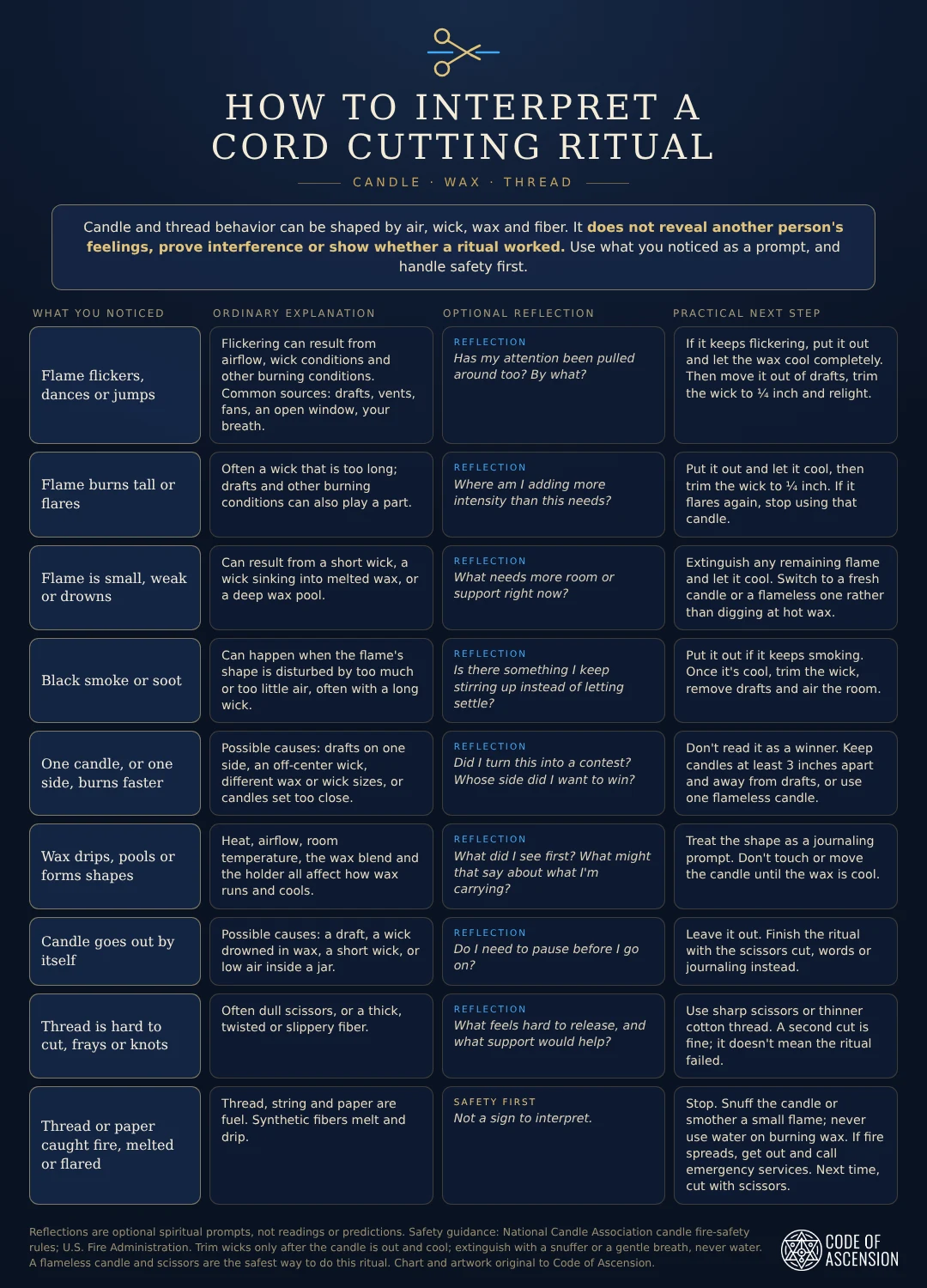
The interpretation guide in text (reflections are optional spiritual prompts, not readings or predictions):
- Flame flickers, dances or jumps. Ordinary explanation: flickering can result from airflow, wick conditions and other burning conditions. Common sources are drafts, vents, fans, an open window or your breath. Reflection (optional): Has my attention been pulled around too? By what? Next step: if it keeps flickering, put it out and let the wax cool completely. Then move it out of drafts, trim the wick to ¼ inch and relight.
- Flame burns tall or flares. Ordinary explanation: often a wick that is too long; drafts and other burning conditions can also play a part. Reflection (optional): Where am I adding more intensity than this needs? Next step: put it out and let it cool, then trim the wick to ¼ inch. If it flares again, stop using that candle.
- Flame is small, weak or drowns. Ordinary explanation: can result from a short wick, a wick sinking into melted wax, or a deep wax pool. Reflection (optional): What needs more room or support right now? Next step: extinguish any remaining flame and let it cool, then switch to a fresh candle or a flameless one rather than digging at hot wax.
- Black smoke or soot. Ordinary explanation: can happen when the flame’s shape is disturbed by too much or too little air, often with a long wick. Reflection (optional): Is there something I keep stirring up instead of letting it settle? Next step: put it out if it keeps smoking. Once it’s cool, trim the wick, remove drafts and air the room.
- One candle, or one side, burns faster. Ordinary explanation: possible causes include drafts on one side, an off-center wick, different wax or wick sizes, or candles set too close together. Reflection (optional): Did I turn this into a contest? Whose side did I want to win? Next step: don’t read it as a winner. Keep candles at least 3 inches apart and away from drafts, or use one flameless candle.
- Wax drips, pools or forms shapes. Ordinary explanation: heat, airflow, room temperature, the wax blend and the holder all affect how wax runs and cools. Reflection (optional): What did I see first, and what might that say about what I’m carrying? Next step: treat the shape as a journaling prompt. Don’t touch or move the candle until the wax is cool.
- Candle goes out by itself. Ordinary explanation: possible causes include a draft, a wick drowned in wax, a short wick, or low air inside a jar. Reflection (optional): Do I need to pause before I go on? Next step: leave it out and finish the ritual with the scissors cut, your words or journaling.
- Thread is hard to cut, frays or knots. Ordinary explanation: often dull scissors, or a thick, twisted or slippery fiber. Reflection (optional): What feels hard to release, and what support would help? Next step: use sharp scissors or thinner cotton thread. A second cut is fine; it doesn’t mean the ritual failed.
- Thread or paper caught fire, melted or flared. Ordinary explanation: thread, string and paper are fuel, and synthetic fibers melt and drip. Reflection: not a sign to interpret; safety comes first. Next step: stop. Snuff the candle or smother a small flame; never use water on burning wax. If the fire spreads, get out and call emergency services. Next time, keep thread and paper at least 12 inches from any flame and cut with scissors.
A safer way to make the cut
The cut doesn’t need fire. Hold the thread and cut it with scissors, as in Step 5. If you’d like candlelight, a battery-operated flameless candle gives you the atmosphere without the risk; the U.S. Fire Administration suggests flameless candles as a safer choice.
If you do light a real candle:
- Set it in a sturdy holder at least 12 inches from anything that can burn, including your thread, journal, paper, fabric and hair.
- Never leave it unattended, and blow it out before you leave the room or go to sleep.
- Don’t tie or run string between lit candles, and don’t burn the thread.
- If the flame grows tall, smokes or flickers repeatedly, put it out and let the wax cool completely. Only then move it out of drafts, trim the wick to ¼ inch and relight.
- Put candles out with a snuffer or a gentle breath. Never use water on a candle or burning wax; it can make hot wax splatter.
- If anything catches fire or the burn starts to feel unsafe, stop. Snuff or smother a small flame (no water), and if fire spreads, get out and call emergency services. Safety matters more than finishing the ritual.
What to interpret instead
The more reliable signs show up over the next few days, in your own behavior: how often you feel the urge to check, how charged a memory feels, whether a boundary holds. That’s what the next section is about.
Signs a Cord Cutting Worked
Signs the ritual worked are usually subtle at first. They may appear as nervous system relief, emotional space, clearer decision-making, or a reduced urge to feed the old loop. Do not expect fireworks. Often, the strongest shift is quiet.
Possible signs include:
- You think of the person or pattern without the same charge.
- You feel tired, then lighter after rest.
- You stop wanting to check, chase, explain, or prove.
- You feel grief without panic.
- Your dreams process the connection.
- You make a boundary that previously felt impossible.
- Your body feels less tense.
- You feel more present in your own life.
- You notice old triggers but do not obey them automatically.
Sometimes emotions rise after the ritual. That does not mean it failed. It may mean the body is releasing what was held down. Crying, journaling, sleeping more, or feeling briefly tender can be part of integration.
The clearest sign is not that you never remember. The clearest sign is that remembering no longer controls you.
What To Do After Cord Cutting
The aftercare is as important as the ritual. If you cut a cord and then spend the next hour scrolling, obsessing, or reopening the same channel, you teach your energy that the pattern still has permission.
Afterward, choose one practical action:
- Delete or archive the conversation.
- Mute or unfollow the person.
- Write the message you will not send.
- Clean your room.
- Take a shower.
- Go for a walk.
- Do a calming breath practice.
- Update one boundary.
- Tell a trusted person what you are choosing.
If this attachment affected your nervous system, consider ongoing regulation work. The Code of Ascension guide to nervous system manifestation can help you understand why your body must feel safe enough to receive a new reality.
You can also repeat a short integration statement for three days:
“My energy is returning. I do not need to reopen what I have released. I can honor the lesson without feeding the attachment.”
Do not make the ritual the only action. Let the ritual become the doorway into new behavior.
For ongoing boundary reflection after the ritual, The Protection Symbols Grimoire offers boundary worksheets and practice logs you can revisit as you make those everyday choices.
Common Mistakes
The first mistake is doing the ritual while secretly trying to control the other person. If the real desire is to make them miss you, you are still attached to their reaction.
The second mistake is cutting too soon. Sometimes you need to feel, grieve, speak, rest, or get support before release is possible. Spiritual timing matters.
The third mistake is repeating the ritual compulsively. If you perform it every night because you are afraid it did not work, the ritual can become another obsession. Do it once with sincerity, then integrate.
The fourth mistake is skipping boundaries. You cannot cut a cord while actively feeding it with constant access. Energetic release and behavioral boundaries belong together. Cleveland Clinic’s guidance on healthy boundaries is a useful reminder that boundaries are not punishment; they clarify what is and is not acceptable.
The fifth mistake is shaming yourself for still caring. You can care and still detach. You can love and still leave. You can remember and still be free.
Journal Prompts for Release
Use these after the ritual or before you begin:
- What part of me has been feeding this attachment?
- What emotion makes this cord feel hard to release?
- What did this connection teach me?
- What did I confuse with love, safety, or belonging?
- What boundary would prove I am choosing myself now?
- What energy am I calling back?
- Who am I when I stop organizing my life around this cord?
Journaling helps turn the ritual into integration. It also reveals whether the attachment is really about the other person, or about the part of you that learned to survive through longing.
A Simple Three-Day Integration Practice
For three days after the ritual, keep the practice simple.
Day one: rest and regulate. Drink water, eat grounding food, and avoid unnecessary emotional stimulation.
Day two: clean one physical space connected to the old energy. This could be a drawer, a playlist, a folder, a photo album, or your phone.
Day three: choose one new action that belongs to your future self. Apply for something, return to a creative practice, move your body, update your routine, or make a decision you delayed.
This is how the ritual becomes real. You are not just cutting. You are redirecting life force.
Go Deeper With Code of Ascension
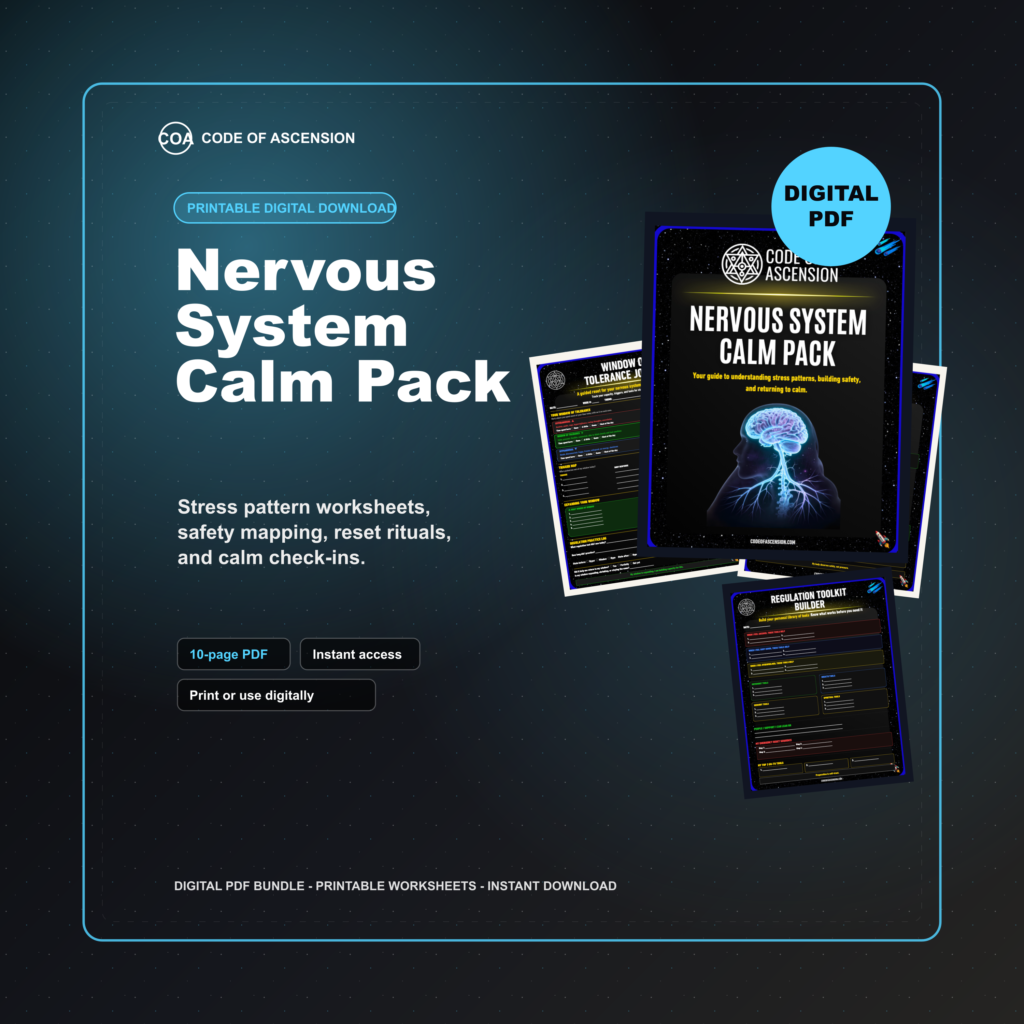
If your body keeps returning to survival loops, the next layer is nervous system support. The Nervous System Calm Pack was created for grounding, regulation, and emotional steadiness when your system needs a calmer baseline.
If you are rebuilding after release and want a simple entry point into manifestation work, start with the free Manifesting Your Dreams ebook.
You can also explore more Code of Ascension guides on the blog.
Cord Cutting FAQ
What does cord cutting mean spiritually?
Cord cutting means spiritually releasing an unhealthy attachment so your energy can return to your own body, choices, and present life. It does not erase love, memory, or compassion. It helps you stop feeding a connection, pattern, or emotional loop that drains your life force or keeps you tied to an outdated version of yourself.
How do you do a cord cutting ritual?
To do a cord cutting ritual, choose one attachment to release, ground your body, name the cord, speak a clear release intention, make a symbolic cut or visualization, call your energy back, and close with water, journaling, and practical aftercare. Keep it calm, safe, and focused on your side of the connection.
How do you interpret a cord cutting ritual?
Start with what actually happened, then reflect. Flames, wax shapes, smoke and thread can be shaped by airflow, wick conditions, wax type, scissors and fiber, and they don’t reliably reveal another person’s feelings, prove interference or show whether the ritual worked. If something you noticed stirs a feeling, use it as a journaling prompt and treat any meaning as your own reflection. The clearer signs come over the following days: fewer urges to check, less charge around the memory, and boundaries that hold.
What are signs a cord cutting worked?
Signs a cord cutting worked may include feeling lighter, calmer, less obsessive, less reactive, or more able to make healthy choices. You may still remember the person or pattern, but it no longer controls your nervous system in the same way. Some people also feel tired or emotional while the release integrates.
Can cord cutting help with love or an ex?
Cord cutting can help with love or an ex when you are ready to release longing, guilt, fantasy, resentment, or energetic dependence. It does not force someone to return or disappear. It helps you stop organizing your emotional life around the connection so healing and self-respect can return.
What is chakra cord cutting?
Chakra cord cutting is a version of the practice drawn from energy-healing traditions, in which you notice where an attachment seems to sit in the body. In those traditions, heart cords are associated with grief, solar plexus cords with control and throat cords with unsaid truth. These are spiritual associations, not physiological facts; the ritual uses them as a focus for release.
What should I do after a cord cutting ritual?
After the ritual, drink water, rest, journal, ground your body, and choose one practical boundary or behavior that supports the release. This may include muting someone, deleting old messages, cleaning your space, or choosing a nervous system practice instead of reopening the emotional loop.
Can cord cutting remove all feelings?
This release practice does not remove all feelings, and it should not be used to bypass grief. You may still care, remember, or feel sadness. The difference is that the emotional charge begins to loosen. The goal is not numbness. The goal is freedom from compulsive attachment and energetic self-abandonment.
Is cord cutting safe?
The practice is generally safe when approached as a calm symbolic ritual with grounded aftercare. The safest version uses scissors and a flameless candle, or no candle at all. If you use a real flame, keep it at least 12 inches from thread, paper and fabric, never leave it unattended, and stop if it burns unsafely. Avoid intense emotional forcing or using ritual instead of real support. If you are dealing with abuse, stalking, trauma, crisis, or danger, prioritize professional, legal, medical, or emergency help first.

Final Thoughts
This ritual is not about becoming cold. It is about becoming whole.
You are allowed to release what taught you something. You are allowed to stop carrying a connection just because it once mattered. You are allowed to keep the wisdom and set down the weight.
The cord was never proof of love. Sometimes it was proof that your energy was waiting for permission to come home.
Let this be that permission.
About The Author
Author: King | Founder of Code of Ascension
King is the founder of Code of Ascension, a spiritual education platform exploring angel numbers, manifestation, consciousness, symbolism, energetic protection, nervous system alignment, and practical ascension work. His writing blends grounded spiritual insight with clear, usable guidance for readers who want meaning, discernment, and transformation without losing their center.
Keep Ascending 🚀