
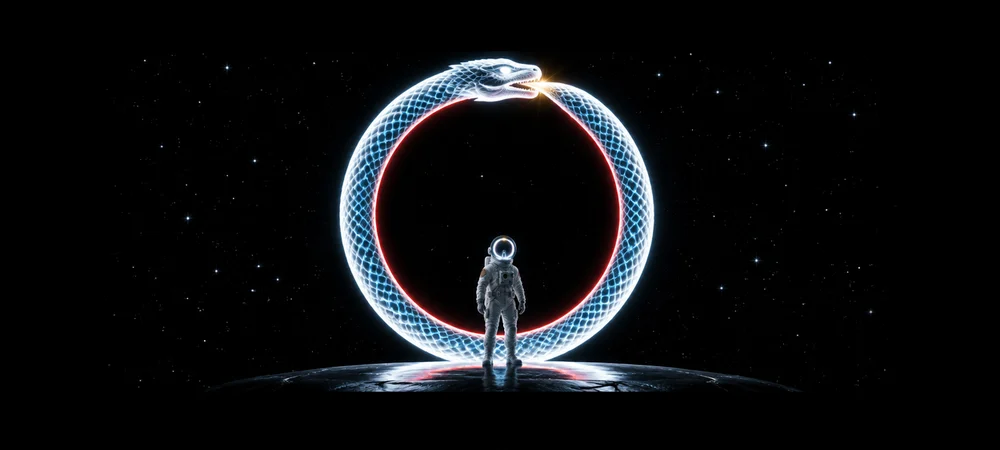
The ouroboros meaning is renewal from within: an ending that turns into its own beginning. The ouroboros is the ancient symbol of a serpent or dragon eating its own tail, a circle with no gap and no outside source. It appears in Egyptian funerary art, Greek alchemy, Gnostic texts and modern tattoos, and across all of them it speaks the same language. Life moves in cycles. What ends feeds what comes next. Wholeness is something you carry inside the circle, not something you wait for from outside it.
Quick Answer: the ouroboros symbol stands for eternity, cycles, self renewal and the unity of all things. In ancient Egypt it was a protective coil around the sun god in the underworld. In Greek alchemy it carried the words “the all is one.” In modern psychology, Carl Jung read it as an archetype of wholeness. Spiritually, it asks one question: what is ready to end so that something truer can begin?
At Code of Ascension, we read the ouroboros as a living map of cycles: a mirror for what you are completing, what you are keeping and what you are becoming. If you are exploring it as a protective sign, start with our index of Protection Symbols and Their Meanings, which gives the ouroboros a short place among 30+ signs. This guide goes deeper into the history, the variations and the ways to work with it.
What Is The Ouroboros?
The ouroboros is a serpent, or sometimes a dragon, drawn in a circle with its tail in its mouth. The name comes from Greek and means, quite literally, “tail eater.” Britannica describes it as an “emblematic serpent of ancient Egypt and Greece represented with its tail in its mouth, continually devouring itself and being reborn from itself” (Britannica: Ouroboros).
That one image holds a paradox. The serpent is eating, so something is being consumed. Yet the serpent is also the food, so nothing is lost. The circle shrinks and grows at the same time. Britannica adds that, as a Gnostic and alchemical symbol, the ouroboros “expresses the unity of all things, material and spiritual, which never disappear but perpetually change form in an eternal cycle of destruction and re-creation.”
That is the heart of the ouroboros meaning. Nothing in the circle is wasted. Everything changes form.
Ouroboros Meaning vs Other Sacred Symbols
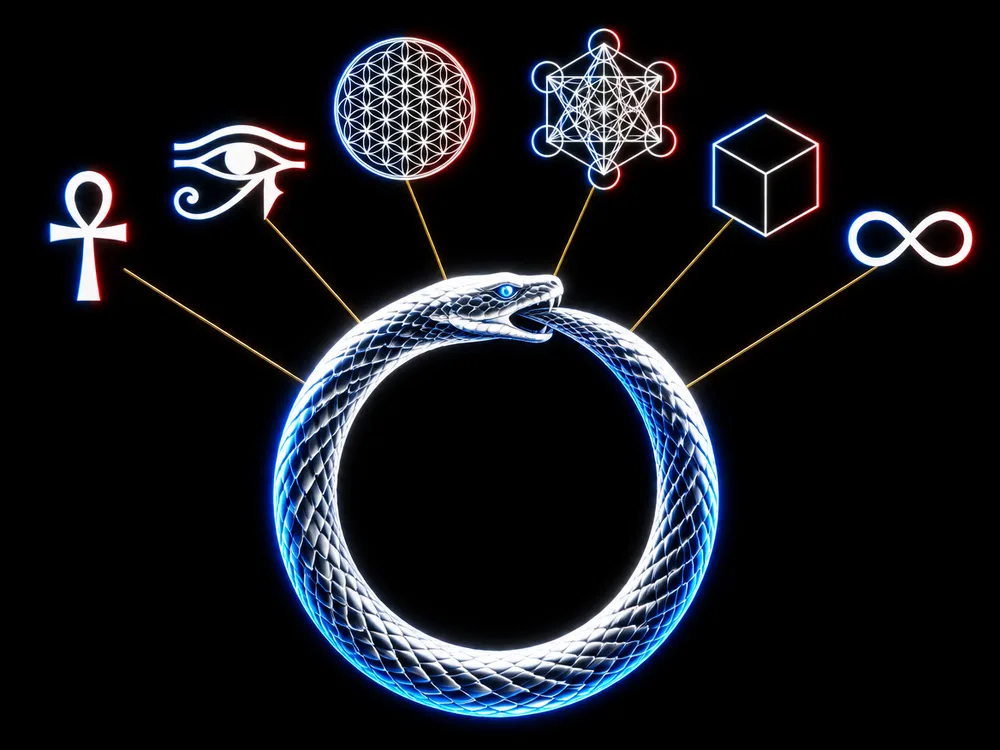
Many sacred symbols speak of life, eternity or protection. The ouroboros has its own voice among them. Where other symbols show a state, the ouroboros shows a motion. It is not only “eternal.” It is eternal because it keeps renewing itself.
| Symbol | Core theme | How it differs from the ouroboros |
|---|---|---|
| Ankh | Life, breath, the key of life | The ankh is life itself. The ouroboros is the cycle life moves through. |
| Eye of Horus | Healing, restoration, watchful protection | The Eye restores what was broken. The ouroboros renews from within. |
| Flower of Life | The pattern of creation | A geometric grid of circles. The ouroboros is one living loop. |
| Metatron’s Cube | Structure, order, sacred geometry | A map of form. The ouroboros is a map of time and change. |
| Black Cube | Saturn, limits, containment | The cube holds form fixed. The ouroboros keeps form moving. |
| Infinity sign (∞) | Endlessness in mathematics | A 1655 mathematical mark. The serpent adds appetite, risk and rebirth. |
If you love sacred geometry, the Flower of Life and Metatron’s Cube are close cousins in spirit. The difference is that the ouroboros is alive. It has a mouth and a tail. It hungers, it grows and it sheds. That makes the ouroboros meaning more personal than most geometric symbols. It is about your own seasons.
The History Behind The Ouroboros Meaning
The ouroboros is one of the oldest continuous symbols in the Western esoteric tradition. Its story runs from Egyptian royal tombs to Alexandrian alchemists, from Gnostic cosmology to Norse myth. Here is what the record shows.
Ancient Egypt: The Serpent In Tutankhamun’s Tomb
The earliest known example of the true ouroboros icon appears on the second gilded shrine of Tutankhamun, made in the 14th century BCE and found in his tomb (KV62). Egyptologist Dana Michael Reemes identifies it as such in his UCLA study of the Egyptian ouroboros (Reemes, The Egyptian Ouroboros: An Iconological and Theological Study, UCLA, 2015). The scene belongs to a cryptic funerary composition often called the Enigmatic Book of the Netherworld, which concerns the sun god Ra and his union with Osiris in the underworld.
In the scene, a large mummiform figure is encircled by two separate serpents, each with its own tail in its mouth: one around the head and upper chest, the other around the feet. They are not biting each other. Egyptologists read the pair as forms of Mehen, the coiled serpent who protects Ra in other funerary texts, and the figure they enclose may stand for the united Ra and Osiris.
Reemes argues that in Egypt the ouroboros was never a stand alone symbol. It is primarily tied to the idea of protective enclosure: the coil marks off and guards what lies inside it. That is the historical Egyptian meaning. The renewal reading this guide uses later, an ending that feeds its own beginning, is Code of Ascension’s spiritual interpretation, built on the later Greek, alchemical and psychological traditions below.
Pause on that for a moment. The very first ouroboros is not a decoration. It is a guardian wrapped around the sun at its darkest hour, the hour just before the sun is reborn. From the start, the ouroboros meaning was tied to night turning into morning.
The Greek Name And Alexandrian Alchemy
The Greeks gave the symbol its name, and the alchemists of Greco-Roman Egypt gave it a voice. The best known example is the Chrysopoeia of Cleopatra (“gold making of Cleopatra”), an alchemical text that probably originated in 3rd century Alexandria. Its earliest surviving copy dates to the 10th century. Inside its ouroboros drawing sit the Greek words hen to pan, “the all is one” (Wikipedia: Ouroboros, citing Mircea Eliade). The serpent there is drawn in two halves, one dark and one light.
The symbol travels through the Greek alchemical manuscripts that followed. A study in the University of La Laguna’s journal Fortunatae presents the Greek passages on the ouroboros from two alchemical manuscripts, including the Marcianus graecus 299, with translation and commentary (Fortunatae: Ouroboros, the snake that bites its tail in alchemical Greek texts).
For alchemists, the ouroboros meaning was the work itself. Matter is broken down, purified and rebuilt, again and again, until it becomes something nobler. The circle is the laboratory. “The all is one” is the conclusion.
The Gnostic Dragon Around The World
Gnostic writers took the serpent and wrapped it around the cosmos, using the tail biting serpent as a symbol of eternity and the world soul. The Pistis Sophia, a Gnostic text from around 400 CE, describes a great dragon of twelve parts encircling the world with its tail in its mouth (Wikipedia: Ouroboros, citing Hornung). Read through a COA lens, that dragon marks the edge of the material world: the boundary the Gnostic seeker longs to see beyond.
That is why the ouroboros sits so naturally beside other Gnostic figures. If you are drawn to this layer of the symbol, read our guides to the Archons, the rulers Gnostics placed over the material realm, and to Abraxas, another Gnostic image of opposites held together in one power.
Jörmungandr: The Norse World Serpent
Norse myth has its own world circling serpent. Britannica describes Jörmungand (Jörmungandr) as “the cosmic serpent… which surrounds the world,” the chief enemy of Thor, with the two fated to kill each other at Ragnarök (Britannica: Jörmungand).
Jörmungandr is not borrowed from Egypt or Greece, but it shares the same instinct: the world is held inside a living ring, and when that ring breaks, an age ends. When the circle breaks, the old world ends.
The Three Turns: How To Read The Ouroboros Meaning

Here is the Code of Ascension way to read the ouroboros meaning in your own life. Picture the serpent as three turns of one motion: the bite, the circle and the return. Each turn asks a different question.
The First Turn: The Bite
The bite is where the serpent meets its own tail. It is the moment of ending. Something old is being consumed: a habit, a role, a relationship pattern, a version of yourself that has done its work.
The bite is not destruction for its own sake. It is digestion. The serpent takes in its past so it can use it. Ask: “What in my life is complete, and what did it teach me?”
The Second Turn: The Circle
The circle is what holds steady while everything moves. It is your core: values, gifts and a sense of self that stays whole through every season.
This is where the ouroboros meaning becomes empowering. You are not starting from zero each time a chapter ends. You carry the circle with you. Ask: “What stays true about me, no matter what changes?”
The Third Turn: The Return
The return is renewal. The serpent sheds its skin and comes back larger, wiser and lighter. The end has become fuel for the next beginning.
Return does not mean repeating the same loop. It means coming back to the same truth at a higher level. Ask: “What is beginning now because something else has ended?”
When all three turns line up, you stop fearing endings. You start to read them as part of your own renewal.
Ouroboros Symbol Variations And What They Mean
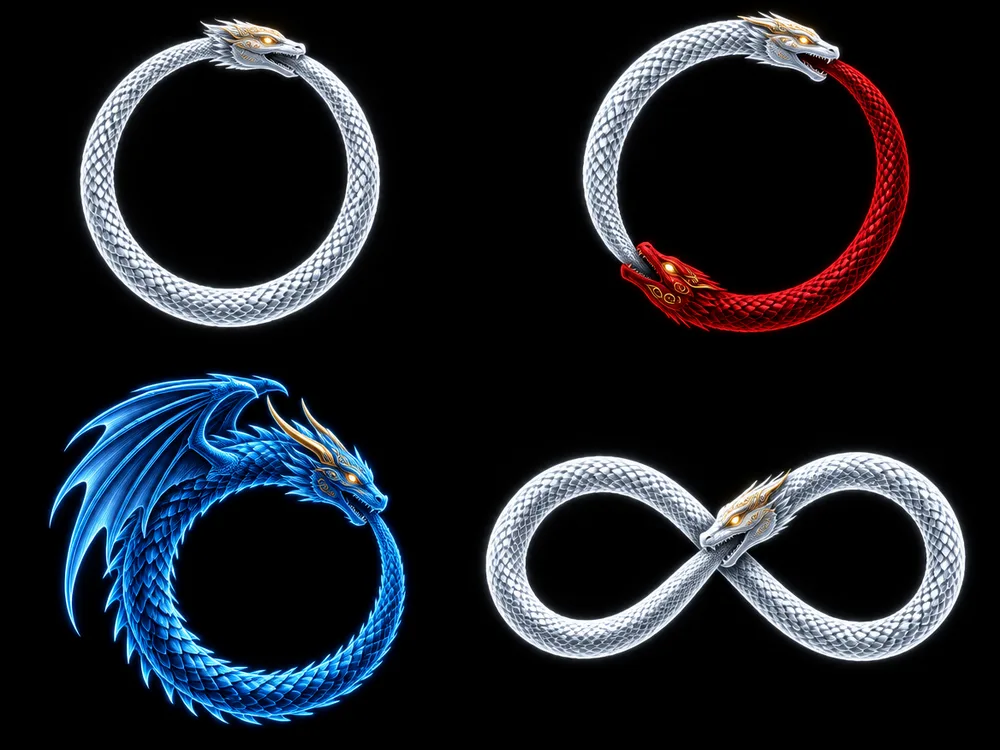
The ouroboros symbol has taken many shapes over the centuries. Each variation keeps the core idea of the circle and adds a nuance.
The Single Serpent
The classic snake eating its tail is the purest form. It speaks of self renewal, eternity and the cycle of life, death and rebirth. A single serpent reads as one being, one life and one continuous story. It is the version most people choose for tattoos and rings because it is clean and instantly recognizable.
Two Serpents: The Egyptian Pair and the Double Ouroboros
Two serpent designs come in two different forms, and it helps to keep them apart. The oldest ouroboros on record, on Tutankhamun’s second gilded shrine, shows two separate serpents, each biting its own tail, each enclosing a different part of one figure. The modern double ouroboros is a different design: two serpents biting each other’s tails to form a single shared ring. The alchemical serpent of the Chrysopoeia, drawn half dark and half light, carries the idea of two natures in a single body.
In esoteric reading, the double ouroboros symbolizes opposites that feed each other: light and dark, masculine and feminine, spirit and matter, conscious and unconscious. Neither can exist without the other. Together they make the whole.
The Dragon Ouroboros
Many later images show a dragon instead of a snake, sometimes winged, sometimes with legs. The Gnostic Pistis Sophia already speaks of a dragon with its tail in its mouth. The dragon adds power, fire and the sense of a guardian. In esoteric reading, wings suggest rising spirit and the coiled body suggests grounded matter, so a winged dragon ouroboros can read as heaven and earth joined in one loop.
The Infinity Ouroboros
Modern designs often twist the serpent into a figure eight. That form borrows from the infinity sign, the lemniscate, which Britannica notes “was invented by the English mathematician John Wallis in 1655” (Britannica: Infinity).
So the infinity ouroboros is a modern blend: an ancient serpent wearing a mathematical shape. It reads as endless connection, balance between two worlds and a love or bond that keeps renewing itself. It is beautiful, and it is newer than the classic ring.
Ouroboros Meaning In Psychology: Jung And The Shadow
Carl Jung, the Swiss psychiatrist who proposed and developed the concepts of archetypes and the collective unconscious (Britannica: Carl Jung), gave the ouroboros a second life in the 20th century. In his writings on alchemy, Jung saw the tail eating serpent as an archetype and as the basic mandala of alchemy. He linked it to the prima materia, the raw starting material of the alchemical work, and to the integration of the shadow (Wikipedia: Ouroboros, citing Jung’s Collected Works, Volume 14).
In Jungian terms, the serpent eating its tail is the psyche taking in what it has rejected. The shadow is the part of you that you have pushed out of view: anger, ambition, grief, desire, even unclaimed gifts. The ouroboros shows that part being swallowed back into the circle and turned into strength.
Jung’s student Erich Neumann used the ouroboros for the earliest stage of consciousness, a “dawn state” before the ego separates from the whole. For Neumann, the ouroboros meaning is where the story of the self begins.
If this layer speaks to you, go deeper with Shadow Work Meaning: How the Hidden Self Affects Healing and Manifestation. Shadow work is the practical side of the same truth. What you stop running from becomes part of your power.
Kekulé’s Dream: Where The Ouroboros Meaning Met Chemistry
One of the most famous stories about the ouroboros comes from a laboratory, not a temple. The German chemist August Kekulé proposed a cyclic structure for benzene in 1865, a ring of carbon atoms. Britannica notes that Kekulé described “a dream figure of a snake that seized its own tail in its mouth,” and that he told the dream stories publicly at an 1890 celebration held in his honor. It also notes that the dating of the dream, and whether it happened at all, is disputed (Britannica: August Kekulé von Stradonitz).
As he recounted it in his later reminiscences, Kekulé was dozing by the fire at his home in Ghent while working on his textbook. He saw dancing strings of carbon atoms, and one of them, snakelike, took its tail into its mouth (Science History Institute: August Kekulé and Archibald Scott Couper). The image gave him the idea of the ring.
Whatever the exact night, the story has lasted because it captures something true about insight. The answer arrived as a symbol, the oldest circle in the book, rising from a mind that had been working hard and then let go.
The Spiritual Ouroboros Meaning: Cycles, Return And Renewal
Spiritually, the ouroboros meaning gathers around five ideas: cycles, eternal return, self renewal, wholeness and the integration of the shadow.
- Cycles: Every season of life has a beginning, a peak, an ending and a return. The ouroboros honors all four.
- Eternal return: The idea that existence moves in repeating cycles appears in many philosophies. Friedrich Nietzsche made eternal recurrence the basic conception of Thus Spoke Zarathustra, asking how fully a person would have to embrace life to desire “the infinite repetition, without alteration, of each and every moment” (Britannica: Eternal recurrence).
- Self renewal: The serpent sheds its skin. You can release an old identity without losing yourself.
- Wholeness: The circle has no missing piece. You are already complete, even mid transformation.
- The shadow: The tail is the part of you that trails behind. The ouroboros brings it back to the front and makes it nourishment.
For seekers on the path of spiritual ascension, the ouroboros is a reassuring teacher. Growth is rarely a straight line. You return to old themes, but each time you meet them with more awareness. That is not going backward. That is spiraling upward.
Ouroboros Meaning As A Protection Symbol And Amulet
The ouroboros has long been read as a protective shape. In Egyptian funerary texts, the coiled serpent Mehen guards the sun god Ra in the underworld. A closed circle draws a boundary: inside is held, outside is kept out.
As a modern protection symbol, the ouroboros works through that boundary. It suits moments when you want to:
- Seal a chapter you have finished, so old energy stops pulling you back.
- Protect a fresh start while it is still tender.
- Hold your own center during a season of big change.
- Remind yourself that you renew from the inside.
Our Protection Symbols and Their Meanings index places the ouroboros beside the Hamsa, Eye of Horus, ankh and other guardians, with a short reading of its protective role. Use that page to compare symbols. Use this one to understand why the ouroboros protects the way it does: not as a shield held up against the world, but as a complete circle that needs nothing from outside to stay whole.
People often keep an ouroboros as an amulet in a pendant, a ring, a coin or a small drawing on an altar or notebook. The symbol’s power comes alive through the meaning you give it. Choose it with an intention, touch it when you need your center and let it remind you of the circle you already are.
Ouroboros Meaning In Tattoos And Jewelry
The ouroboros is one of the most popular symbolic tattoos and jewelry designs, and for good reason. It looks striking, it reads from a distance and it carries a deep message in a simple shape.
A tattoo with the ouroboros meaning at its center often marks:
- Surviving an ending and coming through renewed.
- A commitment to growth that never stops.
- Life, death and rebirth, sometimes in memory of someone loved.
- Balance between opposites, especially in two serpent designs.
- Self reliance: the idea that you can rebuild yourself from within.
In jewelry, the ouroboros ring is a classic because a ring is already a circle. Wearing a serpent ring can feel like wearing a promise to yourself. Pendants and bracelets work the same way. Protection jewelry often draws on this shape, alongside the evil eye and the Hamsa.
The most powerful ouroboros meaning in a tattoo or a piece of jewelry is the one you choose on purpose. Decide which turn you are honoring: the bite, the circle or the return.
Ouroboros Meaning In Manifestation, Money And Personal Growth

In manifestation, the ouroboros meaning is momentum that feeds itself. A small practice repeated becomes a habit. A habit repeated becomes an identity. That identity produces results, and those results fuel the next round of practice. That is the virtuous circle in action.
In money and career, the ouroboros asks you to look at your loops:
- What do you do with what you earn: does it circle back into growth, skills and stability, or leak out?
- Which work habits keep renewing your energy, and which keep draining it?
- What old money story are you ready to digest and release?
- Where could you reinvest what you have learned into your next level?
Wise growth follows the serpent’s rhythm. Grow, shed, grow again. When your skin feels tight, when a role or a pay level no longer fits, that is your cue. The ouroboros meaning here is simple: you are allowed to outgrow your own shell.
Ouroboros Meaning In Love And Relationships

In love, the ouroboros meaning is wholeness that renews. A healthy relationship is not two halves desperately completing each other. It is two whole circles that choose each other, and keep choosing, season after season.
The two serpent ouroboros is especially beautiful here. Each partner nourishes the other, and each is nourished in return. Giving and receiving flow in one continuous loop. Neither drains the other, because the circle feeds itself.
If you are single, the ouroboros invites you to complete your own circle first. Learn your patterns. Digest what past relationships taught you. Release the stories that keep repeating, and bring your wisest self into the next connection.
If you are in a relationship, the ouroboros asks:
- What cycle are we in right now: beginning, deepening, shedding or renewing?
- Is there an old pattern between us that is ready to end?
- How do we feed each other’s growth, not only each other’s comfort?
- What could we begin together because something old has closed?
If you are healing after a breakup, the ouroboros is a powerful companion. The ending is real, and it is also nourishment. What you learned becomes part of who you are. The circle continues, and you continue with it.
How To Work With The Ouroboros Symbol
Here is a simple ten minute practice called The Circle Close. Use it at the end of a month, a project, a relationship chapter or any season that feels finished.
- Draw the circle. On a blank page, draw a simple ouroboros, or just a circle with a small gap where the head meets the tail.
- Name the bite. Write what is ending inside the gap.
- Name the circle. Around the ring, write three things about you that stay true through every change.
- Name the return. At the top of the circle, write what you want to begin next.
- Close the gap. Draw the head meeting the tail. Breathe slowly three times and feel the loop complete.
- Keep or release. Keep the page as a reminder, or fold it and put it away to mark the chapter as done.
You can also use these journal prompts:
The chapter I am completing is [what is ending]. What it taught me is [the lesson you are taking with you]. What stays true about me is [your core quality]. What I am ready to begin is [your next beginning].
The old loop I am ready to break is [the pattern you keep repeating]. The new loop I am choosing is [one habit that renews you].
For a deeper practice with the hidden side of the circle, pair this with the Shadow Work Meaning guide. The aim is not to collect symbols. The aim is to let one symbol help you close one chapter well.
Frequently Asked Questions About The Ouroboros Meaning
What is the ouroboros meaning in simple terms?
The ouroboros meaning, in simple terms, is renewal from within. The serpent eating its own tail shows that endings feed beginnings and that life moves in cycles rather than straight lines. It stands for eternity, self renewal and the unity of all things. At Code of Ascension, we read it as a mirror for what you are completing, what you are keeping and what you are becoming.
Where does the ouroboros symbol come from?
The earliest known ouroboros motif comes from ancient Egypt, on the second gilded shrine of Tutankhamun, made in the 14th century BCE, where two separate serpents, each biting its own tail, enclose a figure linked with Ra and Osiris. The Greeks named it “tail eater,” and Alexandrian alchemists made it famous, most notably in the Chrysopoeia of Cleopatra with the words “the all is one.”
Is the ouroboros meaning positive or negative?
The ouroboros meaning is overwhelmingly positive. It represents renewal, wholeness, eternity and transformation. Some people find the image of a serpent devouring itself unsettling, but the serpent is not destroying itself. It is feeding its own rebirth. In esoteric traditions, the ouroboros is a symbol of balance and self sufficiency, and many people wear it for protection and strength.
What does a double ouroboros with two snakes mean?
A double ouroboros shows two serpents biting each other’s tails. It symbolizes opposites that sustain each other: light and dark, spirit and matter, masculine and feminine, conscious and unconscious. The oldest known ouroboros, on Tutankhamun’s second gilded shrine, is related but different: two separate serpents, each biting its own tail, enclose one figure. In modern use, a two serpent design often represents balance, partnership and a bond that keeps renewing itself.
What is the ouroboros meaning in a tattoo?
An ouroboros tattoo usually represents renewal, resilience and the cycle of life, death and rebirth. People choose it to mark surviving an ending, committing to lifelong growth, honoring a loved one or embracing balance between opposites. A single serpent reads as self renewal, while two serpents read as balance. The strongest tattoo meaning is the one you choose with clear intention.
Is the ouroboros a protection symbol?
Yes, many people use the ouroboros as a protection symbol. In Egyptian funerary texts, the coiled serpent Mehen guards the sun god Ra in the underworld. A closed circle draws a boundary that holds what is inside. Today the ouroboros is used to seal finished chapters, protect fresh starts and hold your center during change. It works best when chosen with a clear intention.
How is the ouroboros related to the infinity symbol?
The ouroboros is much older than the infinity symbol. The serpent eating its tail dates back to ancient Egypt, while the mathematical infinity sign, the lemniscate, was introduced by John Wallis in 1655. Modern designs often twist the serpent into a figure eight, blending the two. That infinity ouroboros reads as endless connection and balance between two worlds.
What is the ouroboros meaning in love?
In love, the ouroboros meaning is wholeness that renews. It describes two complete people who choose each other and keep nourishing each other’s growth, season after season. A two serpent design shows giving and receiving flowing in one loop. If you are single or healing, it invites you to complete your own circle first and bring your wisest self forward.
Go Deeper With The Free Protection Symbols Guide
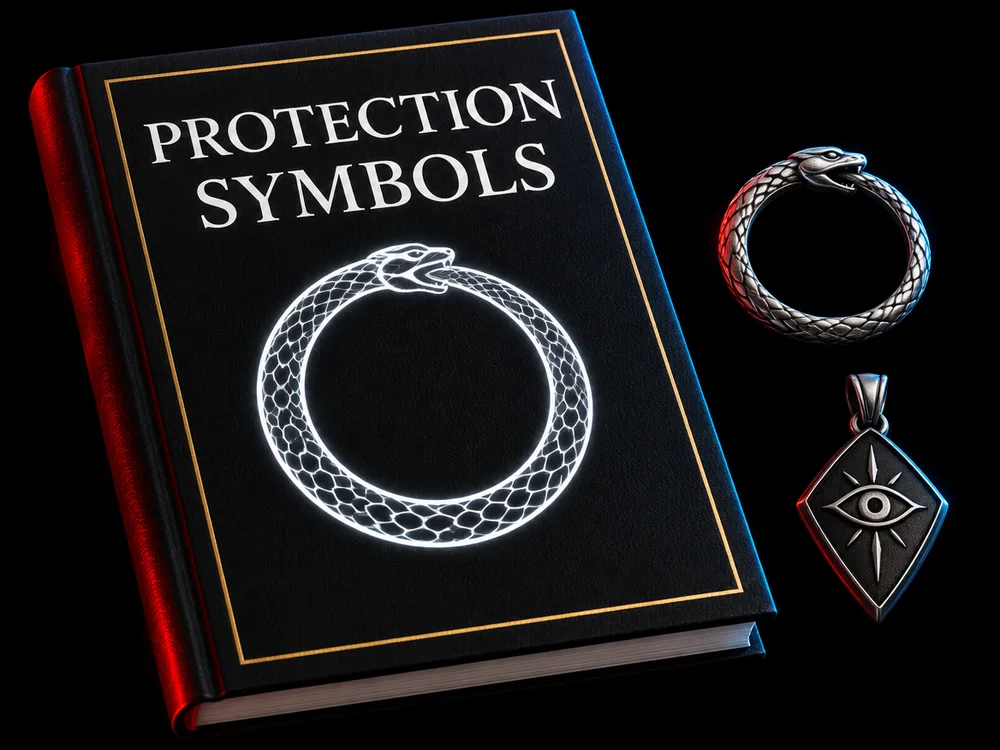
Want to work with the ouroboros alongside other guardian symbols? The free Protection Symbols Field Guide in the Free Ascension Library helps you choose and use protective symbols with clear intention. Pair it with our full index of Protection Symbols and Their Meanings.
Final Thoughts: The Ouroboros Meaning Is A Circle You Can Trust

For more than three thousand years, people have drawn the same simple shape: a serpent with its tail in its mouth. Egyptian funerary art wrapped it around the sun god in the underworld. Alchemists wrote “the all is one” inside it. Gnostics saw it around the whole world. Jung found it in the human psyche, and Kekulé, as he told it, found it in a ring of atoms.
The ouroboros meaning has lasted because it speaks to something every life knows. Things end. Things begin again. And through every turn, something in you stays whole.
So when a chapter closes, remember the serpent. Take in what it taught you. Hold your center. Then return, larger than before.
Keep exploring the symbols:
- Protection Symbols and Their Meanings
- Ankh Meaning
- Eye of Horus Meaning
- Flower of Life Meaning
- Metatron’s Cube Meaning
- Abraxas Explained
- What Is Spiritual Ascension?
About The Author
Author: King | Founder of Code of Ascension
King is the founder of Code of Ascension, a spiritual education platform focused on consciousness, symbolism, manifestation, nervous system awareness, and hidden patterns of reality. Through Code of Ascension, he explores ancient wisdom and modern insights to help others awaken, align, and ascend.
Keep Ascending 🚀