

The Eye of Ra is the fierce, solar eye of the Egyptian sun god Ra, imagined as his daughter: a goddess who goes out into the world as the sun’s burning, protective power. She is the lioness Sekhmet when she rages, the joyful Hathor when she is calmed, and the rearing cobra on the royal crown when she stands guard. If the Eye of Horus is the eye that heals, Ra’s Eye is the eye that defends.
Quick Answer: the Eye of Ra stands for solar power, divine protection, righteous force and the strength to guard what is sacred. In Egyptian thought it was linked with the right, solar eye, while the Eye of Horus was linked with the left, lunar eye. The same eye shape (the wedjat) often served for both, which is why the two get mixed up online. Spiritually, it is about boundaries, courage and fire that protects rather than destroys.
At Code of Ascension, we read ancient symbols as living mirrors: images that carry real history and also reflect the power you are ready to claim. So the question is not only “What did this eye mean in Egypt?” It is also “Where in my life is it time to shine, and what is mine to protect?”
If you came here from the healing side of the story, start with our Eye of Horus Meaning guide, and keep our index of Protection Symbols and Their Meanings close for the wider family of guardian signs.
What Is the Eye of Ra?
Ra’s Eye is both a symbol and a role. In Egyptian religion, the sun god sent out his Eye as a living force: a goddess who acted on his behalf, defended him and punished his enemies. She was described as his eye and also as his daughter, a power born from him that moved independently in the world.
Britannica, which spells the name Re, describes Ra as the “god of the sun and creator god,” whose worship spread from Heliopolis, who traveled across the sky in his solar bark, and who was called the father of Maat, the source of right and justice in the cosmos (Britannica: Re). The Eye is that creator’s power turned outward. It is sunlight with a will of its own.
This is the first thing that sets it apart. It is not only a drawing on an amulet. It is a title that several goddesses carried. Britannica notes that Sekhmet, “like other fierce goddesses in the Egyptian pantheon,” was called the “Eye of Re” (Britannica: Sekhmet), and that Hathor was said to be the sun god’s “eye” or daughter (Britannica: Hathor). One role, many faces.
In plain language, the solar Eye means:
- The sun’s power in motion, acting on the earth rather than resting in the sky.
- Protection that is active and fierce, not passive or polite.
- Righteous force in service of order.
- The return of that force to warmth, joy and home once its work is done.
Ra’s Eye is the daughter who protects the father, the light that keeps the light safe.
Eye of Ra vs Eye of Horus: Fire and Healing

This is the question that brings most people here. The two eyes are related, they can look identical, and they carry different energies.
The Eye of Horus is the eye that was wounded and made whole. The Met explains that the wedjat eye “represents the healed eye of the god Horus,” injured or stolen by Seth and then restored by Thoth, and that its name means “the one that is sound (again)” (The Met: Wedjat Eye Amulet). Its story is healing, restoration and return to wholeness.
Ra’s Eye is the eye that goes out to protect. Its story is fire, defense, rage, mercy and homecoming. One is the medicine. The other is the shield.
| Aspect | Eye of Ra | Eye of Horus |
|---|---|---|
| Core energy | Solar fire, protection, righteous force | Healing, restoration, wholeness |
| Linked eye | Right eye, the sun | Left eye, the moon |
| Personified as | A goddess, Ra’s daughter (Sekhmet, Hathor, Wadjet and others) | The healed eye of the god Horus |
| Key myths | The Destruction of Mankind; the Distant Goddess | Horus and Seth; the eye restored by Thoth |
| Symbolic forms | Sun disk, uraeus cobra, lioness | The wedjat with its falcon markings |
| Spiritual lesson | Guard what is sacred, set boundaries, shine | Heal what was broken, become whole |
One sentence to remember: the Eye of Horus mends, Ra’s Eye defends. Both are protective, and both belong to the same Egyptian language of sacred sight, spoken from different sides of the sky.
Left Eye vs Right Eye: Which Is the Eye of Ra?
The classic answer is that the right eye belongs to the sun god and the left eye belongs to Horus. The Johns Hopkins Archaeological Museum describes the “left lunar eye” as that of Horus and the “right solar eye” as that of the sun god Re. The lunar eye waxes and wanes like the moon and was seen as a healing, regenerative force (Johns Hopkins Archaeological Museum: Ancient Egyptian Amulets).
Egyptian thought was layered, though, and the British Museum adds a twist. Its notes on a wedjat amulet describe the celestial god Horus as having a right eye that was the sun and a left eye that was the moon. The curator explains that “wedjat” is usually read as the moon eye that was injured when it waned and healed when it waxed, but that the term “might just as well apply to the sun eye,” and that this amulet, “like many others, represents the right eye not the left” (British Museum: wedjat eye amulet EA29222).
So the left and right rule is a strong guide, not a rigid law. The sun and the moon were understood as two eyes in the sky, and the sacred eye could speak for either one.
Why the Eye of Ra and the Wedjat Look Alike Online
Search for this symbol and you will see the same painted eye, with its teardrop line and curled tail, that appears under “Eye of Horus.” That is not an error by every jeweler on the internet. The wedjat shape crossed both stories, which is exactly why the British Museum says the name could apply to the sun eye too.
What modern designers often do is add solar signs to make the reading clear: a sun disk above the eye, a rearing cobra beside it, flame shapes, or a right eye rather than a left. Many online designs sold under Ra’s name are really a wedjat dressed in solar clothing. That is a modern convention, and it works well once you know what you are looking at.
A useful rule of thumb, not a hard rule: a sun disk, a cobra or a lioness leans an eye toward the Eye of Ra, while healing, the moon or the story of Horus and Seth leans it toward the Eye of Horus. Context decides. These signs are not exclusive to Ra. The British Museum’s wedjat amulet EA29222, a Horus eye, carries “an upreared cobra wearing a sun disc” in its design (British Museum: wedjat eye amulet EA29222). So read the whole object: its inscription, the story it belongs to and what it was made to do.
Eye of Ra Myths: Rage, Return and Mercy
The two great stories of the solar Eye share a rhythm. The Eye goes out in fury, something stops her, and she comes back softened. That rhythm is the heart of this symbol: power that knows how to return.
The Destruction of Mankind
The most famous story comes from the Book of the Heavenly Cow, a text found in the tombs of several New Kingdom pharaohs, including Seti I and Ramesses III. World History Encyclopedia retells it clearly (World History Encyclopedia: Book of the Heavenly Cow).
Ra has grown old, and humanity plots against him. He calls the gods together for advice, then sends out his Eye. Ra chooses Hathor to carry out his will, and she becomes the bloodthirsty Sekhmet, slaughtering the rebels. Then Ra relents. To stop her without force, he has 7,000 jars of beer mixed with red ochre fetched from Elephantine so that it looks like blood. Sekhmet drinks it, grows drunk, and returns to her peaceful form as Hathor. Wearied by ungrateful humanity, Ra then rides up into the heavens on the back of Nut, transformed into a celestial cow.
Read symbolically, this Eye of Ra myth is about fire that must be honored and also guided. The Eye is never weak, and never simply evil. Notice that Ra does not fight his daughter. He outsmarts her rage with a gift. Mercy is part of the Eye’s power too.
The Distant Goddess
The second story runs the other direction. Instead of being sent out, the Eye leaves on her own.
The Lowe Art Museum at the University of Miami summarizes it through a scene from the tomb of Sety I: the angered eye of the sun, described as the daughter of Ra, a violent goddess in lion form (Tefnut), retreats into Nubia. She is called back, and once home she becomes the benevolent and happy Hathor again, a goddess honored with wine, music, dance and offerings (Lowe Art Museum: Tomb of Sety I). The same page names “the eye-lioness-uraeus forms” of this distant goddess, which ties the lioness, the eye and the cobra into one being.
The UCLA Encyclopedia of Egyptology adds the messenger who brings her home. In a temple scene at el-Dakka, Thoth appears as a baboon with raised arms “to appease the lioness,” addressed as “Tefnut, daughter of Ra,” trying to persuade her to return to Egypt to protect her father (UCLA Encyclopedia of Egyptology: Thoth of Pnubs).
At Code of Ascension, we read the Distant Goddess as the story of power that has been hurt or ignored and walks away. Wisdom does not drag her back. It honors her and reminds her what she protects, and she returns joyful.
The Four Faces of the Eye of Ra
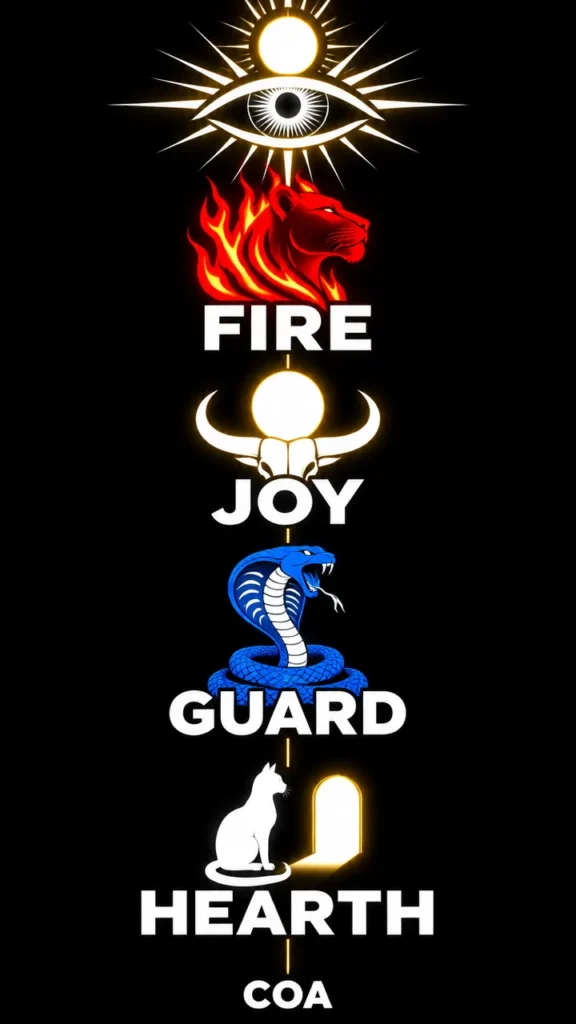
Here is the Code of Ascension way to hold this symbol in one picture. Ra’s Eye wears many faces, and four of them map neatly onto four kinds of protective power. We call them the Four Faces of the Eye: the Fire, the Joy, the Guard and the Hearth.
Sekhmet: The Fire
Sekhmet is the Eye at full blaze. Britannica describes her as usually shown as a lioness or a woman with the head of a lioness, “a goddess of war and the destroyer of the enemies of the sun god Re.” She was the companion of Ptah, worshipped mainly at Memphis, and she was linked with both disease and with healing and medicine (Britannica: Sekhmet).
That pairing matters. The same fire that destroys can also cure. Sekhmet is the face that teaches you to respect your own intensity rather than fear it.
Hathor: The Joy
Hathor is the Eye at peace. Britannica calls her a goddess of the sky, of women, and of fertility and love, whose main animal form was a cow, closely tied to the sun god Re, whose “eye” or daughter she was said to be. Her cult center was at Dandarah (Dendera) in Upper Egypt (Britannica: Hathor).
Hathor is what Sekhmet becomes when she comes home. She shows that the solar Eye is not only a weapon. It is also delight, music, beauty and love. Protection exists so that joy has somewhere safe to live.
Wadjet: The Guard
Wadjet is the Eye on duty. Britannica describes her as the cobra goddess and tutelary goddess of Lower Egypt, and notes that the rearing cobra on a crown is called the uraeus. Wadjet and Nekhbet, the vulture goddess of Upper Egypt, were the protective goddesses of the king and sometimes appeared together on his diadem (Britannica: Wadjet).
Wadjet is the face that never sleeps: alert, upright, watching the threshold. She is the face of boundaries.
Bastet: The Hearth
Bastet is the Eye brought into the home. Britannica describes her as the daughter of Re, native to Bubastis in the Nile Delta, worshipped first in the form of a lioness and later as a cat, with her ferocity easing over time. Small cat figures were worn as amulets (Britannica: Bastet). Britannica’s Sekhmet entry adds that Sekhmet was sometimes identified with Hathor, Bastet and Mut, which shows how fluidly these goddesses shared one role.
Bastet is protection made gentle: the cat by the door, the guardian of the household. Our guide to Egyptian Pets explores the spiritual place cats and dogs held in Egyptian life.
Eye of Ra Symbol: Sun Disk, Uraeus and Cobra

The symbol is built from a few powerful pieces. Learn them and you can read almost any version you find.
The sun disk. The disk is the sun itself, the source of the Eye’s power. The Art Institute of Chicago notes that its statuette of the falcon headed Re-Horakhty once carried his emblem, a sun disk, that was probably covered with gold to make it radiant (Art Institute of Chicago: Statuette of Re-Horakhty). Gold for the sun, because the sun was meant to shine.
The uraeus. The rearing cobra on the crown is Wadjet’s sign and one of the forms of the Eye. The British Museum describes the cobra’s protection as the kind “she gave when she spat fire at the sun god’s and pharaoh’s enemies” (British Museum: wedjat eye amulet EA29222). The uraeus is solar protection worn on the brow, ready to strike before harm arrives.
The lioness. Sekhmet’s and Tefnut’s form. The lioness is heat, hunger and courage: the Eye in its untamed state.
The eye itself. The painted wedjat shape, with the falcon markings beneath it, ties the solar story to the lunar story of Horus.
Put them together and you get the image most people now call the Eye of Ra: a radiant eye, a sun disk and a rearing cobra. Together they say one thing: this light is alive, and it protects.
Color carries meaning too. The British Museum’s wedjat amulet is pale turquoise blue glaze with yellow and black details, a reminder that Egyptian sacred art was bright. For more on how vivid it really was, read Ancient Egypt Was Never Beige.
The Eye of Ra as Protection and Amulets
Above all, this is a protector’s symbol. The Johns Hopkins Archaeological Museum describes the eye of Re as linked to a protective feline goddess whose “ferocity warded away evil, protecting those who used the image apotropaically,” meaning as a charm to turn harm away. The same museum notes that wedjat eye amulets were commonly placed within mummy wrappings to help the dead (Johns Hopkins Archaeological Museum: Ancient Egyptian Amulets). The Met adds that an amulet in the wedjat shape “was thought to protect its wearer” (The Met: Wedjat Eye Amulet).
In Egyptian thought, protection was never only about fear. It was about keeping order. Remember that Ra was called the father of Maat, the principle of truth, balance and right order. His Eye guards that order, which makes it a cousin of the scales in The Weighing of the Heart, where Maat and Anubis preside over what is true at the threshold of the afterlife.
The solar Eye also sits naturally beside other Egyptian signs. The ankh speaks of life, and the Eye protects that life. Outside Egypt, the watchful eye returns in the evil eye, a different tradition with a similar instinct: an eye that looks back at harm and turns it away.
Spiritual Meaning of the Eye of Ra Today
Modern spiritual practice reads the Eye of Ra through the same themes the myths carry. At Code of Ascension, we see four core meanings.
Solar Power and Radiance
Ra’s Eye is your inner sun. It stands for vitality, visibility and the courage to be seen. People are often drawn to it after dimming themselves to keep others comfortable. The Eye says: shine. Light does not apologize for being bright.
Boundaries
Wadjet on the crown is a boundary in symbol form. The solar Eye teaches that saying no is a sacred act. A boundary is not cruelty. It is the line that keeps your energy, time and heart in your own hands.
Fierce Protection
Sekhmet reminds you that anger has a purpose. Righteous anger signals that something you value is being crossed. The Eye does not ask you to suppress that fire, and it does not ask you to burn everything down. It asks you to aim it, then let it cool once the line is safe. For practical tools that pair well with this symbol, read How to Protect Your Energy Spiritually.
Awakening and Homecoming
The Distant Goddess story is an awakening story. Part of you may have wandered off into exhaustion, numbness or resentment, far from home. The Eye invites that part back, not by force but by honor, the way Thoth spoke to the lioness. Awakening, in this reading, is your own power coming home and becoming joyful again.
Eye of Ra in Money and Career

In money and career, the solar Eye is the energy of a person who knows their worth and guards it. It is not hustle and it is not scarcity. It is clear, warm confidence with a cobra on the crown.
Here is how it shows up at work:
- Naming your rate or salary without shrinking it.
- Protecting focused hours the way Wadjet protects the threshold.
- Letting your best work be seen instead of hiding behind others.
- Saying no to projects that drain you so you can say yes to the ones that build you.
Ask yourself: Where am I dimming my light at work? What boundary would protect my best energy this week? What would I ask for if I trusted my own value?
The money lesson here is that radiance and protection belong together. Shine so your value is visible. Guard so your value is not drained. Prosperity grows best where both are true.
Eye of Ra in Love and Relationships

In love, Ra’s Eye holds both faces of the goddess: Sekhmet’s protection and Hathor’s joy. Hathor was a goddess of love, and she was also the Eye. That is a powerful reminder that real love and real boundaries are not opposites. They are the same goddess on different days.
If you are single, the Eye invites you to love from radiance rather than need. Know your standards and let yourself be seen as you are.
If you are in a relationship, the Eye asks two questions. Are we protecting what we have built together? And are we still celebrating it? Protection without joy becomes a fortress. Joy without protection becomes fragile. Hathor and Sekhmet together make a home.
If you are healing from hurt, the Distant Goddess speaks directly to you. Maybe your heart walked off into the desert for a while. That is part of the myth, not a failure. Honor that part of you and let it come home, joyful, in its own time.
Eye of Ra Tattoo and Jewelry Meaning
A tattoo or pendant of the solar Eye usually means protection, solar strength and inner power. People choose it to mark a season of reclaiming their voice, setting boundaries or stepping into leadership. Our Eye of Horus Meaning guide covers the healing side of the eye, so here we focus on the solar side.
A few design choices lean a design toward the solar reading. A right eye leans solar. A sun disk above the eye names the source of its power. A rearing cobra adds Wadjet’s guardianship. Red and gold accents speak of fire and sunlight, and blue echoes the bright glazes of Egyptian amulets.
Whichever form you choose, the strongest Eye of Ra meaning is personal: ask what you want this eye to guard for you.
How to Work With the Eye of Ra: The Sun Gate Practice
Here is a ten minute practice called The Sun Gate. It follows the rhythm of the myths: go out, protect, return. You can do it with an image of the symbol, a piece of jewelry, or simply your imagination.
- Face the light. Sit facing a window, a candle or the morning sun. Take five slow breaths and feel warmth on your face.
- Call the Eye. Picture a radiant eye above your brow, a gold sun disk above it and a cobra rising beside it. Let it feel alert, warm and steady.
- Name what you guard. Ask, “What is mine to protect right now?” Let one answer rise: your time, your body, a relationship, a dream, your peace.
- Set the gate. Picture a ring of sunlight around what you named. Say quietly, “This is protected. Only what honors it may enter.”
- Aim the fire. If frustration comes up, do not push it away. Ask what line it is defending, and choose one calm action that defends that line.
- Welcome Hathor home. Let the light soften into warmth. Name one small joy you will give yourself today.
Then write in your journal:
Today Ra’s Eye is guarding [what you want to protect]. The boundary I am setting is [one clear boundary]. The fire I am aiming is [the frustration you are turning into action]. The joy I am welcoming home is [one joy you will give yourself today].
Return to the Sun Gate whenever you feel drained or dimmed: shine, guard, return.
Frequently Asked Questions About the Eye of Ra
What is the Eye of Ra?
The Eye of Ra is the fierce, solar eye of the Egyptian sun god Ra, imagined as his daughter: a goddess who goes out as the sun’s protective power. Goddesses such as Sekhmet and Hathor carried the title. As a symbol, it stands for solar strength, divine protection and righteous force, often shown with a sun disk and a rearing cobra.
What is the difference between the Eye of Ra and the Eye of Horus?
Ra’s Eye is solar, fierce and protective, linked with the right eye, the sun and goddesses like Sekhmet and Hathor. The Eye of Horus is lunar and healing, linked with the left eye and the story of Horus’s injured eye restored by Thoth. The two often share the same wedjat shape. Simply put, the Eye of Horus heals and Ra’s Eye defends.
Is the Eye of Ra the left or right eye?
It is traditionally linked with the right eye, the sun, while the Eye of Horus is linked with the left eye, the moon. Egyptian thought was layered, though. The British Museum notes that the wedjat name could apply to the sun eye too, and many amulets show the right eye. Treat left and right as a strong guide, not a rigid rule.
Which goddesses are the Eye of Ra?
Several goddesses carried this role. Sekhmet, the lioness, was called the Eye of Re. Hathor was said to be the sun god’s eye or daughter. Tefnut appears as the lioness in the Distant Goddess myth. Wadjet, the cobra goddess, is the uraeus on the crown, and Bastet, the daughter of Re, was sometimes identified with Sekhmet.
What does the Eye of Ra mean spiritually?
Spiritually, Ra’s Eye represents your inner sun: radiance, courage, boundaries and fierce protection of what is sacred to you. Its myths add a second lesson, homecoming. The Eye goes out in fire and returns as joy. At Code of Ascension, we read it as a call to shine, guard what matters and let your power come home softened.
Is the Eye of Ra good or evil?
It is a protective symbol, not an evil one. Its fierce side, Sekhmet, destroys the enemies of the sun god and of order, and its gentle side, Hathor, brings love and joy. Egyptians used the sacred eye in amulets to turn harm away. Its intensity is the power of a guardian, which is exactly why people choose it for protection.
What does an Eye of Ra tattoo mean?
This tattoo usually means protection, solar strength and the courage to be seen. Many people choose it to mark a season of setting boundaries, reclaiming their voice or stepping into leadership. Adding a sun disk, a rearing cobra or a right eye leans the design toward the solar meaning, though the full design and its intention decide how it reads.
How do you use the Eye of Ra for protection?
Use the symbol as a focus for intention. Sit facing the light, picture a radiant eye with a sun disk and cobra, and name what you want to protect. Imagine a ring of sunlight around it and set one clear boundary. Wearing or displaying the symbol keeps that intention visible, so it becomes a daily reminder to guard your energy.
Go Deeper With the Free Protection Symbols Field Guide

Want to build your own protection practice around this symbol and its relatives? The free Protection Symbols Field Guide in the Free Ascension Library gathers the guardian symbols into one clear reference you can return to. Pair it with our full index of Protection Symbols and Their Meanings.
Final Thoughts: The Eye of Ra Is the Sun That Guards

The Eye of Ra is one of the oldest images of protective power in human history. She is the sun’s daughter, the lioness in the desert, the cobra on the crown and the joyful goddess who comes home to music. Her story says that true power is not only the ability to burn. It is the wisdom to know what to guard, when to strike and when to return to warmth.
If this symbol keeps finding you, take it as an invitation. Shine without apology. Guard what is sacred. And when the work is done, let your fire come home as joy.
Keep exploring the pattern:
- Eye of Horus Meaning
- Protection Symbols and Their Meanings
- Ankh Meaning
- Anubis Meaning
- The Weighing of the Heart
- Pyramids in Egypt
- How to Protect Your Energy Spiritually
About The Author
Author: King | Founder of Code of Ascension
King is the founder of Code of Ascension, a spiritual education platform focused on consciousness, symbolism, manifestation, nervous system awareness, and hidden patterns of reality. Through Code of Ascension, he explores ancient wisdom and modern insights to help others awaken, align, and ascend.
Keep Ascending 🚀