
Quick Answer
The Solar Flash is a spiritual theory, popularized by David Wilcock, that the Sun will one day release a single, enormous burst of energy at the end of a vast cosmic cycle and push humanity into a higher state of consciousness, often called ascension. It draws on the Law of One’s teaching about roughly 25,000-year cycles. Science supports parts of the backdrop: Earth’s axis really does wobble in a cycle of about 26,000 years, and the Sun really does produce powerful storms. But there is no evidence of a recurring solar flash that resets civilization or transforms consciousness. At COA we read it as a powerful metaphor for awakening, not a prediction.
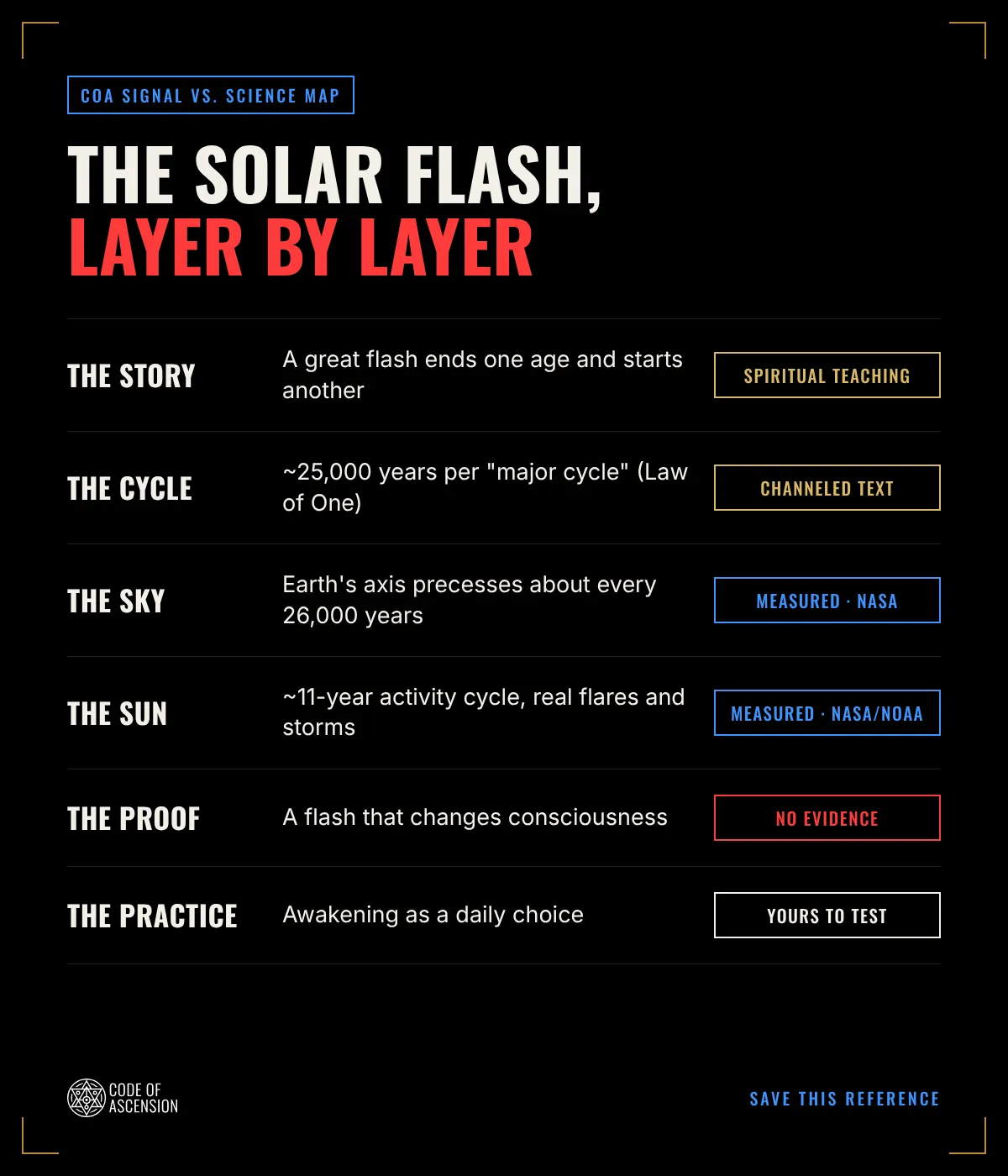
COA Signal vs. Science Map, in text:
- The story: A great flash ends one age and starts another. Spiritual teaching.
- The cycle: ~25,000 years per “major cycle” (Law of One). Channeled text.
- The sky: Earth’s axis precesses about every 26,000 years. Measured (NASA).
- The Sun: ~11-year activity cycle, real flares and storms. Measured (NASA/NOAA).
- The proof: A flash that changes consciousness. No evidence.
- The practice: Awakening as a daily choice. Yours to test.
What Is the Solar Flash?
Picture the Sun brightening, not for a moment but for a whole age. In the Solar Flash story, that light is not a disaster. It is a doorway.
The idea is simple to state. Earth moves through enormous cycles of time. Near the end of a cycle, the energy around our solar system rises. Then, at a pivotal moment, the Sun releases a burst of light that changes life on Earth: some versions say biologically, some spiritually, some both. The old age ends. A new one begins.
The most widely known modern teacher of this idea is David Wilcock, an American author and lecturer whose books include The Source Field Investigations (2011), The Synchronicity Key (2013) and The Ascension Mysteries (2016). He has explored the theme across years of lectures and in the 2019 film The Cosmic Secret.
His descriptions have shifted over time. At some points the flash sounds catastrophic. At others it sounds like a natural evolutionary milestone, closer to a graduation than an ending. That ambiguity matters, and we will come back to it.
Where the Idea Comes From: the Law of One
Wilcock’s framework leans heavily on the Law of One, also called the Ra Material: transcripts of channeling sessions recorded between 1981 and 1984 by Don Elkins, Carla Rueckert and Jim McCarty.
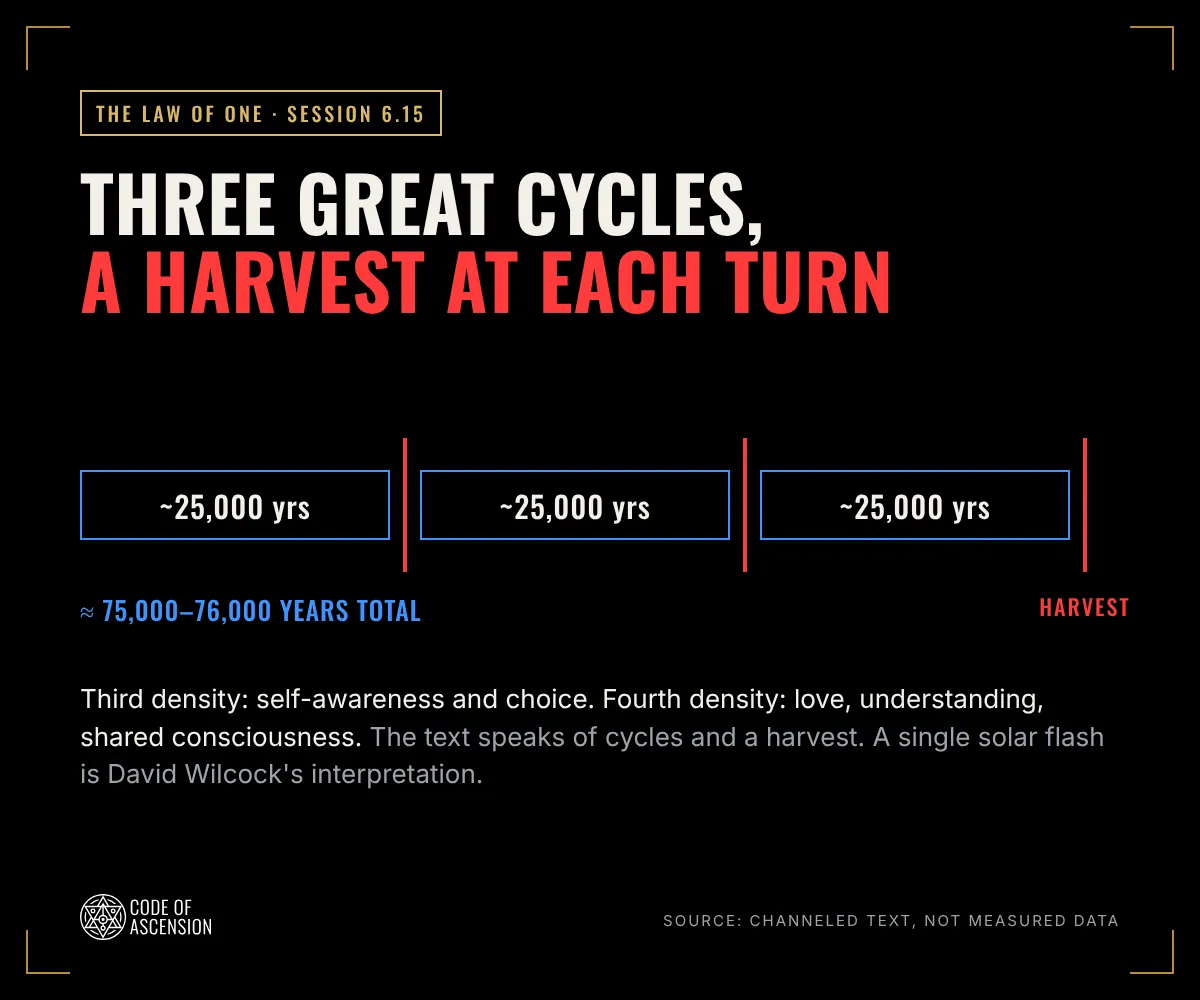
In those sessions, the source calling itself Ra describes time in large cycles. In Session 6 (question 15) it states that one major cycle is “approximately twenty-five thousand” years, and that three major cycles together make a span of roughly 75,000 to 76,000 years. At the end of these cycles comes what the text calls a harvest: a transition in which souls who are ready move on to the next stage of growth.
The Law of One describes that growth in densities:
- Third density: the stage of self-awareness and choice, where we learn through separation, fear and love.
- Fourth density: a stage centered on love, understanding and a more shared, collective consciousness.
The Solar Flash, in Wilcock’s telling, is one way that transition might arrive. (For the wider idea of ascension itself, see our guide to what spiritual ascension really means.) The flash itself is his interpretation layered on top of the channeled material. The Law of One text speaks of cycles and harvest, not of a single solar explosion.
The 25,920-Year Cycle: What Is Real and What Is Story
Here is where the story touches something you can actually measure.
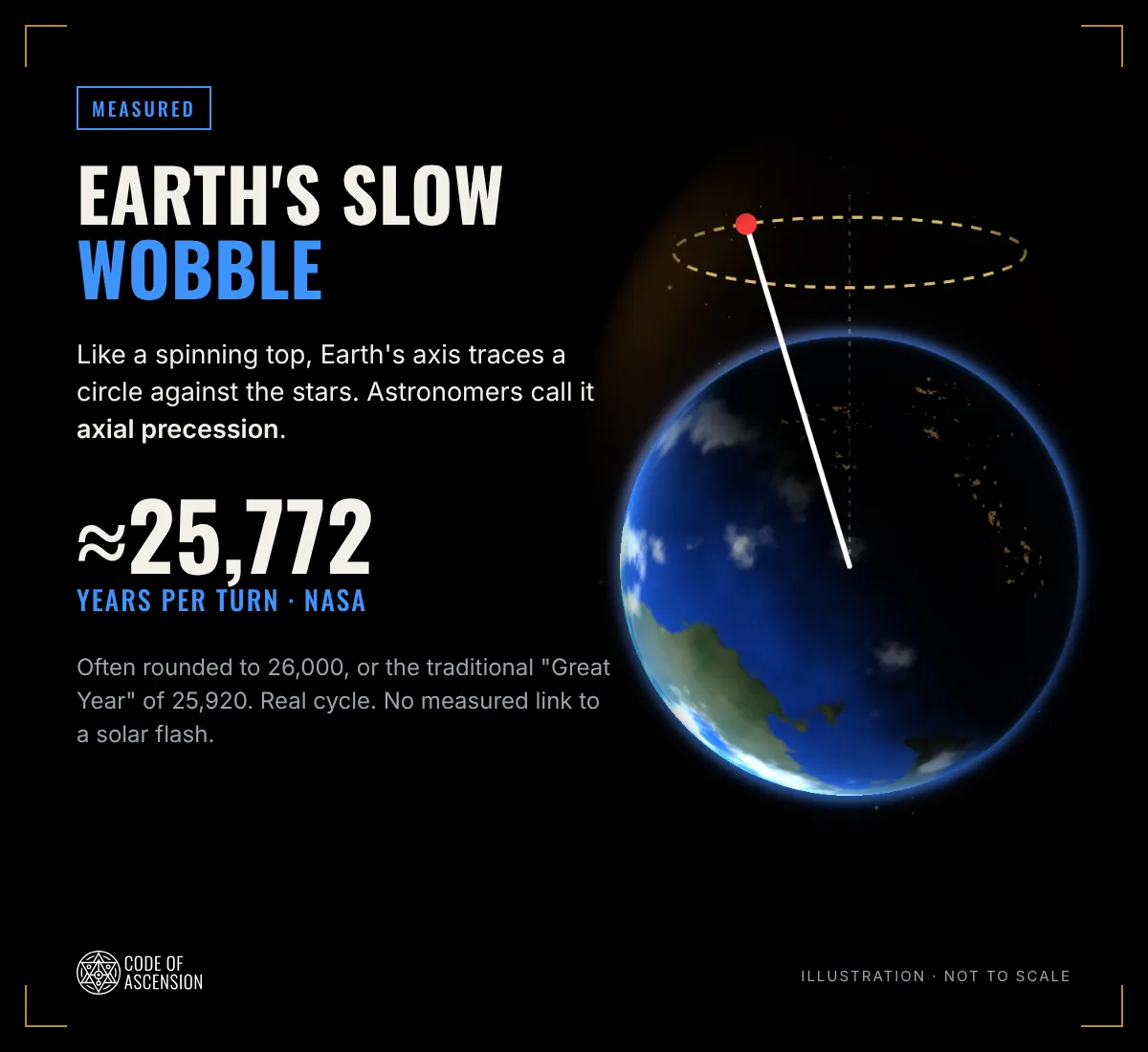
Earth spins like a top, and like a top, its axis slowly wobbles. Over a long cycle, the direction the North Pole points traces a circle against the stars. Astronomers call this axial precession. NASA puts one full turn at about 25,771.5 years, usually rounded to 26,000. It is one of the Milankovitch cycles that scientists use to understand long-term climate patterns. Ancient astronomers noticed its effects too: the slow drift of the equinoxes against the zodiac is the root of the idea of astrological “ages,” like the Age of Pisces and the Age of Aquarius. The often-quoted figure of 25,920 years is a traditional round number for this “Great Year.” (Planets have slow rhythms of their own; see our Saturn’s Hexagon and Mercury is shrinking science stories.)
So the cycle is real. What is not established is any link between precession and a burst from the Sun. Precession is a wobble of Earth’s axis, driven by the gravity of the Sun and Moon pulling on Earth’s equatorial bulge. Solar flares come from magnetic energy tangling and snapping on the Sun’s surface. They are different physical processes, and nothing in the measurements ties one to the other.
COA reading: the Great Year is a beautiful frame for reflection: a reminder that the sky itself moves in slow, patient circles. That is a meaningful symbol. It just is not a countdown clock.
World Ages in Ancient Traditions
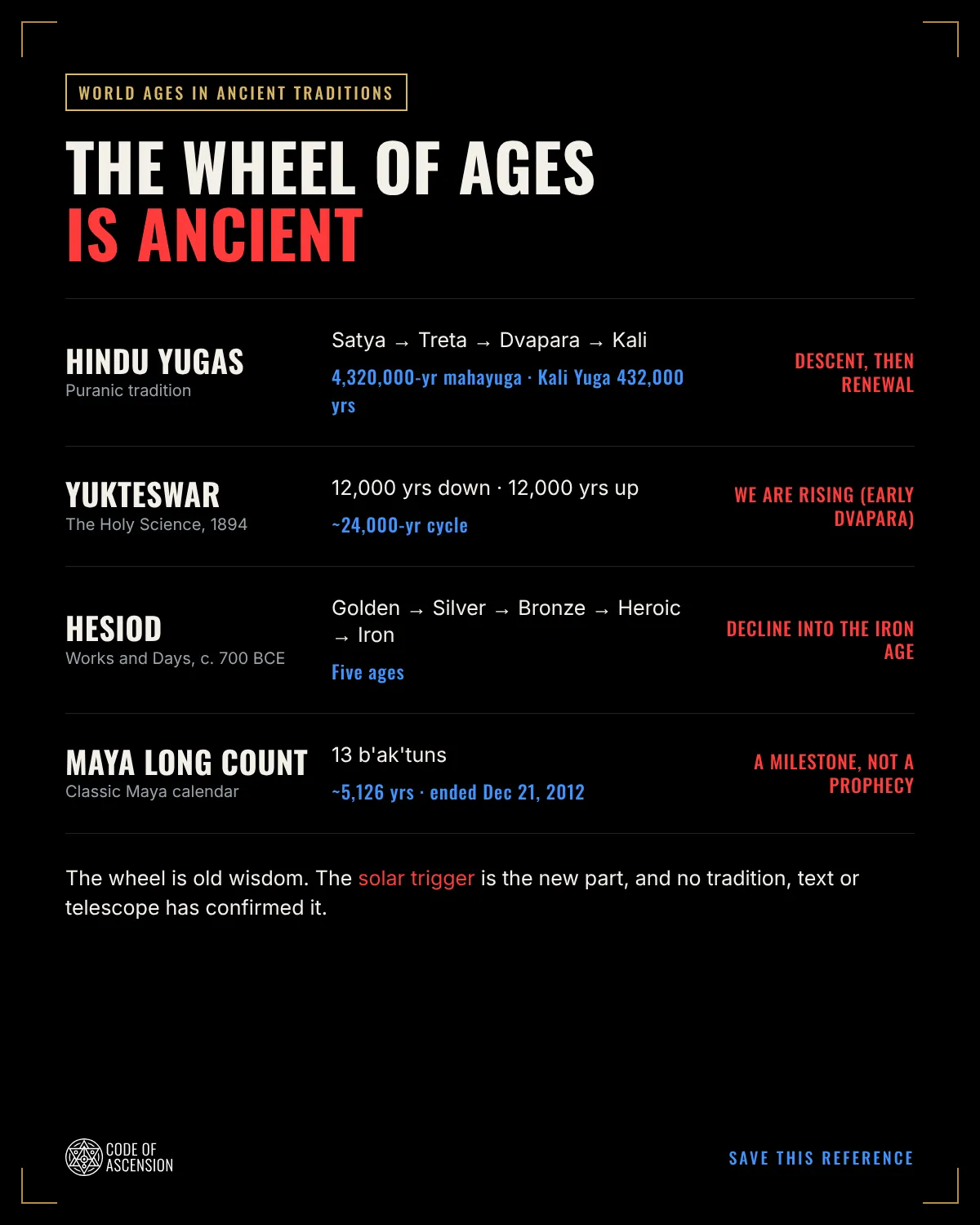
The Solar Flash is a modern story, but the feeling behind it is very old. Across cultures, people have described time as a wheel of great ages: rising, falling and turning over again. Knowing these older maps helps you see what the Solar Flash borrows and what it adds.
The Hindu yugas
Hindu cosmology describes four ages, or yugas: Satya (or Krita), Treta, Dvapara and Kali. Each one is shorter and less virtuous than the last. In the traditional Puranic reckoning, the four together form a mahayuga of 4,320,000 years, and the Kali Yuga alone lasts 432,000 years. On that scale, we are still early in a long dark age.
In 1894, the Indian teacher Sri Yukteswar (guru of Paramahansa Yogananda) proposed a very different version in the book later published as The Holy Science. He described a full cycle of about 24,000 years: about 12,000 years descending into spiritual forgetfulness and about 12,000 years climbing back out. He linked this cycle to the slow drift of the equinoxes and argued that humanity had already left Kali Yuga and entered the early part of Dvapara.
That matters for this story. Yukteswar’s cycle is close in length to precession, and it frames the present as a time of rising awareness. Many modern ascension teachings, the Solar Flash among them, carry the same hopeful shape. Two cautions: most traditional Hindu scholars keep the much longer Puranic lengths, and Yukteswar explained the drift of the equinoxes by the Sun orbiting a companion star, which astronomers have not found. Mainstream astronomy explains it with precession, Earth’s wobble.
Hesiod’s ages of humanity
Around 700 BCE, the Greek poet Hesiod described five ages in Works and Days: Golden, Silver, Bronze, Heroic and Iron. Each age is harder than the one before, and Hesiod placed himself in the Iron Age of toil and conflict. Later writers, including the Roman poet Ovid, retold the scheme as a slide from a lost paradise.
The Greek version is mostly about decline, not renewal. It speaks to a feeling many people share now: that something precious has been lost and that the present age is heavy.
The Maya Long Count and 2012
The Maya Long Count calendar tracks time in units called b’ak’tuns. On December 21, 2012, it completed its 13th b’ak’tun (13.0.0.0.0), the end of a cycle of roughly 5,126 years. In the years before, that date became the center of many end-of-the-world and ascension predictions.
Maya scholars said no classic Maya texts predicted doom on that date, and that treating the calendar as “ending” misread Maya culture. December 21, 2012 came and went. For anyone weighing a Solar Flash timeline, this is the most useful lesson in this section: a calendar turning over is a milestone, not a prophecy.
What these traditions share
- Time moves in great cycles. Not just days and years, but ages.
- The present age feels like a low point. Kali Yuga, the Iron Age, the veil.
- A turning point is possible. In some versions it is decline; in others, return.
COA reading: the Solar Flash takes this ancient wheel of ages and adds a modern trigger: the Sun. The wheel is old wisdom. The trigger is the part no tradition, text or telescope has confirmed.
What Our Sun Actually Does
The real Sun is more dramatic than most people realize.
The 11-year solar cycle
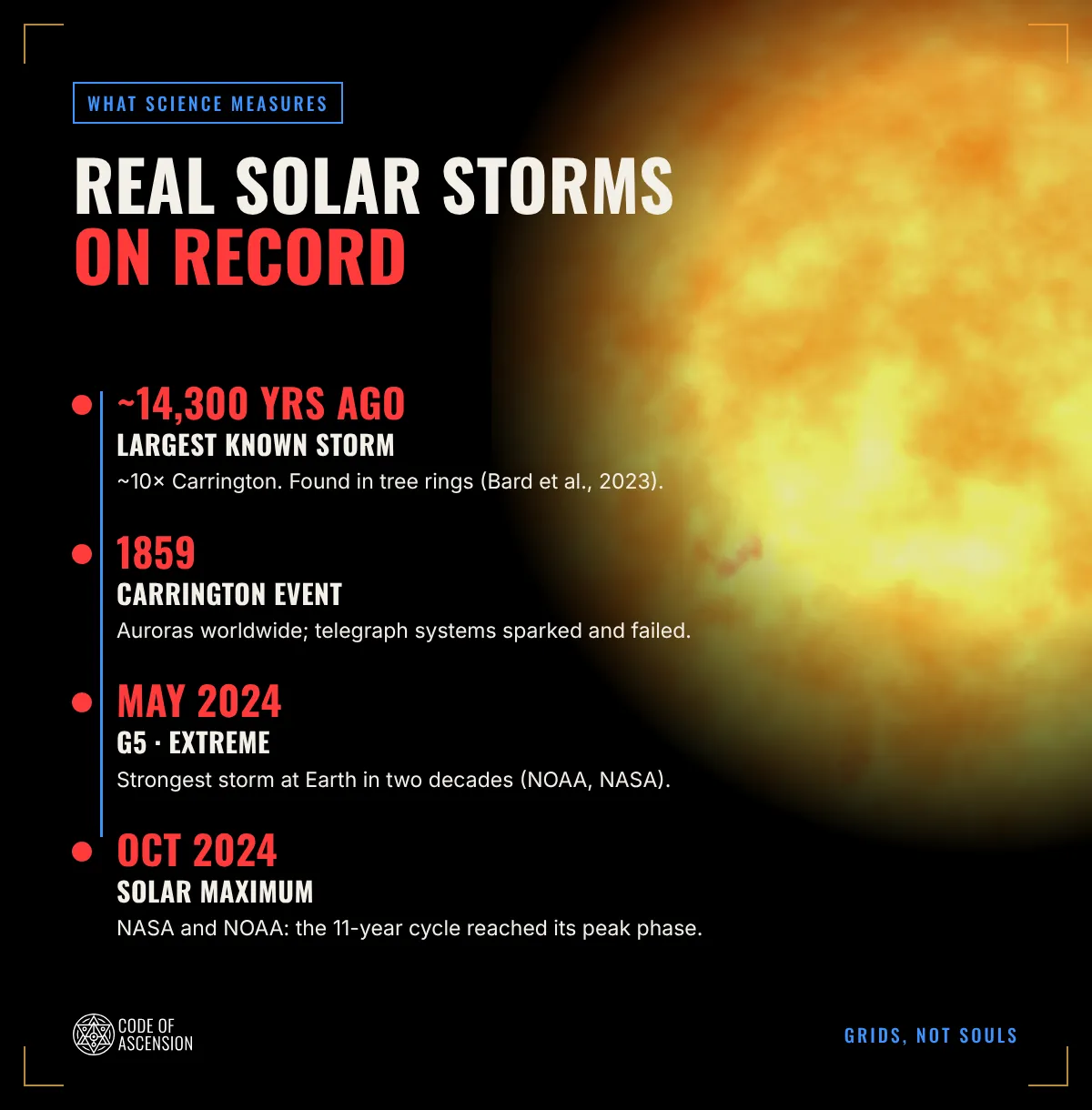
The Sun runs on an activity cycle of roughly 11 years. Near the peak, sunspots multiply, flares and coronal mass ejections (CMEs) become more frequent, and the Sun’s magnetic poles flip. In October 2024, NASA, NOAA and the international Solar Cycle Prediction Panel announced that the Sun had reached the maximum phase of its current cycle.
Real solar storms
- May 2024: a series of large flares and CMEs produced the strongest geomagnetic storm at Earth in about two decades. NOAA rated it G5, the top of its five-level storm scale, and NASA said the auroras were possibly among the strongest on record in the past 500 years. People photographed them far south of where they are usually seen.
- 1859, the Carrington Event: the most famous solar storm in recorded history. Auroras lit skies across much of the world, and telegraph systems sparked and failed, with some operators reportedly able to send messages with their batteries disconnected.
- About 14,300 years ago: in 2023, a team led by Edouard Bard reported tree-ring evidence from a buried forest in the French Alps of a solar storm roughly ten times stronger than Carrington. It is the largest of about ten known “Miyake events,” extreme particle storms identified by carbon-14 spikes in tree rings and beryllium-10 in ice cores.
What these storms affect
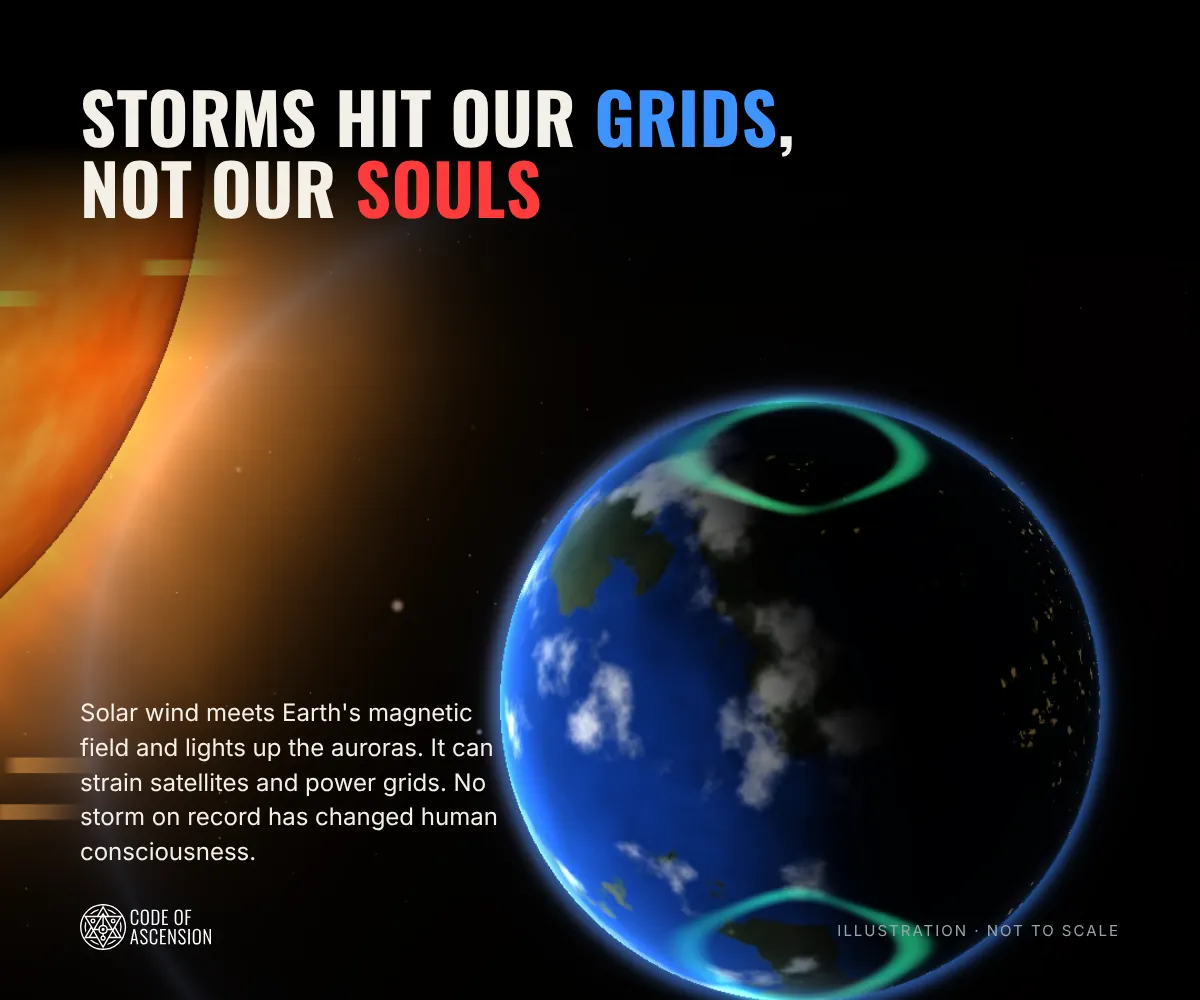
Space weather can damage satellites, disrupt radio and GPS, endanger astronauts and stress power grids. A Carrington-class storm today could cause serious, expensive outages. That is why agencies watch the Sun every day.
Space Weather, the Grounded Way
- Real forecasts live at NOAA. The Space Weather Prediction Center posts storm watches and aurora forecasts. Use it instead of viral “flash warnings.”
- Geomagnetic storms are rated G1 to G5. G5 is the most extreme. The May 2024 storm reached G5.
- For most people, the practical risk is outages. A basic home kit (water, flashlight, a charged power bank, a battery radio) covers a solar storm the same way it covers a winter storm.
- The upside is the sky. Strong storms push auroras far from the poles. When a watch is posted, go outside after dark and look north (or south in the Southern Hemisphere).
What they do not do
None of these events left evidence of a change in human consciousness. The storm 14,300 years ago hit a world of Ice Age hunter-gatherers and left its mark in trees, not in a sudden leap of the human mind. Real solar storms hit our grids, not our souls.
Did a Solar Flash Destroy Atlantis?
Wilcock connects the cycle idea with stories of lost civilizations, including Atlantis. In this view, earlier cultures rose and fell at the turning points of world ages, and survivors carried fragments of their knowledge into later myths.
It is an evocative idea, and the human fascination with lost knowledge is ancient. Plato introduced Atlantis around 360 BCE in the Timaeus and Critias, as a story with a moral about pride and power.
But there is no archaeological or geological evidence that Atlantis existed as a real civilization, and none that any civilization has been erased by a solar flash on a 25,000-year schedule. Earth’s real catastrophes, like volcanic winters, sea-level rise at the end of the Ice Age and asteroid impacts, leave physical evidence. A civilization-ending solar flash would too, and we have not found it.
COA reading: the deeper truth in the Atlantis story is about memory. Civilizations do lose knowledge: through war, fire, neglect and forgetting. Asking how wisdom gets lost and rediscovered is worth your time.
How the Solar Flash Connects to “the Matrix” and the Veil
Part of the theory’s pull comes from how it fits a bigger spiritual picture. In many modern teachings, including Wilcock’s, human life in this age is shaped by a veil of forgetting: we forget where we came from, we feel separate, and we learn by choosing between fear and love. Some people call this experience “the Matrix.” Gnostic writers told a similar story about rulers who keep humanity asleep; we unpack it in The Archons Explained.
In that framework, the Solar Flash is the moment the veil thins: the end of one way of being human and the beginning of another.
There is no scientific evidence that we live in a literal Matrix, or that we must wait for a cosmic event to wake up. But as a metaphor, the veil is useful. Most of us really do live on autopilot, repeating patterns we did not choose. Seeing that clearly is its own kind of awakening, and it does not need the Sun’s permission. If you want a guided way to spot those patterns, shadow work is the practice, and The Shadow Code Journal gives you the pages to do it.
The Solar Flash as a Metaphor for Ascension
Strip away the prediction, and the Solar Flash points at something real in human experience: sudden clarity.
You have probably felt a small version of it. A conversation, a loss, a sunrise, a line in a book, and something that was hidden is suddenly obvious. Psychologists study these moments as insight and transformative experience. Spiritual traditions call them awakening, satori or grace.
At COA, we treat ascension as a direction, not a date:
- From reaction to awareness: noticing the pattern before you repeat it.
- From fear to love: the Law of One’s own measure of growth.
- From separation to connection: with your body, other people and the living world.
If a flash ever comes, it helps to be awake already. If it never comes, you lose nothing by waking up anyway.
How to Work With “Solar Flash” Energy Without the Fear
Some Solar Flash content online leans on fear: catastrophe, deadlines, warnings to prepare. You can take the meaningful part and leave the panic.
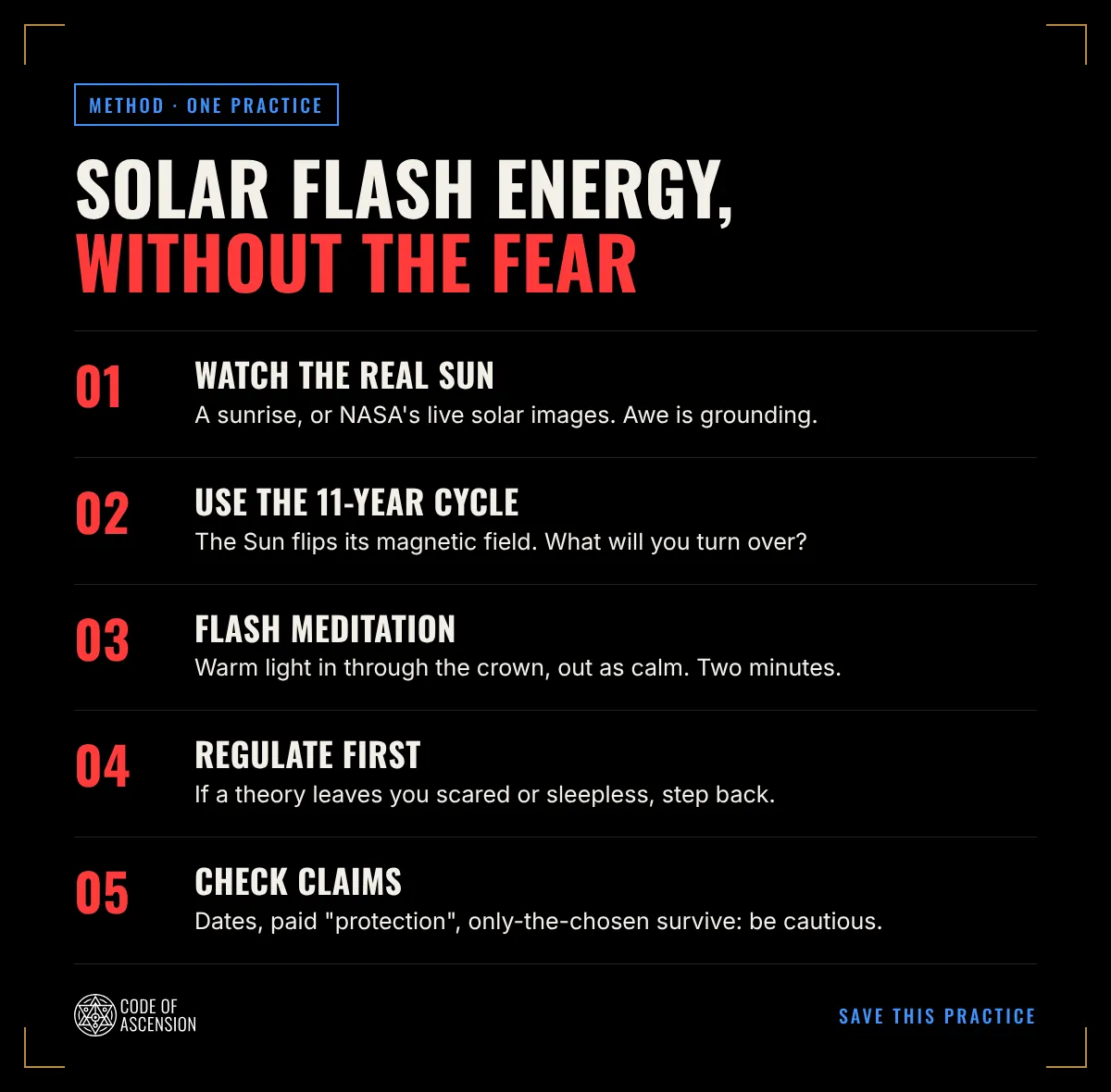
- Watch the real Sun. Look at an actual sunrise. NASA’s Solar Dynamics Observatory also posts live images of the Sun online. Awe is grounding.
- Use the solar cycle as a calendar for reflection. Every 11 years the Sun turns over its magnetic field. Ask what you want to turn over in your own life.
- Practice a “flash” meditation. Close your eyes and imagine warm light entering through the crown of your head and filling your body, then breathe it out as calm. Two minutes is enough. (Our pineal gland activation guide goes deeper on crown-focused meditation.)
- Regulate your nervous system first. Spiritual excitement can spill into anxiety. If a theory leaves you scared or sleepless, step back. Our 5-minute nervous system reset and these grounding techniques help, and the printable Nervous System Calm Pack keeps the resets on hand.
- Check claims. If someone gives a date, sells protection from the flash or says only their followers will survive, be cautious.
Signs You Are Taking the Theory Too Literally
- You are making big life decisions, financial or medical, based on a predicted event.
- You feel dread rather than inspiration.
- You avoid evidence that challenges the story.
- You are spending money on promises of being “saved.”
If any of these sound familiar, come back to the metaphor. The point of ascension is more freedom, not more fear.
Explore More on Code of Ascension
- Spiritual Ascension: What It Really Means
- Reincarnation: What the Evidence and the Traditions Say
- The Akashic Records
- The Archons Explained
- Saturn’s Hexagon (our science deep dive)
- Shadow Work: How the Hidden Self Shapes Healing
- How to Reset Your Nervous System in 5 Minutes
- Science & Discovery hub
- Free: You Are More Than The Body in the Free Ascension Library
- Shop: The Shadow Code Journal · Nervous System Calm Pack
FAQ
What is the Solar Flash?
A spiritual theory that the Sun will release a massive burst of energy at the end of a long cosmic cycle and trigger a leap in human consciousness. It is a belief, not an observed event.
Who created the Solar Flash theory?
It is most associated with David Wilcock, who built it on the Law of One (Ra Material) channeling sessions from 1981 to 1984 and on older ideas about great world ages.
Is the Solar Flash real?
There is no scientific evidence for a recurring solar flash that resets civilization or changes consciousness. The Sun does produce real, powerful storms, but their effects are on technology, satellites and auroras, not on the human mind.
When is the Solar Flash supposed to happen?
Wilcock has not given a reliable date. Earlier ascension timelines were tied to 2012, which passed without such an event. Be cautious of anyone who names a date.
What is the 25,920-year cycle?
A traditional figure for the “Great Year,” based on axial precession: the slow wobble of Earth’s axis, which takes about 26,000 years. Precession is real; its link to a solar flash is not established.
What would a real extreme solar storm do?
A Carrington-level storm today could damage satellites, disrupt GPS and radio, and cause power outages. It would also produce spectacular auroras.
Does the Law of One mention a solar flash?
The Law of One describes roughly 25,000-year cycles and a “harvest” between densities. The idea that a single solar flash triggers that transition is Wilcock’s interpretation.
How can I use this idea spiritually?
Treat it as a metaphor for awakening: notice patterns, choose love over fear and stay grounded. You do not need a cosmic event to start.
Final Thoughts
The Solar Flash is one of the most cinematic ideas in modern spirituality: a Sun that ends one age and opens another. The science says our Sun is powerful, cyclical and occasionally wild, but not a switch for consciousness. The spiritual teaching says we are in the middle of a great transition. Both can be held at once if we are honest about which is which.
The flash nobody can prove may never come. The awakening you can choose is available today.
Sources
- NASA: NASA, NOAA: Sun Reaches Maximum Phase in 11-Year Solar Cycle (Oct 15, 2024)
- NASA Space Place: What Is the Solar Cycle?
- NASA Science: Milankovitch (Orbital) Cycles and Their Role in Earth’s Climate (“The cycle of axial precession spans about 25,771.5 years”)
- NOAA SWPC: G5 Conditions Observed! (May 10, 2024) and Space Weather Prediction Center (storm scales, aurora forecasts)
- NASA: How NASA Tracked the Most Intense Solar Storm in Decades (May 16, 2024)
- Wikipedia: The Holy Science (Sri Yukteswar, 1894, ~24,000-year cycle)
- Wikipedia: Yuga (four yugas; 4,320,000-year mahayuga)
- Wikipedia: Ages of Man (Hesiod, Works and Days)
- Wikipedia: 2012 phenomenon (13th b’ak’tun; Maya scholars on the doom claims)
- NOAA SciJinks: What Was the Carrington Event?
- Scientific American: Traces of Oldest and Largest Solar Storm Found in Buried French Forest (Bard et al., 2023, Phil. Trans. R. Soc. A)
- L/L Research: The Ra Contact, Session 6 (question 15: ~25,000-year cycles, harvest)
- Wikipedia: David Wilcock (books, The Cosmic Secret, 2012 timeline)
About The Author
Author: King | Founder of Code of Ascension
King is the founder of Code of Ascension, a spiritual education platform focused on consciousness, symbolism, manifestation, nervous system awareness, and hidden patterns of reality. Through Code of Ascension, he explores ancient wisdom and modern insights to help others awaken, align, and ascend.
Keep Ascending 🚀