
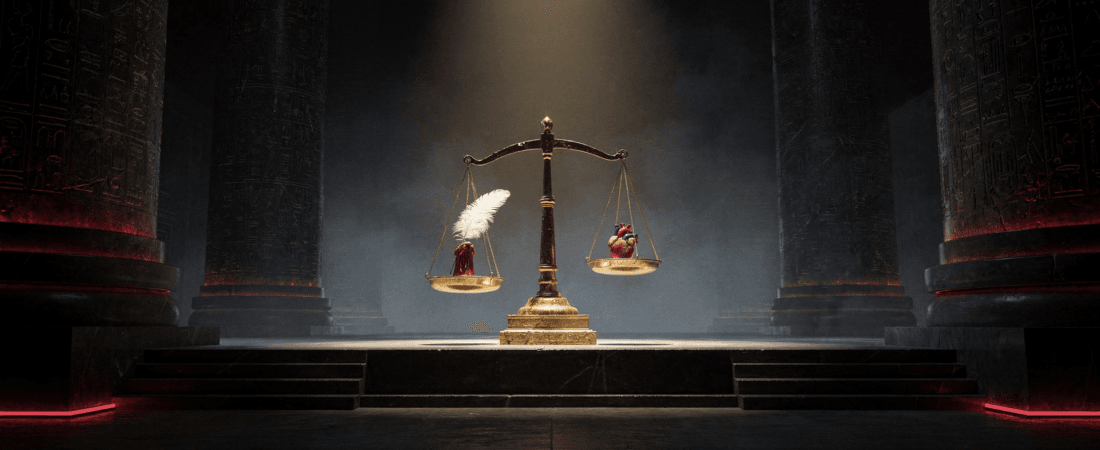
The Weighing of the Heart is the most famous judgment scene in the ancient world. A human heart on one side of a golden scale. A single feather on the other. A jackal-headed god steadying the balance, an ibis-headed scribe recording the result, and a monster part crocodile, part lion, part hippopotamus crouching underneath, waiting to see if it gets to eat.
For more than 1,500 years, Egyptians prepared for this moment in life and in the tomb. They wrote spells for it, carved amulets for it, and paid real money to have it painted on papyrus and buried beside them. And more than three thousand years later, the image still stops people in their tracks, because it asks the question every one of us eventually asks: when my life is measured, what will it weigh?
This guide walks through the Weighing of the Heart as the Egyptians actually described it: where it comes from, what happens step by step, who every figure in the scene is, what the famous 42 declarations said, and why the heart mattered so much. Then we will look at what the ritual can teach us today, without pretending that a papyrus proves what happens after death. ⚖️🖤
Quick Answer: What Is the Weighing of the Heart?
Quick Answer: The Weighing of the Heart is the ancient Egyptian judgment of the dead described in Spell 125 of the Book of the Dead. The deceased was led into the Hall of Two Truths, declared their innocence before Osiris and 42 divine judges, and had their heart weighed against the feather of Ma’at, the principle of truth and balance. Anubis tended the scale and Thoth recorded the verdict. A heart in balance meant the person was “true of voice” and could enter the Field of Reeds; a heart that failed was devoured by Ammit.
The COA Hall of Two Truths Map
Every figure in the Weighing of the Heart had a job. This Code of Ascension reference maps each one to its role in the judgment, its key symbol, and the question it still asks of us today.
| Figure | Role in the judgment | Symbol | What it asks of you |
|---|---|---|---|
| The Heart (ib) | The record of a life: thought, memory, and character | Heart on the scale | What have I carried? |
| Ma’at | The standard of truth, balance, and cosmic order | Ostrich feather | Am I living in truth? |
| Anubis | Guides the deceased and checks the scale | Jackal, balance | Am I willing to be measured honestly? |
| Thoth | Records the verdict | Ibis, reed pen, palette | What story is my life writing? |
| The 42 Assessors | Hear the declarations of innocence | 42 named judges | How have I treated others? |
| Ammit | Devours a heart that fails | Crocodile, lion, hippo | What am I refusing to face? |
| Horus | Presents the justified soul to Osiris | Falcon | Who stands with me? |
| Osiris | Presides as lord of the afterlife | Crook, flail, throne | What in me is ready to be renewed? |
“The Egyptians did not ask what you believed. They asked what your heart weighed.” (A Code of Ascension reflection, not an ancient quotation.)
On the COA Afterlife Evidence Ladder, the Weighing of the Heart sits on the Taught rung: a historical religious tradition, documented in real artifacts.
Cite this map: Code of Ascension, “The COA Hall of Two Truths Map,” codeofascension.com/weighing-of-the-heart/
Where the Weighing of the Heart Comes From
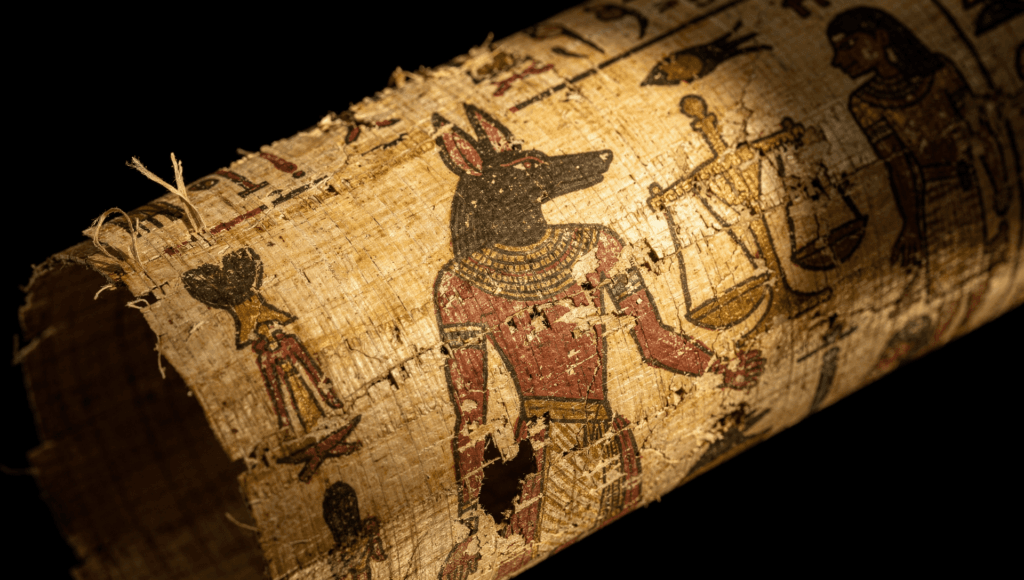
The Weighing of the Heart appears in the Book of the Dead, a modern name for a collection of funerary spells the Egyptians called the Spells of Coming Forth by Day. These spells were written on papyrus scrolls, painted with illustrations called vignettes, and placed in the tomb to guide the deceased through the dangers of the afterlife.
The Book of the Dead did not appear out of nowhere. It grew out of older traditions:
- The Pyramid Texts (around 2400 BCE) were carved inside royal pyramids and were originally meant for kings.
- The Coffin Texts of the Middle Kingdom painted similar spells inside the coffins of wealthy officials, widening access to the afterlife.
- The Book of the Dead took shape at the start of the New Kingdom (around 1550 BCE) and stayed in use for well over a thousand years, into the Roman period.
Scholars have identified roughly 190 different spells, but no single scroll contains them all. Families chose which spells to include, and a finely illustrated copy was expensive, by some estimates as much as half a year’s wages for a laborer. The judgment scene of Spell 125 became one of the most popular and most lavishly painted parts of these scrolls.
Two of the most famous surviving examples are held at the British Museum:
- The Papyrus of Hunefer (19th Dynasty, around 1300 BCE), made for a royal scribe who served under Pharaoh Seti I. Its judgment scene is the one you have probably seen in textbooks.
- The Papyrus of Ani (also 19th Dynasty), a long, richly painted scroll made for a scribe named Ani, often called one of the finest Book of the Dead manuscripts ever found.
Why the Heart?
To understand the ritual, you have to understand what the heart meant to the Egyptians. They called it the ib, and it was not just a muscle. It was the seat of thought, memory, emotion, intention, and moral character. In other words, the heart was the record of who you had been.
That is why, in many mummification practices, embalmers removed most internal organs, including the brain, while the heart was preserved in the body. The heart had to stay with the body because it would be needed at the judgment.
The Heart Scarab and Spell 30B
There was one problem: the heart knew everything. What if it testified against its owner?
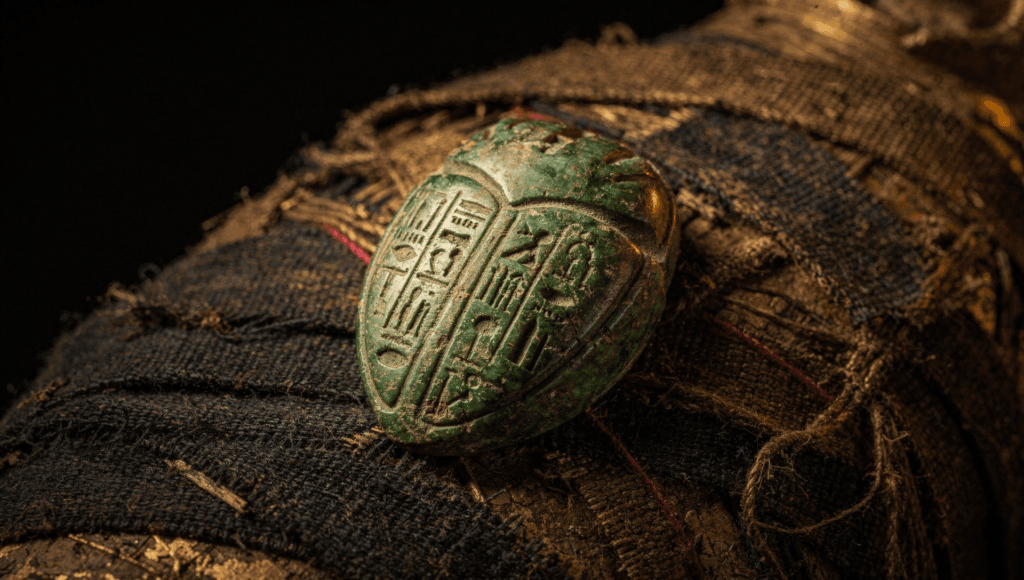
The Egyptians had a solution. A heart scarab, a large amulet shaped like a scarab beetle and usually carved from green or dark stone, was placed over the chest of the mummy, wrapped into the bandages. On its flat underside, many were inscribed with Spell 30B of the Book of the Dead, in which the deceased speaks directly to their own heart, calling it the heart received from their mother, and asks it not to stand up as a witness against them or to create opposition in the presence of the keeper of the balance.
It is a remarkably human detail. Even a people who believed in divine judgment wanted a little insurance.
The Judgment, Step by Step
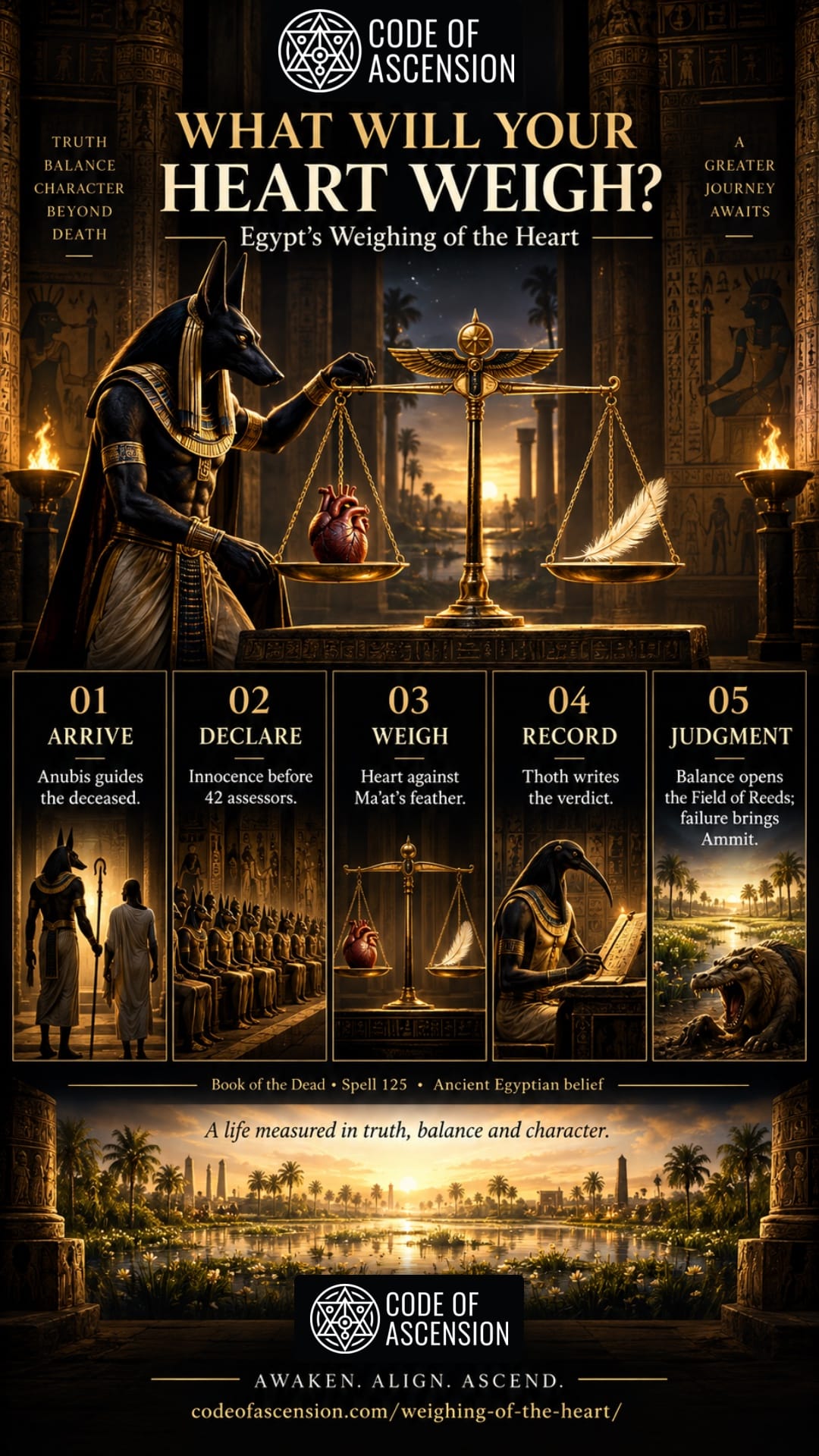
The judgment scenes differ from papyrus to papyrus, but the core sequence is consistent. Here is how it unfolds, drawing on the famous vignette in the Papyrus of Hunefer and the text of Spell 125.
1. Arrival at the Hall of Two Truths
After passing through the gates and dangers of the Duat, the underworld, the deceased arrives at the Hall of Two Truths (sometimes called the Hall of the Two Ma’ats). In the Hunefer papyrus, the jackal-headed god Anubis leads Hunefer by the hand toward the scale.
2. The Declarations Before the 42 Judges
The deceased stands before Osiris, lord of the underworld, and a tribunal of 42 divine judges, known as the Assessors of Ma’at. Each assessor is named and associated with a particular place or realm. The deceased addresses them one by one with a statement of innocence, a sequence modern scholars call the Negative Confession.
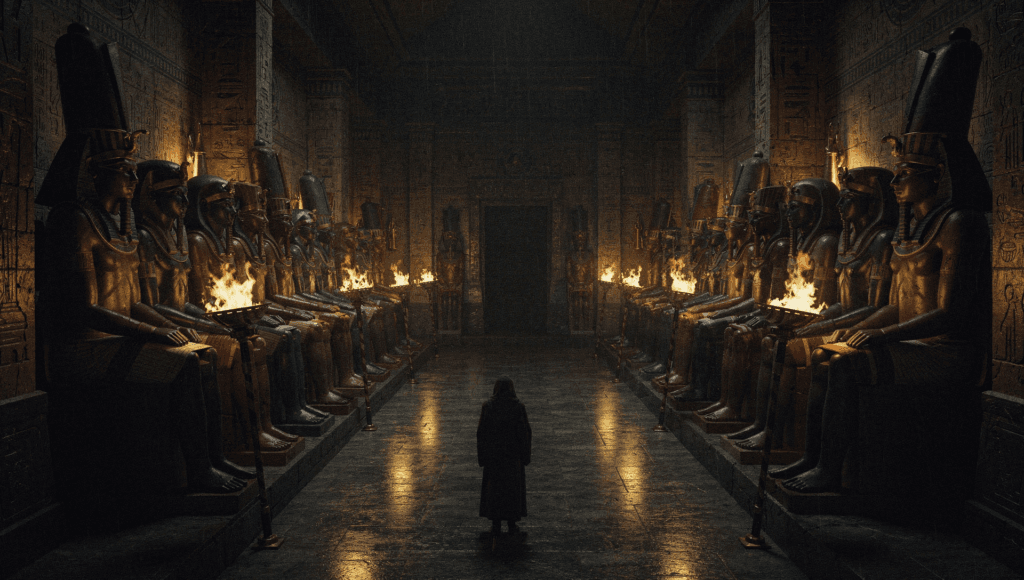
3. The Weighing
Then comes the moment itself. The heart is placed on one pan of a great balance. On the other pan sits the feather of Ma’at, the hieroglyph that stands for truth, justice, and cosmic order. In the Hunefer scene, Anubis kneels beside the scale to check the plumb weight, making sure the reading is true.
4. Thoth Records the Result
The ibis-headed god Thoth, divine scribe and god of writing and wisdom, stands ready with a reed pen and scribal palette to record the outcome. In Egyptian thought, a verdict was not complete until it was written.
5. The Verdict
If the heart and the feather were in balance, the deceased was declared maa-kheru, “true of voice” or “justified.” That phrase was added after the names of the dead on countless monuments, the way we might write “of blessed memory.” In the Hunefer papyrus, Horus then leads the justified Hunefer to a shrine where Osiris sits enthroned, accompanied by Isis and Nephthys.
If the heart failed, it was thrown to Ammit, the Devourer, who waited beneath the scale. A devoured heart meant the end of the person’s existence in the afterlife, a “second death” from which there was no return.
The Cast of the Weighing of the Heart
Every figure in the scene carried meaning. Here is who they are.
Ma’at: Truth, Balance, and Cosmic Order
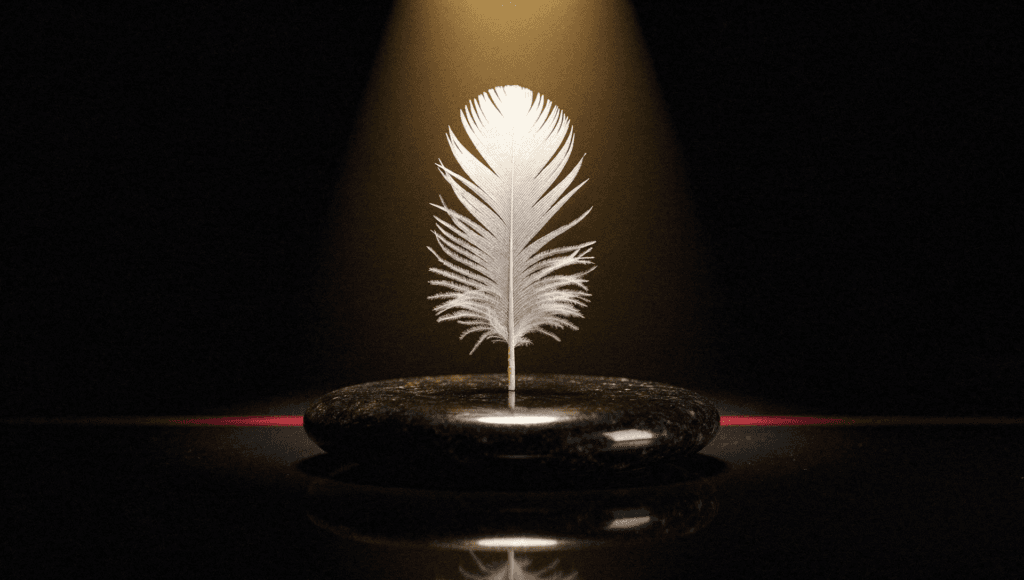
Ma’at was both a principle and a goddess. As a principle, ma’at meant truth, justice, balance, and the right order of the universe. Its opposite was isfet: chaos, injustice, and violence. As a goddess, Ma’at was shown as a woman wearing a single ostrich feather on her head. Pharaohs called themselves “beloved of Ma’at,” and their core job was to uphold her order on earth. When the heart was weighed against her feather, it was being measured against the order of the universe itself.
Anubis: Guide of Souls and Keeper of the Scale
Anubis, the jackal-headed god, was the patron of embalming and the protector of the dead. In the judgment scene he is the guide who leads the deceased in and the careful hand that checks the balance. Read our full guide to Anubis meaning for more on his symbolism.
Thoth: The Divine Scribe
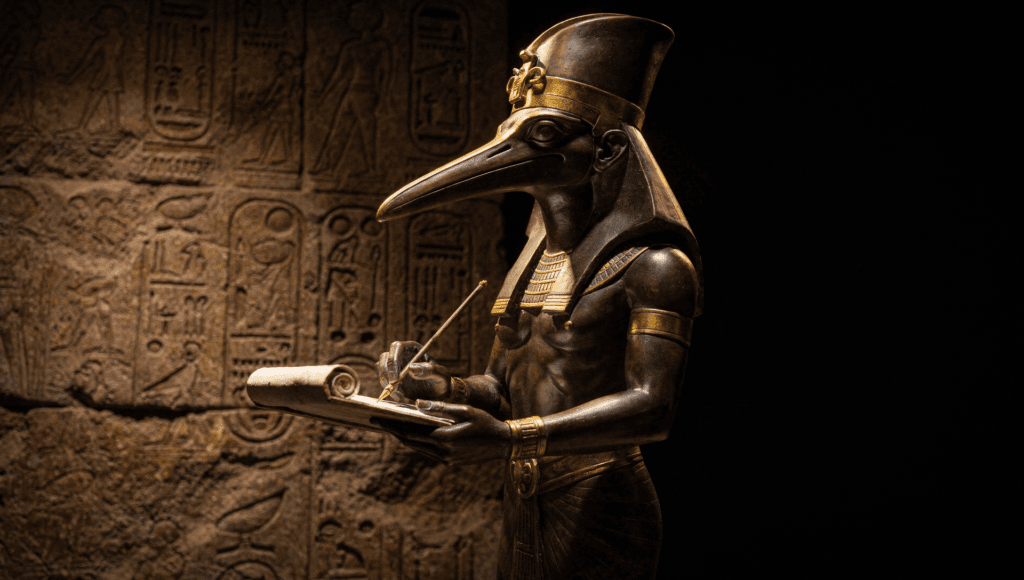
Thoth, usually shown with the head of an ibis, was the god of writing, knowledge, and measurement. His presence at the scale means the judgment is precise and permanent. In some traditions, Thoth is also described as Ma’at’s consort, pairing the principle of truth with the power to record it.
Ammit: The Devourer
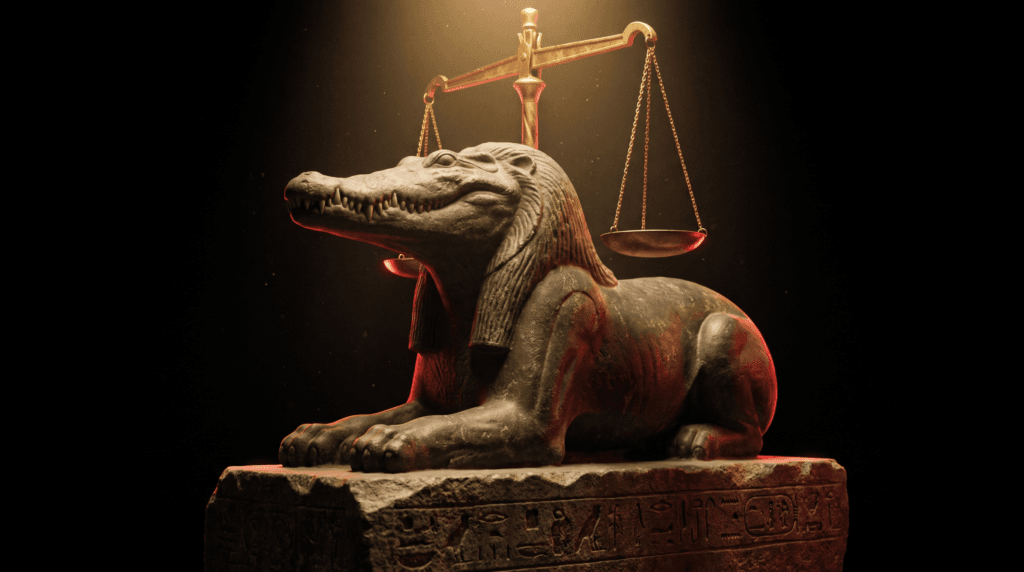
Ammit, whose name means “devourer of the dead,” was a composite creature: the head of a crocodile, the forequarters of a lion, and the hindquarters of a hippopotamus, three of the most dangerous animals the Egyptians knew. She was not worshipped as a goddess. She was a feared guardian figure whose only job was to consume hearts that failed the test. She appears prominently in judgment scenes from the New Kingdom onward.
Osiris, Horus, Isis, and Nephthys
Osiris, the god who was killed and restored to life, presides over the judgment as ruler of the underworld. Because he himself passed through death, the deceased hoped to join him. Horus, his son, presents the justified soul to his father. Isis and Nephthys, Osiris’s wife and her sister, stand behind his throne as protectors and mourners.
The 42 Declarations of Innocence
The Negative Confession is one of the most fascinating texts from ancient Egypt, because it shows what the Egyptians considered wrong. Translations vary, but the declarations include statements like:
- I have not stolen.
- I have not killed.
- I have not told lies.
- I have not caused pain.
- I have not caused anyone to weep.
- I have not taken milk from the mouths of children.
- I have not cheated with weights and measures.
- I have not held back running water.
- I have not been arrogant.
- I have not stirred up strife.
Notice how many of these are about how you treated other people and the shared world: honesty in trade, care for children, shared water, not causing tears. The Egyptian afterlife was not earned by belief alone. It was earned by how you lived.
You may have seen modern lists called the “42 Laws of Ma’at” or “42 Ideals of Ma’at,” rewritten as positive affirmations such as “I honor truth.” Those are modern adaptations, popular in contemporary Kemetic spirituality. The ancient material is the series of denials the deceased spoke before the divine assessors in Spell 125. The modern lists can be meaningful tools, but they are not ancient texts, and it is worth knowing the difference.
Did Anyone Ever Fail?
Here is a detail that surprises many people: in the surviving funerary papyri, the verdict is shown as favorable. We do not have scrolls showing their owner’s heart being eaten.
That makes sense once you remember what the Book of the Dead was for. It was not a neutral record of what would happen. It was a set of spells meant to make the right outcome happen. Painting the scene with a successful verdict, and burying it beside you, was a way of securing that result. Ammit’s presence was the stakes. The scroll was the plan.
The Weighing of the Heart and the COA Evidence Ladder
At Code of Ascension, we use the COA Afterlife Evidence Ladder to separate different kinds of claims about death. The Weighing of the Heart is a perfect example of why that matters.
- What is measured: The papyri, heart scarabs, mummies, and tomb paintings are real, physical, datable artifacts. Museums hold them, and Egyptologists have translated them. It is documented fact that Egyptians believed in and prepared for this judgment.
- What is taught: The judgment itself, the scale, the 42 judges, and the Field of Reeds belong to the Taught rung: a historical religious tradition, held with deep sincerity for more than a millennium.
- What is lived: What the ritual means to you today, as a symbol, a practice, or a source of reflection, belongs to the Lived rung.
The artifacts cannot prove what happens after death. What they prove is something just as powerful: an entire civilization believed that the way you treat others is weighed, and built their lives around that belief. For the bigger question, read our full guide to what happens after death.
Echoes of the Scale in Other Traditions
The image of a soul being weighed did not stay in Egypt. Similar ideas appear across cultures:
- Ancient Greece: In Homer’s Iliad, Zeus weighs the fates of heroes on golden scales, a motif known as the kerostasia.
- Islam: The Qur’an describes the Mizan, the scales on the Day of Judgment on which deeds are weighed.
- Medieval Christianity: Artists often painted the Archangel Michael holding scales and weighing souls at the Last Judgment, a scene known as psychostasis.
- Hindu and Buddhist thought: Karma works like a moral balance sheet that shapes future lives, though without a single courtroom scene.
Whether these ideas share roots or arose independently, they point to the same deep human intuition: our actions carry weight, and that weight is not erased by death.
The Field of Reeds: What Came After

Those found true of voice could enter the Field of Reeds (Aaru), an idealized version of the Egyptian world: fertile fields, abundant harvests, waterways, and eternal life among the gods and ancestors. It was not a cloud-filled heaven. It looked a lot like the best version of home, where the grain always grew and the river always rose.
Symbols like the ankh, the sign of life, and the Eye of Horus, a symbol of protection and restoration, were woven throughout this afterlife system, and the pyramids themselves were built around the same hope of eternal life.
What the Weighing of the Heart Teaches Us Today
You do not have to believe in Ammit to feel the power of this ritual. Its core message is timeless: live in a way that would weigh light.
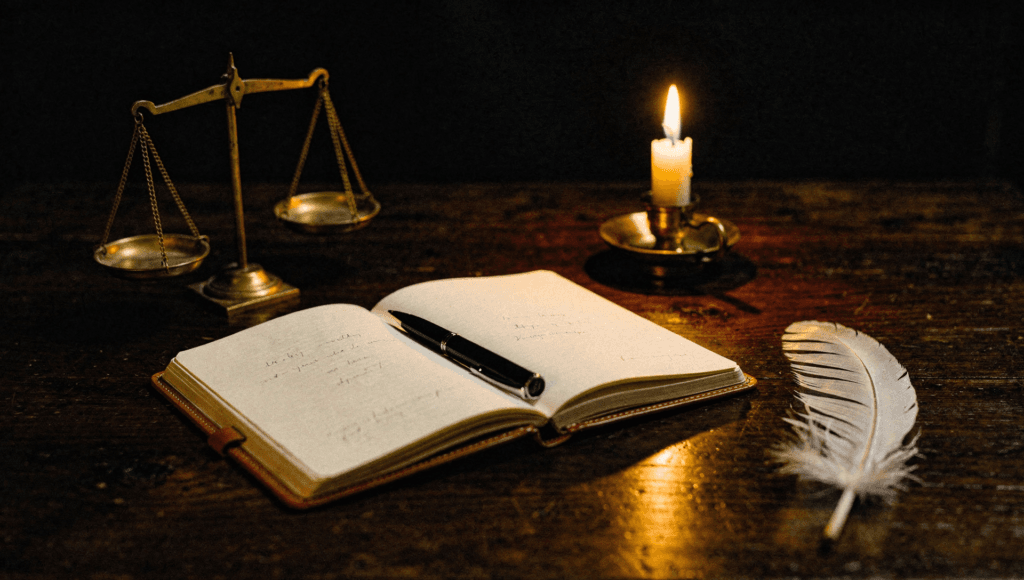
Here is a simple practice inspired by the judgment scene:
- End the day at the scale. Before bed, sit quietly for two minutes and ask: “If my heart were weighed today, what would feel light? What would feel heavy?”
- Name one heavy thing honestly. A harsh word, a shortcut, a promise you avoided. No shame, just truth. Ma’at begins with honesty.
- Choose one repair. An apology, a correction, a kinder choice tomorrow. The Egyptians spoke their declarations out loud; you can write yours down.
- Keep your own record, like Thoth. A short journal entry each night turns reflection into a habit. The Shadow Code Journal offers guided prompts for exactly this kind of honest self-review.
- Release what you have made right. A heavy heart is not the goal. Repair, then let it go, so your heart can return to balance.
If you want to go deeper into protective Egyptian symbols like the ankh, the Eye of Horus, and more, The Protection Symbols Grimoire is our illustrated guide. And for the bigger question of who you are beyond the body, grab our free field guide You Are More Than The Body from the Free Ascension Library. ✨
Modern near-death experiencers often describe a “life review” that echoes this ancient judgment, a moment of feeling the full weight of how they lived and loved. You can explore that connection in our deep dive on near-death experiences, and if you are ready to turn these lessons into daily practice, start with What Is Spiritual Ascension?
Journal Prompts: Weighing Your Own Heart
- What would my own “declarations of innocence” be? What could I honestly say I have not done?
- Which declaration would be hardest for me to say truthfully right now?
- Where in my life am I living by ma’at, truth and balance, and where by isfet, chaos?
- If Thoth recorded one sentence about how I lived this year, what would I want it to say?
- What does “true of voice” mean for me: saying what I mean, and meaning what I say?
- What is one heavy thing I am ready to repair or release?
Final Thoughts
The Weighing of the Heart has lasted more than three thousand years because it captures something every human feels: that a life is not measured by wealth or status, but by truth and by how we treated others. The Egyptians painted it in gold, protected it with amulets, and carried it into the tomb.
Whatever you believe happens after death, the scale is still a powerful mirror. Keep your heart honest, your actions balanced, and your voice true. Keep Ascending. 🚀
Sources: The British Museum, Book of the Dead of Hunefer (EA 9901); The Fitzwilliam Museum, “Spell 125: Osiris and the judgement of the dead”; R. O. Faulkner (trans.), The Ancient Egyptian Book of the Dead; John H. Taylor (ed.), Journey Through the Afterlife: Ancient Egyptian Book of the Dead (British Museum Press, 2010).
FAQ
What is the Weighing of the Heart?
The Weighing of the Heart is the ancient Egyptian judgment of the dead, described in Spell 125 of the Book of the Dead. The deceased’s heart was weighed against the feather of Ma’at to decide whether they could enter the afterlife.
What happens if your heart is heavier than the feather?
According to Egyptian belief, a heart that failed the weighing was devoured by Ammit, a creature with the head of a crocodile, the body of a lion, and the hindquarters of a hippopotamus. This meant the end of the person’s existence in the afterlife.
Who weighs the heart in Egyptian mythology?
Anubis, the jackal-headed god of embalming, leads the deceased to the scale and checks the balance, while Thoth, the ibis-headed scribe god, records the result. Osiris presides over the judgment with 42 divine assessors.
What does the feather of Ma’at represent?
The feather represents ma’at, the Egyptian principle of truth, justice, balance, and cosmic order. Weighing the heart against it meant measuring a person’s life against the order of the universe.
What are the 42 declarations of innocence?
They are statements the deceased recited before the 42 judges in Spell 125, such as “I have not stolen,” “I have not told lies,” and “I have not caused anyone to weep.” Scholars call this the Negative Confession.
Why did the Egyptians keep the heart in the body?
The Egyptians believed the heart was the seat of thought, memory, and moral character, so it was needed for the judgment. In many mummification practices, the brain and most organs were removed while the heart was preserved in the body.
What is a heart scarab?
A heart scarab is a scarab-shaped amulet placed over the heart of a mummy. Many were inscribed with Spell 30B, which asks the heart not to testify against its owner during the judgment.
Is the Weighing of the Heart real?
The artifacts are real: papyri, heart scarabs, and tomb paintings prove Egyptians believed in and prepared for this judgment. Whether the judgment itself happens is a matter of religious belief, not historical proof.
About The Author
Author: King | Founder of Code of Ascension
King is the founder of Code of Ascension, a spiritual education platform focused on consciousness, symbolism, manifestation, nervous system awareness, and hidden patterns of reality. Through Code of Ascension, he explores ancient wisdom and modern insights to help others awaken, align, and ascend.
Keep Ascending 🚀