
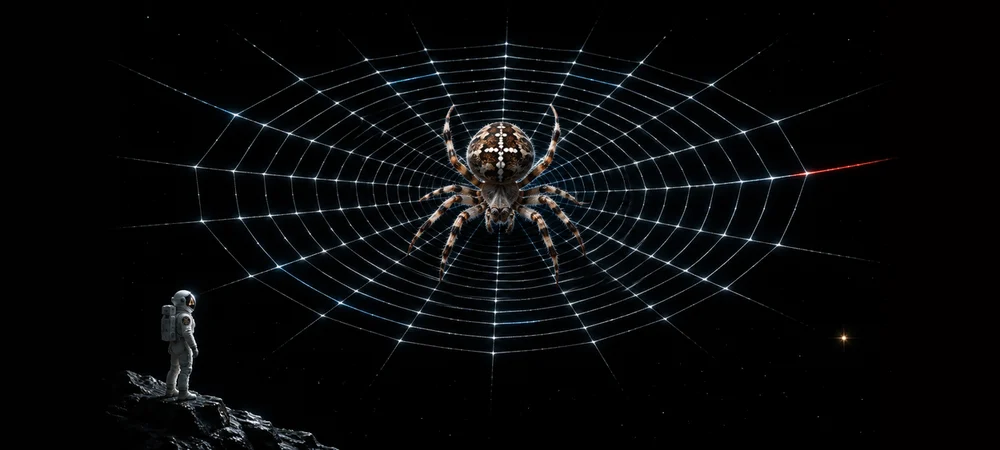
The spider spiritual meaning is about creation, pattern and the web you are weaving with your life. A spider makes its world out of its own body. It spins a thread, anchors it, builds a structure strand by strand and then stays alert to every tremor. So when a spider crawls across your floor, drops down in front of you or strings a web across your path, the message reads like the animal itself: look at what you are building, and notice what you are getting caught in.
Quick Answer: the spider spiritual meaning is creation, patience, pattern, connection and entanglement. A web asks what structure is holding your life together, a spider in your house points to the patterns you repeat at home, a spider crawling on you calls for immediate attention and clear boundaries, and repeated sightings mark a season of building. Spider symbolism also carries story and the gift of weaving, from Anansi, the Akan and Asante trickster of the tales, to Spider Woman, who gave weaving to the Diné.
At Code of Ascension, we read animal encounters as symbolic mirrors: real moments with real animals that reflect back what your own attention is ready to see. So the question is not only “What does a spider mean?” It is “What am I weaving, and what am I caught in?”
If you are new to reading animal signs, our Animal Symbolism guide shows how to tell an encounter, a personal association and a cultural tradition apart, and links every species guide in the series.
Spider Spiritual Meaning: Symbolism At A Glance
Here is the spider spiritual meaning in brief, encounter by encounter. Each line is the COA reading, and each comes with its own question.
- A spider web: what structure is holding your life together right now?
- A spider in your house: which pattern keeps repeating at home?
- A spider crawling on you: where do you need to pay attention, and where do you need a boundary?
- Seeing spiders again and again: what are you building slowly, and are you still showing up for it?
- A jumping spider: what are you ready to move toward instead of waiting for?
- A spider dream: what are you building, and what do you fear about it?
Spider symbolism, in one line: what you build, you live inside.
The Maker And The Pattern: The Core Spider Spiritual Meaning

First, the animal. Spiders are not insects. The Smithsonian’s National Museum of Natural History puts it simply: “An animal like a spider, which has eight legs, is not an insect” (Smithsonian: What Is an Insect?). Spiders are arachnids, a class named after a myth you will meet below (Britannica: Arachne). Every spider makes silk, a natural fiber the Natural History Museum in London describes as “made of protein,” spun from “structures called spinnerets on their abdomen” (NHM London: What are spider webs made of?).
Spider symbolism grows from that fact. Four themes carry it, and the traditions below add story and weaving. This is the COA reading.
Creation: you are weaving your life. A spider does not find its home. It makes it, from material produced inside its own body. The maker and the material are the same. Your habits are threads. Your words are threads. Your daily choices are the lines that hold the structure in place. The spider asks: are you weaving on purpose, or letting the pattern build itself?
Patience as readiness. The spider’s patience is not passive. A web builder prepares first, then waits in contact with its work, ready to respond the moment something touches a thread. A hunting spider watches, then moves. In the COA reading, spider patience means doing the preparation and staying alert, not waiting forever for life to arrive.
Boundaries: the edge of the web. Every web has a frame, a deliberate edge. Inside it, the spider’s world works. Outside it, the spider does not try to control everything. The spider asks where your structure ends, and what you are trying to hold that was never yours to hold.
Connection and entanglement. A web is two things at once. For the spider it is a network that carries information, a home that supports its life. For whatever flies into it, it is a trap. That double image is the heart of the spider spiritual meaning. The same pattern that connects you can also tangle you: a relationship, a routine, a commitment, a habit of thought.
Spider Web Spiritual Meaning: Structure, Sensitivity And Repair
The spider web spiritual meaning deserves its own reading, and the real webs are richer than the cartoon.
Not every spider builds a web. The Burke Museum’s spider myths series explains that “Only about half of the known spider species catch prey by means of webs.” The rest hunt or wait. “Hunting spiders use their silk for the dragline…, the egg sac, and in some species, the retreat,” and the museum names “members of the wolf spider, jumping spider, ground spider” families among the hunters (Burke Museum: Myth, all spiders make webs).
Not every web is a wheel. The round orb web is the classic picture, yet the Burke Museum says orb webs are “neither the most common type nor the ‘normal’ or standard type of web.” In fact, “In temperate regions, sheet webs are by far the most common, and cobwebs are also more abundant than orb webs.” It adds that “Sheet webs and funnel webs have no sticky silk” (Burke Museum: Myth, orb webs are normal). The Natural History Museum sorts British webs into “seven broad types: orb, sheet, tangle, funnel, lace, radial and purse” (NHM London: Spider webs).
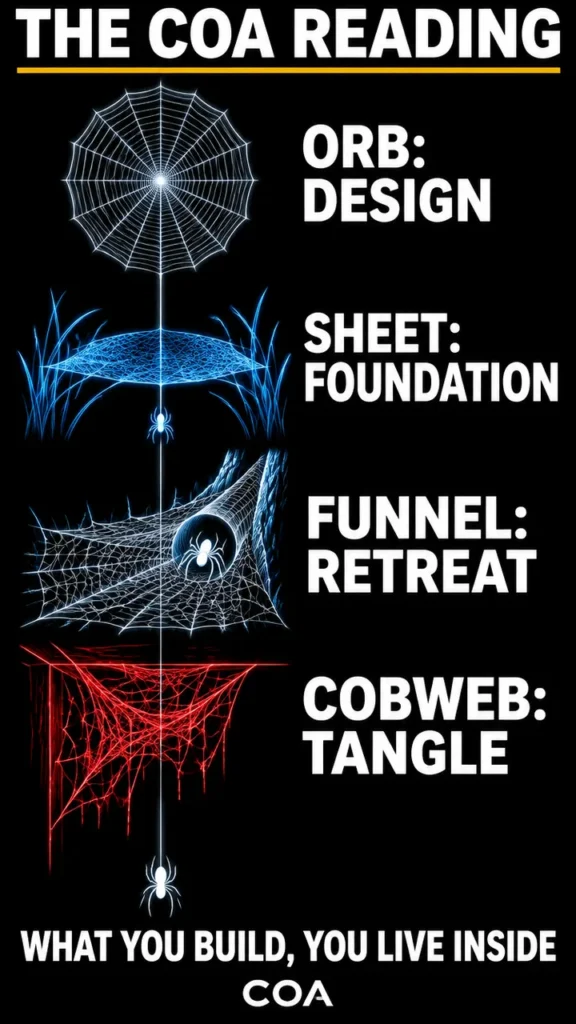
In the COA reading, the type of web you notice adds a shade to the spider spiritual meaning:
- An orb web: a deliberate design. A plan with a center, a frame and a clear purpose.
- A sheet web: a wide base. Foundations, steady ground, the support under your daily life.
- A funnel web: a retreat with an entrance. Your safe place, and who you let into it.
- A cobweb or tangle: a complicated knot. The situation that grew without a plan.
The web is a listening device. In orb webs, the Natural History Museum explains, the spider often “remains in contact by means of a signal thread,” and when prey arrives, “the spider approaches the source of the vibrations” (NHM London: Spider webs). That is sensitivity built into structure. The spider spiritual meaning of a web includes this: the life you build should tell you what is happening in it. If your systems never send you a signal until something breaks, the web needs a better line to the center.
Maintenance and repair. Some orb weavers rebuild on a daily rhythm. The Australian Museum says the garden orb weaving spider “constructs its web in the evenings and takes it down again at dawn” (Australian Museum: Garden Orb Weaving Spiders). The Natural History Museum adds that when an orb web “becomes badly damaged,” the spider “rolls the threads into a ball and eats them to recycle the silk components” (NHM London: Spider webs). Indiana University’s A Moment of Science puts it plainly: “The protein from the old silk is never wasted” (Indiana University, A Moment of Science: Spiders Recycling). That rhythm belongs to those orb weavers, not to every spider, and it gives the web its most practical lesson: take in what tore, keep what is useful, and build again.
People have long contemplated the order in natural forms, and our guide to Sacred Geometry Symbols explores how certain shapes became symbols. A web needs no secret formula to be meaningful; its lesson is in how it is made.
Seeing Spiders: Spider Spiritual Meaning In Your House And Beyond
The seeing spiders spiritual meaning changes with how the spider meets you. The middle column describes what is often happening. The last column is the COA reading.
| Encounter | What is often happening | The COA reading |
|---|---|---|
| One unexpected spider | A spider passing through on a dragline or the floor | Notice the thought you were having |
| Many spiders in your house | Late summer wandering by males, among indoor species | A pattern at home asks for attention |
| A spider in your bed | A wanderer that found a quiet place | What you carry into rest |
| A spider crawling on you | A spider exploring or traveling | Attention and boundaries, now |
| Spiders seen again and again | Seasonal activity | A season of building and patience |
| A dead spider | The end of one small life | A pattern or project that has finished |
One Unexpected Spider
A single spider that appears out of nowhere, especially one lowering itself on a silk line at eye level, marks a moment of timing. The Natural History Museum describes the dragline as a thread a spider anchors so a fall does not go far (NHM London: What are spider webs made of?). In the COA reading, a spider on a single thread is a message on a single thread: ask what you were thinking about the second it appeared.
Seeing A Lot Of Spiders In Your House: Spiritual Meaning
The popular story says spiders move inside in autumn to escape the cold. The Burke Museum lists that as a myth: “Spiders come into houses in the fall to get out of the cold.” It explains that “House spiders belong to a small number of species specially adapted for indoor conditions,” and that the wave of sightings, usually in late summer, has a simpler cause: “What you are seeing is sexually mature males wandering in search of mates” (Burke Museum: Myth, spiders come indoors).
So the spiders in your house most likely live there already. In the COA reading, seeing a lot of spiders in your house points to the patterns you repeat at home: the routines, the conversations and the atmosphere you spin day after day. Many spiders at once ask you to look at the whole web of your household, not one strand.
Some traditions read the house spider as a blessing. In a 1999 Illinois State Museum article, Judith A. Franke wrote that “The Muskogee Creek Indians today believe that a spider in the house means good health and good fortune” (Illinois State Museum: The Gift of Spider Woman).
A Spider In Your Bed
A spider in your bed is a wanderer that found a quiet place. In the COA reading, it turns attention to rest: what thoughts, worries or unfinished threads are you carrying into sleep? It is a nudge to clear the space you rest in, inside and out.
Seeing Spiders Repeatedly: The Spider Spiritual Meaning Of A Season
Spiders come in seasons, so one spider is ordinary. What makes repetition meaningful is the pattern around it: spiders every time you think about one project, or a web on the day you finally commit. Our Synchronicity Numbers Guide explores how repeating signs gain meaning through timing and context, and the same logic applies here. In the COA reading, repeated sightings mark a season of building. Keep showing up for the slow work.
Spider Crawling On Me: The Spider Spiritual Meaning Of A Spider On You
A spider crawling on you asks for a response right now. In the COA reading, the spider spiritual meaning here is attention and boundaries. Something is close, and you get to decide what is allowed on you and what is not.
Read it in two parts. First, attention: what were you focused on, or avoiding, when you felt it? Second, boundaries: how calmly can you respond to something that has crossed your edge? Brush it away gently or let it walk off onto a surface. The lesson lives in your reaction, not in handling the spider.
Folklore has its own reading of this moment, the British money spider, covered in the traditions below.
Spider Spiritual Meaning In Named Traditions

Spider symbolism has specific roots, and they belong to the people who carry them. As the Smithsonian’s National Museum of the American Indian puts it, “Clan and kinship systems are specific to each tribal community and may vary widely from one another” (Smithsonian NMAI: Honoring Animal Relatives). So each tradition below is named, not blended.
Anansi: The Akan And Asante Trickster Of The Stories
Britannica describes Ananse as an Akan character famous for his “insight, intelligence, and wisdom,” whose “normal form is a spider,” and notes that “According to the Asante people, who are part of the larger Akan culture in western Africa, Ananse can be a trickster.” It records that “Ananse was able to win a collection of stories, or wisdom narratives, from Nyame, the almighty creator and Sky God” (Britannica: Ananse).
He is not a simple helper. Smithsonian Folkways, describing folklorist Harold Courlander’s Ashanti: Folk Tales from Ghana, recorded in 1959 from stories “as they were told to him in Ghana,” calls Anansi “the popular trickster character of Ashanti folklore, who serves alternately as hero, villain, moral inspiration, and comic relief” (Smithsonian Folkways: Ashanti, Folk Tales from Ghana).
The tradition is alive. Britannica notes that Ananse folklore “appears to be quite extensive in the African communities throughout the Americas,” and that Anansesem stories sit “at the core of many of the moral tales told to children in Suriname.” The Natural History Museum in London calls Ananse, “also spelled Anansi and Anancy,” a “folk hero of the West African heritage diaspora,” and says “he is known as the keeper of stories” (NHM London: Ananse).
In the COA reading, Anansi gives the spider spiritual meaning its wit: intelligence, improvisation, storytelling and the consequences of cunning, all in one character.
Spider Woman And The Diné Gift Of Weaving
The Bard Graduate Center’s exhibition Shaped by the Loom tells the Diné (Navajo) story of Spider Woman, “who brought the gift of weaving to them.” She “collected wood for her husband, Spider Man, to construct a loom,” and “Spider Woman then wove the first pattern of the universe.” She “gifted her weaving knowledge to the Diné so that they could integrate hózhó into their daily lives,” which the exhibition defines as “the harmony, balance, and local order established between the Diné people” and their world. It adds that “Diné women are at the center of both the Navajo creation story and textile production” (Bard Graduate Center: Spider Woman and the Role of Diné Women).
Judith A. Franke’s Illinois State Museum article adds that “The Navajo leave this spirit line in the motifs of both basketry and textiles,” and, separately, that “The Pomo and Hupa Indians of California believe that a break left in the motif is a pathway” that “allows Spider Grandmother to enter and inspect the finished basket, then leave” (Illinois State Museum: The Gift of Spider Woman). These are distinct teachings of distinct nations, and they belong to them. What carries into the COA reading, respectfully, is that weaving is world making.
Arachne In Ovid’s Metamorphoses
Arachne’s story comes to us through Ovid’s Roman literary telling of the Greek myth, in Book VI of the Metamorphoses. She is famous for one thing: “The girl was not known for her place of birth, or family, but for her skill.” She challenges the goddess Minerva (Pallas) directly: “Contend with me.” Her tapestry shows the gods’ deceptions, such as “Europa deceived by the form of the bull,” and Ovid is clear about its quality: “Neither Pallas nor Envy itself could fault that work.” Transformed, she still “as a spider, weaves her ancient web” (Ovid, Metamorphoses Book VI, A.S. Kline translation). Britannica adds that the goddess tore the work to pieces, “Enraged at the perfection of her rival’s work (or, alternatively, offended by its subject matter)” (Britannica: Arachne).
So this is not a tale of a poor weaver punished. It is about skill, pride and power, and the truth Arachne told through her craft. In the COA reading, Arachne adds an edge to the spider spiritual meaning: the courage to stand behind your work, and the fact that making survives.
The British Money Spider
In Britain, tiny spiders landing on people became a luck sign. The British Arachnological Society’s factsheet identifies money spiders as members of “one family, the Linyphiidae,” and records that “One widespread folk myth was that when a Money spider lands on you it has arrived to weave a new set of clothes.” It explains: “When clothes were very expensive, this was indeed equivalent to a gift of money.” The same factsheet notes older customs of tossing the spider over the left shoulder or circling it round the head for good fortune (British Arachnological Society: Money Spiders).
That is a historical charm, not a recipe. In the COA reading, the money spider adds a lucky note to the spider spiritual meaning: being newly clothed with a fresh role, a new skill or a new season of resources arriving through work you are already weaving.
Spider Spiritual Meaning By Color And Kind
Color readings add a modern layer to the spider spiritual meaning. They are contemporary interpretations, not ancient rules, and color alone cannot tell you a spider’s species.
- White spider spiritual meaning: a clean thread. Many people read a pale spider as clarity, pure intention or a fresh start in a creative project.
- Black spider spiritual meaning: depth and the unknown. A dark spider often points to the hidden material that wants attention before you build further, the kind of work our guide to Shadow Work Meaning explores.
- Brown spider spiritual meaning: earth and the everyday. Grounded, practical building.
Jumping spider spiritual meaning: the jumping spider is the hunter that never waits in a web. The Burke Museum names it among the hunters that make no prey-catching web. In the COA reading, the jumping spider is the active side of the spider spiritual meaning: focused attention, a measured leap, and the courage to go toward what you want rather than waiting for it to land in your structure.
Spider Spiritual Meaning In Work, Creativity And Love

In creative work, the spider is the patron of long projects. A web starts with a few strong anchor lines, then the frame, then the fill. Set the anchors of your project first: the core idea, the schedule, the space. In work, the spider spiritual meaning points to the habits that support everything else, and asks whether a signal reaches you before something breaks. When a draft or a launch tears, take in the old silk, keep what worked and spin again.

In love, the spider asks what pattern you keep weaving. In the COA reading, the spider spiritual meaning in love is about repetition: the same argument, the same type of partner, the same silence after conflict. Name the pattern and you can rebuild it. A web can be shelter or snare, so ask honestly which one a bond feels like. If it is worth keeping, mend the strand that broke instead of tearing down the whole structure.
Spider Spiritual Meaning In Dreams: Webs, Traps And Approaching Spiders
In the COA reading, spider dream meaning points to what you are building and how you feel about it. Spiders in dreams are rarely about spiders, and the spider spiritual meaning in a dream is about structure, closeness and control.
- Building or watching a web: a project, plan or relationship is taking shape. If you are spinning, your creative power is active. If you are watching someone else spin, notice whose design you are living inside.
- Being trapped in a web: entanglement. A commitment, a habit or a situation feels sticky. The dream asks which single thread, if cut or loosened, would set you free.
- A spider approaching you: something is coming closer that you have not fully faced, perhaps a decision, perhaps your own ambition.
- Many spiders: many small projects or worries at once. Which one deserves your silk?
The most important clue is your feeling. Calm curiosity around a dream spider points to creative readiness. Fear points to a pattern you sense but have not named. Neither feeling predicts what someone else will do. They tell you about your own web.
Record four things when you wake: the image, the spider’s action, your feeling and what is happening in your waking life. If spider dreams repeat and you want to meet them awake inside the dream, our guide to Lucid Dreaming shows how. To track your dream symbols over time, the free Dream & Sleep Signs Tracker in the Free Ascension Library gives you a simple log for patterns like the spider.
How The Spider Spiritual Meaning Differs From Other Animal Signs
Here is how the spider compares with other animal signs, in the COA reading.
| Sign | Its core theme | How the spider differs |
|---|---|---|
| Spider | Creation, pattern, entanglement | The maker of structures |
| Moth | Night, light and orientation | The moth seeks a light; the spider builds a pattern |
| Ladybug | Luck, wishes and gentle blessing | The spider earns its catch through craft |
| Dragonfly | Transformation across life stages | The spider maintains rather than changes form |
Go deeper with our guides to Moth Symbolism, the Ladybug Meaning and the Dragonfly Meaning.
What To Do When You See A Spider: The Web And Pattern Reflection
When a spider crosses your path, turn the moment into a map of your own web. Take a sheet of paper and a pen.
- Draw the center. In the middle, write one central commitment in your life right now: a project, a relationship, a goal.
- Add the supporting threads. Draw four to six lines out from the center. Label each one with something that holds the commitment up: a habit, a person, a skill, a routine.
- Find the torn thread. Mark one thread that needs repair. What has frayed?
- Find the sticky thread. Mark one thread that entangles you rather than supports you. What keeps pulling you off center?
- Choose one action. Pick one concrete step this week: mend the torn thread, or loosen the sticky one.
If the sticky thread is an attachment you are ready to release, our guide to Cord Cutting Ritual Meaning offers one way to work with it.
You can write it down too. Use these journal prompts:
When I saw the spider, I was thinking about [what was on your mind].
The center of my web right now is [your central commitment].
The thread that needs repair is [what has frayed], and the thread that entangles me is [what pulls you off center].
My one action this week is [one concrete step].
Frequently Asked Questions About Spider Spiritual Meaning

What is the spider spiritual meaning?
The spider spiritual meaning is creation, patience, pattern, connection and entanglement. At Code of Ascension, we read the spider as a sign that you are weaving your own life, thread by thread, and that every pattern you build can either support you or catch you. Its two questions are simple: what are you building, and what are you getting caught in?
Is seeing a spider a good omen?
Many traditions read the spider kindly. In British folklore, a money spider landing on you was said to weave new clothes, which once meant a gift of money. The Muskogee Creek, according to the Illinois State Museum, link a spider in the house with good health and good fortune. In the COA reading, a spider is a creative sign that asks you to look at what you are building.
What does it mean to see a lot of spiders in your house?
The Burke Museum explains that house spiders are species adapted to indoor life, and that waves of sightings, usually in late summer, are often mature males wandering in search of mates. So they most likely live there already. In the COA reading, many spiders in your house point to the patterns you repeat at home and ask you to look at the whole web of your household.
What is the spider web spiritual meaning?
In the COA reading, a spider web is the structure holding your life together: your commitments, habits and connections. It is also a listening device, since an orb weaver often stays in touch with its web through a signal thread. A web asks whether your life sends you clear signals, whether it needs repair, and whether it supports you or tangles you.
Do all spiders spin webs?
No. The Burke Museum explains that only about half of the known spider species catch prey by means of webs. The others hunt or wait for prey, including wolf spiders and jumping spiders, though all spiders make silk. In the COA reading, web builders speak to patience and structure, while hunters like the jumping spider speak to focused attention and decisive movement.
What does a white spider mean spiritually?
White spider meanings are modern interpretations rather than ancient rules, and color alone cannot identify a spider’s species. Many people read a pale spider as a clean thread: clarity, pure intention or a fresh start in a creative project. In the COA reading, the color adds tone, but the encounter and its timing carry the main message.
What does a dead spider mean spiritually?
In the COA reading, a dead spider marks the end of a pattern. A project, a habit or a stage of a relationship may have run its course, and the web it built is ready to be taken down. Like the orb weaver that takes in its old silk and spins again, you can keep what was useful and build something new.
What does it mean to dream about spiders?
In the COA reading, spider dream meaning points to what you are building and how you feel about it. Building or watching a web suggests a plan taking shape, being trapped suggests entanglement, and a spider approaching suggests something you have not fully faced. Your feeling in the dream is the strongest clue. Record the image, the action, the feeling and your waking context.
Explore The Animal Symbolism Series

The spider is one voice in a larger language. Our Animal Symbolism hub explains how to read any animal encounter and keep an encounter journal. From there, compare the spider’s pattern making with the moth’s search for light in Moth Symbolism, or with the transformation in the Dragonfly Meaning.
Final Thoughts: The Spider Spiritual Meaning Is Deliberate Creation

A spider does not wait for the perfect home. It makes one, from its own body, line by line, and it stays alert to every tremor in what it has built. When the web tears, the orb weaver takes in the old silk and spins again. That is the spider spiritual meaning in a single picture: deliberate creation, patient readiness and the honesty to see when a pattern supports you and when it catches you.
The next time a spider crosses your floor or drops down in front of you, take it as a question: what am I weaving, and do I want to live inside it? Build. Listen. Rebuild.
Keep exploring the animal guides:
- Animal Symbolism: Meanings and Encounters
- Moth Symbolism
- Ladybug Meaning
- Dragonfly Meaning
- Owl Spiritual Meaning
- Shadow Work Meaning
About The Author
Author: King | Founder of Code of Ascension
King is the founder of Code of Ascension, a spiritual education platform focused on consciousness, symbolism, manifestation, nervous system awareness, and hidden patterns of reality. Through Code of Ascension, he explores ancient wisdom and modern insights to help others awaken, align, and ascend.
Keep Ascending 🚀