
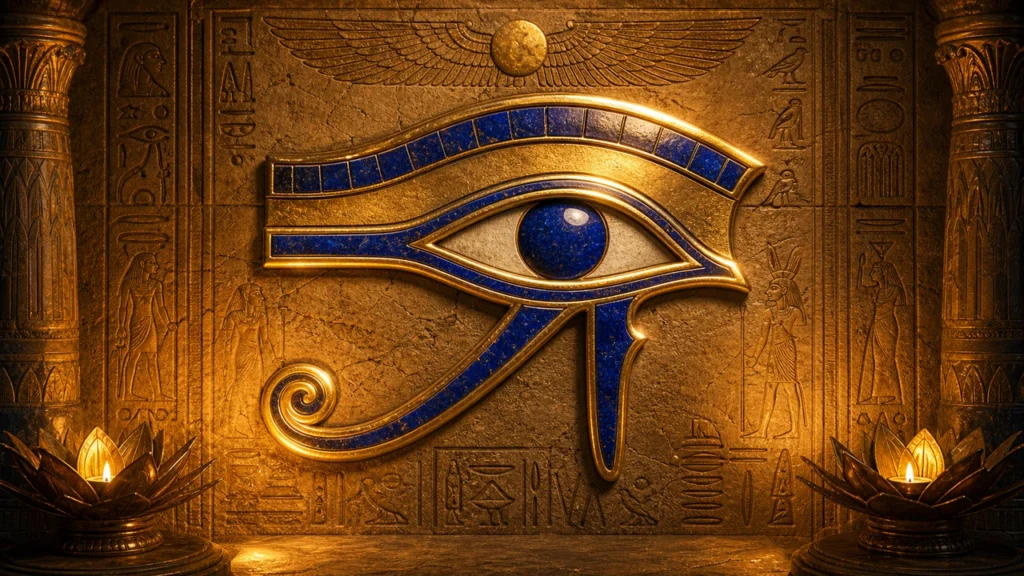
The Eye of Horus is one of the most recognizable symbols from ancient Egypt, but its meaning goes far deeper than decoration. It is a symbol of protection, healing, restoration, wholeness, spiritual sight, and recovered power. It carries the energy of a sacred eye that was wounded, restored, and made whole again.
If you feel drawn to this symbol, you may be responding to more than its beauty. The Horus eye speaks to the part of you that wants clarity after confusion, protection after vulnerability, and inner sight after spiritual amnesia. It is not merely an image that looks mystical. It is a symbol of perception returning.
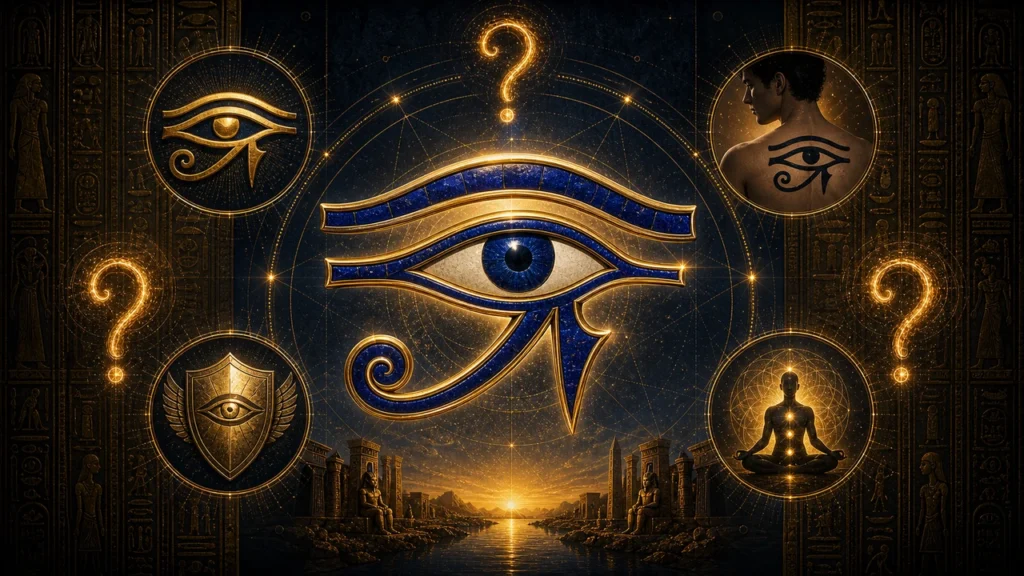
This guide explains the Eye of Horus meaning in ancient Egypt, its connection to Horus and the wedjat eye, why it became a protection symbol, what it means spiritually, how it differs from the Eye of Ra, and what it can mean as a tattoo.
Fast Answer: What Does the Eye of Horus Mean?
The Horus eye is an ancient Egyptian symbol connected to protection, healing, restoration, wholeness, and spiritual sight. In myth, Horus loses his eye in conflict with Seth, and the eye is restored. Because of that restoration, the symbol became associated with recovered power, protection from harm, renewal, and the return of sacred order.
The symbol is also known as the wedjat eye. Museum collections often describe wedjat amulets as protective objects connected to healing, regeneration, and good health. Spiritually, the symbol can be read as a reminder to protect your energy, trust your perception, and restore the parts of yourself that have been fragmented by fear or confusion.
What Is the Eye of Horus?
The Horus eye is a stylized Egyptian eye associated with Horus, the falcon-headed god. Its shape combines the human eye with markings that echo the falcon, which connects the symbol to divine sight, sky power, kingship, and protection.
In the mythic story, Horus battles Seth, a figure connected with conflict and disruption. Horus loses his eye, and the damaged eye is later restored. That restored eye becomes the wedjat, often understood as the whole, sound, or completed eye.
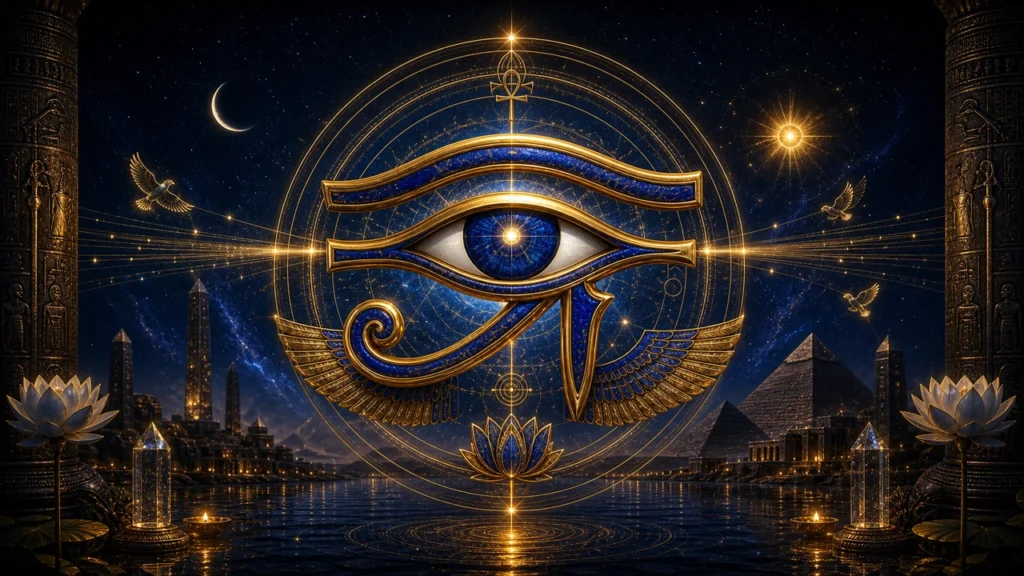
This is the heart of the symbol. It is not only an eye that sees. It is an eye that has survived rupture and returned to wholeness.
That is why the symbol resonates with people who have moved through betrayal, grief, spiritual confusion, emotional fragmentation, or a season where their inner vision felt damaged. It represents the moment perception comes back online.
Eye of Horus Meaning in Ancient Egypt
In ancient Egypt, the wedjat appeared on amulets, jewelry, coffins, temple imagery, and ritual objects. It was not treated as a casual design. It carried protective and regenerative meaning.
The Metropolitan Museum of Art describes a wedjat eye amulet as embodying healing power and symbolizing rebirth, with the amulet thought to protect its wearer and transfer regenerative force. The British Museum and Museo Egizio also identify wedjat-eye amulets as ancient protective and regenerative objects.
Ancient Egyptians did not separate symbol and power in the modern way. A sacred image could act as a bridge between the visible and invisible worlds. A symbol could focus divine presence, mythic memory, and spiritual function.
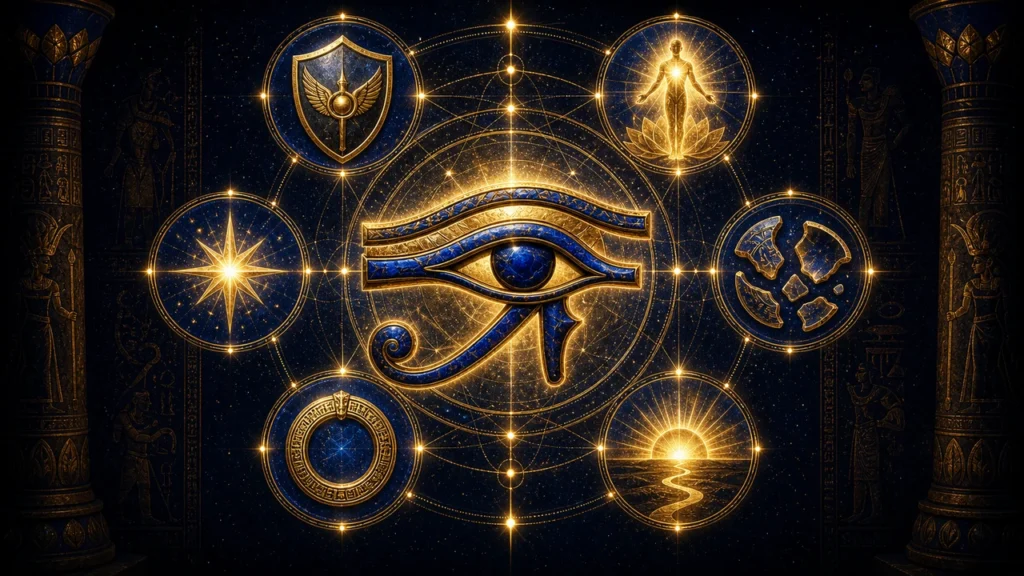
The wedjat carried several linked meanings:
- Protection.
- Healing.
- Restoration.
- Wholeness.
- Rebirth.
- Sacred sight.
- The return of order after disorder.
This is why the symbol feels so alive. It does not simply represent protection as defense. It represents protection through restored wholeness.
Eye of Horus Symbol Meaning
The Eye of Horus symbol meaning begins with vision. An eye sees. It notices. It watches. It perceives what is hidden. In spiritual symbolism, eyes often point to awareness, consciousness, divine attention, intuition, and the ability to see through illusion.
But this symbol adds another layer: the eye was restored.
That means its sight is not naive. It is not innocent sight untouched by darkness. It is sight that has passed through conflict and returned wiser.
The symbol can represent:
- Seeing clearly after confusion.
- Healing after spiritual battle.
- Reclaiming power after fragmentation.
- Protection through perception.
- Wisdom gained through trial.
- Inner vision restored after fear.
This is one reason the Horus eye belongs beside other protection symbols. Like the evil eye, it is connected to sight and energetic defense. But its emotional tone is different. The evil eye often focuses on warding off harmful gaze, envy, or projection. The Horus symbol focuses on restored perception, divine protection, and wholeness after damage.
Eye of Horus Spiritual Meaning
Spiritually, the Horus eye points to inner sight. It reminds you that protection is not only about blocking what is outside you. Sometimes protection is the ability to see clearly enough that manipulation, illusion, and confusion cannot enter as easily.
This is a very Code of Ascension reading of the symbol: perception is protection.
When your inner eye is fragmented, you may ignore warning signs, abandon your intuition, confuse intensity for truth, or give your power away to people and systems that drain you. When your inner eye is restored, you begin to notice what your body, energy, and spirit have been trying to tell you.
The symbol can become a reminder to ask:
- Where have I stopped trusting what I see?
- What part of me needs restoration?
- What pattern becomes obvious when I stop denying it?
- What would protection look like if I honored my perception?
This does not mean the symbol guarantees psychic power or supernatural protection. It means the symbol can focus your attention on clarity, discernment, and restoration.
Eye of Horus Protection Meaning
The protection meaning is rooted in ancient amulet use and mythic restoration. Historically, the wedjat was worn, placed, carved, or included in sacred contexts as a sign of protection and regenerative power. Spiritually, it can be understood as protection that comes through watchfulness, wholeness, and divine order.
Protection here has two layers.
Outer protection is the symbolic shield: the sense of being watched over, guarded, and held by sacred order.
Inner protection is discernment: the ability to see what is happening before your energy is consumed by it.
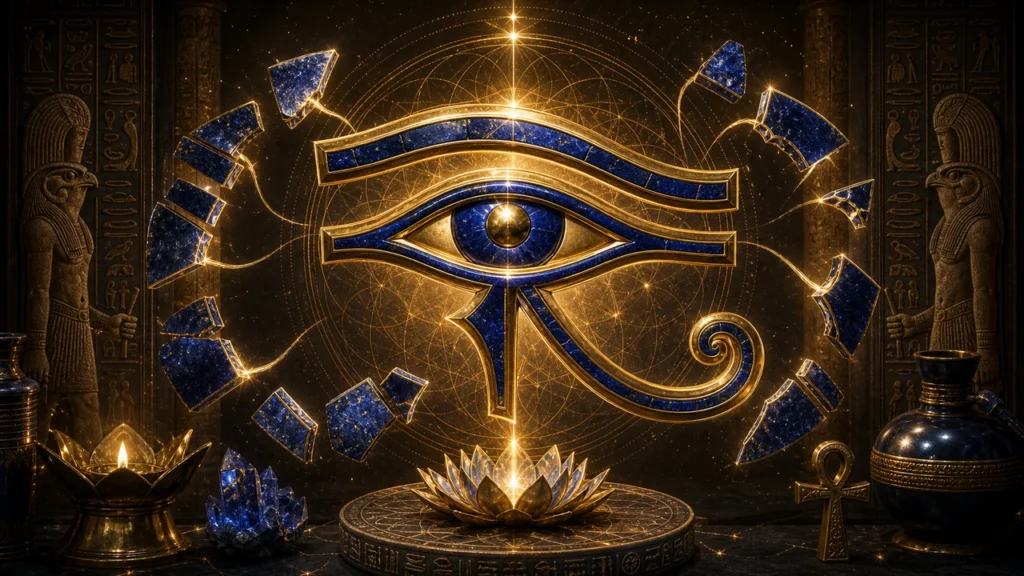
That is why this symbol works beautifully in a broader protection practice. It does not have to be used as superstition. It can be used as a reminder:
- Stay awake.
- Trust your perception.
- Restore your center.
- Do not hand your energy to confusion.
- Let clarity protect you.
For more protective symbols, see Spiritual Protection Symbols, where the Horus eye sits beside the ankh, evil eye, pentagram, and other signs of energetic boundary.
To compare the wedjat with other protective symbols and keep a reference nearby, explore The Protection Symbols Grimoire, which includes origins, traditions, altar cards and printable reflection pages.
Eye of Horus and the Third Eye
Many modern spiritual seekers connect the Horus eye with the third eye, intuition, pineal gland symbolism, and awakened perception. That connection is understandable because the symbol is literally an eye and because its deeper meaning centers on restored sight.
Still, it is important not to flatten ancient Egyptian symbolism into only a modern third-eye concept. The original context belongs to Horus, the wedjat myth, protection, healing, and sacred order. The modern third-eye interpretation can be meaningful, but it should be treated as a later spiritual reflection rather than the only definition.
Read this layer carefully:
- Ancient layer: Horus, restoration, protection, wholeness, amulets, divine order.
- Modern spiritual layer: intuition, inner vision, consciousness, discernment, expanded perception.
- Personal layer: what the symbol awakens in your own life.
The symbol is powerful because all three layers can speak at once.
Eye of Horus vs Eye of Ra
People often confuse the Horus eye and the Eye of Ra because both are Egyptian eye symbols connected to divine power. They overlap visually and symbolically, but they are not identical.
The Horus symbol is usually associated with healing, restoration, protection, wholeness, and the moonlike rhythm of damage and repair. It feels restorative, watchful, and protective.
The Eye of Ra is more often associated with solar force, divine authority, heat, wrath, royal power, and the fierce extension of Ra’s will. It feels more commanding and fiery.
The simplest distinction:
- Horus: restoration, protection, healing, wholeness, recovered sight.
- Ra: solar power, authority, force, divine heat, fierce protection.
This difference matters when reading jewelry, tattoos, artwork, or spiritual imagery. One eye may be calling you toward healing and clarity. The other may be calling you toward sovereignty, power, and decisive force.
Eye of Horus Tattoo Meaning
Tattoo meaning depends on the person wearing it, but the most common themes are protection, inner vision, healing, Egyptian spirituality, personal transformation, and recovered strength.
A tattoo makes a symbol intimate. It is not only something you look at; it becomes part of the body. That is why the intention matters.
People may choose this tattoo to represent:
- Protection from negative energy.
- Trust in intuition.
- Healing after a painful chapter.
- Connection to ancient Egyptian wisdom.
- Spiritual awakening.
- Seeing through illusion.
- Reclaiming power after loss.
Placement can also shift the tone. Near the wrist or hand, it may symbolize conscious action and protection in daily life. Near the heart, it may symbolize emotional healing and guarded compassion. Near the back or neck, it may symbolize unseen protection or watchfulness. Near the third eye area in artwork or symbolic designs, it may emphasize intuition and inner perception.
Before choosing it as a tattoo, study the symbol respectfully. Ask whether you are drawn to the aesthetic, the Egyptian meaning, the protection symbolism, or the personal story of restoration. A sacred symbol deserves more than surface-level attraction.
Wearing the Wedjat as Jewelry
Many people encounter the wedjat through necklaces, rings, bracelets, charms, and protective jewelry. That makes sense historically, because ancient amulets were not only decorative. They were worn close to the body as signs of protection, regeneration, and spiritual identity.
In modern use, wearing the Horus eye can mean several things. For one person, it may be a reminder to trust intuition. For another, it may represent Egyptian ancestry, spiritual curiosity, or a personal healing chapter. For someone else, it may simply be a beautiful ancient symbol that invites deeper study.
The important thing is intention. A sacred symbol worn casually is still a sacred symbol. You do not need to be perfect to wear it, but you should be willing to learn what it carries.
If you choose jewelry with this symbol, ask yourself:
- Am I wearing this for protection, identity, beauty, or remembrance?
- Do I understand the wedjat layer, not only the aesthetic?
- Does this piece remind me to see clearly?
- Does it help me return to my center instead of outsourcing power to an object?
Jewelry can be powerful because it turns meaning into a daily reminder. The object does not do your discernment for you. It calls you back to it.
Colors and Materials in Modern Use
Modern jewelry and artwork often place the wedjat in gold, silver, lapis blue, turquoise, black, or green tones. These color choices can add emotional symbolism, even when they are not strict ancient rules.
Gold may emphasize solar power, divinity, value, and sacred presence. Silver can feel lunar, intuitive, reflective, and protective. Blue and turquoise often suggest clarity, sky, water, healing, and ancient Egyptian visual language. Black can point to mystery, boundary, shadow wisdom, or protection. Green may suggest regeneration, life, renewal, and the return of vitality.
Materials matter too. Metal can feel strong and protective. Stone can feel grounding. Enamel or glass can make the symbol bright and devotional. Ink on skin can make the symbol personal and permanent.
The deeper point is not that one color is automatically correct. The deeper point is that symbols become stronger when your intention is clear. Choose the version that reflects the kind of restoration, sight, and protection you are actually calling into your life.
Eye of Horus Meaning for Love, Money, and Daily Life
The Horus eye can also be read as a practical spiritual mirror.
In love, it asks whether you are seeing clearly. Are you protecting your heart without closing it? Are you trusting your intuition when something feels misaligned? Are you letting old wounds distort your perception, or are you allowing healing to restore your sight?
In money and career, it asks whether your ambition is guided by clarity. Are you able to see opportunities without being blinded by fear? Are you protecting your energy from roles, clients, or expectations that drain you? Are you restoring confidence after a setback?
In spiritual growth, it asks whether you are confusing information with wisdom. The modern world gives constant content, but sacred sight is quieter. It is the ability to know what matters, what is noise, and what is asking for healing.
This symbol does not ask you to become suspicious of everything. It asks you to become perceptive.
Eye of Horus, Ankh, and Egyptian Symbolism
The symbol becomes even richer when placed beside other Egyptian signs.
The ankh is connected to life force, breath, eternal life, and spiritual vitality. The Horus eye is connected to protection, healing, restoration, and sight. Together, they create a language of life and vision.
The pyramids in Egypt point toward sacred structure, mystery, initiation, and alignment between earth and sky. The Anubis meaning article explores death, transition, guardianship, and the afterlife. In that larger symbolic world, the Horus eye sits as a sign of recovered sight within a universe ordered by spiritual law.
This is the power of Egyptian symbolism: each sign opens a doorway, but together they form a temple.
Common Misconceptions About the Horus Eye
One common misconception is that the symbol is only an occult image. That reading is too narrow. The wedjat belongs first to ancient Egyptian religious and protective symbolism. Modern esoteric readers may add layers of intuition, inner sight, or hidden wisdom, but those later meanings should not erase the older sacred context.
Another misconception is that it is the same as the evil eye. Both symbols involve sight and protection, but they do not carry the same story. The evil eye is usually connected to harmful gaze, envy, projection, and the need to ward off energetic negativity. The Horus symbol is connected to restoration, divine order, and recovered perception after injury.
A third misconception is that it is only about the third eye. That is a meaningful modern association, but it is not the whole symbol. Ancient context matters. If the modern spiritual reading is the only layer you keep, you lose Horus, Seth, the wedjat, amulets, regeneration, and the Egyptian worldview that gave the symbol its original depth.
The cleanest approach is layered: honor the ancient meaning first, then explore modern resonance with humility.
How To Read the Symbol Respectfully
Start with context. Ask where the image appears, who is using it, and what tradition is being referenced. A museum amulet, a tattoo, a necklace, a meditation image, and a decorative graphic may all use the same shape, but they are not automatically doing the same spiritual work.
Then ask what the symbol is awakening in you. Does it make you think about protection? Healing? Intuition? Recovered strength? A need to trust what you see? Your response is not the entire historical meaning, but it can reveal why the symbol has entered your awareness.
Finally, avoid turning sacred imagery into a costume. Ancient symbols carry cultural, historical, and spiritual weight. You can study them, wear them, meditate on them, or create art with them, but do it with reverence. Respect keeps spiritual curiosity from becoming spiritual consumption.
Go Deeper With Code of Ascension
If you are studying sacred symbols, continue with Spiritual Protection Symbols to place this symbol in a wider protection system. You can also compare it with Evil Eye Meaning to understand how different eye symbols carry different spiritual tones.
For a softer next step into spiritual alignment and conscious creation, download the free Manifesting Your Dreams ebook. You can also explore more guides on the Code of Ascension blog.
Eye of Horus FAQ
What does the Eye of Horus mean spiritually?
Spiritually, the Eye of Horus means protection, healing, restoration, wholeness, and awakened perception. It represents an eye that was wounded and restored, which makes it a powerful symbol of recovered clarity. Many modern seekers also connect it with intuition, inner sight, and protection through spiritual discernment.
What is the Eye of Horus symbol meaning?
The Eye of Horus symbol meaning comes from ancient Egyptian mythology and the restored eye of Horus. It represents healing, protection, regeneration, and the return of order after conflict. As a symbol, it points to sacred sight, recovered power, and the ability to become whole again after fragmentation.
Is the Eye of Horus good or bad?
The symbol is generally understood as protective and restorative, not bad. In ancient Egyptian contexts, wedjat eye amulets were connected with healing, protection, and regeneration. Like all symbols, its meaning depends on context, use, intention, and the tradition interpreting it.
What is the Eye of Horus protection meaning?
The Eye of Horus protection meaning is connected to divine watchfulness, amulet use, restored wholeness, and clear perception. It can symbolize being guarded from harm, but it also represents inner protection through discernment. In spiritual practice, it reminds you to see clearly and protect your energy.
What does an Eye of Horus tattoo mean?
An Eye of Horus tattoo can mean protection, intuition, healing, Egyptian spirituality, personal transformation, and recovered strength. Because a tattoo places the symbol on the body, the intention matters. Many people choose it to represent spiritual sight, protection from negative energy, or healing after a difficult chapter.
What is the difference between Eye of Horus and Eye of Ra?
The Horus eye is usually associated with healing, restoration, protection, and wholeness. The Eye of Ra is more often associated with solar power, divine force, authority, and fierce protection. Horus feels more restorative and watchful, while Ra feels more fiery, commanding, and forceful.
Is the Eye of Horus connected to the third eye?
Many modern spiritual seekers connect the Horus eye with the third eye, intuition, and inner vision. That can be a meaningful modern interpretation, but it should not erase the ancient Egyptian context. The older meaning centers on Horus, the wedjat eye, protection, healing, restoration, and sacred order.
Why do people wear the Eye of Horus?
People wear the symbol for protection, spiritual identity, connection to ancient Egypt, intuition, and healing symbolism. Historically, wedjat eye amulets were used as protective and regenerative objects. Today, people may wear it as jewelry or body art to represent clarity, wholeness, and energetic protection.
Final Thoughts
The Horus eye is not only a symbol of seeing. It is a symbol of seeing again after something has been wounded.
That is why it still speaks across time. It carries the memory of protection, healing, and return. It reminds you that clarity can be restored. Power can be reclaimed. The part of you that lost sight can open again.
Sometimes a symbol enters your life because it is beautiful. Sometimes it enters because it is ancient.
And sometimes it enters because something in you is ready to become whole.
About The Author
Author: King | Founder of Code of Ascension
King is the founder of Code of Ascension, a spiritual education platform exploring angel numbers, manifestation, consciousness, symbolism, energetic protection, nervous system alignment, and practical ascension work. His writing blends grounded spiritual insight with clear, usable guidance for readers who want meaning, discernment, and transformation without losing their center.
Keep Ascending 🚀