
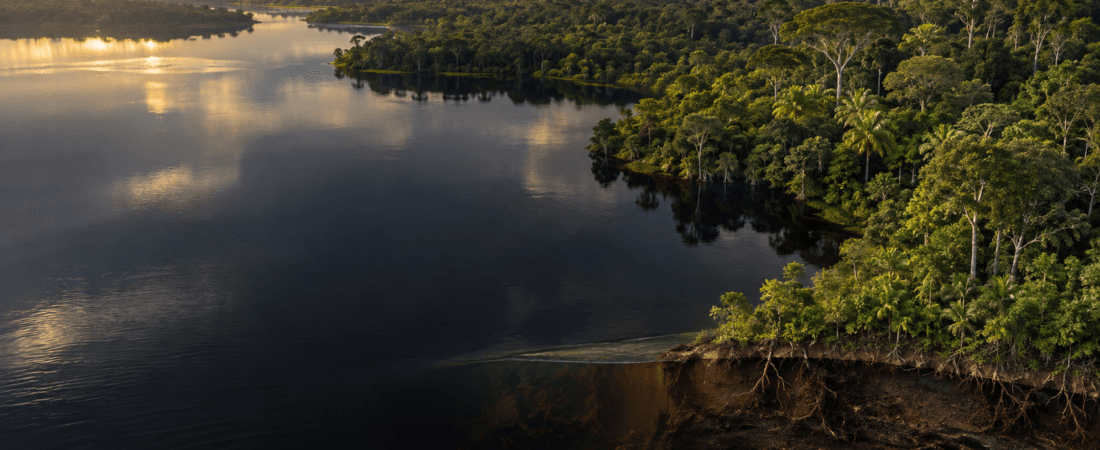
Scientists have traced ancient peat carbon from the Congo Basin peatlands into two large lakes in the central Congo Basin. The finding reveals a pathway that connects one of Earth’s largest stores of tropical peat carbon to the modern atmosphere. It does not mean the entire peatland is suddenly collapsing, but it does show that this carbon vault is more active than a sealed underground deposit.
The 2026 study focused on Lake Mai Ndombe and Lake Tumba in the Democratic Republic of the Congo. Researchers found that about 39 to 40 percent of the dissolved inorganic carbon sampled in the lakes came from old peat. The mean radiocarbon age was about 2,170 years in Lake Mai Ndombe and 3,515 years in Lake Tumba.
Those numbers matter because the lakes sit within the Cuvette Centrale, the world’s largest known tropical peatland complex. A 2022 field-based estimate put its area at roughly 167,600 square kilometers and its below-ground carbon stock at about 29 billion metric tons.
What Are the Congo Basin Peatlands?
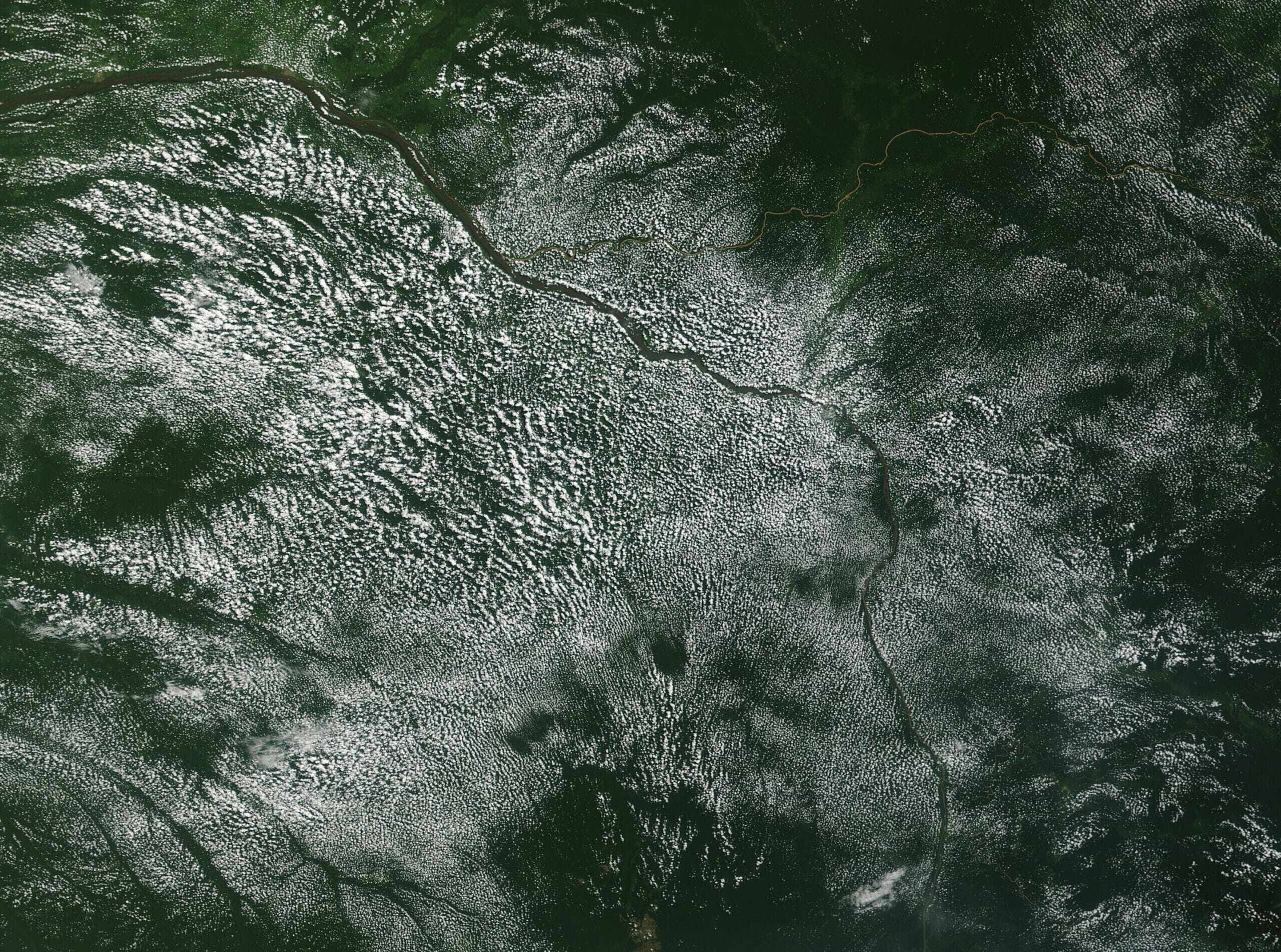
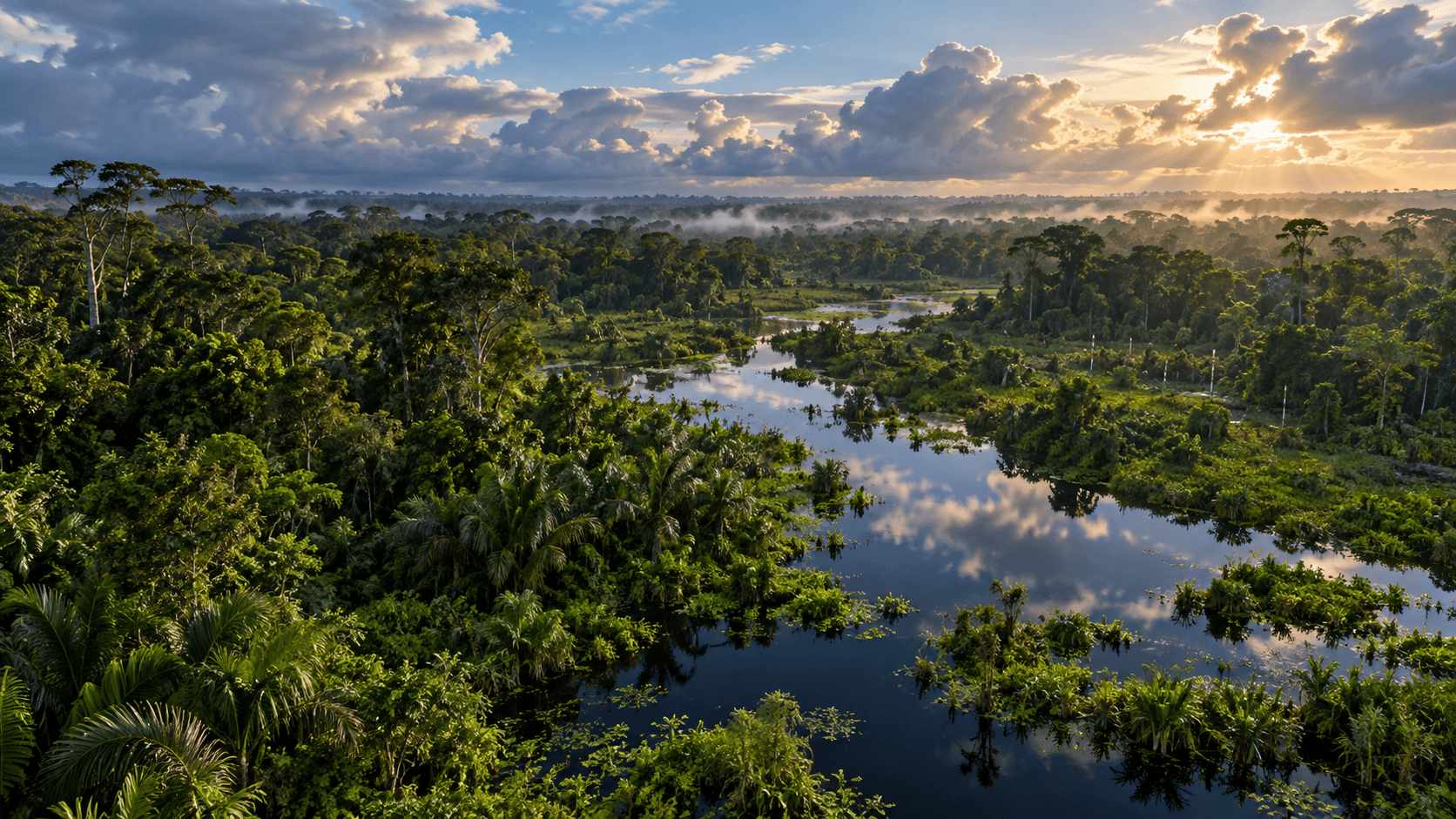
The Cuvette Centrale is a broad, low-lying depression near the center of the Congo Basin. Its swamp forests extend across parts of the Democratic Republic of the Congo and the Republic of the Congo. Much of the ground stays waterlogged for long periods, which slows the decomposition of fallen leaves, wood, roots, and other plant material.
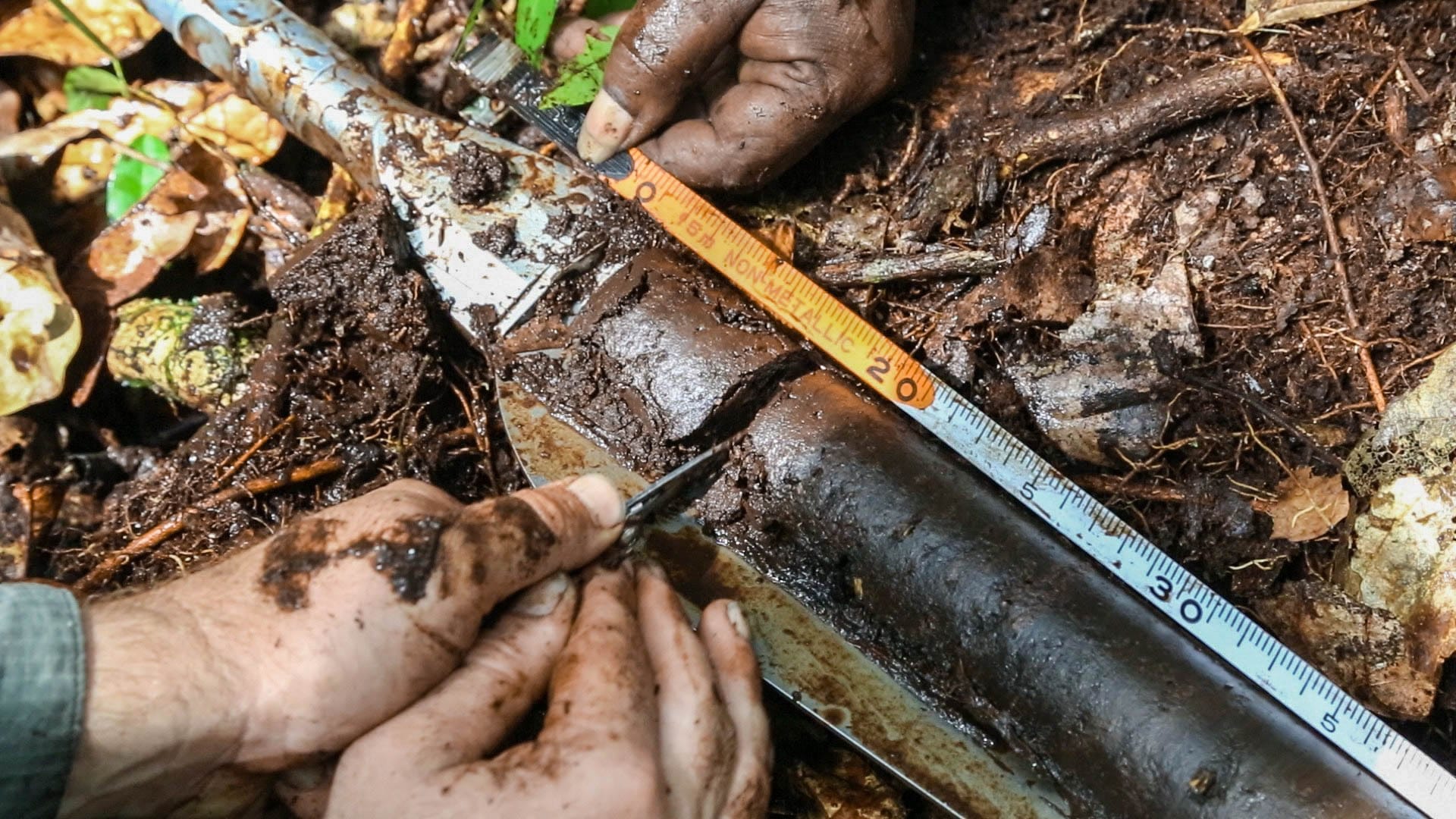
Over thousands of years, partially decomposed vegetation accumulated as peat. The resulting layer is not uniform. A 2022 mapping study used field data from both countries to estimate a mean peat thickness of 1.7 meters, with measured depths reaching 5.6 meters. The same research estimated that the complex contains about 28 percent of the world’s tropical peat carbon.
Earlier work published in 2017 first revealed the global scale of the system. Researchers combined peat cores, radiocarbon dates, field measurements, and remote sensing to show that peat began accumulating in parts of the region more than 10,000 years ago. Later fieldwork expanded the mapped area and tightened the carbon estimate.
Why Peat Can Hold So Much Carbon
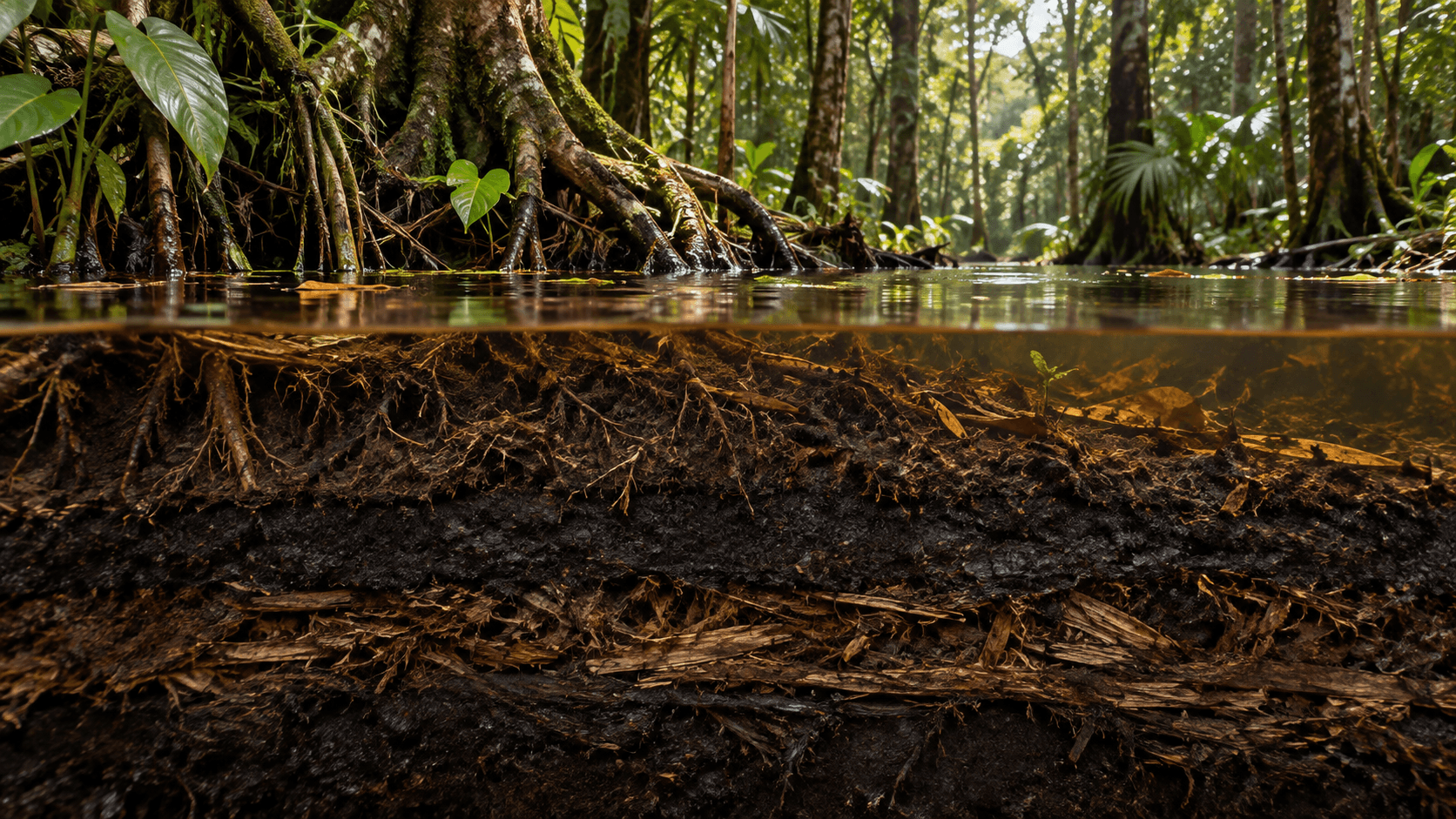
Plants remove carbon dioxide from the atmosphere as they grow. In many soils, dead plant material decomposes and some of that carbon returns to the air. Peatlands interrupt the process because saturated soil contains little oxygen. Decomposition slows, and carbon-rich plant remains build up faster than they break down.
This makes water the peatland’s main defense. The forest canopy is important, but the water table controls whether buried organic matter remains protected from rapid oxidation. Drainage, prolonged drought, road building, industrial agriculture, logging, and other changes to the hydrology can expose peat to air and accelerate decomposition.
The carbon figure also needs careful wording. The peatland contains about 29 billion metric tons of carbon, not 29 billion tons of carbon dioxide. Carbon and carbon dioxide are related measurements, but they are not interchangeable.
What the 2026 Lake Study Found
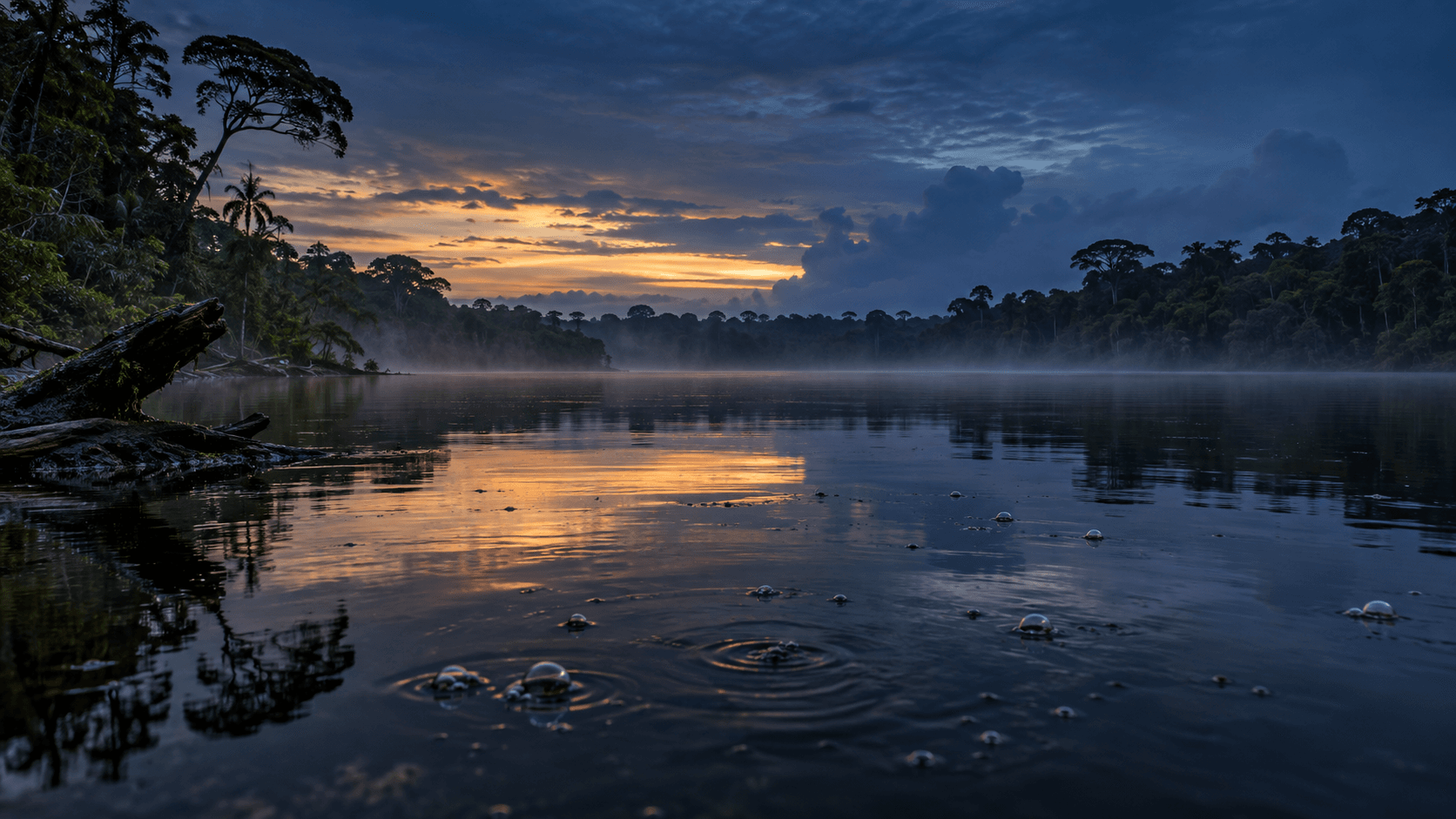
The researchers collected water samples from Lake Mai Ndombe and Lake Tumba and examined the isotopic composition of dissolved inorganic carbon. This pool includes carbon dioxide and related dissolved forms that can exchange with the atmosphere.
Radiocarbon measurements showed that the dissolved inorganic carbon was surprisingly old. The mean age was about 2,170 radiocarbon years in Mai Ndombe and 3,515 radiocarbon years in Tumba. An isotopic mixing analysis then estimated how much of the carbon came from ancient peat, modern organic matter, and atmospheric exchange.
The two modeling approaches converged on similar results. Ancient peat contributed an estimated 39 percent of the dissolved inorganic carbon in Mai Ndombe and 40 percent in Tumba, with uncertainty ranges around both figures.
For Mai Ndombe alone, the researchers combined their source estimate with existing measurements of lake carbon dioxide emissions. They calculated that more than 150 gigagrams, or about 150,000 metric tons, of peat-derived carbon may leave the lake each year. The estimate does not include every downstream pathway, and it should not be treated as a total balance for the entire Congo peatland.
What Does “3,515 Radiocarbon Years Old” Mean?

Radiocarbon dating tracks the decay of carbon-14, a radioactive isotope absorbed by living organisms. Once plant material stops exchanging carbon with the atmosphere, its carbon-14 content gradually declines. Scientists can use the remaining amount to estimate how long that carbon has been isolated from the modern atmosphere.
In this study, the age applies to the dissolved inorganic carbon measured in lake water. It does not mean researchers watched a single 3,515-year-old bubble rise from the peat. The number describes the average radiocarbon age of a mixed carbon pool, which contains material from more than one source and time period.
How Can Buried Peat Carbon Reach a Lake?
The study proposes that microbes process old organic matter within the peat, producing carbon dioxide at depth. Subsurface water then carries some of that carbon toward the lakes. Once it enters lake water, part of the carbon dioxide can escape into the atmosphere.
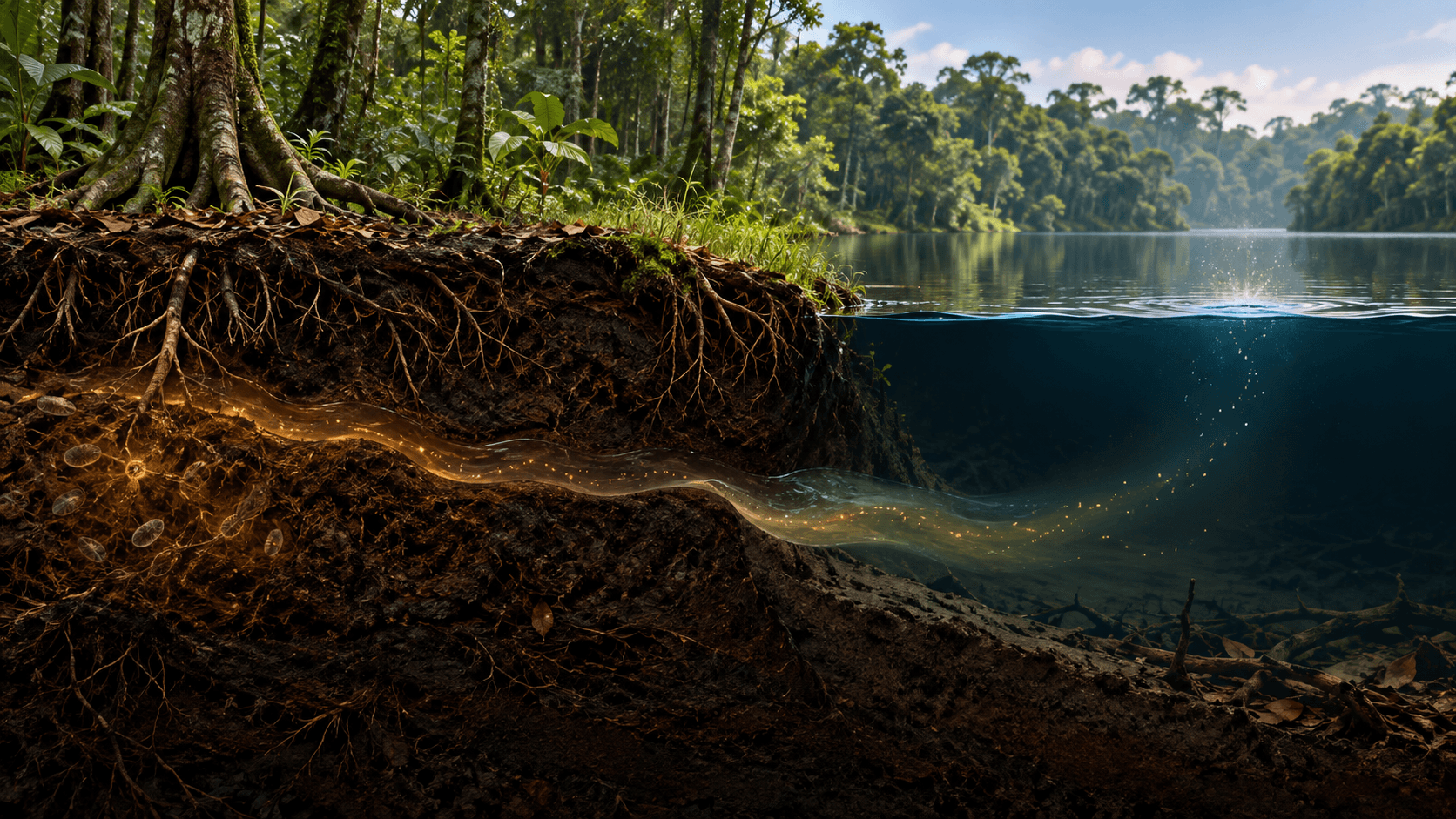
The broad pathway fits the isotopic evidence, but the details remain unresolved. The researchers describe several possible microbial routes, including processes involving methane production and later oxidation. They do not claim to have identified one dominant mechanism. Hydrology is another open question: scientists still need to determine exactly how carbon-rich water moves through the peat and into each lake.
This distinction separates observation from interpretation. The team directly measured old dissolved inorganic carbon and used isotope models to estimate its sources. The underground transport mechanism is a scientifically informed model that future fieldwork must test.
Does This Mean the Congo Peatland Is Collapsing?
No. The 2026 study identifies an existing loss pathway, not the sudden failure of all 29 billion metric tons of stored carbon. Peatlands can store carbon over long periods while also releasing carbon dioxide and methane through lakes, streams, soils, and vegetation. Scientists need complete measurements of gains and losses before they can calculate the net balance of the entire system.
The finding still matters because it connects millennial-aged carbon to current atmospheric exchange. If drying or land disturbance accelerates decomposition, the size of that connection could change.
The Warning Preserved in the Peat
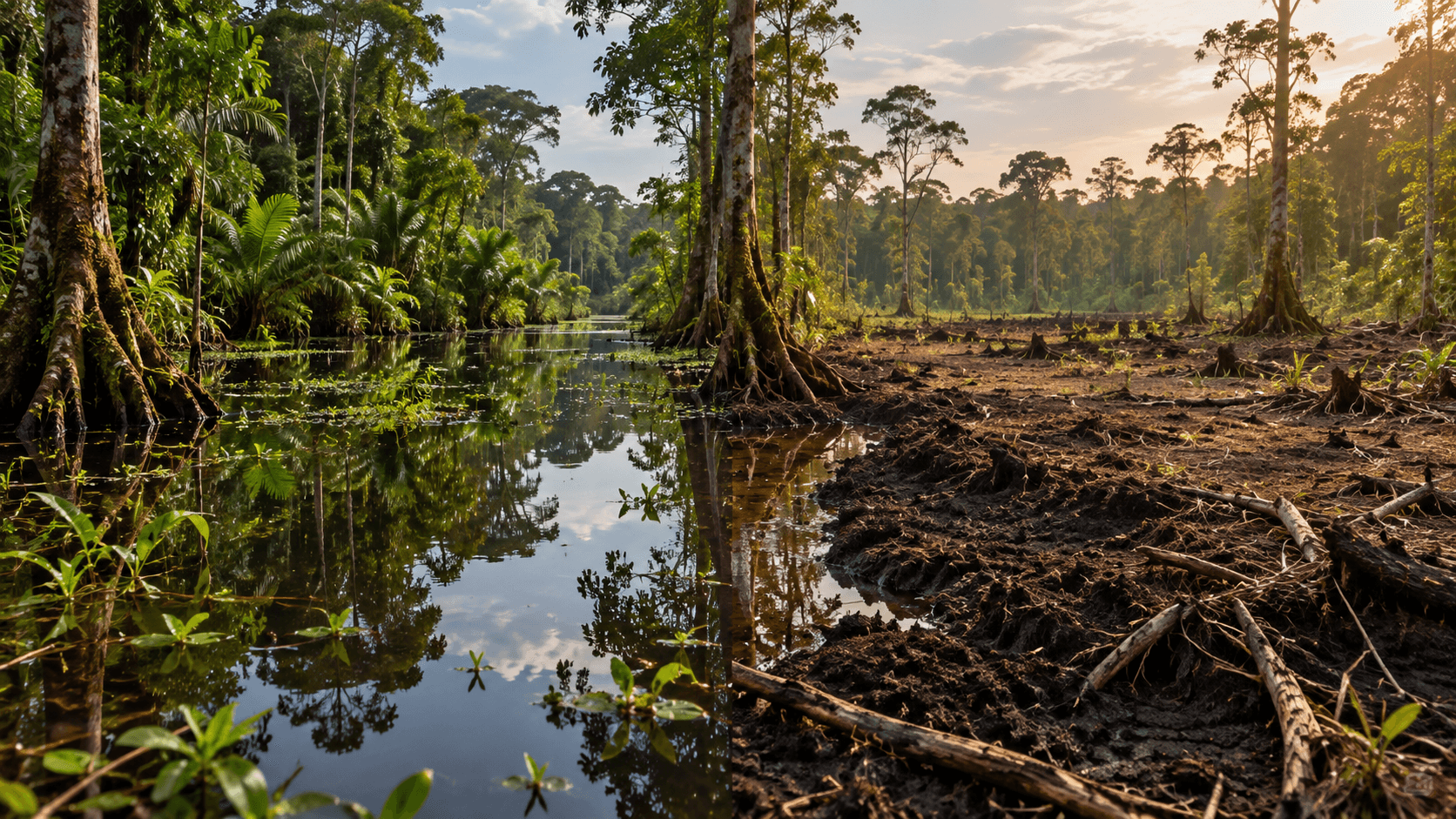
A separate 2022 study reconstructed the peatland’s response to past climate changes. Peat cores recorded a long dry interval that began several thousand years ago. As the regional water table fell, older peat decomposed and the ecosystem shifted from storing carbon to losing it. Peat accumulation recovered after wetter conditions returned.
The ancient record does not provide a precise modern tipping date. It shows that the carbon store has limits. Continued warming, longer dry seasons, drainage, or other disruption to the water table could move the peatland toward conditions that favored carbon loss in the past.
The 2022 mapping study also estimated that only 8 percent of the peat carbon lies inside nationally protected areas. Protection on paper is only one part of the issue. The wetland spans communities, transport routes, development pressures, and national borders, so long-term conservation depends on local governance and the people who live with the forest.
Protecting the Congo Carbon Vault
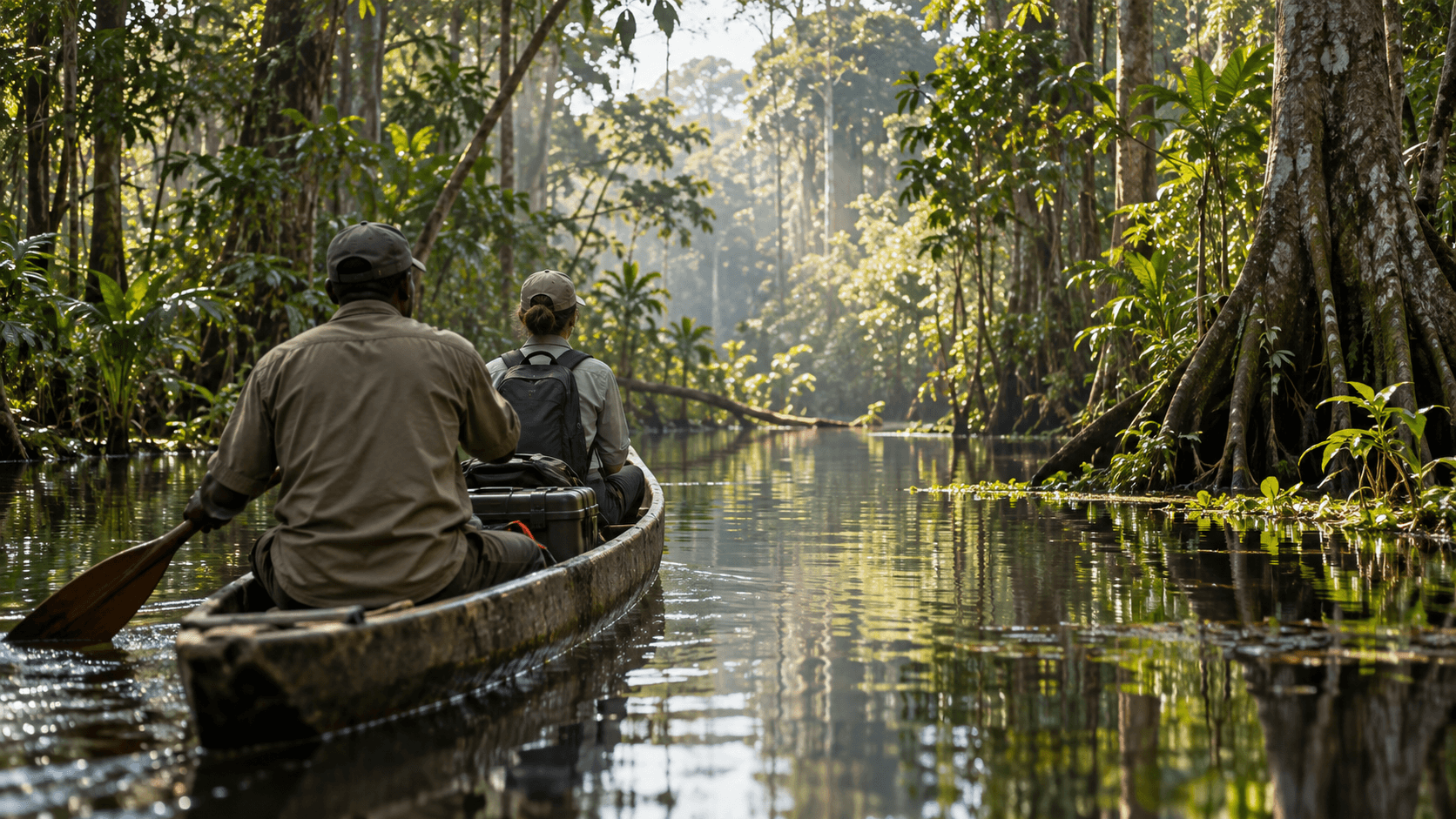
The Congo Basin is inhabited, traveled, studied, and managed. Calling it an empty or unconquered void erases the knowledge of local and Indigenous communities and turns a complex region into an outsider’s adventure story.
The more useful question is how to keep the peat wet and intact while supporting the people whose lives are connected to it. In 2018, the Democratic Republic of the Congo, the Republic of the Congo, and Indonesia signed the Brazzaville Declaration, which called for cooperation to prevent unregulated drainage and degradation of major tropical peatlands.
The viral appeal of the deep Congo often begins with the idea that humans have failed to conquer it. The science points toward a different conclusion. The peatland’s value does not depend on whether outsiders can force a path through it. Its water, soil, forests, wildlife, and communities form a living system that has held carbon for thousands of years.
Scientists have now found one route by which ancient carbon can leave that system. Understanding the route may help researchers recognize change before a slow leak becomes a larger loss.
Watch the Dark Cosmic Insights Short
Watch the DCI Short on YouTube for the under-one-minute version. This article carries the full evidence, uncertainty, and source record behind that story.
Congo Peatlands FAQ
What are the Congo peatlands?
The Congo peatlands are waterlogged tropical swamp forests with thick layers of partially decomposed plant material beneath them. The largest complex lies in the Cuvette Centrale across the Democratic Republic of the Congo and the Republic of the Congo.
How much carbon is stored in the Cuvette Centrale?
A 2022 field-based study estimated that the peatland stores about 29 billion metric tons of carbon below ground. The estimate refers to carbon, not the equivalent mass of carbon dioxide.
What did scientists discover in Lake Mai Ndombe and Lake Tumba?
Researchers found that about 39 to 40 percent of the dissolved inorganic carbon sampled in the two lakes came from ancient peat. The measured carbon had mean radiocarbon ages of about 2,170 years in Mai Ndombe and 3,515 years in Tumba.
Is 3,515-year-old carbon literally bubbling out of the lake?
The age describes the mean radiocarbon age of dissolved inorganic carbon in the sampled water. It does not identify one bubble with an exact age. The lake contains a mixture of ancient peat carbon, modern organic carbon, and carbon affected by atmospheric exchange.
How does peat carbon reach the lakes?
The researchers propose that microbes process old peat at depth and that subsurface water transports the resulting carbon dioxide into the lakes. The isotopic evidence supports a deep peat source, but the dominant biochemical and hydrological pathways remain uncertain.
Does the new study prove the entire Congo peatland is failing?
No. It identifies a route by which old peat carbon reaches lake water and the atmosphere. Measuring that pathway does not establish the net carbon balance of the whole peatland or show that the full carbon store is being rapidly released.
Why does keeping peat wet matter?
Water limits oxygen in peat soil and slows decomposition. When peatlands are drained or exposed to prolonged drought, oxygen can reach previously saturated organic matter and accelerate the release of stored carbon.
Are the Congo peatlands protected?
The Democratic Republic of the Congo and the Republic of the Congo have joined international conservation commitments, including the 2018 Brazzaville Declaration. However, a 2022 study estimated that only 8 percent of the peat carbon lies within nationally protected areas.
Sources and Further Reading
- Drake et al., “Millennial-aged peat carbon outgassed by large humic lakes in the Congo Basin,” Nature Geoscience, 2026
- Crezee et al., “Mapping peat thickness and carbon stocks of the central Congo Basin using field data,” Nature Geoscience, 2022
- Garcin et al., “Hydroclimatic vulnerability of peat carbon in the central Congo Basin,” Nature, 2022
- Dargie et al., “Age, extent and carbon storage of the central Congo Basin peatland complex,” Nature, 2017
- UN Environment Programme, Brazzaville Declaration announcement, 2018
Continue Exploring Science & Discovery
Explore more source-backed stories in Science & Discovery, including why Mercury is still shrinking and what surviving ancient Egyptian colors reveal.
Editorial note: This article separates direct measurements from proposed mechanisms. The supporting pathway image is an editorial visualization, not a photograph of underground carbon movement. Last reviewed September 22, 2026.