

Quick Answer
Your Big Three are your Sun, Moon and Rising signs. In astrology, the Sun describes the direction you are growing toward, the Moon describes what you need to feel safe, and the Rising sign describes how you meet the world at first contact. Read together, they describe one person with three layers, not three personalities fighting for the remote.
Why one sign never felt like the whole story
You read your Sun sign description, nodded at half of it, and quietly argued with the rest. That reaction is common, and astrology itself has an explanation for it: your Sun sign is one placement out of many. The Big Three is the shortest useful step past that single label.
This guide teaches you to read your Sun, Moon and Rising together, not as three separate horoscopes. You’ll learn what each layer describes, how to find all three accurately, and a simple four-step way to read them as one picture. Then you’ll watch that method work on four fictional charts, including one where the birth time is unknown.
One promise before we start. Astrology is a symbolic tradition, not a science of personality, and The 9th King treats it that way. A chart is a mirror for reflection. It won’t predict your week, diagnose anyone, or excuse anything. If that sounds less magical, it’s actually more useful: a mirror you can question is a mirror you can learn from.
For the meaning of each individual sign, keep the spiritual meanings of the zodiac signs open in another tab. This guide is about how the pieces fit.
Part of Astrology with The 9th King, Code of Ascension’s astrology branch.
What each of the Big Three describes
Each placement answers a different question. Keep the questions separate and most of the confusion about “which one is the real me” disappears.
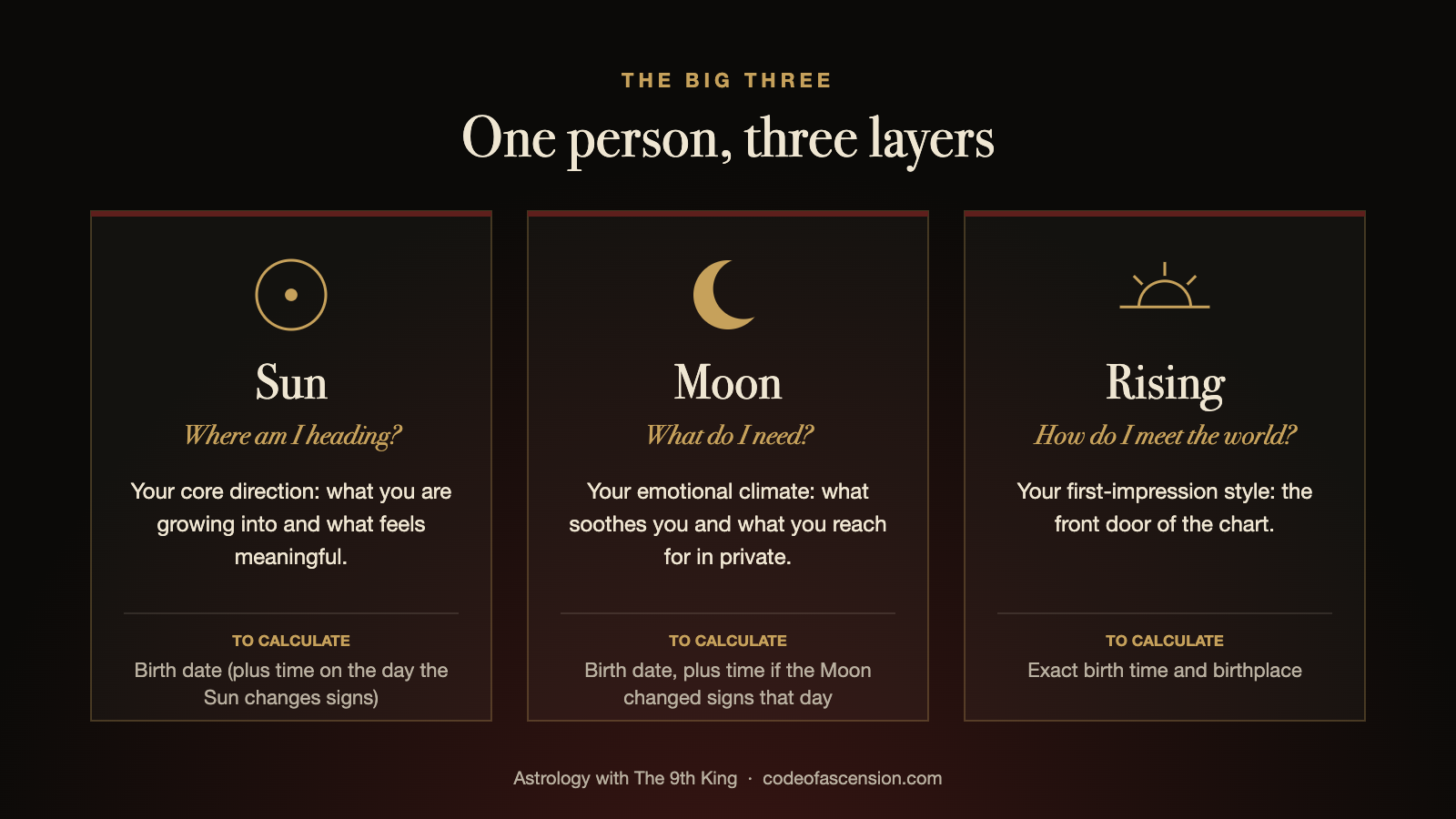
Your Sun sign: where you are heading
The Sun sign is set by where the Sun was along the zodiac on your birth date. It’s the sign most people know, because it usually only needs a date. The exception is a birthday on which the Sun changes signs, covered below. In astrology, the Sun is read as your core direction: the qualities you are growing into over a lifetime, what lights you up, and the kind of effort that feels meaningful rather than draining. Think of it as the destination written on the ticket, not a description of how you look at the station.
Your Moon sign: what you need
The Moon sign is set by where the Moon was at your birth. Astrologers read it as your emotional climate: what soothes you, what unsettles you, and what you reach for when no one is watching. It’s often the layer the people closest to you recognize first, and the one strangers miss. When someone says “that’s not like you,” they’ve usually met your Rising sign and missed your Moon.
A quick note: your Moon sign is not the Moon phase you were born under. Moon phases are a separate practice, covered in our guide to working with Moon phases.
Your Rising sign: how you meet the world
The Rising sign, also called the ascendant, is the zodiac sign that was rising on the eastern horizon at the moment you were born. In astrology it describes your approach to new situations: your first-impression style, your instinctive way of entering a room, the “front door” of the chart. It also anchors the houses of a birth chart, which is why astrologers ask for your birth time and not just your birthday. For the sign-by-sign detail, read rising sign meaning.
| Placement | The question it answers | What it needs to calculate |
|---|---|---|
| Sun | Where am I heading? | Birth date, plus time and year if you were born on the day the Sun changes signs |
| Moon | What do I need? | Birth date, plus time on days the Moon changes signs |
| Rising | How do I meet the world? | Exact birth time and birthplace |
How to find your Big Three accurately
Most “wrong sign” problems come from the inputs, not the astrology. Gather these before you open any chart app:
- Birth date, including the year. The year matters because the Sun’s sign boundaries shift by about a day from year to year, and the Moon’s position depends on it.
- Recorded local birth time. A birth certificate or hospital record beats family memory. Check AM versus PM; it’s the most common mistake.
- Birthplace. City or town is enough for most charts.
- Time zone and daylight saving for that date and place. Good chart software looks up the historical time zone for you. If you enter a time manually, confirm whether daylight saving applied that day, because one hour can change your Rising sign.
- The zodiac setting. Western astrology, and this guide, uses the tropical zodiac, which fixes 0° Aries to the March equinox and ties the signs to the seasons (overview). Sidereal systems, used in Vedic astrology, are star-referenced instead: they measure the zodiac against the fixed stars rather than the seasons, so the same birth can show different signs. Neither setting is a typo; they’re different systems.
Why birth time matters so much
- Rising sign: a new sign rises about every two hours on average, but not on a fixed schedule. Away from the equator, some signs cross the horizon in about an hour and others take over three, so the interval depends on the sign and your latitude (ascendant; long and short ascension).
- Moon sign: the Moon circles the zodiac in about 27.3 days (lunar month), so it spends roughly two and a quarter days in each sign on average. If the Moon changed signs on your birthday, an unknown birth time leaves your Moon sign uncertain too.
- Sun sign: usually certain from the date alone. The exception is a “cusp” birthday, the day the Sun moves into the next sign, when you need the time and year to be sure.
Don’t know your birth time? You can still read your Sun, and often your Moon. Example D below shows how to read honestly with what you have.
How to read them together: The Big Three Reading Method
The Big Three Reading Method is Code of Ascension’s symbolic reflection framework. It’s our own method for turning three placements into one useful picture. It isn’t a traditional astrological technique or a scientific test, and it doesn’t predict anything.
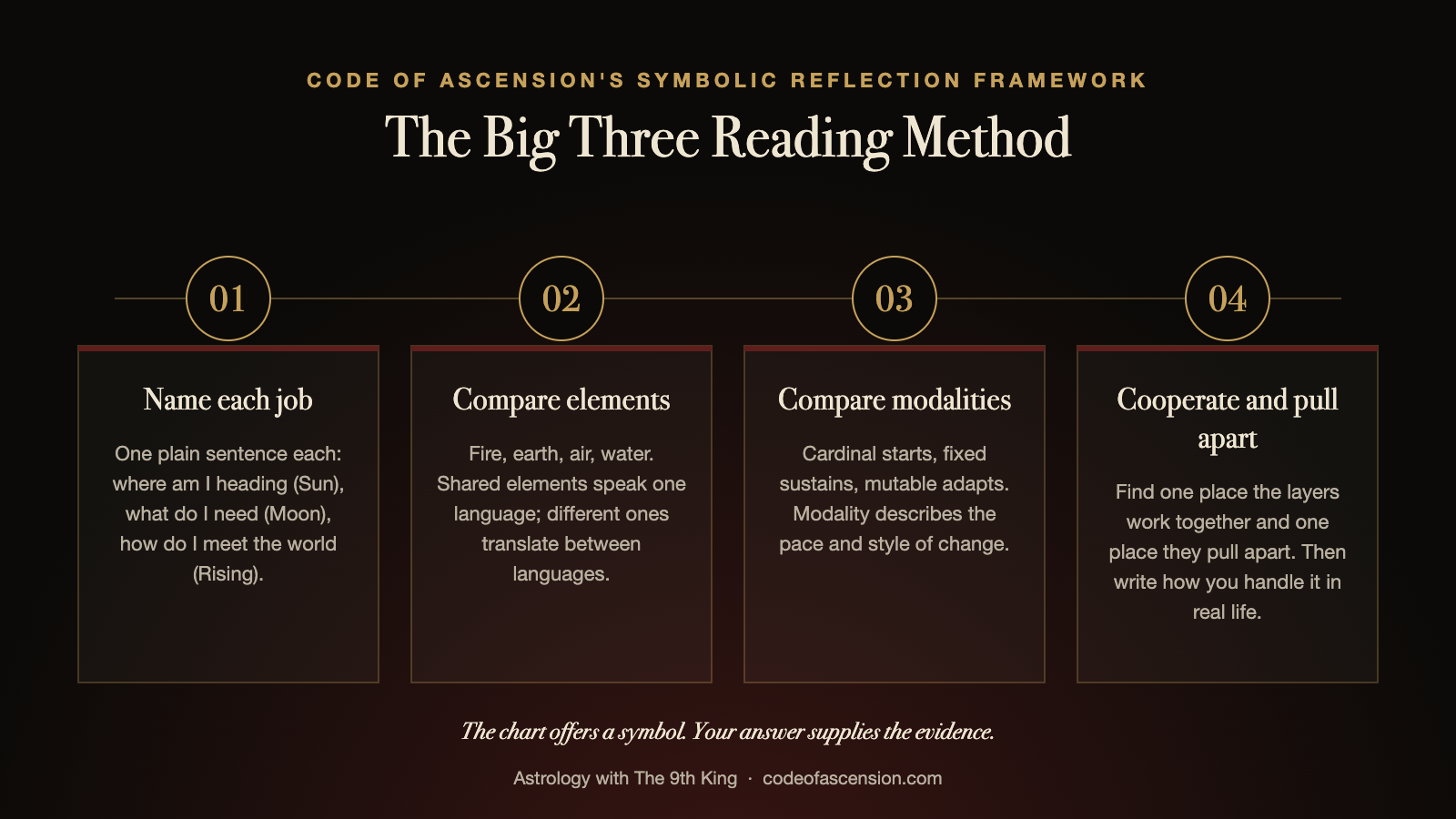
Step 1: Name each layer’s job in one line. Write a single sentence for each placement using the three questions: where am I heading (Sun), what do I need (Moon), how do I meet the world (Rising). Keep the sentences plain. “Leo Sun: heading toward visible, generous self-expression” beats a paragraph of adjectives.
Step 2: Compare the elements. Each sign belongs to one of four elements: fire (Aries, Leo, Sagittarius), earth (Taurus, Virgo, Capricorn), air (Gemini, Libra, Aquarius) and water (Cancer, Scorpio, Pisces). Shared elements suggest layers that speak the same language. Different elements suggest layers that translate between languages, which can feel like range or like friction.
Step 3: Compare the modalities. Each sign is also cardinal (starts things: Aries, Cancer, Libra, Capricorn), fixed (sustains things: Taurus, Leo, Scorpio, Aquarius) or mutable (adapts: Gemini, Virgo, Sagittarius, Pisces). Modality describes pace and style of change. Two fixed placements, for example, may both prefer to hold their ground.
Step 4: Find one place they cooperate and one place they pull apart. Then write how you actually handle that tension in real life. This is the step that turns astrology from a description into a reflection. The chart offers a symbol; your answer supplies the evidence.
That’s the whole method. It works the same way for every combination, which is why all four examples below use it in the same order.
Four worked examples
These four charts are fictional. They aren’t real people, and they’re chosen to show four common shapes a Big Three can take. Each one runs through the same four steps.
Example A: Leo Sun, Sagittarius Moon, Aries Rising (all fire)

Step 1, the jobs. Leo Sun: heading toward warm, visible self-expression. Sagittarius Moon: needs room, movement and something to believe in. Aries Rising: meets the world head-first, ready to start.
Step 2, elements. All three are fire. The layers speak one language, so what this person shows at first meeting is fairly close to what drives them and what they need. Same element doesn’t mean simple, though; it means a lot of one kind of energy.
Step 3, modalities. One of each: fixed (Leo), mutable (Sagittarius), cardinal (Aries). That suggests range within the fire: starting, sustaining and adapting are all available.
Step 4, cooperate and pull apart. Cooperation: enthusiasm is easy to access and easy for others to read. Possible pull: a fire-heavy chart may point to rest, follow-through or patience as themes worth checking. That’s a question to reflect on, not a verdict.
Takeaway: if this were your chart, the useful question isn’t “am I too much?” It’s “where do I want my energy to last longer than the first spark?”
Example B: Virgo Sun, Cancer Moon, Libra Rising (earth, water, air)

Step 1, the jobs. Virgo Sun: heading toward skill, usefulness and refinement. Cancer Moon: needs safety, belonging and people who feel like home. Libra Rising: meets the world with diplomacy and an eye for balance.
Step 2, elements. Three different elements: earth, water and air. Three languages. This person may look agreeable and easygoing at first (Libra), care intensely about the people close to them (Cancer), and hold themselves to exacting standards (Virgo). Others often meet the Libra first and miss the Virgo underneath.
Step 3, modalities. Mutable Sun, cardinal Moon, cardinal Rising. Two cardinal placements suggest someone who starts things, especially in relationships and at home, while the mutable Sun adapts the plan as it goes.
Step 4, cooperate and pull apart. Cooperation: Cancer’s care and Virgo’s competence can make this person deeply reliable. Possible pull: Libra’s wish to keep the peace may hide Virgo’s honest assessment, or Cancer’s hurt feelings. A reflection question: when do you say “it’s fine” when it isn’t?
Takeaway: the first impression isn’t fake. It’s the front door, and the house is bigger than the porch.
Example C: Taurus Sun, Aquarius Moon, Scorpio Rising (two fixed lights)

Step 1, the jobs. Taurus Sun: heading toward steadiness, comfort and building what lasts. Aquarius Moon: needs independence, perspective and room to think differently. Scorpio Rising: meets the world with reserve and intensity, revealing little at first.
Step 2, elements. Earth Sun, air Moon, water Rising. The Taurus Sun wants things tangible and settled; the Aquarius Moon processes feelings from a step back. Others may sense depth (Scorpio) without being shown much of it.
Step 3, modalities. All three are fixed: Taurus, Aquarius and Scorpio. In this framework that suggests persistence and loyalty, and a tendency to hold a position once it’s chosen. Taurus and Aquarius also sit three signs apart, a relationship astrologers call a square by sign. (A degree-based square would need exact positions, which we’re not claiming here.)
Step 4, cooperate and pull apart. Cooperation: fixed persistence can make this person remarkably dependable. Possible pull: the Sun’s wish for comfort and closeness and the Moon’s need for emotional distance may feel like two different requests. Read as a growth edge, not a flaw: the work is learning to ask for both space and steadiness out loud.
Takeaway: “I need room” and “I’m not going anywhere” can both be true. Say both.
Example D: Gemini Sun, birth time unknown
This fictional person knows their birth date but not their birth time. On that date, the Moon moved from Aries into Taurus partway through the day.
What can be read: the Sun is clearly in Gemini, heading toward curiosity, communication and variety. That part is solid.
What’s uncertain: the Moon is either Aries (needs action, independence, a quick reset) or Taurus (needs calm, comfort, a slower pace). Without a birth time we can’t choose. The Rising sign, and therefore the houses, are unknown.
How to read honestly: run the four steps twice, once for each possible Moon. Here are both readings, worked through.
Reading 1: Gemini Sun, Aries Moon. Step 1, the jobs: heading toward curiosity, communication and variety; needs action, independence and a quick reset. Step 2, elements: air Sun, fire Moon. Different elements, but ones that tend to feed each other, the way air feeds a flame, so ideas can turn into action quickly. Step 3, modalities: mutable Sun, cardinal Moon. Adapting meets starting, which suggests someone who launches fast and changes course easily. Step 4: cooperation, a quick mind and a quick reset work together. Possible pull: Aries may want to act before Gemini has finished gathering information, or Gemini may want to talk through a feeling that Aries would rather burn off. Reflection question: when I’m upset, do I need to move first or talk first?
Reading 2: Gemini Sun, Taurus Moon. Step 1, the jobs: heading toward curiosity, communication and variety; needs calm, comfort and a slower pace. Step 2, elements: air Sun, earth Moon. Two different languages: the mind wants new input while the body wants steadiness. Step 3, modalities: mutable Sun, fixed Moon. The Sun adapts; the Moon prefers to keep what already works. Step 4: cooperation, Taurus can give Gemini’s ideas a place to land and grow. Possible pull: a full, fast-moving schedule may feel exciting to the Sun and draining to the Moon. Reflection question: what routine keeps me grounded without making life feel small?
Notice which reflection question lands harder. That isn’t proof of your birth time, and the Rising sign stays blank until a recorded time turns up. It’s a reading that stays honest about its limits.
Next steps: request a long-form birth certificate or hospital record, ask relatives who might have documents, and avoid charts that quietly assume noon without telling you.
Takeaway: a partial chart read honestly is more useful than a complete chart built on a guess.
“Why don’t I relate to my Sun sign?”
It’s the most common reason people look up their Big Three. A few honest answers:
- The Sun is a direction, not a finished state. In astrology you grow into your Sun over time, so it can feel more like an aspiration than a description, especially when you’re young or under pressure.
- Your Moon or Rising may be louder day to day. If your Rising is the style people meet and your Moon is how you feel at home, your Sun may be the quietest layer in daily life.
- Sun sign descriptions are generic. A paragraph written for millions of people born in the same month will always miss. That’s a limit of the description, not a sign that you were born “wrong”.
- The rest of the chart adds more. Planets, houses and aspects all add layers that the Big Three can’t show on its own.
The Big Three in relationships

Many people first meet someone’s Rising sign and only later discover their Moon. That’s why a first date can feel very different from month six. In astrology, the Moon describes what each person needs to feel safe, which is often where real compatibility questions live. The Rising describes the first impression you fall for, or misread.
If you’re comparing charts, start with the two Moons and ask what each person needs on a hard day. Then visit the zodiac compatibility chart for how signs are traditionally paired. Any pairing is a set of symbols to talk about, never a verdict on a person or a relationship.
What your Big Three can’t tell you
- It isn’t a prediction. Your Big Three won’t tell you what happens next week, next year, or in your next relationship.
- It isn’t a diagnosis or a personality test. When astrologers in a well-known double-blind study tried to match natal charts to personality profiles, they did no better than chance (Carlson, Nature, 1985). Code of Ascension presents astrology as a symbolic tradition for reflection, not established science.
- It isn’t an excuse. “I’m a Scorpio Rising” explains a style, not a behavior you’re excused from.
- It isn’t the whole chart. Planets, houses and aspects add more. The Big Three is the doorway, not the house.
Three journal prompts for your Big Three

- The translation prompt: “When people meet my Rising first, what do they usually miss about my Moon?”
- The direction prompt: “Name one choice this month that moved me toward my Sun sign’s direction, and one that moved me away from it.”
- The tension prompt: “Where do two of my placements ask for different things, and what would honoring both look like this week?”
Write real examples from your life, not the description. The chart offers the symbol; your answer is the evidence.
If you’d like a guided place to keep this kind of reflection going, The Shadow Code Journal is our guided self-discovery journal, built for this kind of honest, pattern-noticing writing.
Big Three FAQ
What are the Big Three in astrology?
Your Big Three are your Sun, Moon and Rising signs. In astrology, the Sun describes your direction, the Moon your emotional needs, and the Rising sign how you meet the world. Together they give a fuller picture than a Sun sign alone.
Which of the Big Three matters most?
None of them outranks the others; they answer different questions. Many astrologers lead with the Sun for direction, but your Moon or Rising may feel more noticeable in daily life.
Can I know my Big Three without a birth time?
Partly. Your Sun sign is usually clear from your birth date. Your Moon sign is often clear too, unless the Moon changed signs that day. Your Rising sign needs your birth time and birthplace.
Why does my Moon or Rising sign differ between apps?
Usually because of the inputs or settings: birth time, AM/PM, birthplace, time zone and daylight saving, or a tropical versus sidereal zodiac setting. Check those first.
What if my Sun, Moon and Rising are the same sign?
Astrologers sometimes call it a “triple” placement. It suggests one sign’s themes run through direction, needs and first impressions alike. It doesn’t make you a stereotype, and the rest of the chart still adds variety.
Is the Big Three the same as my birth chart?
No. The Big Three are three placements within your birth chart, which also includes the other planets, the houses and the aspects between them.
Does my Rising sign change as I get older?
Not in your birth chart, which is fixed to your birth moment. Some astrologers use separate timing techniques, such as progressions, but those don’t change your natal Rising sign.
Is astrology scientifically proven?
No. Controlled tests haven’t shown that birth charts predict personality, and Code of Ascension presents astrology as a symbolic tradition for self-reflection, not established science.
Keep going: The Big Three Starter
Want a printable version? The free Big Three Starter (Field Guide No. 08) includes a one-page reference card, eight reflection questions and a quick guide to what each layer governs. Get the free Big Three Starter (email signup required).
Next reads: Rising sign meaning · Spiritual meanings of the zodiac signs · Zodiac compatibility chart · Astrology with The 9th King
About The Author: King | Founder of Code of Ascension
King is the founder of Code of Ascension, a spiritual education platform focused on consciousness, symbolism, manifestation, nervous system awareness, and hidden patterns of reality. Through Code of Ascension, he explores ancient wisdom and modern insights to help others awaken, align, and ascend.
Keep Ascending 🚀
Sources
- Ascendant (Wikipedia): the definition; signs don’t take equal time to rise away from the equator
- Ascension, long and short (Skyscript): signs of long and short ascension
- Lunar month (Wikipedia): tropical month of about 27.32 days
- Sidereal and tropical astrology (Wikipedia): the tropical zodiac is tied to the March equinox
- Zodiac (Britannica): signs no longer match the constellations because of precession
- Carlson, S. (1985). “A double-blind test of astrology”. Nature 318, 419–425. doi:10.1038/318419a0