
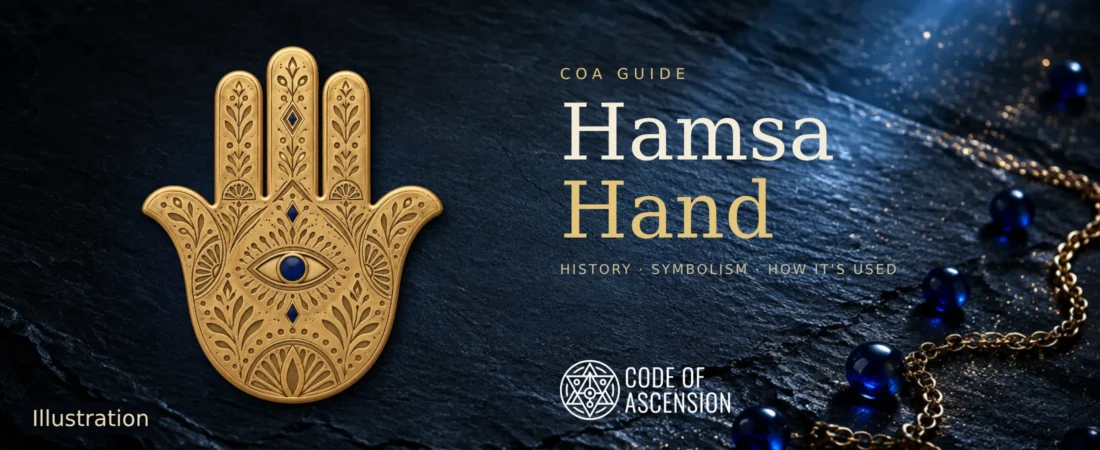
The open palm with five fingers, often with an eye at its centre, is a widely recognised protection symbol. You see it on doorways in Fez and Jerusalem, on silver pendants, on wedding gifts, on keyrings at airport shops, and now on your phone’s emoji keyboard.
But the hamsa is older and more layered than a good-luck charm. It has been carried by Muslim, Jewish and Christian families for centuries, each giving it their own names and meanings. This guide separates what the historical record shows from what later traditions and modern jewelry culture added, so you can understand the symbol, and use it, with clear eyes.
Quick answer: The word hamsa comes from the Arabic khamsa, meaning “five”; the Hebrew hamesh also means five. The hamsa is an open-hand amulet used across North Africa and the Middle East to turn away the evil eye and invite blessing. It’s widely called the Hand of Fatima, the Hand of Miriam is a more recent name used in some Jewish contexts, and an equivalent Christian symbol is known as the Hand of Mary. An eye in the palm reinforces its protective role. The hamsa is documented in museum collections and Jewish and Islamic home life; claims that it descends directly from a single ancient goddess remain unproven.
What Does the Hamsa Hand Mean?
At its core, the hamsa means protection through an open hand. The raised palm says “stop” to envy, harm and the evil eye, while also signalling openness to blessing. That double message, block what harms, welcome what heals, is why the symbol has crossed so many borders.
The name comes from the number five. Hamsa comes from the Arabic khamsa (خمسة), meaning “five”; in the Maghreb you’ll also hear khmisa. The Hebrew hamesh (חמש) also means “five,” and Jewish usage spells the amulet’s name in Hebrew as חמסה (hamsa or chamsa).
The five fingers are the point. In Arabic-speaking North Africa, a common protective phrase is khamsa fi ainek, roughly “five [fingers] in your eye,” said to push back an envious look. The hand itself is that phrase made visible.
One quick clarification for search: the Sanskrit word haṃsa means a swan or goose and appears in Hindu and Buddhist imagery. It sounds the same in English but is a different word with a different symbol. The open-hand hamsa’s name comes from the Arabic khamsa, “five.”
The Hamsa’s Names Across Traditions
The same hand carries different names depending on who holds it. None of these is “the real one”; each reflects a community’s own way of making the symbol sacred.
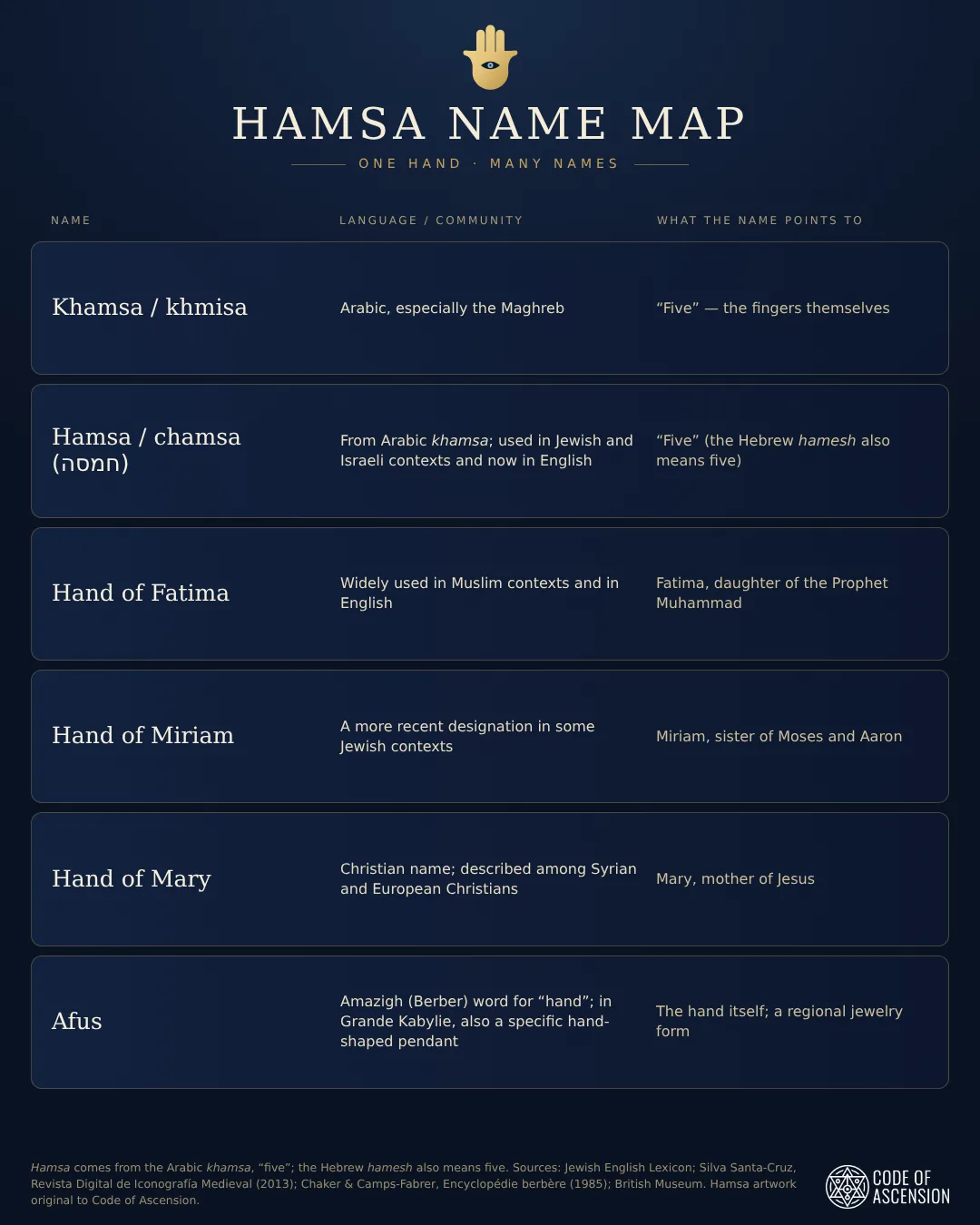
The name map in text:
- Khamsa / khmisa (Arabic, especially the Maghreb): “Five” — the fingers themselves
- Hamsa / chamsa (חמסה) (From Arabic khamsa; used in Jewish and Israeli contexts and now in English): “Five” (the Hebrew hamesh also means five)
- Hand of Fatima (Widely used in Muslim contexts and in English): Fatima, daughter of the Prophet Muhammad
- Hand of Miriam (A more recent designation in some Jewish contexts): Miriam, sister of Moses and Aaron
- Hand of Mary (Christian name; described among Syrian and European Christians): Mary, mother of Jesus
- Afus (Amazigh (Berber) word for “hand”; in Grande Kabylie, also a specific hand-shaped pendant): The hand itself; a regional jewelry form
A few notes on these names:
- Hand of Fatima is widely used in English, and the British Museum uses it alongside khamsa in its catalogue.
- Hand of Miriam is a more recent designation. Jewish dictionaries record it as the Jewish counterpart to “Hand of Fatima.” Historian Shalom Sabar notes the hamsa has also been associated with other figures, such as Joseph, in Jewish tradition.
- Hand of Mary is a Christian name for an equivalent symbol. Silva Santa-Cruz describes its use among Syrian and European Christians, and the 2020 Unicode emoji proposal describes it among Levantine Christians.
- Afus is the everyday Amazigh word for “hand,” used across Berber languages. The Encyclopédie berbère records that in Grande Kabylie, afus also names a particular hand-shaped silver pendant hung on necklaces, often set with coral and enamel. Elsewhere in North Africa, the Arabic khamsa is the usual name for hand amulets.
Among many Shia Muslims, the five fingers are also read as the Panjtan, the five holy figures of the Prophet’s household: Muhammad, Ali, Fatima, Hasan and Husayn. In that context the hand can appear on processional standards during Muharram, carrying devotional rather than “lucky charm” meaning.
History: What the Evidence Shows
The hamsa’s history is often told as a straight line from a single ancient goddess to your necklace. The record is messier, and more interesting, than that.
Protective hands in the ancient world
Raised and open hands appear as protective or votive images in several ancient cultures, which is why so many articles claim a direct ancestry. Two examples are often cited:
- Iron Age Judah: An inscription from a tomb at Khirbet el-Qom, dated to the second half of the 8th century BCE, is accompanied by an engraved hand. Scholars debate both the inscription’s reading and the hand’s meaning, and no direct link to the later hamsa has been established.
- Mesopotamia and Egypt: Hand imagery and hand-shaped amulets appear in these regions too. Popular claims that the hamsa began as the “Hand of Ishtar” or “Hand of Inanna” are repeated widely online but rest on thin evidence.
The fair reading: protective hands are an old and widespread human idea. The specific North African and Middle Eastern hamsa grew within that wider pattern, but any single “original” source is speculation.
Al-Andalus and the Maghreb
Some of the clearest early evidence for the khamsa comes from the western Islamic world: North Africa and medieval Muslim Spain (al-Andalus). The Universidad Complutense de Madrid’s medieval iconography database documents the hand on several objects:
- a 13th-century brass plaque from Murcia
- a 14th-century jug from Jerez
- the Gate of Justice of the Alhambra in Granada (1333–1354)
- a 15th-century Manises ceramic tile
That source describes the khamsa as a protection against the evil eye for Muslims.
Later, Christian authorities in Spain moved against it. Art historian Noelia Silva Santa-Cruz records that in 1526, an episcopal commission convened by Emperor Charles V prohibited its use. The commission had met to rule on the customs of Moriscos, Muslims recently converted to Christianity, and it called for crosses or medals of sacred figures in its place. The same study notes that Syrian and European Christians used an equivalent symbol known as the Hand of Mary.
Jewish homes and synagogues
Jewish communities did not simply “borrow” the hamsa. Researchers such as Shalom Sabar and Noam Sienna show how Sephardi, Mizrahi and Maghrebi Jews made it their own. They added Hebrew inscriptions and divine names, linked it to rabbinic teachings, and placed it on Torah pointers, marriage contracts (ketubbot), amulets for newborns and walls of homes.
Sabar also traces how its status changed. In the late 19th century the hamsa pervaded daily life in many Sephardi and Middle Eastern Jewish homes. By the mid-20th century it had largely fallen out of protective use, and in modern Israel it often became a decorative or secular emblem. His chapter title captures the arc: From Sacred Symbol to Key Ring.
Museum evidence
Museums hold many hamsas from the 19th and early 20th centuries. One example is a silver, enamel and glass “Hand of Fatima” or khamsa pendant from Morocco, c. 1890s, in the British Museum (2014,6009.1). The museum notes that such amulets “may have been used by Muslims or Jews to ward off the ‘eye of envy’.” That shared use is the heart of the hamsa’s story.
Modern life
Today the hamsa appears on the national emblem of Algeria (adopted in its current form in 1976). It became an official emoji, 🪬, in Unicode Emoji 14.0 (2021), with the keywords amulet, Fatima, hand, Mary, Miriam and protection. It’s also a popular motif in protection jewelry.
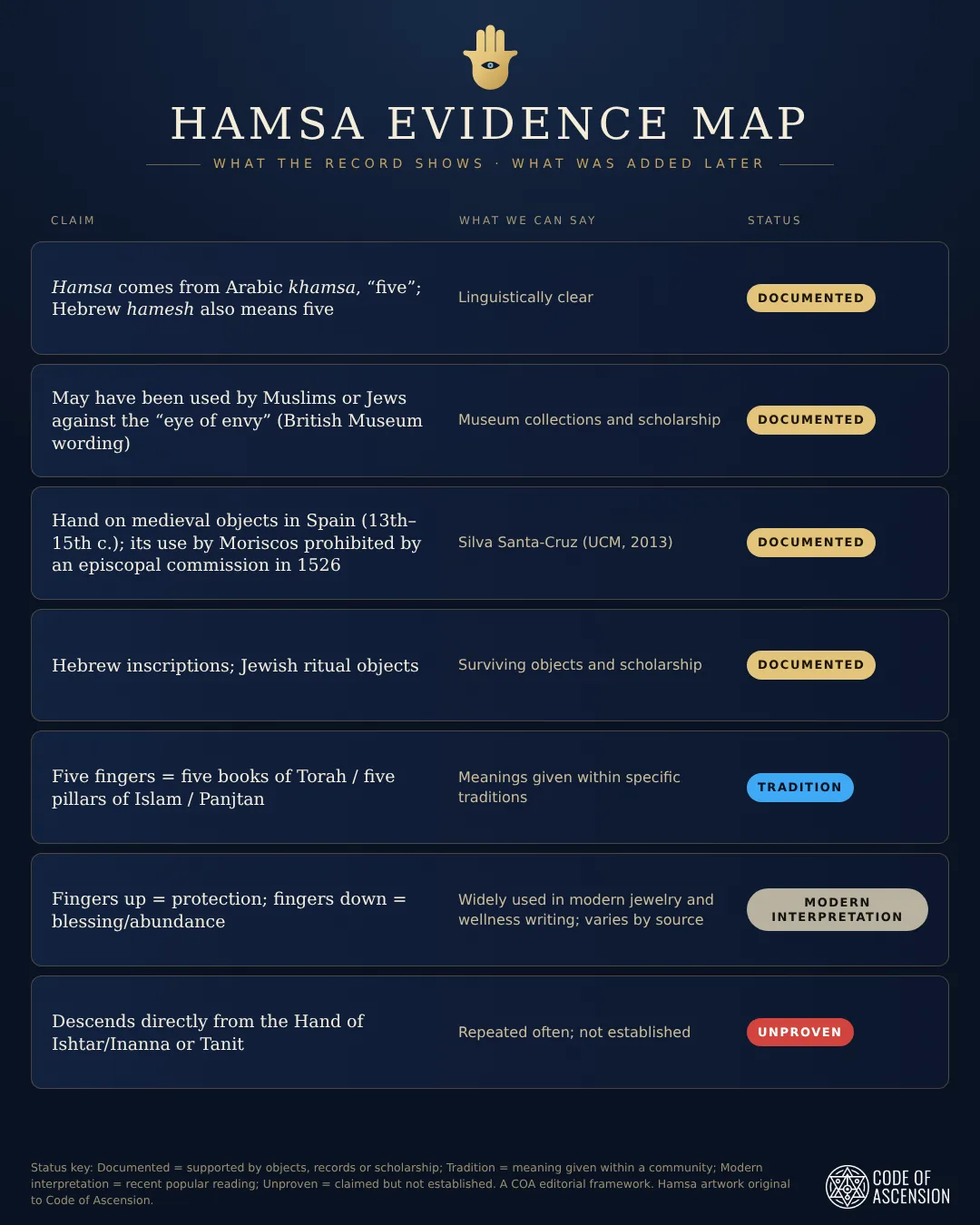
The evidence map in text:
- Documented: Hamsa comes from Arabic khamsa, “five”; Hebrew hamesh also means five. Linguistically clear.
- Documented: May have been used by Muslims or Jews against the “eye of envy” (British Museum wording). Museum collections and scholarship.
- Documented: Hand on medieval objects in Spain (13th–15th c.); its use by Moriscos prohibited by an episcopal commission in 1526. Silva Santa-Cruz (UCM, 2013).
- Documented: Hebrew inscriptions; Jewish ritual objects. Surviving objects and scholarship.
- Tradition: Five fingers = five books of Torah / five pillars of Islam / Panjtan. Meanings given within specific traditions.
- Modern interpretation: Fingers up = protection; fingers down = blessing/abundance. Widely used in modern jewelry and wellness writing; varies by source.
- Unproven: Descends directly from the Hand of Ishtar/Inanna or Tanit. Repeated often; not established.
Hamsa Symbolism: Eye, Fingers and Direction
The eye in the palm
Many hamsas carry an eye, often blue, at the centre of the palm. The hand already “pushes back” an envious look. The eye adds a watching guard, a mirror that returns the gaze. This is why the hamsa and the evil eye so often appear together. They are partners rather than the same symbol.
Five fingers
The five fingers carry different meanings depending on who’s reading them:
- “Five” itself: the protective number, behind phrases like khamsa fi ainek.
- Jewish interpretation: often linked to the five books of the Torah.
- Islamic interpretation: often linked to the Five Pillars of Islam.
- Shia devotion: the Panjtan, the five holy figures of the Prophet’s household.
These are layered readings, not one fixed code.
Fingers up or fingers down?
Online, you’ll often read that an upward hamsa protects and a downward hamsa brings abundance, fertility or blessing. Treat this as a modern interpretation: helpful as a personal intention, but not a rule from any one historical tradition. Traditional hamsas appear in both orientations, often with the fingers together, sometimes slightly spread. Many are drawn as a stylized, bilaterally symmetrical hand rather than a realistic left or right hand.
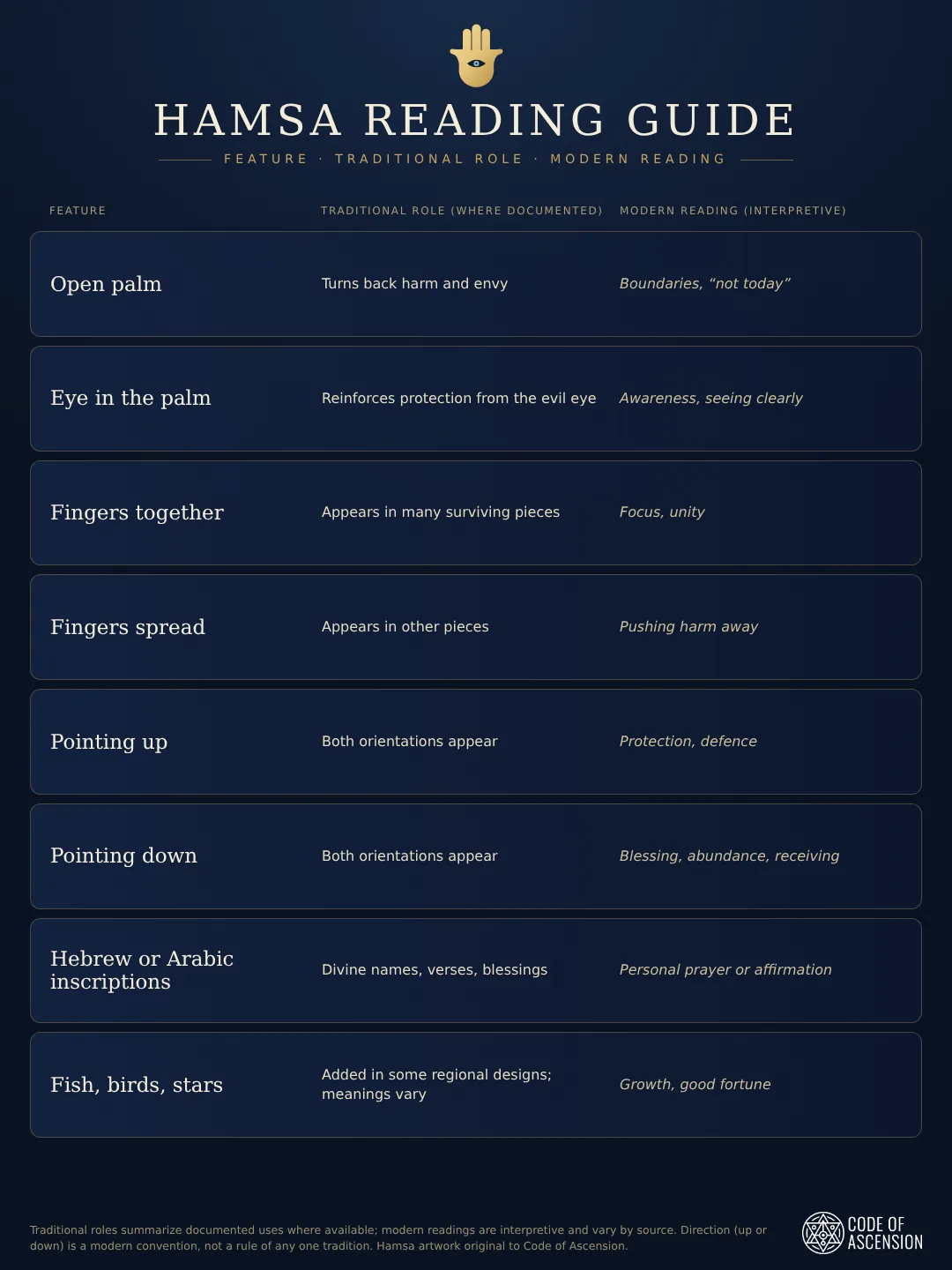
The reading guide in text:
- Open palm. Traditional role: Turns back harm and envy. Modern reading: Boundaries, “not today”.
- Eye in the palm. Traditional role: Reinforces protection from the evil eye. Modern reading: Awareness, seeing clearly.
- Fingers together. Traditional role: Appears in many surviving pieces. Modern reading: Focus, unity.
- Fingers spread. Traditional role: Appears in other pieces. Modern reading: Pushing harm away.
- Pointing up. Traditional role: Both orientations appear. Modern reading: Protection, defence.
- Pointing down. Traditional role: Both orientations appear. Modern reading: Blessing, abundance, receiving.
- Hebrew or Arabic inscriptions. Traditional role: Divine names, verses, blessings. Modern reading: Personal prayer or affirmation.
- Fish, birds, stars. Traditional role: Added in some regional designs; meanings vary. Modern reading: Growth, good fortune.
How the Hamsa Is Used
At home
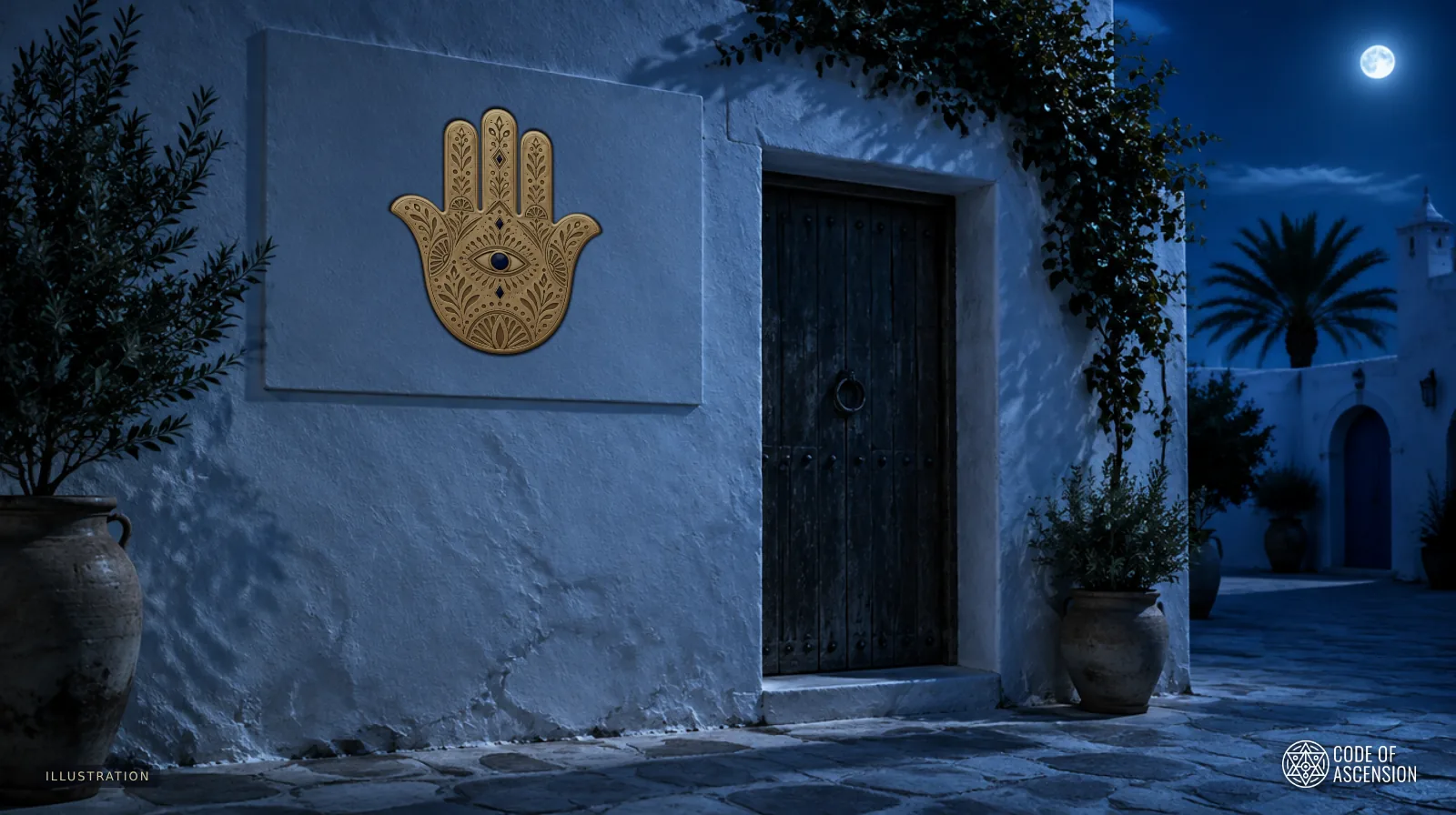
A traditional place for a hamsa is the home: above a door, near the entrance, or on a wall facing the street. In many Maghrebi and Middle Eastern homes it was painted, carved, cast in metal or pressed in plaster. Some families hung it where guests entered, to greet blessing and turn away envy at the threshold.
For babies, brides and new beginnings
Moments of joy were seen as moments when envy could strike, so hamsas often appeared around births and weddings. Historically, these included protective amulets for newborns and mothers, decorations on marriage contracts, and pendants given to brides.
If you display a hamsa today to welcome a new baby, choose a wall piece that’s securely mounted and out of children’s reach. Keep jewelry and small charms away from babies and their sleeping space.
As jewelry
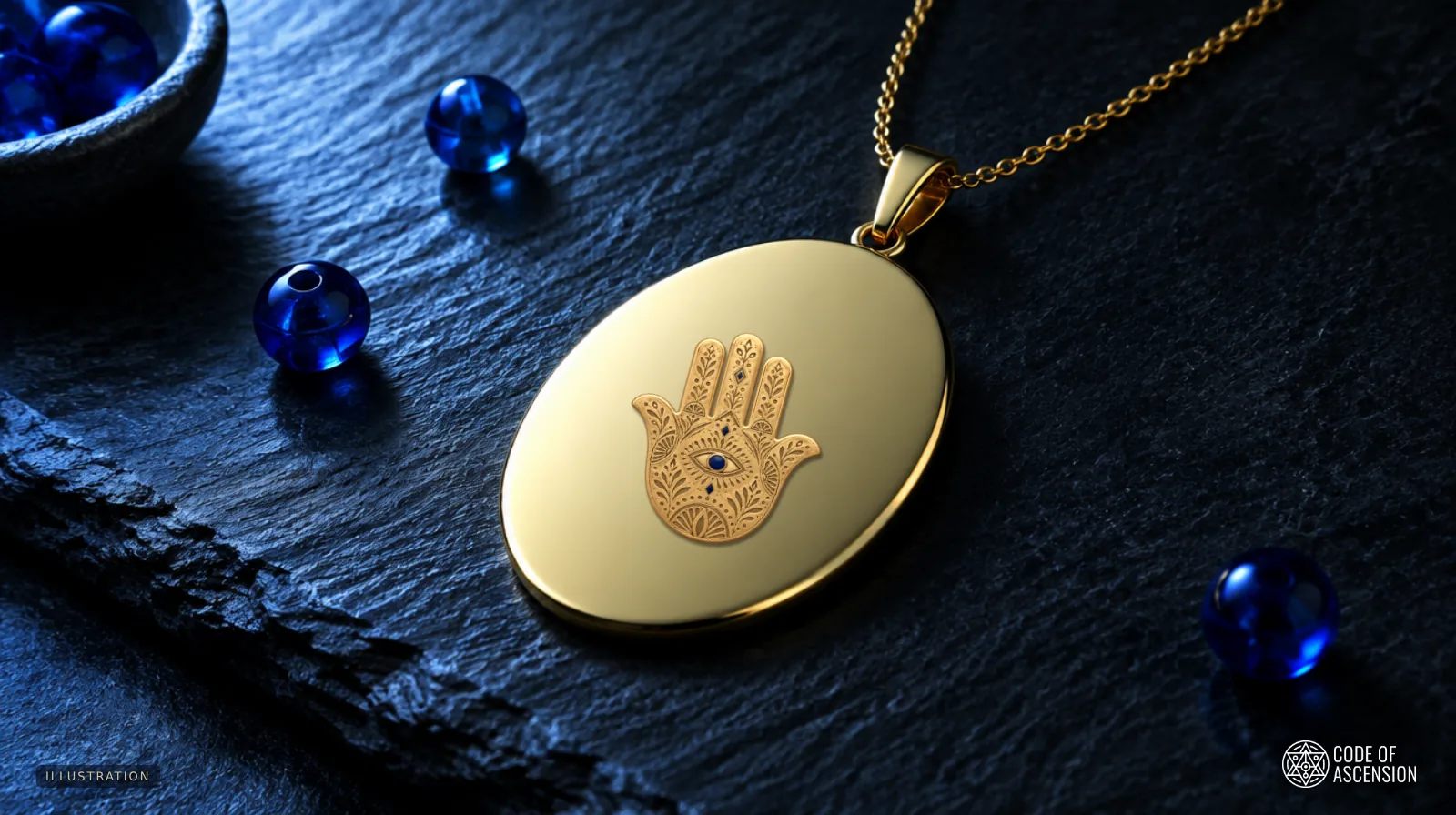
Today many people meet the hamsa as a pendant, bracelet charm, ring or earring. If you’re choosing one, our protection jewelry guide covers metals, real-photo checks and how to read labels like “gold filled” and “vermeil.” A few hamsa-specific tips:
- Pick a design you can read. A clear eye, a balanced hand and clean edges age better than overly busy castings.
- Decide on direction with intention, not because a listing says one way is “correct.”
- Pair thoughtfully. Hamsa plus evil eye is a traditional combination. Hamsa plus the Eye of Horus mixes two different traditions, which is fine as long as you know the difference.
As a personal reminder
In COA practice, a hamsa can serve as a boundary anchor: a small object you touch to remember that you can stay open-hearted without absorbing everyone’s energy. That’s a modern, personal use, and we label it that way. It sits naturally beside the grounding and shielding practices in our guide to protecting your energy.
A 60-second hamsa intention (COA reflection, optional):
- Hold the hamsa in your palm, fingers of the symbol pointing toward your own fingertips.
- Breathe in for four counts and name one thing you’re open to receiving.
- Breathe out for six counts and name one thing you’re choosing not to carry.
- Close your hand gently and place the hamsa where you’ll see it.
How to Read a Hamsa You Already Own
If a hamsa has been handed down to you, or you picked one up while travelling, a few details can tell you a lot about it:
- Look for writing. Hebrew letters often point to a Jewish maker or owner. Common examples are the divine name Shaddai, or the letter shin worked into the hand. Arabic script may be a verse or a blessing. Translation help from a community member or museum is worth seeking before you assume what it says.
- Check the shape. Many North African and Middle Eastern hamsas are a stylized, bilaterally symmetrical hand. Others are drawn more like a realistic right or left hand. Both forms exist, so shape alone doesn’t date a piece.
- Notice the extras. Fish, birds, stars, crescents and small coins appear in some regional designs. Their meanings vary by place and maker.
- Don’t judge by look or weight. Many older North African hamsas were made in silver, sometimes with enamel, coral or glass. But appearance and weight alone don’t establish a piece’s metal, age or origin. A jeweller’s test, a hallmark or the seller’s documentation tells you far more.
- Ask the family story. For heirlooms, who wore it and when can matter more than any symbol chart.
Whatever you learn, the most important “meaning” of an inherited hamsa is often the simplest: someone wanted you protected.
Wearing the Hamsa With Respect
The hamsa belongs to living Muslim, Jewish, Christian and Amazigh communities. You don’t need to share a faith to appreciate it, but a few habits keep it meaningful:
- Learn the names and use them. Knowing the difference between khamsa, hamsa and Hand of Miriam is a small act of respect.
- Avoid making it a costume. Pairing it with mocking or sexualised imagery strips it of its meaning.
- Support real makers when you can. North African and Middle Eastern silverwork has a long hamsa tradition.
- Notice context. Some religious authorities reject amulets entirely. If you’re giving a hamsa as a gift, know your recipient.
Hamsa vs Evil Eye vs Eye of Horus
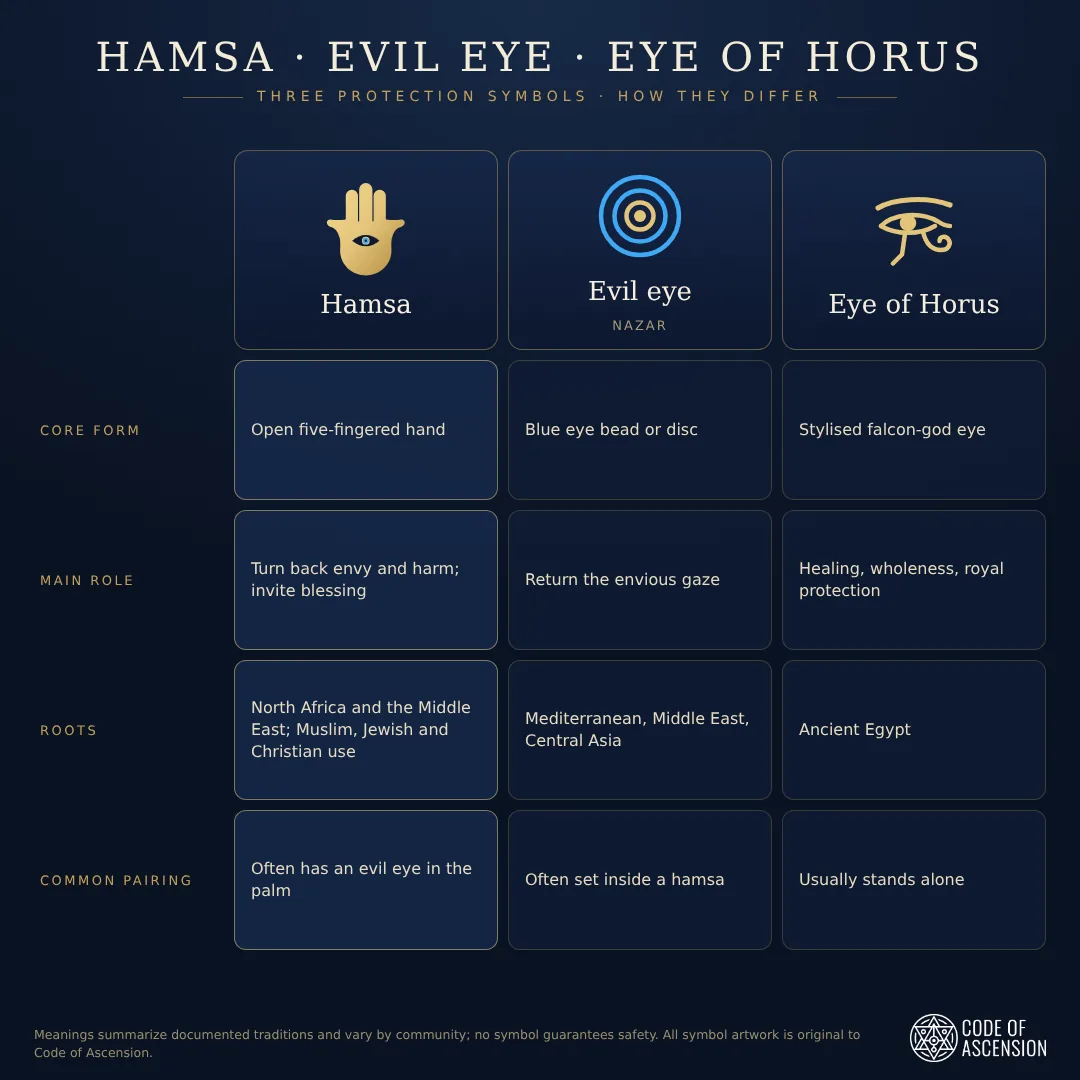
The comparison in text:
- Hamsa. Core form: Open five-fingered hand. Main role: Turn back envy and harm; invite blessing. Roots: North Africa and the Middle East; Muslim, Jewish and Christian use. Common pairing: Often has an evil eye in the palm.
- Evil eye (nazar). Core form: Blue eye bead or disc. Main role: Return the envious gaze. Roots: Mediterranean, Middle East, Central Asia. Common pairing: Often set inside a hamsa. Deep dive: Evil Eye Meaning.
- Eye of Horus. Core form: Stylised falcon-god eye. Main role: Healing, wholeness, royal protection. Roots: Ancient Egypt. Common pairing: Usually stands alone. Deep dive: Eye of Horus Meaning.
For more than 30 protection symbols side by side, see Protection Symbols and Their Meanings. For a printable overview, grab the free Protection Symbols guide. If you’d like a deeper ritual and journaling companion, The Protection Symbols Grimoire gathers the symbols, their histories and COA practices in one place.
Hamsa FAQ
What does the hamsa hand mean?
The hamsa is an open-hand amulet meaning protection and blessing. Its name comes from the Arabic khamsa, “five”; the Hebrew hamesh also means five. It’s traditionally used to turn away the evil eye and envy, and it’s shared by Muslim, Jewish and Christian communities in North Africa and the Middle East.
Is the hamsa Jewish or Muslim?
It belongs to more than one tradition. It’s widely called the Hand of Fatima in Muslim contexts. Jewish communities usually call it the hamsa, and “Hand of Miriam” is a more recent Jewish name. Christians in Syria and elsewhere used an equivalent symbol known as the Hand of Mary. The British Museum notes such amulets may have been used by Muslims or Jews.
What does a hamsa pointing down mean?
In modern jewelry and wellness writing, a downward hamsa usually means blessing, abundance or receiving, while upward means protection. This is a modern interpretation. Traditional hamsas appear both ways, so choose the direction that matches your intention.
What does the eye in the hamsa mean?
The eye reinforces the hamsa’s protection against the evil eye. The hand pushes back envy, and the eye returns the envious gaze. That’s why the hamsa and the evil eye bead are so often combined.
Is it okay to wear a hamsa if I’m not religious?
Many people wear it as a general protection or good-luck symbol. Wear it with respect: learn its names and history, avoid mocking or costume-style uses, and be mindful when giving it to someone whose tradition discourages amulets.
Where should I hang a hamsa at home?
Traditionally near the entrance: above or beside the front door, or on a wall facing visitors. Some people also hang one in a workspace. Wherever you place it, mount it securely and keep it out of young children’s reach.
Is the hamsa the same as the Hand of Fatima?
Yes. “Hand of Fatima” is one of the hamsa’s names, widely used in English and in Muslim contexts. In North Africa many speakers simply say khamsa (“five”).
How old is the hamsa?
Protective hand images go back thousands of years in the Near East, but a direct line to the modern hamsa isn’t established. The hand appears on medieval objects in Spain from the 13th to 15th centuries, and many museum pieces date from the 19th and early 20th centuries.
Sources and Further Reading
- Noelia Silva Santa-Cruz, “La mano de Fátima,” Revista Digital de Iconografía Medieval V, no. 10 (2013): 17–25 (1526 prohibition, p. 21; Hand of Mary, p. 22). ucm.es · database entry: ucm.es
- S. Chaker and H. Camps-Fabrer, “Afus,” Encyclopédie berbère 2 (1985), 224–227. doi.org
- Jewish English Lexicon, “Hamsa.” jel.jewish-languages.org
- O. Grebet, A. Pandey and J. Daniel, “Proposal for Emoji: Hamsa,” Unicode L2/20-218 (2020). unicode.org
- Shalom Sabar, “From Sacred Symbol to Key Ring: The Ḥamsa in Jewish and Israeli Societies,” in Simon J. Bronner (ed.), Jews at Home: The Domestication of Identity (Liverpool University Press, 2010). cambridge.org
- Noam Sienna, “Five in Your Eye: The Khamsa among Maghrebi Jews.” academia.edu
- British Museum, Pendant/amulet (“Hand of Fatima” or khamsa), Morocco, c. 1890s, 2014,6009.1. islamicworld.britishmuseum.org
- Judith M. Hadley, “The Khirbet el-Qom Inscription,” Vetus Testamentum 37 (1987). (Context for the Iron Age hand engraving.)
- Unicode Consortium, Emoji 14.0 — U+1FAAC HAMSA. unicode.org
- Emblem of Algeria (current form adopted 1976).
Keep Ascending.