
Quick Answer: Protection jewelry is a necklace, bracelet, ring or charm carrying a symbol that a tradition links with warding off harm, such as the evil eye (nazar), the hamsa, the Eye of Horus or a red string. No piece guarantees safety. What it can serve as is a reminder, an expression of belief or a connection to a tradition. Choose a symbol whose meaning and origin you understand, a format that keeps its details readable, and a metal whose specifications you’ve actually checked.
People have worn protective objects for thousands of years. Ancient Egyptians wore amulets shaped like the restored eye of Horus. Blue glass eye beads hang in homes and cars across Turkey and the eastern Mediterranean. Hammer-shaped pendants are known from Viking Age Scandinavia, and a 10th-century example from Lolland, Denmark, even carries a runic inscription identifying it as a hammer.
What has changed is the shopping. Search “protection necklace” today and you’ll find thousands of pieces, many sold with promises no metal can keep. This guide explains what each major protection symbol means, where it comes from, how it’s commonly worn, and how to read a metal label before you buy. A note on how we work: Code of Ascension sells its own Protection Symbols Grimoire, and some future links on this page may be affiliate links. We’ll always mark those clearly, and when we describe a product we’ll say whether we’ve handled it or are going on the maker’s published specifications.
If you want the full meanings library first, start with our guide to protection symbols and their meanings. This page is about wearing them.
What Is Protection Jewelry?
Protection jewelry is any wearable piece built around a symbol that a culture, faith or practice associates with guarding the wearer: against envy, misfortune, spiritual harm, or simply the feeling of being exposed.
The older word for this is amulet: an object worn for protection, and museums hold many of them. The Metropolitan Museum of Art describes a New Kingdom wedjat eye amulet as embodying healing power and rebirth, and as an object thought to protect its wearer. The British Museum holds an early-20th-century hand-shaped amulet pendant from Gaza, which its curators describe as used against the “evil eye” or “eye of envy,” possibly by Muslims or Jews.
Here’s the frame COA uses throughout: a symbol carries meaning; it doesn’t carry a warranty. What a protection piece can serve as is quieter but real for many people: a reminder of an intention, an expression of belief, or a connection to the people who wore the same sign before you.
The Protection Jewelry Map
Before choosing a piece, it helps to see the major symbols side by side: what each one means, the jewelry formats it commonly appears in, and one thing worth knowing before you wear it.
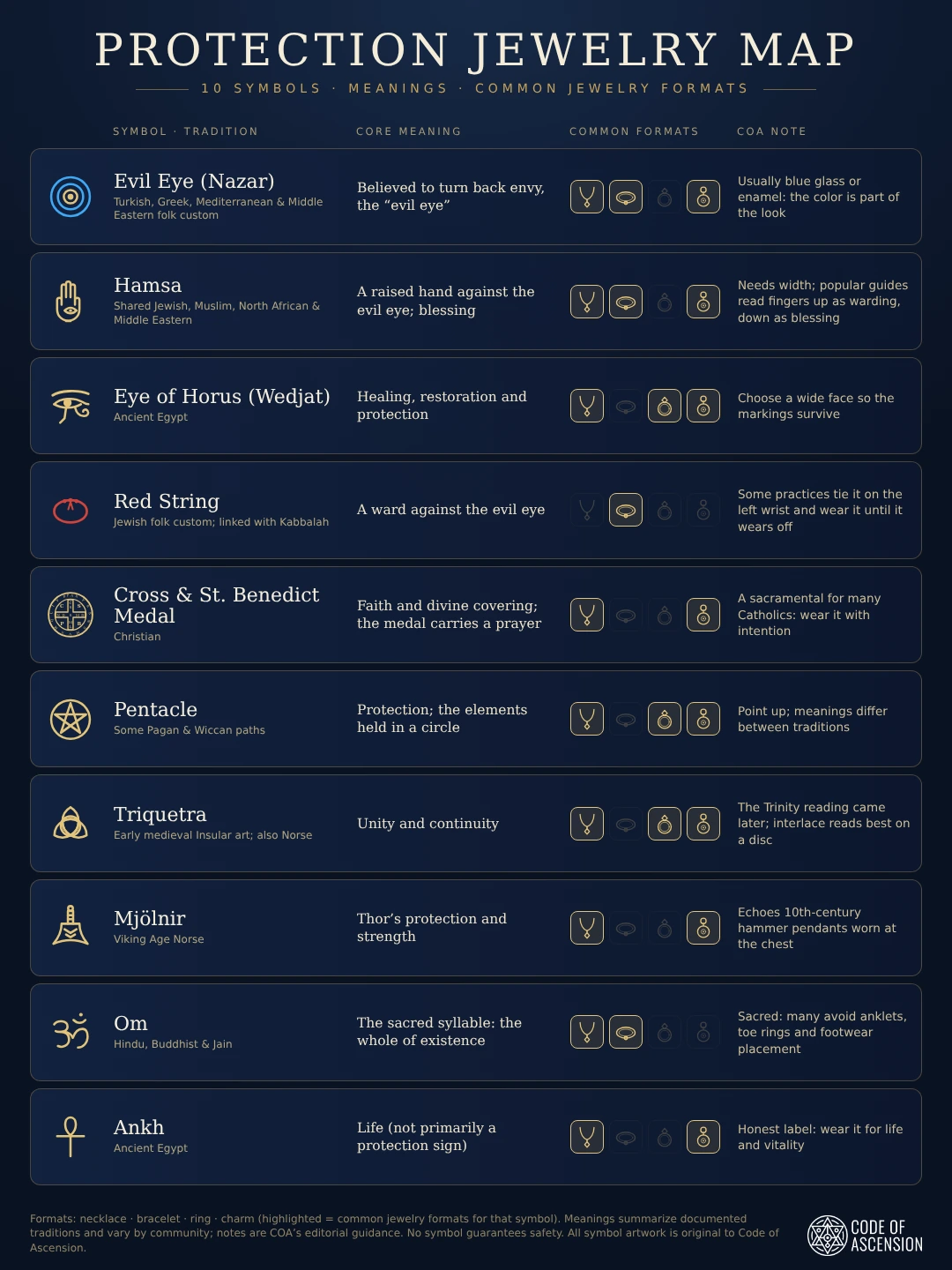
The map in text:
- Evil Eye (Nazar) (Turkish, Greek, Mediterranean & Middle Eastern folk custom): Believed to turn back envy, the “evil eye”. Common formats: necklace, bracelet, charm. COA note: Usually blue glass or enamel: the color is part of the look.
- Hamsa (Shared Jewish, Muslim, North African & Middle Eastern): A raised hand against the evil eye; blessing. Common formats: necklace, bracelet, charm. COA note: Needs width; popular guides read fingers up as warding, down as blessing.
- Eye of Horus (Wedjat) (Ancient Egypt): Healing, restoration and protection. Common formats: necklace, ring, charm. COA note: Choose a wide face so the markings survive.
- Red String (Jewish folk custom; linked with Kabbalah): A ward against the evil eye. Common formats: bracelet. COA note: Some practices tie it on the left wrist and wear it until it wears off.
- Cross & St. Benedict Medal (Christian): Faith and divine covering; the medal carries a prayer. Common formats: necklace, charm. COA note: A sacramental for many Catholics: wear it with intention.
- Pentacle (Some Pagan & Wiccan paths): Protection; the elements held in a circle. Common formats: necklace, ring, charm. COA note: Point up; meanings differ between traditions.
- Triquetra (Early medieval Insular art; also Norse): Unity and continuity. Common formats: necklace, ring, charm. COA note: The Trinity reading came later; interlace reads best on a disc.
- Mjölnir (Viking Age Norse): Thor’s protection and strength. Common formats: necklace, charm. COA note: Echoes 10th-century hammer pendants worn at the chest.
- Om (Hindu, Buddhist & Jain): The sacred syllable: the whole of existence. Common formats: necklace, bracelet. COA note: Sacred: many avoid anklets, toe rings and footwear placement.
- Ankh (Ancient Egypt): Life (not primarily a protection sign). Common formats: necklace, charm. COA note: Honest label: wear it for life and vitality.
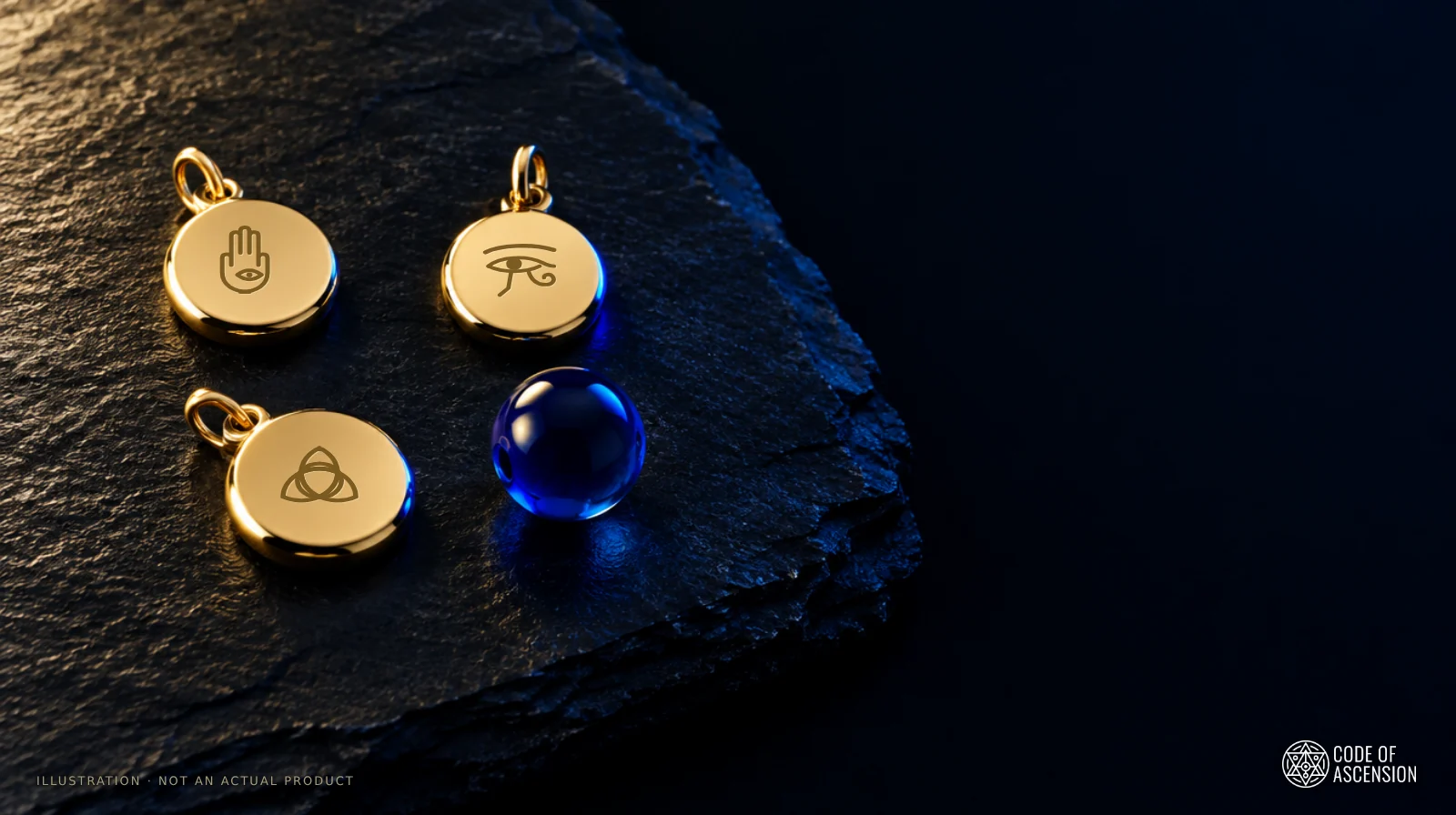
Two patterns stand out. First, detailed symbols need room. An Eye of Horus or a hamsa engraved on a narrow bar can lose the markings that make it recognizable; a disc or shaped pendant keeps them. Second, some symbols are about color as well as shape. A nazar is usually made in blue glass or enamel, and the blue is part of how people recognize it.
The Most Popular Protection Jewelry Symbols
Evil Eye (Nazar)
The blue-and-white eye bead, nazar boncuğu in Turkish, is one of the most widely worn protection charms. It belongs to a belief found in many cultures around the Mediterranean and the Middle East: that envious or admiring looks can cause harm, and that an eye can “look back” and turn that harm away. Bracelets, pendants and charms are common formats; glass and enamel keep the traditional color. For the full story, including what different colors are said to mean, read our evil eye meaning guide.
COA reflection: the evil eye can work as a boundary you can see, a reminder that other people’s envy is theirs to carry.
Hamsa
The name comes from Arabic khamsa, meaning five; Hebrew hamesh also means five. It’s an open hand, often with an eye in the palm, shared across Jewish, Muslim and wider North African and Middle Eastern traditions, and also known as the Hand of Fatima or the Hand of Miriam. You’ll see it with the fingers pointing up or down. Popular explanations often read fingers up as warding off harm and fingers down as blessing, but there’s no single rule. The shape needs some width to read clearly, so a pendant or charm usually suits it better than a slim bar. For the hamsa’s names, history and symbolism in depth, see our hamsa hand meaning guide.
Eye of Horus (Wedjat)
In Egyptian myth, the god Horus lost his eye in battle and had it restored. The restored eye, the wedjat, became a common amulet, associated with healing, regeneration and protection. Its distinctive brow, teardrop line and spiral are what make it recognizable, so pick a piece with enough face to keep them. Our Eye of Horus meaning guide covers the myth and symbolism in depth.
Red String
The red string bracelet is a Jewish folk custom often linked with Kabbalah. In one well-known practice, a red thread is wound around the Tomb of Rachel near Bethlehem and then cut into bracelets. Some practices, including the teaching of the Kabbalah Centre, place it on the left wrist, described as the “receiving” side, and wear it until it wears off. That’s a particular custom rather than a universal rule, and views on the practice vary within Judaism. Because it’s a living religious custom, buy from makers within the tradition or deeply familiar with it.
Cross and St. Benedict Medal
For Christians, the cross is the central sign of faith, and it’s worn as an expression of belief rather than as a charm. The St. Benedict medal, a Catholic sacramental, carries the initial letters of a Latin prayer of protection; its familiar form is the Jubilee design of 1880. Necklaces and pocket medals are common formats.
Pentacle
The pentacle, a five-pointed star within a circle, is used for protection and balance in some Pagan and Wiccan traditions, often read as the elements held together by spirit. Meanings and orientation vary between paths, so if you wear one, learn what it means in the tradition you’re drawing from. Our pentagram meaning guide explains the history beyond the fear.
Triquetra and Celtic Knots
The interlaced triquetra is prominent in early medieval Insular (Irish and British) art from around the 7th century, including manuscripts like the Book of Kells, and also appears on Norse and Anglo-Saxon objects. Reading it as a symbol of the Christian Trinity is documented much later, and the “Celtic” label owes a lot to the 19th-century Celtic Revival. Today it’s widely read as unity and continuity, and the related “shield knot” as a boundary with no gaps. Interlace tends to read best on a round disc or ring face.
Mjölnir (Thor’s Hammer)
Hammer-shaped pendants are known from Viking Age Scandinavia and are widely understood as amulets connected with Thor, the protector god. A 10th-century pendant found on the Danish island of Lolland carries a runic inscription that reads, roughly, “this is a hammer.” Today’s Mjölnir pendants usually hang on a cord or chain at the chest, much like those early finds.
Om
The sacred syllable Om (ॐ) is central to Hindu, Buddhist and Jain practice and is understood as representing the whole of existence. Many wearers treat it as protective in the sense of alignment rather than defense. Because it’s sacred, placement matters: the Hindu American Foundation’s guidelines, for example, ask that sacred imagery not appear on footwear, socks or underwear, or on items meant to be stepped on. For the same reason, many people avoid Om anklets and toe rings. When in doubt, ask someone who practices.
Ankh: An Honest Label
The ankh appears in many protection collections, but its documented meaning is life. It’s a fine choice if vitality and continuity are what you’re after; just wear it for what it is. More in our ankh meaning guide.
Necklace, Bracelet, Ring or Charm?
The same symbol can work very differently depending on where it sits. Use this quick guide to match the format to the symbol and to how you live.
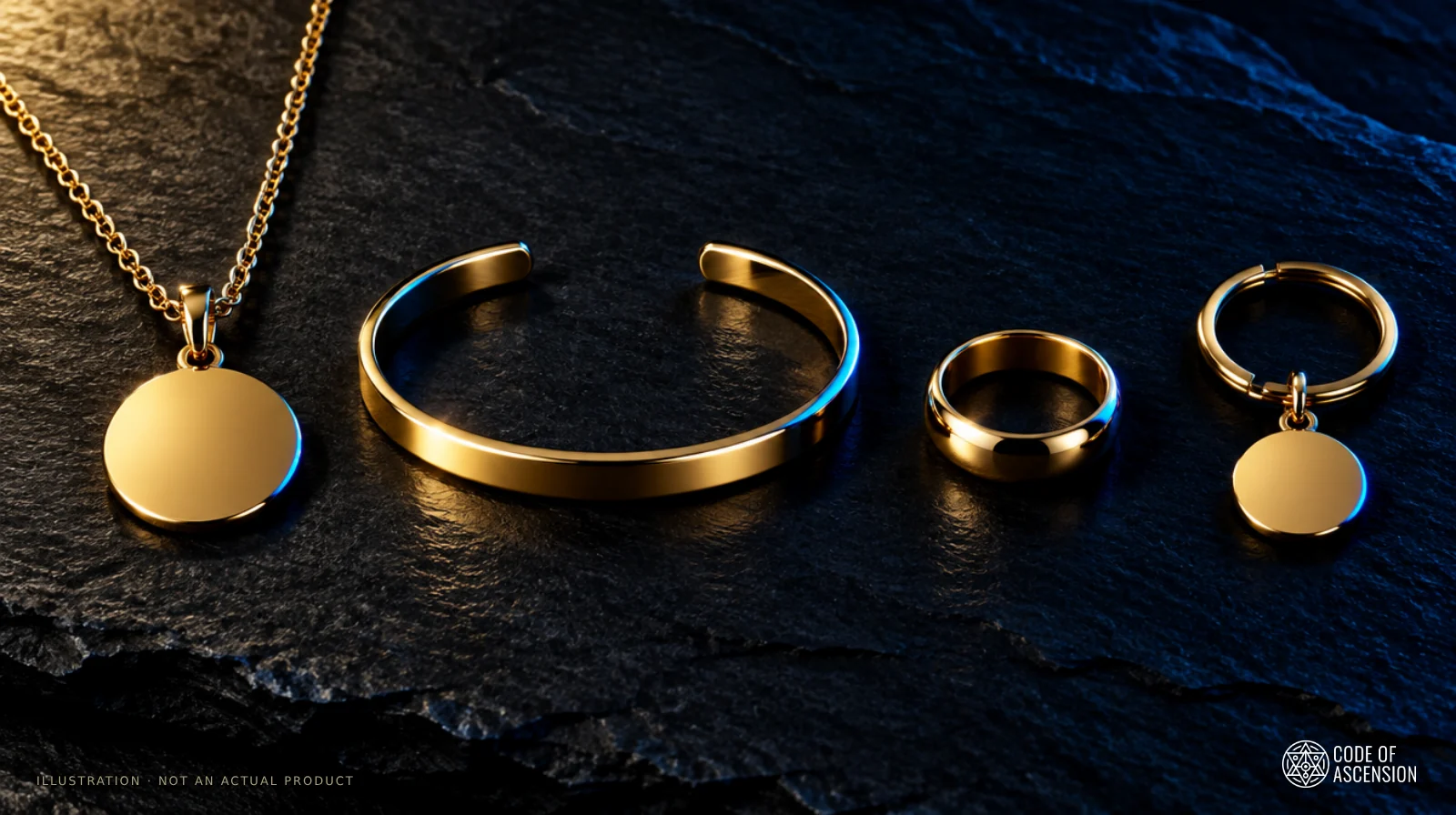
- Necklace. Often chosen for a piece close to the chest and for detailed symbols such as the Eye of Horus, hamsa, Mjölnir, cross, pentacle or triquetra. Watch out for: chain length and where it sits vary with the wearer, so check the listed length against your own neck measurement.
- Bracelet. Often chosen for something you will see often, or for stacking; evil eye beads, red string and hamsa charms are common. Watch out for: bracelets take knocks, so check what any coating is and how the maker says to care for it.
- Ring. Often chosen as a private, constant reminder; simple, bold shapes like a pentacle, triquetra or a wide-faced Eye of Horus work best. Watch out for: fine engraving can soften with wear.
- Charm. Often hung on bags, keys, cars or doorways; the nazar and hamsa are common. Watch out for: glass and enamel can chip, so follow the maker’s care notes.
Where to Wear Protection Jewelry
Placement customs are exactly that: customs. Families, regions and traditions differ, and none of them comes with a guarantee.
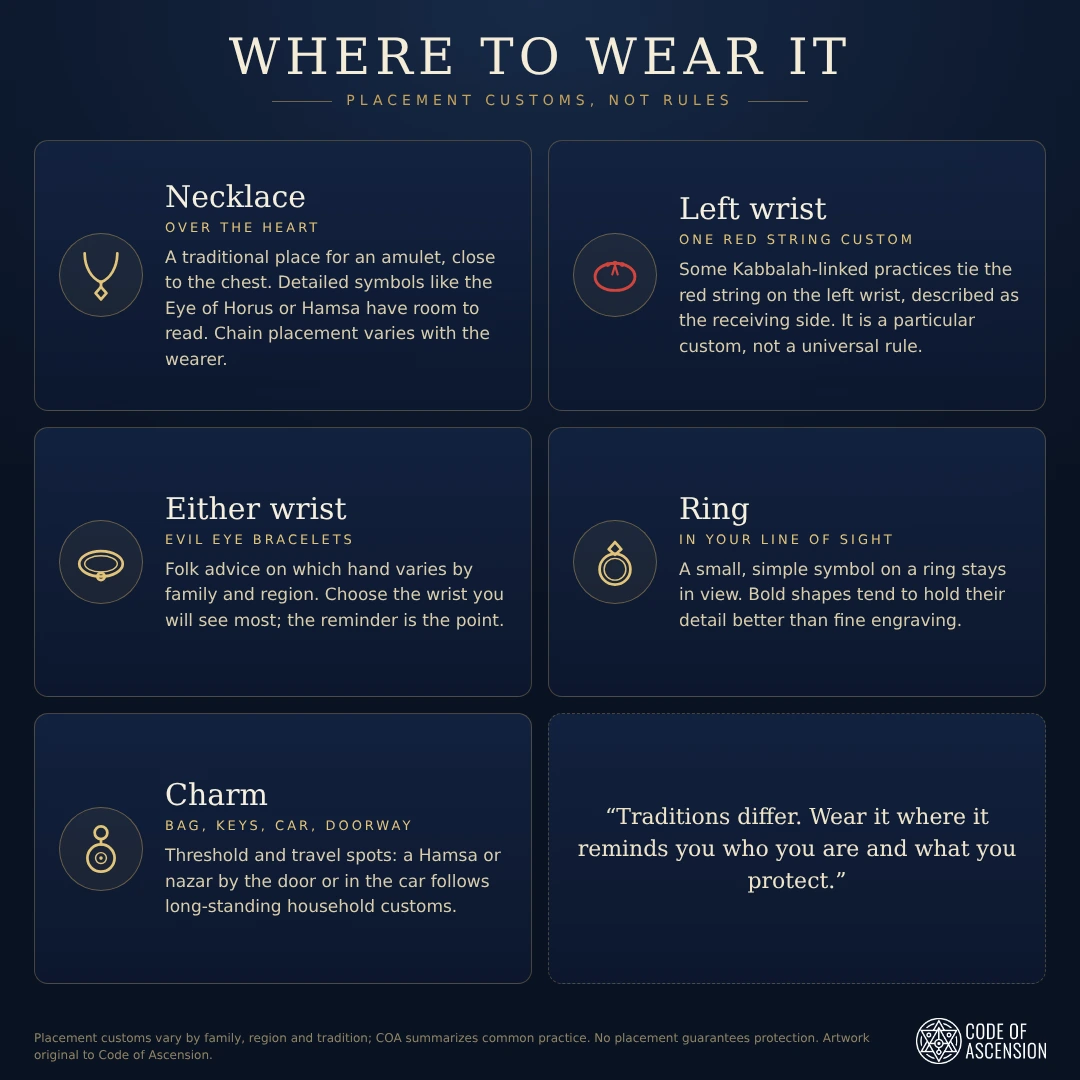
Placement customs in text:
- Necklace (Over the heart): A traditional place for an amulet, close to the chest. Detailed symbols like the Eye of Horus or Hamsa have room to read. Chain placement varies with the wearer.
- Left wrist (One red string custom): Some Kabbalah-linked practices tie the red string on the left wrist, described as the receiving side. It is a particular custom, not a universal rule.
- Either wrist (Evil eye bracelets): Folk advice on which hand varies by family and region. Choose the wrist you will see most; the reminder is the point.
- Ring (In your line of sight): A small, simple symbol on a ring stays in view. Bold shapes tend to hold their detail better than fine engraving.
- Charm (Bag, keys, car, doorway): Threshold and travel spots: a Hamsa or nazar by the door or in the car follows long-standing household customs.
Which wrist for an evil eye bracelet? You’ll find confident answers both ways online. In practice, folk advice varies by family and region. A useful approach is simple: wear it on the wrist you’ll see most, since a visible reminder is part of the point.
Which wrist for a red string? Many people who follow the custom wear it on the left, following teachings that describe the left as the receiving side. It’s a particular practice, not a rule every tradition shares.
Can you wear more than one protection symbol? Many people do, such as a hamsa with an evil eye set in the palm. If you combine symbols from different faiths, learn what each one means so the combination reflects you and respects them.
Protection Jewelry for Men
Protection jewelry isn’t a women’s category; it just gets marketed that way. Men’s pieces often lean on bolder shapes and darker finishes: a Mjölnir or St. Benedict medal on a heavier chain, a steel or titanium band with an engraved Eye of Horus, a cord bracelet with a single evil eye bead, or a signet-style ring with a pentacle or triquetra. Whatever the metal, check the maker’s specifications and care instructions; coatings, stones and cords don’t all suit water, sweat or the gym.
Giving Protection Jewelry as a Gift
Protective objects have long been given as gifts: a hamsa for a new home, a St. Benedict medal for someone starting a hard journey, an evil eye charm for a friend going through a season of change. A few things help the gift land well:
- Match the symbol to the person, not the trend. A red string means something specific to someone raised in that custom; a pentacle means something specific to a practicing Pagan. If you’re unsure, ask, or choose something less tied to a particular faith.
- Include the meaning. A short handwritten card explaining the symbol turns a pretty object into a story they can carry.
- Think about daily life and skin. Someone who works with their hands may prefer a necklace to a bracelet. If they’ve reacted to metal before, check the exact alloy and coating, not just the label.
Metals Explained: What the Label Actually Means
The fastest way to waste money on jewelry is to misread the metal. In the US, the Federal Trade Commission’s Guides for the Jewelry, Precious Metals, and Pewter Industries (16 CFR Part 23) describe how terms like “gold filled” and “vermeil” should be used.
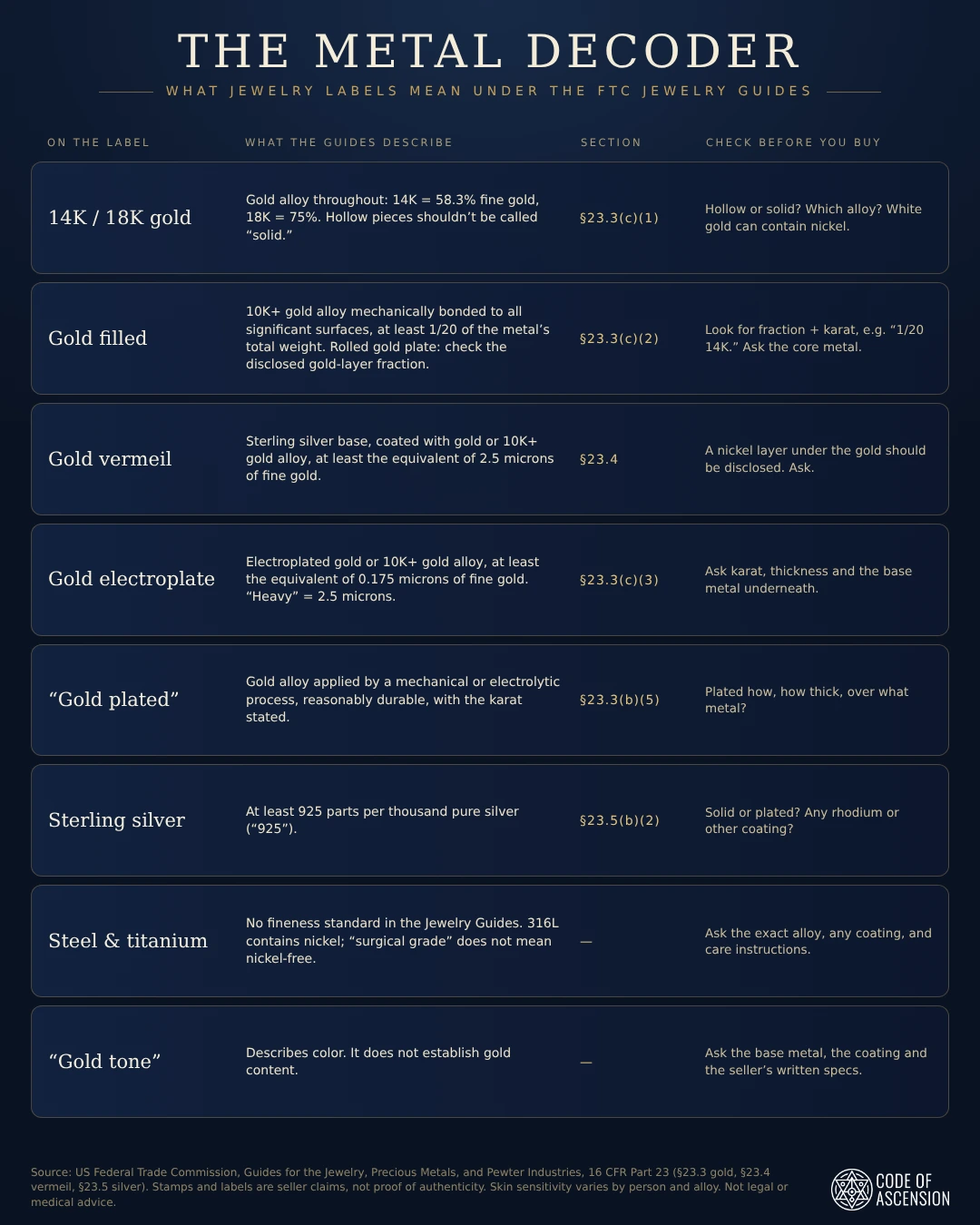
The short version:
- Karat gold (§23.3(c)(1)). Gold alloy all the way through, marked with its karat: 14K is 14/24, about 58.3% fine gold; 18K is 75%. Pieces with a hollow center shouldn’t be called “solid.”
- Gold filled (§23.3(c)(2)). A layer of gold alloy of at least 10K, mechanically bonded (by soldering, brazing, welding or other mechanical means) to all significant surfaces, making up at least 1/20 of the weight of all the metal in the piece. A “1/20 14K” piece means the 14K layer is one-twentieth of the metal’s weight, so its fine-gold content is roughly 1/20 × 14/24, about 2.9%. Pieces sold as “rolled gold plate” or “gold overlay” carry a thinner mechanically bonded layer; check the disclosed gold-layer fraction (for example, “1/40 12K”) rather than assuming a number.
- Gold electroplate (§23.3(c)(3)). Gold or gold alloy of at least 10K, applied by electrolysis, with a minimum thickness equivalent to 0.175 microns of fine gold. “Heavy gold electroplate” means at least the equivalent of 2.5 microns. Thickness is measured as fine-gold equivalent, so a micron of 12K counts as half a micron of 24K.
- “Gold plated” (§23.3(b)(5)). A broader term for gold alloy applied by any process, mechanical or electrolytic, that should be reasonably durable and labeled with its karat. The 0.175-micron figure belongs to the electroplate description, so “plated” on its own doesn’t tell you the thickness. Ask.
- Gold vermeil (§23.4). A sterling silver base, coated with gold or gold alloy of at least 10K, with a minimum thickness equivalent to 2.5 microns of fine gold. If there’s a base-metal layer such as nickel between the silver and the gold, the Guides say that should be disclosed.
- Sterling silver (§23.5(b)(2)). At least 925 parts per thousand pure silver, often stamped “925.”
- Stainless steel and titanium. The Jewelry Guides don’t set fineness standards for them, so ask for the exact alloy and any coating. Note that 316L contains nickel: the standard 316/316L specification calls for roughly 10–14% nickel. “Surgical grade” is a marketing term that doesn’t establish a specific composition, and it does not mean nickel-free.
- “Gold tone.” Describes color; it doesn’t establish gold content. Check the base metal, the coating and the seller’s written specifications.
Remember: a stamp or label is the seller’s claim, not proof. When it matters, ask for the specifications in writing and buy from sellers who answer clearly.
Sensitive skin? Mayo Clinic describes nickel allergy as an immune reaction that usually causes an itchy rash where the metal touches the skin. Its prevention advice is to look for jewelry made from materials such as nickel-free stainless steel, surgical-grade stainless steel, titanium, 18-, 22- or 24-karat yellow gold, nickel-free white gold, or sterling silver. Even with those materials, alloys, coatings and individual sensitivities vary, so if you’ve reacted before, check exact compositions and talk to a clinician about anything persistent.
How to Choose a Protection Piece: The COA Five-Thread Fit
The Five-Thread Fit is COA’s editorial framework for choosing a protection piece. Five questions, one at a time:
- Meaning. Can you say in one sentence what the symbol means to you? If not, read first and buy second.
- Origin. Where does it come from, and is it part of a living faith? If so, favor makers who belong to that tradition or represent it accurately.
- Format. Does the format keep the symbol readable? Detailed symbols need a wider face.
- Material. Have you checked the base metal, coating and the maker’s specifications against your skin, budget and daily life?
- Ritual. How will you use it? Some people set an intention when they first put a piece on, or touch it as a reminder during the day. Decide what yours is, if anything.
When the five threads line up, you’re choosing a piece for reasons you understand, not just because it photographed well.
Before You Buy: 7 Checks
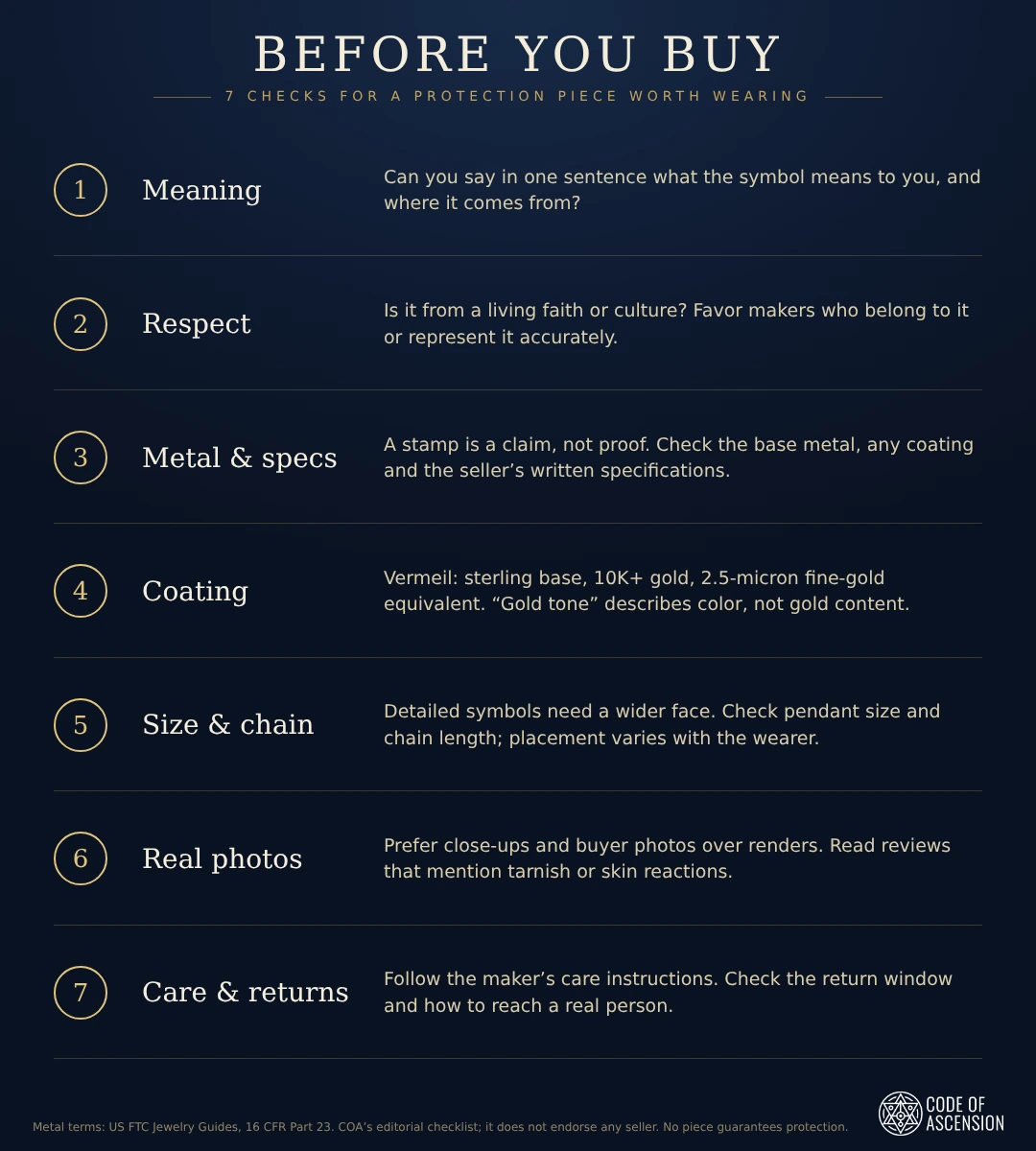
- Meaning. Can you say in one sentence what the symbol means to you, and where it comes from?
- Respect. Is it from a living faith or culture? Favor makers who belong to it or represent it accurately.
- Metal & specs. A stamp is a claim, not proof. Check the base metal, any coating and the seller’s written specifications.
- Coating. Vermeil: sterling base, 10K+ gold, 2.5-micron fine-gold equivalent. “Gold tone” describes color, not gold content.
- Size & chain. Detailed symbols need a wider face. Check pendant size and chain length; placement varies with the wearer.
- Real photos. Prefer close-ups and buyer photos over renders. Read reviews that mention tarnish or skin reactions.
- Care & returns. Follow the maker’s care instructions. Check the return window and how to reach a real person.
And a few red flags worth walking away from:
- “Guaranteed protection” or health claims. No piece of metal can promise that.
- “Energy-charged” or “blessed” with no explanation. If a blessing matters to you, ask who performed it and in what tradition.
- Vague metals: “gold tone,” “gold color,” “alloy,” or no metal listed at all. Ask for the base metal and coating.
- Only renders, no real photos. Look for close-ups and buyer photos.
- Sacred symbols treated as decoration by sellers with no connection to the tradition.
How COA Evaluates Jewelry Makers
When we point to a maker, we look at four things: whether the symbolism is described accurately, whether metals and coatings are specified clearly, whether there are real photos, and whether the return policy and customer contact are clear. We’ll say plainly whether a recommendation is based on a piece we’ve handled or on the maker’s published specifications, and we’ll label any affiliate relationship where it appears.
Caring for Your Piece
Care depends on the exact materials, so the maker’s instructions come first. As a general habit, store pieces dry and separately so they don’t scratch, wipe them after wear, and keep plated, vermeil, glass, enamel and cord pieces away from harsh chemicals. Sterling silver darkens with tarnish and can usually be polished back with a soft silver cloth. Cord and red string bracelets fray over time; in the red string custom, many people let a worn string go and tie on a new one.
COA reflection: some people treat cleaning a piece as a small reset, a moment to remember why they started wearing it.
Go Deeper: The Meanings Behind the Metal
If you want more than a piece of jewelry and would like to understand the symbols and work with them, the Protection Symbols Grimoire goes deeper into meanings, history and practice. (It’s our own product.) Prefer to start free? The Free Ascension Library has guides you can download today.
Protection Jewelry FAQ
What is the most powerful protection jewelry?
No symbol is objectively the most powerful; each comes from a different tradition with its own meaning. The evil eye (nazar), the hamsa and the Eye of Horus are among the most widely worn. The most meaningful piece is usually one whose symbol and origin you understand.
Does protection jewelry really work?
No piece of jewelry can guarantee protection. What it can serve as is a reminder of an intention, an expression of belief, or a connection to a tradition, and many people value it for those reasons.
Which wrist should I wear a protection bracelet on?
It depends on the custom. Some red string practices place it on the left wrist, described as the receiving side. For evil eye bracelets, folk advice varies by family and region, so many people simply choose the wrist they’ll see most.
Can I wear an evil eye and a hamsa together?
Yes, and many people do. The two are often combined, with an eye set into the hamsa’s palm, since both are associated with turning away the evil eye.
Can anyone wear a hamsa or red string?
Both are worn widely beyond their communities of origin. Respect matters: learn what the symbol means, buy from makers who represent the tradition accurately, and don’t treat a sacred object as a costume.
What metal is best for protection jewelry?
It depends on your skin, budget and how you’ll wear it. Check what the label actually means: under the FTC Jewelry Guides, gold filled, vermeil and electroplate each have specific definitions, and “gold tone” describes color, not gold content. If you react to nickel, Mayo Clinic suggests materials such as titanium, sterling silver, 18-karat-or-higher yellow gold, nickel-free white gold, or nickel-free or surgical-grade stainless steel, but alloys and coatings vary, so check the exact composition.
What does it mean when protection jewelry breaks?
Some traditions read a broken evil eye or worn-through red string as a sign it has done its job, and replace it. That’s a custom, not something anyone can verify, but replacing it can be a meaningful moment.
What protection jewelry is good for men?
Bolder shapes and darker finishes are popular: a Mjölnir or St. Benedict medal on a heavier chain, a steel or titanium ring with an Eye of Horus or pentacle, or a cord bracelet with a single evil eye bead. Check the maker’s specifications and care instructions for daily wear.
Final Thoughts
The best protection jewelry isn’t the most expensive piece or the one with the boldest promise. It’s one you understand: a symbol whose story you know, in a format that keeps it readable, made of materials whose specifications you’ve checked. Choose with care, wear it with intention, and let it remind you of what you’re protecting.
Keep Ascending.