
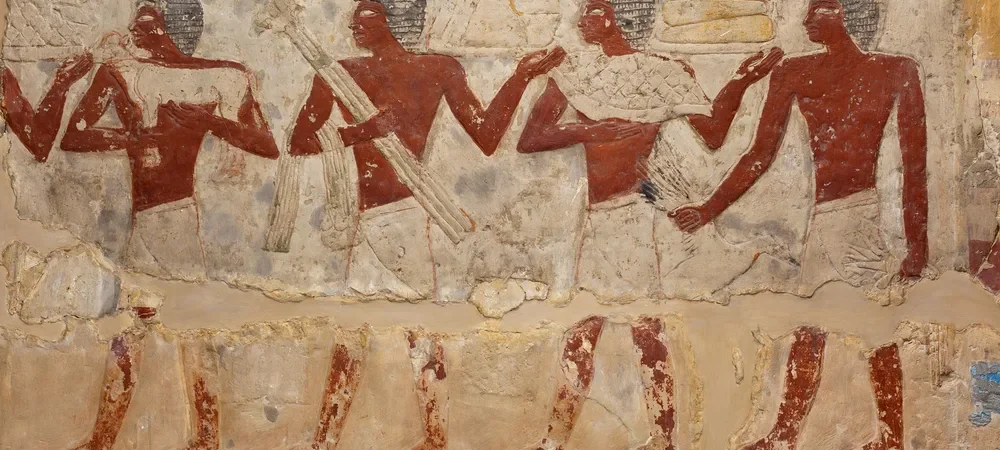
Ancient Egypt was not a world of bare beige stone. Temple walls, tomb chapels, coffins, sculpture, papyri, jewelry, and everyday objects could carry intense color. What survives today is only a fraction of that visual world, filtered through burial conditions, chemical change, cleaning, excavation, and thousands of years of exposure. The evidence still shows a culture that understood color as material, craft, identity, and meaning.
The safest way to recover that world is to start with objects and excavation records. A painted relief can show where a color was placed. Microscopy and chemical analysis can identify a pigment or alteration product. Museum conservation records can reveal where a modern repair or old coating changed the appearance. Texts and repeated visual patterns can help with interpretation, but they cannot replace the physical evidence.
Ancient Egypt Was Painted in Color
Modern photographs often encourage a false impression. The surviving monuments are dominated by sandstone, limestone, granite, mud brick, and desert dust, so viewers may imagine that ancient Egyptians preferred the same muted palette. In reality, many surfaces were prepared and painted. Relief carving and color worked together: the carved line organized a figure, while paint separated skin, clothing, hair, plants, offerings, signs, and architectural details.
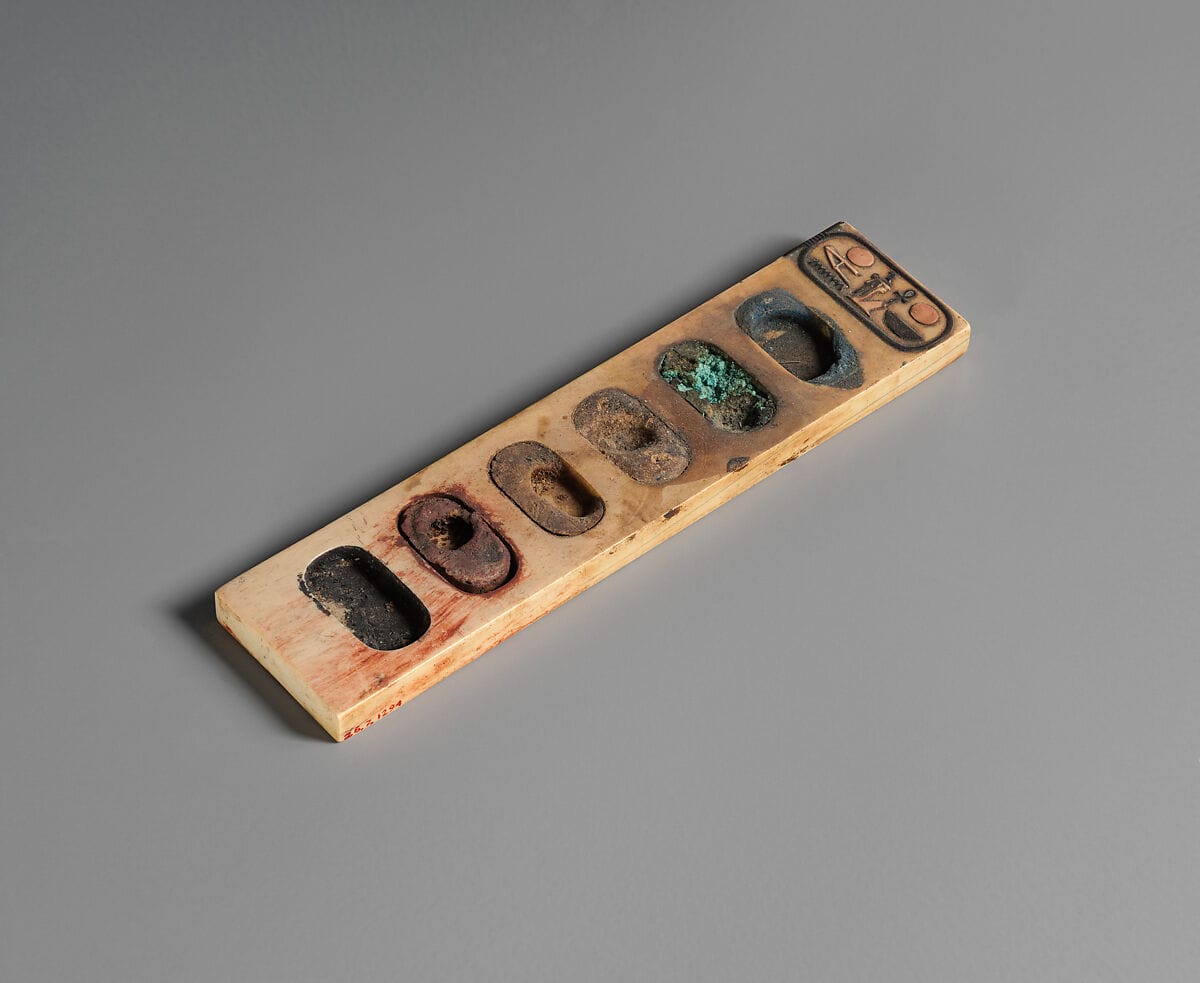
Color also appeared on objects that were never architectural. The Metropolitan Museum of Art preserves palettes with pigment cakes, decorated coffins, painted wooden models, blue faience, illustrated papyri, and stone objects with traces of color. These objects matter because they show that color was part of workshop practice across different scales and materials. A monumental wall and a painter’s palette belong to the same technological history.
The tomb of Perneb, excavated at Saqqara and now displayed at The Met, is a vivid case. Red, blue, black, and other surviving tones still guide the eye across carved figures and hieroglyphs. They are not a reconstruction of a generic “Egyptian look.” They are physical remains on a documented monument, which makes them more valuable than a modern recoloring made only for atmosphere.
What the Saqqara Evidence Can Tell Us
Saqqara is a vast cemetery landscape associated with the ancient capital region of Memphis. It contains monuments from many periods, so “found at Saqqara” does not by itself identify a date, ruler, workshop, or meaning. Archaeologists must use inscriptions, architecture, pottery, burial context, style, and scientific analysis to establish what an individual discovery represents.
That caution applies to reports about a recently announced tomb connected with an individual named Iti. The University of Barcelona mission’s announcement describes a decorated monument and a newly documented context. It can support claims about the discovery, the excavation team, and the presence of painted decoration. It does not automatically support every viral claim about the exact chemistry of the pigments or a hidden color code. Those questions require technical publication and object-specific analysis.
This distinction is useful beyond one tomb. Excavation announcements often arrive before the full scholarly report. The announcement is primary evidence for what the team says it found. It is not the final word on every historical interpretation. A responsible article separates the documented discovery from broader background supplied by well-studied museum objects and conservation science.
How Egyptian Artists Made Their Colors
Ancient Egyptian painters used mineral and synthetic colorants prepared as powders and mixed with a binding medium. The Metropolitan Museum of Art’s technical overview describes common materials such as red and yellow ochres, carbon-based black, white minerals, green copper compounds, and the manufactured material now called Egyptian blue. Recipes varied by period, workshop, intended surface, and available resources.
Ochres are iron-rich earth pigments. Their color can range from yellow to red and brown depending on mineral composition and treatment. Carbon black could come from soot or charred material. White paints could use calcium-based materials. Green might be produced with minerals such as malachite or with manufactured copper-bearing compounds. These labels describe families of materials; a laboratory must test the object before naming the exact pigment on a particular area.
The powdered pigment needed a binder to adhere to a wall, wood, plaster, or papyrus. Plant gums, including acacia gum, are commonly discussed in Egyptian painting technology, but binders can be difficult to identify after millennia. They may survive in tiny amounts, change chemically, or require destructive sampling. Conservators therefore balance the value of an answer against the need to preserve the object.
Egyptian Blue Was an Engineered Material
Egyptian blue is especially important because it was manufactured rather than simply collected and ground from a naturally blue stone. Its principal blue phase is a copper calcium silicate known as cuprorivaite. Production required silica, a calcium source, a copper-bearing ingredient, an alkali flux, heat, and controlled workshop practice. The result could be crushed into pigment or shaped into material used for objects and inlays.
Calling it “the first synthetic pigment” is common and broadly useful, but the phrase should be handled with care. It describes Egyptian blue’s early, deliberate manufacture from combined ingredients. It does not mean every blue surface in Egypt used the same recipe, or that every workshop produced an identical material. Grain size, firing conditions, impurities, and later alteration can change how the blue looks.
Egyptian blue also has a property that helps researchers find traces invisible to the eye. Under suitable visible-light stimulation, the material emits strongly in the near-infrared. Imaging can reveal tiny residues on worn sculpture or walls, sometimes mapping decoration that appears lost in ordinary light. The glow identifies a promising area, but microscopy and spectroscopy remain important for confirming what is present.
How a Painted Surface Was Built
A painted wall was a layered object. Craftspeople first had to prepare an uneven stone or mud-brick surface. They could fill gaps, smooth the face with plaster or a ground layer, establish guidelines, draw or incise the design, and then apply areas of color. On carved relief, painting interacted with raised or sunk contours. A final coating may sometimes have altered gloss or saturation.
The sequence matters to archaeologists. A red guideline beneath a finished figure can reveal planning. An overlap between two colors can show which was painted first. A correction can show that the design changed during execution. Tool marks, brushwork, and pigment boundaries make the wall a record of labor rather than a flat image that appeared all at once.
Workshop practice was not perfectly uniform. Different teams could work on separate zones, and a monument could remain unfinished. Some surfaces preserve preliminary stages that are rarely visible in completed scenes. Those incomplete areas can be exceptionally informative because they expose the process that finished decoration normally conceals.
What Colors May Have Communicated
Color could help classify and distinguish. Artists repeatedly used conventional colors for bodies, clothing, water, vegetation, metals, divine figures, and hieroglyphic signs. In religious contexts, colors could gather symbolic associations: green with flourishing life and regeneration, black with fertile soil and rebirth, blue with sky or water, and gold with the enduring brilliance associated with the gods.
Those associations are patterns, not a universal one-word dictionary. Meaning depended on object, place, period, material, and combination. Black paint in an inscription is not automatically a coded reference to resurrection. A green plant may be green because it depicts vegetation. A blue crown, blue hair, and a blue decorative band do not perform the same job simply because the pigment appears similar.
Material could matter as much as hue. Gold leaf was not merely yellow; its durability and sheen carried associations that ordinary yellow paint could not fully reproduce. Lapis lazuli was a costly imported stone, while Egyptian blue was a manufactured colorant with a different economic and technical story. Modern screens collapse these distinctions into pixels, so object records remain essential.
Why Ancient Egyptian Colors Look Different Today
No surviving color should be assumed to look exactly as it did when applied. Pigments can darken, fade, react with salts, or transform into new minerals. Binders and coatings can yellow or disappear. Burial moisture can mobilize salts. Soot, dust, biological growth, excavation, old consolidants, and previous restoration can all alter the surface seen by a modern visitor.
A green area may once have looked more blue, or a darkened surface may preserve a copper pigment that changed chemically. A white ground can become stained. Bright details may survive in protected recesses while exposed areas appear nearly blank. Conservators compare protected and exposed zones, examine cross-sections, and use noninvasive imaging to separate original material from alteration.
This is why digital recolorings should be labeled as reconstructions. They can help viewers imagine a painted monument, but the confidence varies from area to area. A useful reconstruction distinguishes sampled pigment, visible trace, pattern-based inference, and artistic completion. Without that evidence ladder, a beautiful image may imply more certainty than the object supports.
How Researchers Identify Ancient Pigments
Researchers rarely rely on color alone. Portable X-ray fluorescence can indicate chemical elements at the surface. Raman spectroscopy and X-ray diffraction can identify crystalline compounds. Infrared and ultraviolet imaging can reveal patterns or residues. Microscopy can show particle shape and paint layering. When sampling is allowed, a tiny cross-section can preserve the order of ground, pigment, and coating.
Each method has limits. Elemental copper does not by itself prove Egyptian blue; several copper pigments contain it. Fluorescence can flag Egyptian blue but may be affected by coatings or the instrument setup. A sample from one corner does not describe an entire tomb. Strong conclusions usually come from multiple methods joined to archaeological context.
Open museum collections make this process easier to follow. The Met’s collection records link a pigment palette, the tomb of Perneb, and other painted objects to dates, materials, excavation histories, and images. These records are primary object documentation. Technical publications then add the scientific interpretation needed to explain how the color was made and how it changed.
What the Evidence Does Not Prove
Surviving pigments do not prove that every Egyptian monument was equally colorful. Decoration depended on function, resources, status, time, and whether work was completed. Nor can one painted tomb define practice across more than three thousand years of Egyptian history. The Old Kingdom, New Kingdom, Ptolemaic period, and Roman period were connected but not interchangeable.
The evidence also does not support claims that a single color carried one secret meaning everywhere. Symbolic readings can be historically grounded, but they must follow the scene and period. Claims about lost advanced technology require the same standard as any other claim: a documented object, secure context, reproducible analysis, and a result that distinguishes the proposal from ordinary ancient craft.
Nor does a color’s modern name establish the ancient name or category. “Blue,” “green,” and “turquoise” are convenient English labels, while Egyptian words, scripts, materials, and visual conventions organized experience in their own ways. Translation can illuminate that system, but a modern color chart should not be projected backward as if it were an ancient workshop manual.
The real achievement does not need exaggeration. Ancient craftspeople selected minerals, engineered synthetic compounds, controlled heat, prepared surfaces, organized large workshops, and built visual systems that lasted for millennia. That material intelligence is more interesting when its limits and evidence are visible.
Watch the DCI Short
Watch the Ancient Egypt Short on YouTube. The video introduces the discovery; the article separates the excavation announcement, established pigment science, and open questions.
Ancient Egyptian Colors FAQ
Was ancient Egypt really colorful?
Yes. Painted tombs, temple reliefs, coffins, papyri, sculpture, palettes, and decorated objects preserve direct evidence of a broad color tradition. The bare stone seen today is often the result of weathering, burial chemistry, damage, and lost surface layers. The amount of surviving paint varies greatly, so reconstructions should show which colors are documented and which are inferred.
What pigments did ancient Egyptians use?
Common materials included red and yellow ochres, carbon black, calcium-based whites, green copper minerals or compounds, and manufactured Egyptian blue. Artists ground colorants and mixed them with a binder before painting. Recipes changed across time and workshops, and visual appearance alone cannot identify a pigment with certainty; object-specific scientific analysis is required.
What is Egyptian blue made from?
Egyptian blue contains the blue copper calcium silicate mineral cuprorivaite. Ancient makers combined silica, calcium, a copper-bearing ingredient, and an alkali flux, then heated the mixture under controlled conditions. Exact recipes and firing results varied. Researchers can often detect surviving grains through their strong near-infrared luminescence, even when little blue remains visible.
Why did Egyptian paint survive for so long?
Some mineral pigments are chemically stable, and protected tomb environments can reduce sunlight, rain, and abrasion. Prepared surfaces and binders helped paint adhere. Survival is still uneven: moisture, salts, microorganisms, soot, excavation, and conservation history can damage or transform color. A vivid protected recess may sit beside an exposed area where the same paint has vanished.
Did every Egyptian color have a symbolic meaning?
Colors could carry associations, but there was no universal one-word code. Green could suggest vegetation or regeneration, black fertile soil or rebirth, and gold divine brilliance, depending on context. Color also served practical visual roles. Researchers interpret hue together with material, object type, inscription, scene, date, and placement rather than assigning a fixed meaning in isolation.
How do scientists identify pigment on a tomb wall?
They combine methods such as microscopy, X-ray fluorescence, Raman spectroscopy, X-ray diffraction, and infrared or ultraviolet imaging. Each method answers a different question about elements, compounds, layers, or hidden residues. The strongest identification uses more than one line of evidence and connects the measurement to a documented location on the object.
Was the newly reported Saqqara tomb analyzed for pigments?
The excavation announcement documents painted decoration and the archaeological discovery. It should not be treated as a complete pigment study unless the mission publishes object-specific analytical results. Claims about exact compounds, recipes, or symbolic meanings need a technical report. For established pigment science, this article relies on analyzed museum objects and conservation research.
Can we reconstruct the original colors accurately?
Sometimes researchers can reconstruct parts with high confidence using visible traces, imaging, samples, repeated patterns, and comparison with related objects. Other areas remain uncertain because paint was lost or altered. A responsible reconstruction labels degrees of confidence and avoids filling every blank with modern taste. It is an evidence-based model, not a time photograph.
Keep Exploring
- Explore Science & Discovery
- Why Mercury Is Shrinking
- The Ancient Egyptians’ Blueprint for the Afterlife
- The Egyptian Book of the Dead
For readers drawn to Egyptian history and symbolism, the Code of Ascension shop may include related books, prints, or learning tools. Product links support the site; they are not evidence for the archaeological claims in this article.