
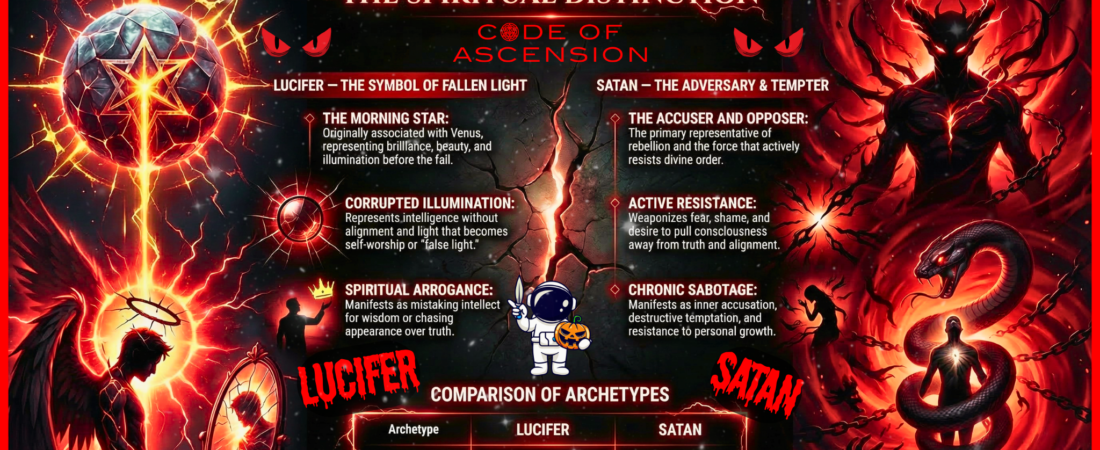

Lucifer vs Satan is one of the most misunderstood topics in biblical interpretation, spiritual symbolism, and esoteric thought. Many people use the names as if they mean the exact same thing, but the deeper you study the subject, the more layered it becomes.
In many Christian traditions, Lucifer and Satan are treated as the same fallen being. In that view, Lucifer is the angelic name or title before the fall, while Satan is the adversary after the fall. But historically, linguistically, and symbolically, the picture is more complex.
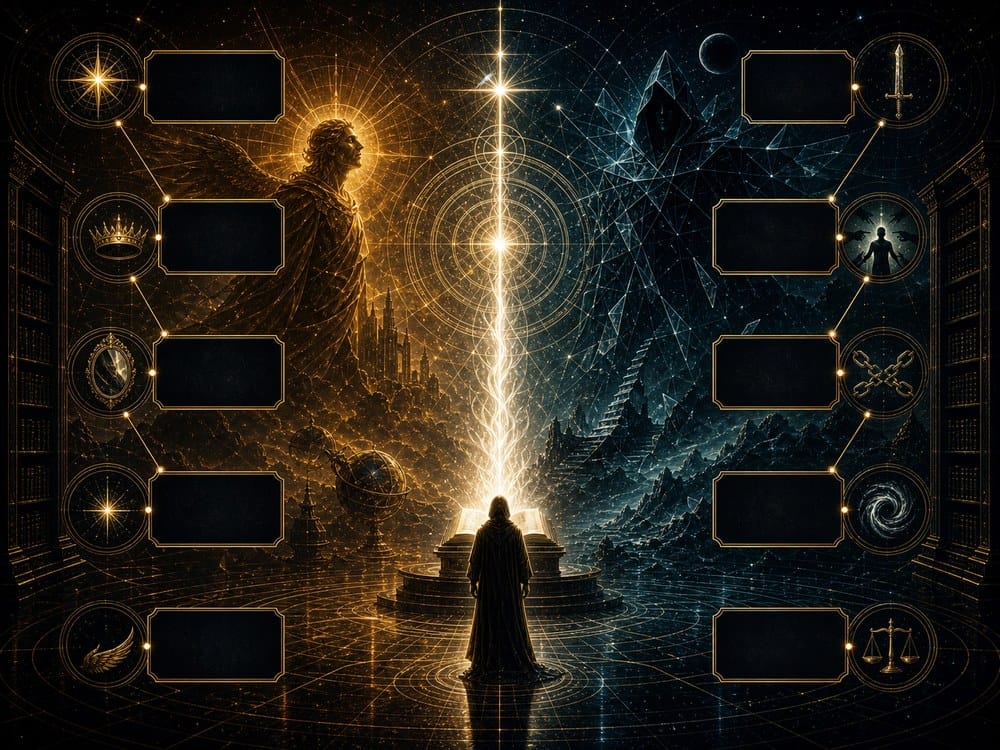
Lucifer is connected with the morning star, light bearing, brilliance, pride, beauty, and fallen illumination. Satan is connected with the adversary, accuser, tempter, opposer, and force of spiritual resistance. Those meanings overlap in later Christian tradition, but they do not begin from the same symbolic place.
That distinction matters because Lucifer vs Satan is not only a question about names. It is a question about discernment. What is true light, and what is false light? What is divine wisdom, and what is ego pretending to be wisdom? What is temptation, and what is resistance? What part of us wants to awaken, and what part of us wants to use awakening as another costume for pride?
Fast answer: Lucifer vs Satan can be understood on two levels. In much Christian tradition, Lucifer is commonly treated as Satan before the fall. Symbolically, Lucifer represents fallen light, pride, beauty, and false illumination, while Satan represents opposition, accusation, temptation, and resistance to truth.
Lucifer vs Satan: What Is The Difference?
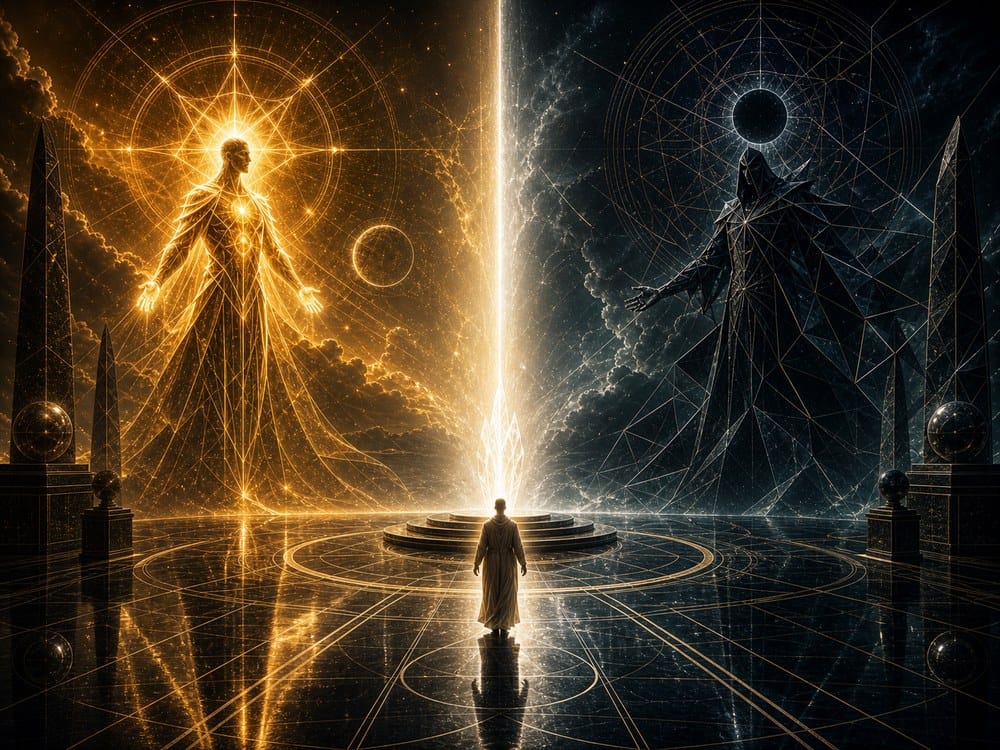
The simplest Lucifer vs Satan difference is this: Lucifer represents distorted light, while Satan represents adversarial opposition.
Lucifer comes from Latin roots connected with light bearing or the morning star. The image is bright, elevated, beautiful, and dangerous when pride corrupts illumination. Satan comes from a Hebrew root meaning adversary or opponent. The image is not first about beauty. It is about resistance, accusation, and opposition.
In Christian theology, the two are often merged. Many believers understand Lucifer as the pre-fall name and Satan as the post-fall role. That interpretation has shaped sermons, art, poetry, demonology, and popular imagination for centuries.
But when you study the words symbolically, they reveal different spiritual patterns.
Lucifer says, I am brilliant, therefore I should rule.
Satan says, I will oppose, accuse, tempt, divide, and pull consciousness away from truth.
One is seduction through radiance. The other is pressure through conflict.
That is the heart of the distinction. Lucifer warns that light can become pride. Satan warns that resistance can become destruction.
Lucifer vs Satan In The Bible And Christian Tradition
The Lucifer vs Satan conversation often begins with Isaiah 14:12. In the King James Version, the verse uses the phrase O Lucifer, son of the morning. Many modern translations render the same image as morning star or day star, son of the dawn. In its immediate historical context, the passage addresses the king of Babylon, but later Christian interpretation often read it as a symbolic description of Satan’s fall.
That later interpretation became very influential.
Over time, Christian tradition connected several images together: the fallen morning star of Isaiah, the prideful angelic fall, the serpent of Eden, the tempter in the wilderness, the accuser, the devil, and Satan. These images fused into one larger spiritual figure representing rebellion against God and opposition to divine order.
For external context, Britannica explains Lucifer as a name connected with the morning star that later came to be regarded in Christian tradition as a name of Satan before the fall. Britannica also describes Satan as an adversary figure in Judaism, Christianity, and Islam. Those reference points help explain why the names are often used together.
Still, the development is layered. Scripture, translation history, church interpretation, medieval imagination, literature, art, and modern pop culture all shaped how people now understand Lucifer vs Satan.
So when someone asks, Is Lucifer Satan? the answer depends on the lens. In many Christian traditions, yes, Lucifer and Satan are treated as the same fallen being. In a more historical or symbolic study, Lucifer and Satan carry different roots and different archetypal meanings.
That difference does not have to weaken spiritual interpretation. It can deepen discernment.
Lucifer Symbolism: Fallen Light And False Illumination
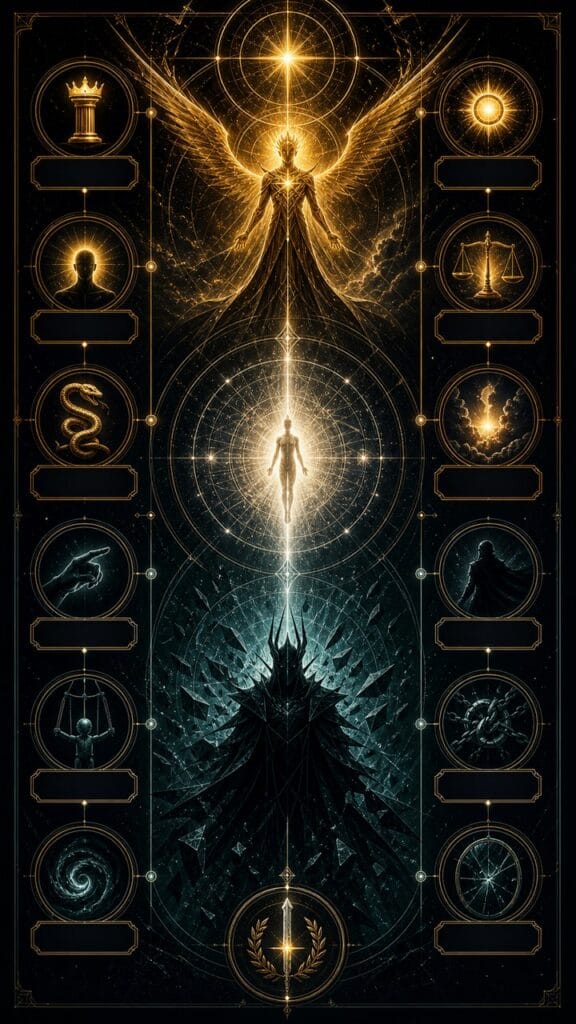
Lucifer symbolism begins with light. That is what makes it spiritually subtle. Obvious darkness is easy to reject. False light is harder because it arrives dressed as brilliance, beauty, knowledge, charisma, superiority, and spiritual specialness.
This is why Lucifer is such an important symbol for awakening work. The Lucifer pattern is not simply evil in a cartoon sense. It is illumination that has become self-worship. It is knowledge without humility. It is beauty without devotion. It is spiritual power without surrender. It is the part of consciousness that wants to rise, but wants to rise as an egoic throne.
Lucifer energy can appear when someone becomes attached to being special, chosen, more awakened, more advanced, or more enlightened than others. It can appear when spiritual language becomes a way to avoid accountability. It can appear when a person confuses intensity with truth, aesthetics with depth, or secret knowledge with wisdom.
This does not mean light is bad. Light is sacred when it reveals truth. The danger is false light: the kind of brightness that flatters the ego while separating the heart from humility.
The spiritual lesson of Lucifer is not, reject illumination. The lesson is, purify illumination.
Ask: does this light make me more honest, loving, grounded, and responsible? Or does it make me inflated, superior, performative, and disconnected?
That one question cuts through a lot.
Satan Symbolism: The Adversary, Accuser, And Opposer
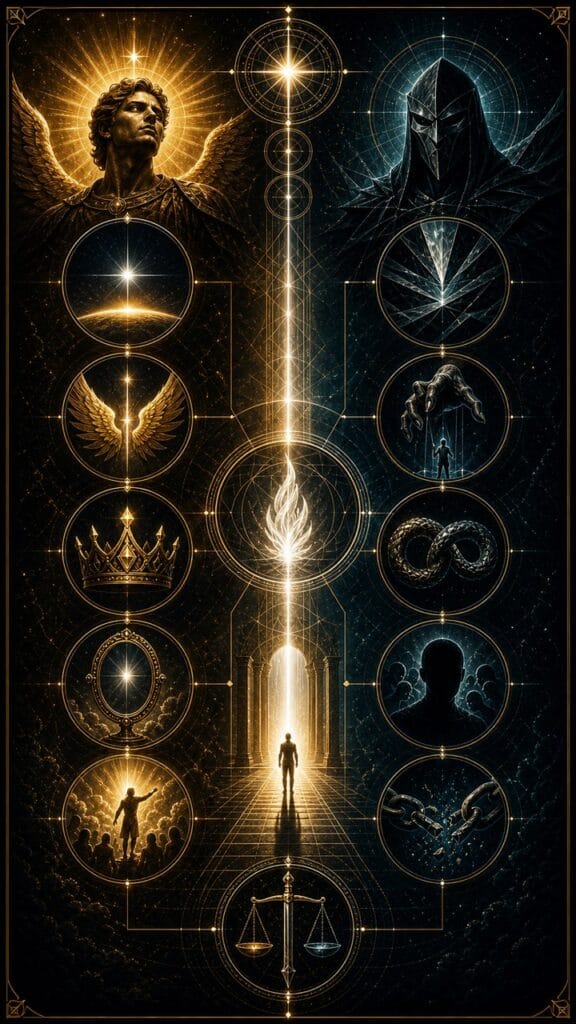
Satan symbolism begins with opposition. The word is commonly connected with adversary, accuser, or opponent. This gives Satan a different spiritual function than Lucifer. Satan is less about corrupted brilliance and more about the force that resists truth, tests integrity, tempts weakness, accuses the soul, and pulls attention toward separation.
In symbolic terms, Satan is the pattern that says no to alignment.
It may show up as temptation. Not only dramatic temptation, but small daily temptations: betray your values, numb the feeling, choose the easier lie, feed the resentment, scroll instead of act, collapse into shame, prove your superiority, hide from the conversation, take the shortcut that weakens your spirit.
It may show up as accusation. The inner voice that says you are beyond repair, that your past defines you, that your shadow makes you unworthy, that your growth is fake, that you should give up because you already failed.
It may show up as opposition. Every time you move toward a more aligned life, an old pattern may rise to test whether your new choice is real.
This is why Satan symbolism can be useful without becoming fear-based. It names the adversarial current. It helps you recognize when something is pulling you away from truth.
The goal is not paranoia. The goal is discernment.
Lucifer vs Satan And Shadow Work
Lucifer vs Satan becomes powerful when applied to shadow work. These symbols show two different ways the shadow can distort spiritual growth.
The Lucifer shadow says: I am too brilliant to be corrected. I know more than others. I should not have to be humble. My light makes me exempt from ordinary accountability.
The Satan shadow says: I will resist the truth. I will accuse, divide, tempt, and sabotage. I will turn every wound into evidence that growth is impossible.
Both patterns can live inside a person. One inflates the self. The other attacks the self. One creates spiritual superiority. The other creates spiritual despair. One says you are above everyone. The other says you are beneath redemption.
Neither is truth.
Shadow work is the process of bringing these patterns into awareness without worshipping them, fearing them, or pretending they do not exist. You do not heal pride by collapsing into shame. You do not heal temptation by hating your body. You do not heal accusation by arguing with every dark thought. You heal by seeing clearly and returning to grounded responsibility.
If this kind of symbolic work feels intense, pause and regulate. The body must feel safe enough to metabolize truth. For grounding support, the confirmed Code of Ascension path is the Nervous System Calm Pack.
Lucifer vs Satan, Baphomet, Abraxas, And Archons
Lucifer vs Satan belongs inside the wider Code of Ascension esoteric cluster because it deals with misunderstood symbols, polarity, hidden meaning, shadow, and discernment.
Baphomet Meaning explores the union of opposites and the integration of light and shadow. Abraxas Explained explores totality, polarity, and the force beyond simplistic dualism. The Archons Explained explores false authority, control loops, and the patterns that hijack awareness.
Lucifer vs Satan adds a different lesson. It asks you to discern between true light, false light, and adversarial resistance.
True light reveals. False light flatters. Adversarial resistance divides.
That distinction is incredibly practical. In spiritual spaces, not everything bright is healing. Not everything intense is deep. Not everything rebellious is free. Not everything that accuses you is truth. Not everything that challenges you is evil.
The seeker needs discernment strong enough to hold nuance.
Lucifer vs Satan In Money And Career

In money and career, Lucifer vs Satan reveals two different distortions.
The Lucifer distortion appears as pride, image, status, and the desire to be seen as exceptional without doing the grounded work. It can show up as chasing influence instead of mastery, choosing glamour over service, or using success as proof of superiority.
The Satan distortion appears as resistance, sabotage, accusation, and temptation away from alignment. It says you will fail anyway, so do not begin. It says take the shortcut, betray the standard, hide your gift, resent the people ahead of you, or confuse discipline with oppression.
Both patterns can block prosperity.
Lucifer blocks prosperity by making success about ego. Satan blocks prosperity by making action feel impossible or corrupt. The aligned path is different. Build with humility and move with courage. Let your light serve something larger than your image. Let resistance become a signal to return to your values.
Money is not automatically spiritual or unspiritual. Career is not automatically ego or purpose. These are arenas where your inner patterns become visible.
If you are building a conscious creation path, the Manifestation Starter Pack is the clean confirmed CTA path for manifestation and aligned action.
Lucifer vs Satan In Love And Relationships

In love, Lucifer vs Satan can show up as two shadow patterns.
The Lucifer pattern wants to be adored. It wants the mirror. It wants to feel chosen, superior, impressive, or impossible to replace. In relationships, this can create vanity, emotional performance, spiritual superiority, and the need to be worshipped rather than truly known.
The Satan pattern accuses and divides. It looks for evidence, keeps score, tempts you into cruelty, feeds suspicion, and turns conflict into a courtroom. It may whisper that vulnerability is weakness or that repair is humiliation.
A spiritually mature relationship asks for something cleaner. It asks for truth without performance. Boundaries without punishment. Devotion without worship. Accountability without shame. Passion without domination.
Lucifer vs Satan in love is not about labeling your partner. It is about recognizing the patterns that distort intimacy. Where do you need attention more than connection? Where do you accuse before you understand? Where do you confuse control with safety? Where do you use spiritual language to avoid emotional honesty?
Love becomes clearer when light is humble and resistance is named.
Common Misconceptions About Lucifer vs Satan
One misconception is that Lucifer and Satan always meant the exact same thing in every context. In much Christian tradition they are merged, but the words carry different roots and symbolic textures. Lucifer begins with morning star and light-bearing imagery. Satan begins with adversary and opposition.
Another misconception is that separating the symbolism means denying religious tradition. It does not have to. You can honor the traditional Christian fusion while still learning from the difference between fallen light and adversarial resistance.
A third misconception is that Lucifer symbolism means all light is dangerous. No. True light is sacred. The warning is against false light: illumination corrupted by pride, glamour, superiority, or disconnection from humility.
A fourth misconception is that Satan symbolism should make you afraid of every challenge. Challenge is not automatically evil. Sometimes resistance tests your integrity. Sometimes discomfort reveals the next place you need courage. Discernment matters.
Grounded Reflection For Lucifer vs Satan
This article is not a ritual guide, invocation manual, or fear-based warning. It is a symbolic study.
Use the topic as a mirror.
Ask: where am I being tempted by false light? Where do I want to be seen as wise more than I want to become wise? Where am I performing awakening instead of embodying it? Where does pride dress itself as spiritual certainty?
Then ask: where am I being ruled by adversarial resistance? Where does accusation keep me small? Where does temptation pull me away from truth? Where do I call sabotage protection?
Choose one clean action. Apologize. Tell the truth. Finish the work. Stop performing. Ground your body. Close the tab. Keep the promise. Ask for support. Return to the path.
Spiritual discernment becomes real when it changes behavior.
Related Code Of Ascension Links

For polarity and shadow integration, read Baphomet Meaning. For the union of opposites in Gnostic symbolism, read Abraxas Explained. For false authority and repeating spiritual loops, read The Archons Explained. For grounded symbolic perception, read Pineal Gland Activation.
For more Code of Ascension articles, visit the Code of Ascension blog.
Lucifer vs Satan FAQ
What is the difference between Lucifer and Satan?
The Lucifer vs Satan difference depends on the lens. In many Christian traditions, Lucifer is treated as Satan before the fall. Symbolically, Lucifer represents fallen light, pride, beauty, and false illumination, while Satan represents the adversary, accuser, tempter, opposer, and force of spiritual resistance.
Are Lucifer and Satan the same being?
In much Christian tradition, Lucifer and Satan are treated as the same fallen being. Historically and symbolically, the names carry different roots. Lucifer is linked with the morning star and light-bearing imagery, while Satan is linked with adversary or opposition. Both meanings later became fused in Christian interpretation.
What does Lucifer mean spiritually?
Spiritually, Lucifer means light that must be purified by humility. The symbol points to brilliance, beauty, knowledge, and illumination, but also the danger of pride and false light. Lucifer symbolism asks whether your awakening makes you more loving, grounded, and truthful, or more inflated and separate.
What does Satan mean spiritually?
Spiritually, Satan means the adversarial force that resists truth, accuses the soul, tempts weakness, and pulls consciousness away from alignment. Satan symbolism can represent external evil in religious traditions, but it can also be read as the inner pattern of opposition, sabotage, fear, and spiritual resistance.
Why is Lucifer called the morning star?
Lucifer is associated with the morning star because the Latin word is connected with light-bearing and the planet Venus appearing before sunrise. In Isaiah 14:12, the King James wording uses Lucifer, while many modern translations use morning star or day star. Later Christian tradition connected that image with Satan’s fall.
What is false light in Lucifer symbolism?
False light is brightness without humility. In Lucifer symbolism, it can appear as spiritual pride, glamour, superiority, secret knowledge, charisma, or the feeling of being chosen. False light looks elevated, but it disconnects the seeker from love, accountability, embodiment, and honest service.
Is Satan only a symbol?
For many religious believers, Satan is understood as a real spiritual being or force. Symbolically, Satan also represents opposition, accusation, temptation, and resistance to truth. This article focuses on spiritual symbolism while respecting that different traditions interpret Satan literally, mythically, psychologically, or theologically.
How can I study Lucifer vs Satan safely?
Study Lucifer vs Satan through scripture, history, symbolism, and grounded self-reflection. Avoid fear spirals, sensational claims, and practices that feel destabilizing. Let the topic sharpen discernment: notice false light, pride, accusation, temptation, and resistance, then return to humility, truth, embodiment, and aligned action.
Final Thought: True Light Does Not Need Pride

The deepest Lucifer vs Satan lesson is discernment.
Lucifer teaches that light can fall when it becomes pride. Satan teaches that resistance becomes destructive when it opposes truth. One distorts illumination. The other distorts will.
But true light does not need pride. True power does not need domination. True discernment does not need panic. True awakening does not need performance.
The point is not to obsess over names. The point is to recognize patterns. When light makes you humble, it is serving truth. When resistance makes you honest, it can become a test of integrity. When accusation becomes shame, step back. When brilliance becomes superiority, come back to the heart.
The path is not fear. The path is clear seeing.
About The Author: King | Founder of Code of Ascension
King is the founder of Code of Ascension, a spiritual education platform focused on consciousness, symbolism, manifestation, nervous system awareness, and hidden patterns of reality. Through Code of Ascension, he explores ancient wisdom and modern insights to help others awaken, align, and ascend.
Keep Ascending. 🚀