
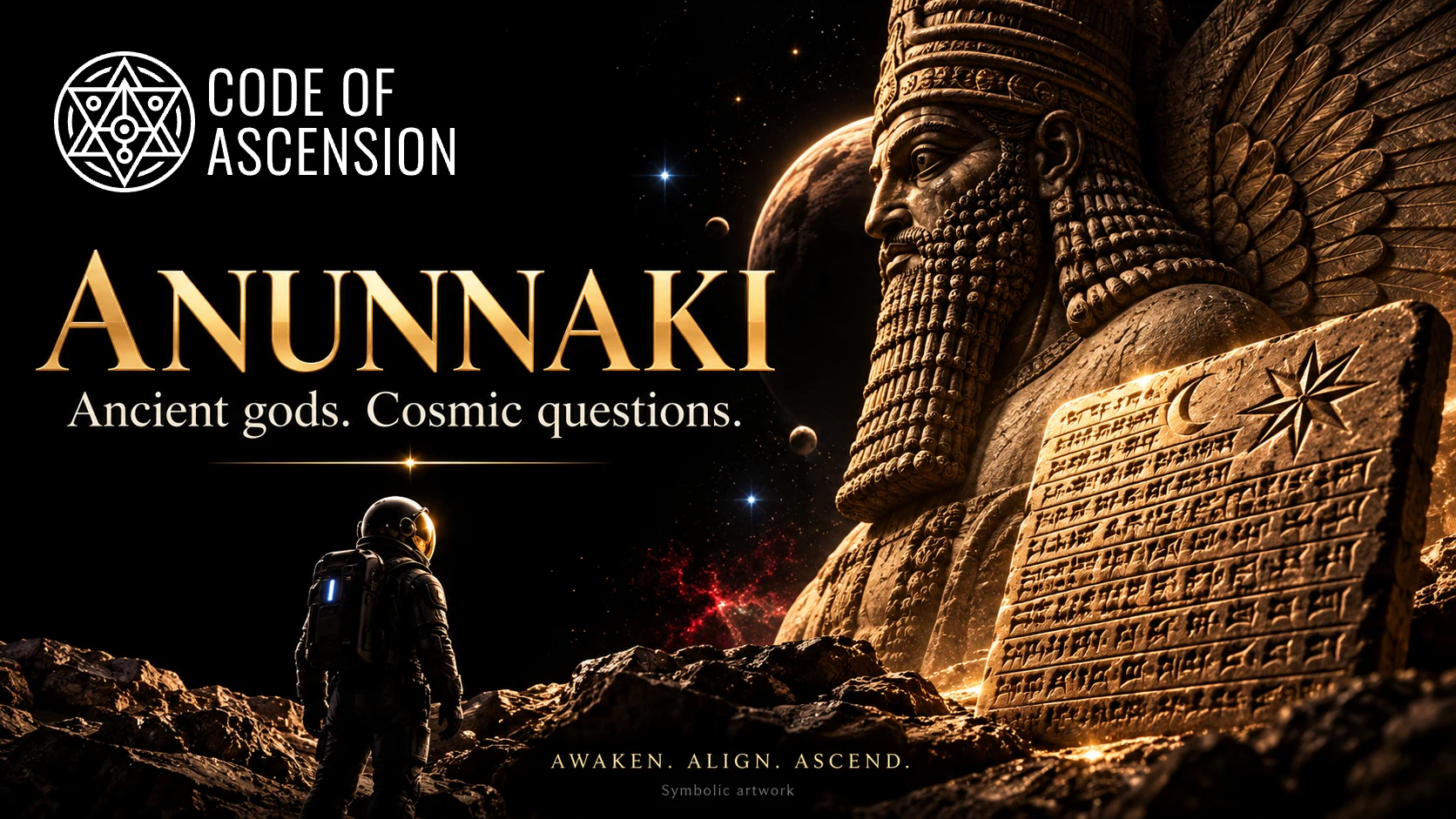
Imagine a river city at dusk, about four thousand years ago. Reed boats knock against the banks of the Euphrates. In a quiet room, a scribe presses a reed stylus into wet clay, wedge after wedge. The story he is copying is already old: gods who grew tired of digging canals, a wise god asleep in the deep waters, and a clay figure shaped so that the work of heaven could be carried on earth.
(That scene is imagined, not reconstructed from a record. The story the scribe copies is real.)
Those clay tablets survived. Millennia later, they would be dug up, translated, argued over and reimagined, until the word written on them, Anunnaki, travelled from temple hymns to bestselling books, YouTube documentaries and late-night conversations about where humanity really came from.
This guide follows that whole journey: what the ancient texts say, what specialists conclude, how a modern author turned these gods into visitors from another planet, and why the question of our origins still pulls so hard.
Quick answer: who were the Anunnaki?
The Anunnaki (Sumerian Anuna) were a group of gods in ancient Mesopotamian religion, named in texts from roughly the late third millennium BCE onward. Their membership and roles shift from text to text: sometimes great gods who decide destinies, sometimes judges of the underworld. The idea that they were extraterrestrials comes from modern authors, especially Zecharia Sitchin in 1976, not from the ancient texts themselves.
In this guide
- How to read this guide: four lenses
- Who were the Anunnaki?
- Selected major Mesopotamian deities
- Enki and Enlil: wisdom and authority
- Who created the Anunnaki?
- Why were humans created in these myths?
- The flood: when the gods regretted their creation
- Inana and the seven judges below
- The tablets: where these stories actually come from
- When gods became ancient astronauts
- What did Nibiru mean?
- The Anunnaki, the Bible and the Nephilim
- Where did the Anunnaki go?
- What would count as evidence?
- Why the question still matters
- Anunnaki FAQ
- Final thought
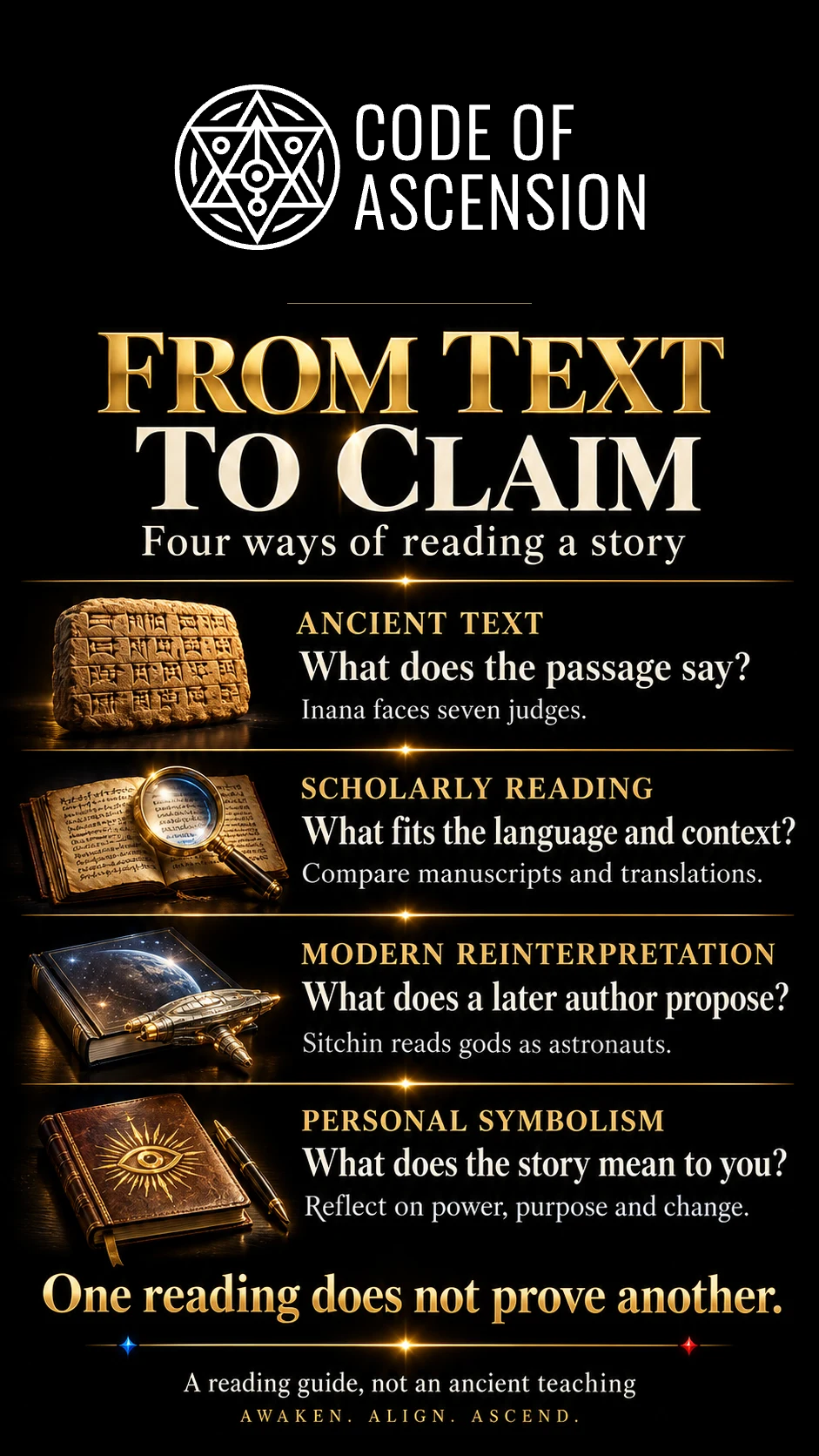
How to read this guide: four lenses
The Anunnaki sit at a crossroads where ancient religion, modern speculation and personal spirituality all meet, and they easily blur together. To keep the story clear, this guide uses four lenses. This is a reading aid, not an ancient teaching:
- Ancient text: what a named composition says, in a cited translation.
- Historical interpretation: what specialists conclude about its language, date and setting.
- Modern reinterpretation: what a named modern author proposes.
- Personal meaning: what the story can mean to you today. Reflection can be powerful without proving an archaeological, genetic or astronomical claim.
You’ll see the transitions as we go: “In this poem…”, “Scholars read…”, “Sitchin later proposed…”, “Read symbolically…”.
Who were the Anunnaki?
In the surviving texts, Anuna (Sumerian) and Anunnaki (the Akkadian form) refer to a group of gods, not one god and not a fixed family. Specialists generally read the name as something like “princely offspring” or “seed of the prince”. Treat that as a scholarly proposal; the exact literal meaning isn’t perfectly settled. (ORACC, “Anunna”) Separately, some texts name An, the sky god, as the Anunnaki’s father. (ORACC, “An/Anu”)
You may have read that the name means “those who from heaven to earth came.” That translation belongs to Zecharia Sitchin’s modern interpretation. Specialists of Sumerian don’t accept it.
The earliest uses of the term appear in royal inscriptions and texts from the late third millennium BCE, such as the inscriptions of Gudea of Lagash and texts from the Ur III period. Mesopotamia wasn’t one kingdom with one church, either. It was a land of rival cities (Uruk, Nippur, Eridu, Ur, Babylon), each with its own patron gods, temples and traditions, and those traditions changed over two thousand years.
That’s why the Anunnaki look different depending on where you stand:
- In some texts they are the great gods who meet in council and decide fates.
- In others they are underworld judges (you’ll meet seven of them in Inana’s story below).
- Later Babylonian texts sometimes divide the gods into the Anunnaki and the Igigi, groupings whose meanings also shift over time.
So if you’ve seen a neat “Anunnaki family tree” with every god in a fixed rank, know that it’s a modern simplification. The ancient picture is richer, and messier.
Selected major Mesopotamian deities
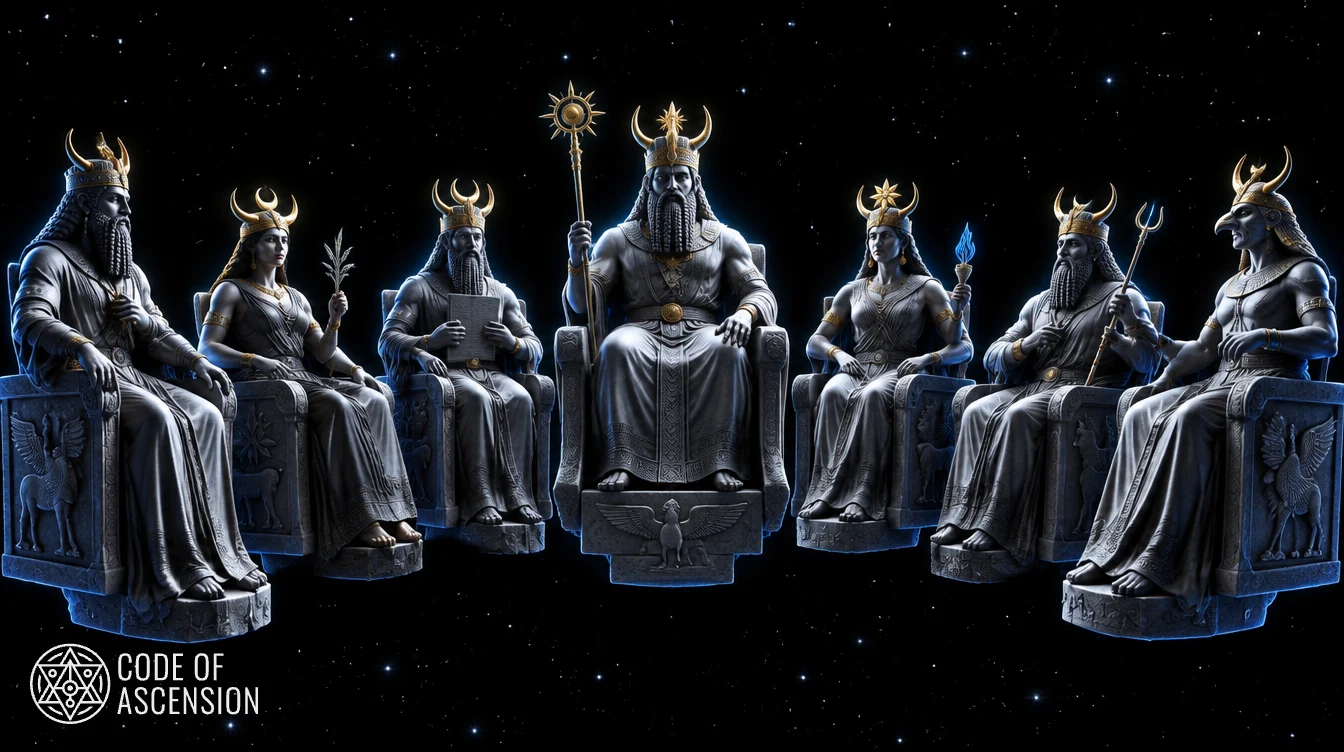
This is not an official Anunnaki roster; no such list exists across all the texts. It’s a short guide to major gods who often appear in Anunnaki-related stories, with their best-known associations. Names and roles vary by city and period.
| Deity | Commonly associated with | Key city or temple |
|---|---|---|
| An (Akkadian Anu) | The sky; the highest authority in many traditions | Uruk |
| Enlil (Ellil) | Authority, kingship, the destiny of the land | Nippur |
| Enki (Akkadian Ea) | Wisdom, fresh water and the deep (the abzu), crafts, magic, protection of humanity | Eridu |
| Ninhursag / Ninmah | Birth, mother-goddess roles, shaping life | Kesh and other sites |
| Inana (Akkadian Ishtar) | Love, war, the morning and evening star | Uruk |
| Nanna (Akkadian Sin) | The moon | Ur |
| Utu (Akkadian Shamash) | The sun, justice | Sippar, Larsa |
Sources (ORACC, Ancient Mesopotamian Gods and Goddesses): An/Anu · Enlil/Ellil · Enki/Ea · Mother Goddess (Ninmah) · Inana/Ištar · Nanna/Suen · Utu/Šamaš
Enki and Enlil: wisdom and authority
Enki and Enlil are central to several creation and flood stories discussed here. Online they’re often flattened into “the good alien scientist” and “the cruel commander.” The ancient picture is more interesting than that.
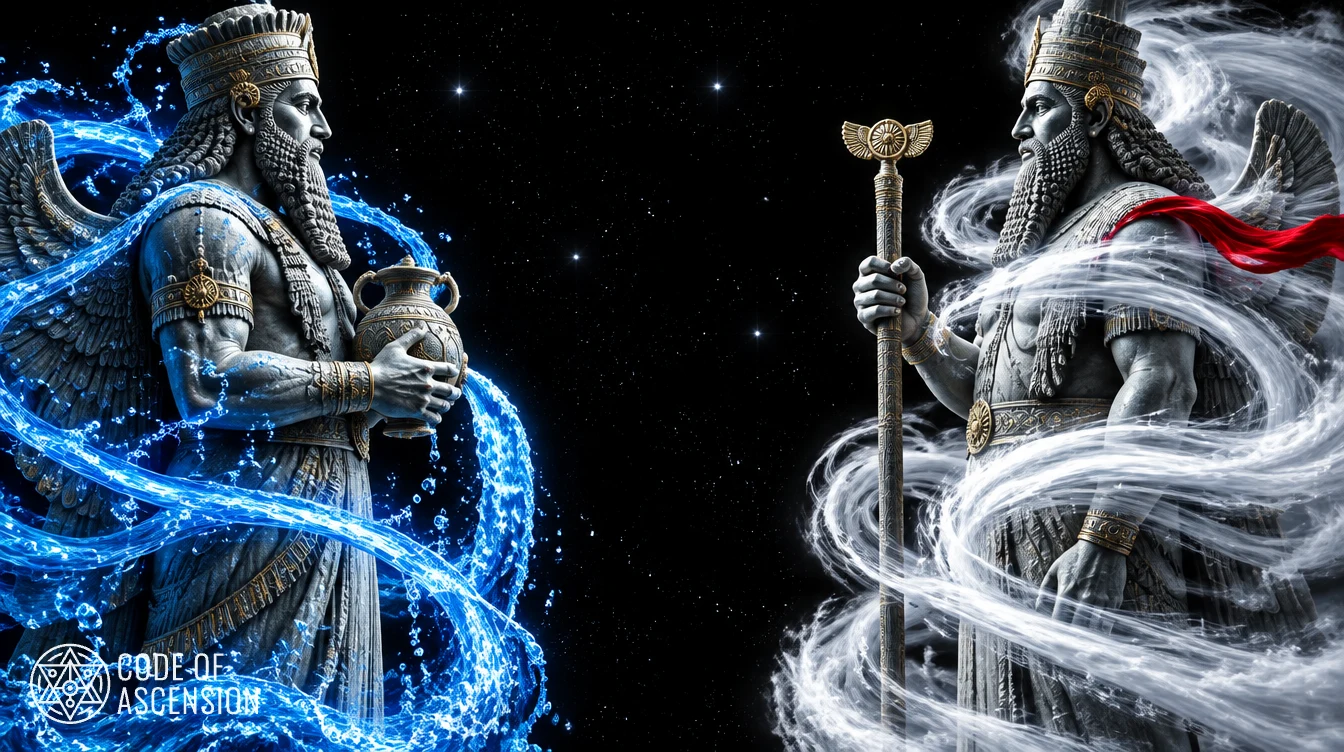
Enki (Ea in Akkadian) lives in the abzu, the sweet freshwater deep beneath the earth. He is the god of wisdom, craft and clever solutions: the one who knows the ritual, finds the loophole and invents the tool. Again and again, it’s Enki who steps in when people are in danger. His home city was Eridu, one of the oldest sacred sites in southern Mesopotamia. (ORACC, “Enki/Ea”)
Enlil (Ellil) is the god of authority and destiny. His temple at Nippur, the Ekur, was the religious heart of Sumer, and kings looked to Enlil to grant them the right to rule. His name is often translated “Lord Wind” or “Lord Air”, but specialists caution that the etymology is debated. (ORACC, “Enlil/Ellil”)
In some stories, especially the flood narratives below, Enlil makes a harsh decision and Enki quietly works around it. That makes for great drama, but it isn’t a permanent good-versus-evil war. In other texts the two cooperate, and Enlil is praised as the righteous guardian of order. Read symbolically, the pair gives us a familiar human tension: the rule and the exception, order and compassion, the decree and the wisdom that softens it.
Who created the Anunnaki?
It’s one of the most-asked questions, and the honest answer is: it depends on the text.
Many traditions place An, the sky, near the top of the divine family, and some texts name An as the Anunnaki’s father. Some cosmologies pair An with Ki, the earth. Others reach further back, to primordial waters. In the Babylonian creation poem Enūma eliš, for example, the story begins with Apsu and Tiamat, the fresh and salt waters, mingling before any of the gods had been formed. Later in the same poem, Ea fashions humankind from the blood of the defeated god Qingu, and Marduk organizes the Anunnaki into upper and lower groups. (Enūma eliš, Tablets I and VI, W. G. Lambert’s translation)
There is no single, universal Mesopotamian genealogy. Different cities told the story of divine origins differently, and later scribes reorganized the gods to suit their own city’s patron. In Babylon, that patron was Marduk.
Read symbolically, it’s a reminder that even the gods, in these myths, have origins. Nothing in this universe appears from nowhere.
Why were humans created in these myths?
Here the stories become intimately human, because they’re about us.
The Atra-hasis story: carrying the gods’ burden
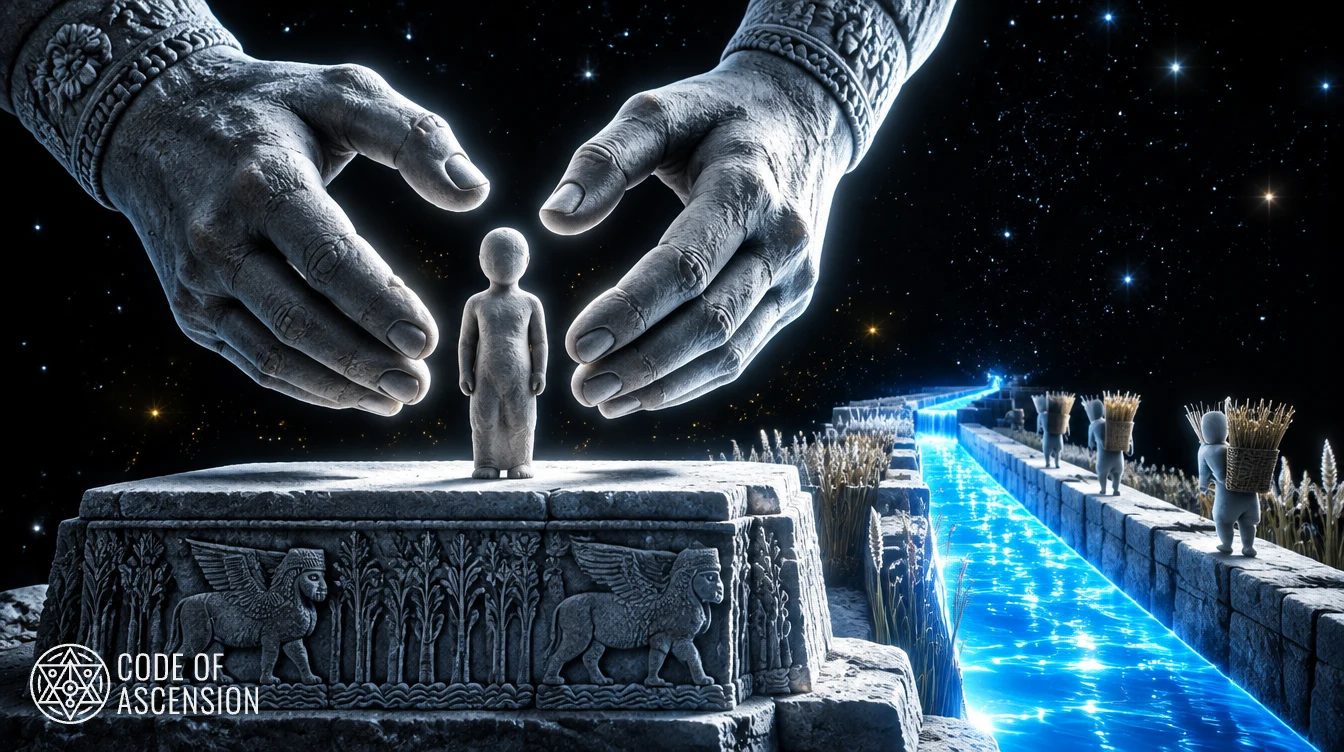
The Old Babylonian Atra-hasis epic opens in a world where the gods themselves do the work. In the British Museum’s summary, the junior gods had to labor all day digging and maintaining the land, until they rebelled against the senior gods. The solution was a new creature. One god was killed, and “his blood mixed with spit and clay” was used to form the first humans, who would take over the gods’ heavy work. (British Museum, “When the gods were man”, tablet 1889,0426.234, Sippar)
The copy the museum describes is an Old Babylonian tablet. The museum’s display dates it to about 1635 BCE, and its description places the epic around 1700 BCE. That’s a date for the clay and the composition, not a date for the creation of humanity.
Enki and Ninmah: another telling
A second, Sumerian story, Enki and Ninmah, opens in a similar place. The lesser gods dig canals and pile up silt, and they complain about their lives. The primeval mother Namma carries their tears to her son Enki, who is asleep in the deep. She urges him to use his wisdom to make a substitute. Enki directs her to knead clay from above the abzu, with birth goddesses shaping it, and he names Ninmah as her assistant. (ETCSL, Enki and Ninmah, lines 1–38)
Notice two things. First, these are different accounts, with different details. There isn’t one “Sumerian creation story.” Second, goddesses do essential creative work in them: Namma pleads, shapes and decrees; Ninmah assists and assigns. Retellings that make humanity the project of a single male “scientist” leave them out.
Read symbolically, these myths ask questions that still land today: What is human life for? Are we only here to work? Who carries whose burden, and is that just? The ancient answer is complicated. Humans are made to serve, but the gods soon discover they can’t live without us either.
The flood: when the gods regretted their creation
The creation story in Atra-hasis doesn’t end with peace. In the British Museum’s summary, humanity multiplies and grows noisy. Enlil sends disasters, and “finally Enlil destroys mankind with a catastrophic flood.” But Enki, the god of wisdom, warns a man named Atrahasis (“Exceedingly Wise”) and tells him to build a boat and load it with his family and animals. (British Museum)
The same core story was retold later in the Epic of Gilgamesh, Tablet XI. There the flood hero is Utnapishtim, and again it’s Ea (Enki) who reveals the gods’ plan and tells him to build a boat. The famous “Flood Tablet” in the British Museum, a 7th-century BCE copy from the library of Ashurbanipal at Nineveh, preserves this version. (British Museum, K.3375)
Yes, it resembles Noah’s story, and scholars have discussed the parallels since the tablet was first translated in the 19th century: a divine decision to destroy, a warned hero, a boat, animals, survival. But parallel doesn’t mean identical. Atrahasis, Utnapishtim and Noah are different characters in different traditions, told for different purposes. Genesis has one God acting in judgment; the Mesopotamian versions have a council of gods who disagree. Comparing them is fascinating. Merging them into one “real” event is a step the texts don’t take.
Read symbolically, the flood asks: What happens when power acts without wisdom? And who quietly keeps the knowledge that lets life continue?
Inana and the seven judges below
One of the most haunting Anunnaki scenes comes from the Sumerian poem Inana’s Descent to the Netherworld.
Inana, goddess of love and war, decides to travel to the underworld, ruled by her sister Ereshkigal. At each of seven gates she must surrender part of her regalia: her crown, her jewelry, her robe. When she finally arrives, stripped bare, the poem says:
“The Anuna, the seven judges, rendered their decision against her. They looked at her. It was the look of death.” (ETCSL, Inana’s Descent, lines 164–172)
Inana dies and hangs on a hook. She is revived only through the help of Enki, and even then, as she tries to ascend, “the Anuna seized her”: if she is to leave, she must provide a substitute (lines 282–289).
In this poem, the Anuna are seven judges in the land of the dead. That doesn’t mean the Anunnaki always numbered seven or always lived below. It’s how this story uses them. The translation is also reconstructed from several manuscripts with gaps, and the scholarly edition shows those variants openly.
Read symbolically, the descent is one of the oldest stories of ego death and return: stripping away status, facing judgment, and discovering that coming back always costs something. (If this theme speaks to you, our guide to what happens after death explores how different traditions, and modern research, approach the threshold. These are separate traditions, not one shared map of the afterlife.)
The tablets: where these stories actually come from
When people search for “Anunnaki tablets,” they’re often looking for one secret tablet that explains everything. There isn’t one. These are some of the real compositions, each preserved across copies, fragments and centuries:
| Composition | Language | What it contributes | Translation or museum guide |
|---|---|---|---|
| Atra-hasis | Akkadian | Gods’ labor, the creation of humans from clay and divine blood, the flood | British Museum summary |
| Enki and Ninmah | Sumerian | A second creation account; Namma, Enki and Ninmah | ETCSL |
| Inana’s Descent to the Netherworld | Sumerian | The Anuna as seven judges of the underworld | ETCSL |
| Epic of Gilgamesh, Tablet XI | Akkadian | Utnapishtim’s flood, Ea’s warning | British Museum, Flood Tablet |
| Enūma eliš | Akkadian | Babylonian creation; Marduk’s rise; reorganization of the gods | W. G. Lambert’s translation |
| Lament for Urim | Sumerian | Gods abandon their city during disaster | ETCSL |
Three dates are worth keeping apart, because blending them causes most of the confusion online:
- When a tablet was copied: a 7th-century BCE Flood Tablet, for example.
- When a story was first composed: often earlier, and rarely known precisely.
- When events happen inside the story: a mythic “time before,” not a datable year.
When gods became ancient astronauts
In 1976, Zecharia Sitchin published The Twelfth Planet. It launched a story that millions of people now know better than the original myths.
In Sitchin’s reading, the Anunnaki weren’t gods at all but astronauts from a planet called Nibiru, whose long orbit brings it into our solar system. According to his books, they came to Earth seeking gold to repair their planet’s atmosphere, and they genetically engineered humans as a workforce. His official site summarizes these ideas and attributes them to his books. (Sitchin.com)
It’s easy to see why the idea caught fire. The ancient myths really do describe:
- gods who came with power
- humans made to work
- a council that decides our fate
- a wise one who protects us
Sitchin noticed those threads and wove them into a technological origin story for a space-age audience.
The leap happens in the reading. The texts describe gods, temples, offerings and myth; Sitchin reread them as records of spacecraft, mining and genetics. Specialists in Sumerian and Akkadian have rejected many of his translations, including the “from heaven to earth came” reading of Anunnaki. The gold-mining mission, for example, isn’t in the creation passages quoted above; it’s Sitchin’s addition.
None of that makes his readers foolish. Sitchin was asking the questions ancient people asked too: Where did we come from? Are we alone? Who decided we should work so hard? The tablets don’t answer those questions with spaceships, but the questions themselves are real and worth keeping.
This pattern, an ancient word reread through a modern lens, appears elsewhere too. Our guide to the Akashic Records traces how an old idea gained a new esoteric meaning.
What did Nibiru mean?
“Nibiru” is now one of the most famous words connected to the Anunnaki, and also one of the most misunderstood. There are really four different things going on:
1. The ancient word. In Akkadian, nēberu is connected to the idea of a crossing: a ford, a ferry, a passage. In astronomical texts, it could also name a celestial “crossing point” or a body associated with Marduk. In several passages this is plausibly Jupiter, though the identification depends on context and scholars debate details. (ORACC glossary, nēberu; Freedman, Cuneiform Digital Library Bulletin 2015:3)
2. Sitchin’s planet. Sitchin used the name for a hidden twelfth planet, the Anunnaki home world, on a 3,600-year orbit. That’s his interpretation, not a meaning found in the ancient texts.
3. Doomsday predictions. Later writers, not always Sitchin himself, claimed Nibiru would collide with Earth, most famously around 2012. NASA/JPL’s Don Yeomans responded in 2009 that there was no credible telescopic or gravitational evidence for such an object: “Nibiru… simply put, does not exist.” (NASA/JPL, “2012: A Scientific Reality Check”, Nov 10, 2009)
4. Planet Nine. Today, some astronomers propose a real but undiscovered “Planet Nine” far beyond Neptune, to explain the clustered orbits of distant icy objects. It’s a separate scientific hypothesis, is still unconfirmed, and has nothing to do with Nibiru or the Anunnaki. (NASA Science, Planet X / Planet Nine)
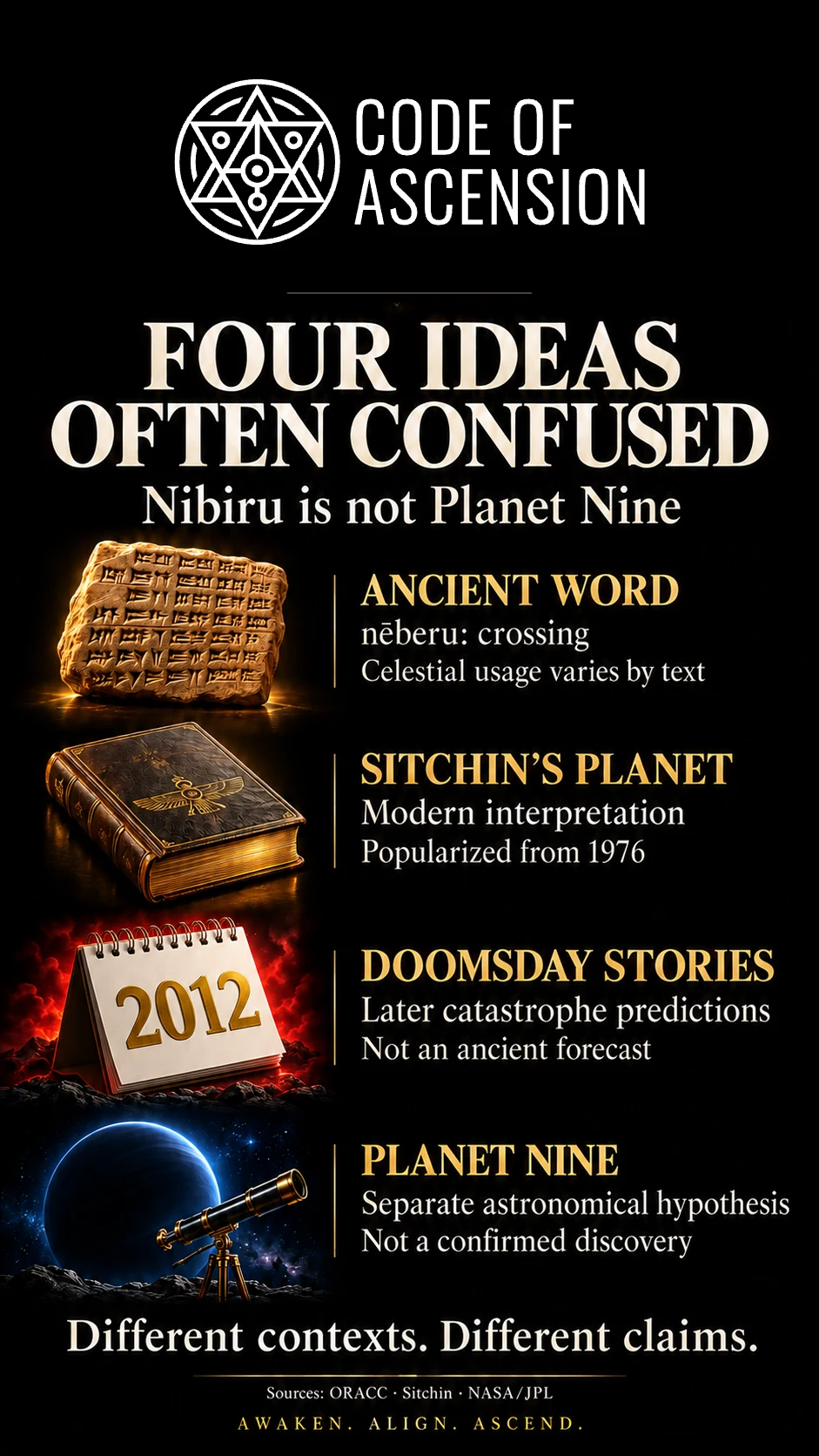
Uncertainty about an ancient word doesn’t give evidence for a hidden planet. But the word’s real meaning is lovely in its own way: a crossing, a passage between worlds.
The Anunnaki, the Bible and the Nephilim
Many readers arrive here wondering whether the Anunnaki appear in the Bible. They don’t. The word Anunnaki isn’t found in the Hebrew Bible or the New Testament.
Online, the Anunnaki are often merged with two biblical groups:
- The Nephilim (Genesis 6:4), a mysterious group linked to the “sons of God” before the flood.
- The Anakim (for example, Numbers 13:33), described as people of great stature in Canaan.
These belong to different traditions, languages and texts. “Anunnaki” and “Anakim” sound alike in English, but sounding alike isn’t evidence of a connection. Merging all three into one race of giants or aliens is a modern blend, not an ancient teaching.
The real, documented connection is the flood story above. Scholars have long compared the Mesopotamian flood narratives with Genesis, and the parallels are genuine, while the characters and the theology remain distinct.
Where did the Anunnaki go?
If the Anunnaki were real visitors, people ask, why did they leave? The question deserves a careful answer, because the ancient texts do contain something like departure.
Mesopotamian city laments describe gods abandoning their homes. In the Lament for Urim, as disaster falls on the city of Ur, “Nanna has abandoned Urim and has let the breezes haunt his sheepfold”, and the goddess Ningal likewise abandons her shrine. (ETCSL, Lament for Urim, lines 9–18)
These are powerful poems of grief. In Mesopotamian belief, a city could fall when its gods withdrew their favor. But they describe divine abandonment of a city and its temple, the theological heart of a historical catastrophe.
These laments describe gods abandoning cities and shrines, not a documented departure from Earth. Historically, worship of the Mesopotamian gods faded slowly as empires, languages and religions changed over the first millennium BCE and the following centuries. Their temples went quiet, and their stories waited in the ground.
What would count as evidence?
There’s an important difference between two kinds of evidence:
- Evidence that people told a story. For the Anunnaki this is abundant: tablets, temple inscriptions, god lists, hymns and laments, studied in museums and universities around the world.
- Evidence that the story’s literal events happened. For extraterrestrial Anunnaki, that would need things like verified artifacts of non-human technology, independently confirmed astronomical observations, or genetic findings that specialists can replicate. None of the sources cited here provides such evidence.
A real tablet and a speculative translation of it aren’t the same thing. The clay is real. The question is always: what does it actually say, and who is reading it?
Why the question still matters
Strip away the spaceships and the skepticism, and the Anunnaki stories still offer something rare: some of the oldest surviving reflections on what it means to be human.
- Authority: who has the right to decide our fate, and what happens when power acts without wisdom?
- Labor and purpose: were we made only to carry burdens, or is there more to a human life than work?
- Wisdom and compassion: like Enki, can we find the quiet loophole that lets life continue?
- Descent and return: like Inana, what must we surrender to face our own depths and come back changed?
These are COA’s contemporary readings, not ancient “activation” teachings. You don’t need to believe in visitors from Nibiru, or in nothing at all, to find them meaningful.
Some readers feel a similar pull in other traditions of “ruling powers,” such as the Gnostic Archons. That’s a different tradition with different texts. Compare the themes, but don’t treat them as the same beings.
Two journal prompts:
- What origin story shapes how I live, and did I choose it, or inherit it?
- Where do I mistake an inherited role for my whole identity?
Anunnaki FAQ
Were the Anunnaki real?
The Anunnaki were really worshipped. Their names and stories are well attested in ancient Mesopotamian texts. That establishes a real religious tradition, not a literal visit from extraterrestrials.
Were the Anunnaki aliens?
That’s a modern interpretation, popularized by Zecharia Sitchin from 1976. The ancient texts describe them as gods. No verified evidence cited here shows they were extraterrestrial.
Did the Anunnaki create humans?
Several Mesopotamian myths describe gods creating humans. In Atra-hasis, it’s from clay and divine blood; in Enki and Ninmah, from clay shaped by goddesses; in Enūma eliš, from the blood of the god Qingu. These are different accounts, not one universal story.
Why did the Anunnaki want gold?
The gold-mining story comes from Sitchin’s modern books, not from the ancient creation passages.
Are Enki and Enlil enemies?
Not permanently. In some stories, like the flood, Enki works around Enlil’s harsh decree; in others they cooperate. “Hero vs. villain” is modern shorthand.
Is Nibiru the same as Planet Nine?
No. Nibiru (as a hidden home world) is Sitchin’s idea; Planet Nine is a separate, still-unconfirmed astronomical hypothesis about the outer solar system.
Are the Anunnaki in the Bible?
No. The word doesn’t appear in the Bible. The Nephilim and Anakim are separate biblical traditions; the clearest documented link between the two worlds is the flood story.
Can these stories have spiritual meaning without being literal?
Yes. Many readers explore them as myths about authority, labor, wisdom and transformation, while recognizing that this is a modern, personal interpretation.
Final thought: the clay remembers
Four thousand years ago, someone pressed these stories into clay so they wouldn’t be forgotten. They weren’t forgotten. They’ve crossed empires, languages and centuries to reach you, on a phone screen, in a world those scribes couldn’t have imagined.
Maybe that’s the real nēberu, the real crossing: a story passing from one human mind to another across an impossible distance of time.
Whatever you believe about the Anunnaki, let the question do its work. Stay curious, read the sources, and notice which origin story you’re living by.
Sources
- ORACC, Ancient Mesopotamian Gods and Goddesses: Anunna · An/Anu · Enki/Ea · Enlil/Ellil · Mother Goddess (Ninmah) · Inana/Ištar · Nanna/Suen · Utu/Šamaš
- Enūma eliš, W. G. Lambert’s translation (hosted by Maricopa Open Textbooks)
- British Museum: “When the gods were man” (Atra-hasis), 1889,0426.234 · The Flood Tablet, K.3375
- Electronic Text Corpus of Sumerian Literature (University of Oxford): Inana’s Descent · Enki and Ninmah · Lament for Urim
- ORACC glossary, nēberu; I. Freedman, “The Marduk Star Nēbiru”, CDLB 2015:3
- NASA/JPL, “2012: A Scientific Reality Check” (2009) · NASA Science, Planet X / Planet Nine
- Zecharia Sitchin, official site (primary source for his claims only)
About The Author
Author: King | Founder of Code of Ascension
King is the founder of Code of Ascension, a spiritual education platform focused on consciousness, symbolism, manifestation, nervous system awareness, and hidden patterns of reality. Through Code of Ascension, he explores ancient wisdom and modern insights to help others awaken, align, and ascend.
Keep Ascending 🚀