
Supporting young people aging out starts with listening, not assumptions. Turning 18 is supposed to be a beginning. For many young people, it comes with a safety net: family who help with a first apartment, co-sign a lease, answer a panicked call about a car repair or let them move back home for a while.
Young people leaving foster care as adults may or may not have that kind of net; circumstances differ from person to person. “Aging out” means leaving the foster care system because of age rather than returning home, being adopted or moving into another permanent family arrangement.
This guide explains what aging out is, what public support exists, and the practical ways community members, employers and organizations can help. It focuses on Maryland and national programs, with notes for DC.
Quick Answer: public programs offer real help, including transition planning, college tuition waivers, education vouchers and extended health coverage. But young people still need reliable adults, practical resources and opportunities. That’s where the rest of us come in, through approved programs and with respect for each young person’s choices.
How many young people age out
According to the federal Children’s Bureau, 15,030 young people left foster care through emancipation in federal fiscal year 2025 (October 1, 2024 to September 30, 2025). That’s about 9% of the 169,927 children who left foster care that year. These figures are preliminary.
Emancipation usually means a young person left care as an adult rather than leaving to a permanent family. Behind each of those numbers is a person starting adult life, each with their own mix of supports, strengths and needs.
What support exists
A lot of help is available on paper. Knowing what it is helps you point young people to it, and helps you understand where community support fills the gaps.
Transition planning in Maryland: Ready by 21
The Maryland Department of Human Services runs Ready by 21, which serves youth in foster care from age 14 until their 21st birthday. DHS describes preparing youth for adulthood as “a critical priority of the Department of Human Services (DHS).”
Each young person gets an individualized, strengths-based transition plan, developed with the youth, their local foster care worker and their team. Plans focus on five areas:
- Education and employment
- Financial empowerment
- Permanent and supportive connections
- Safe and stable housing
- Well-being and civic engagement
Maryland’s MyLife website is described as “an interactive hub of information and resources designed to assist Maryland’s youth and young adults” connected to the child welfare system, including aftercare services and contacts for local Independent Living Coordinators.
The federal Chafee program
The federal John H. Chafee Foster Care Program for Successful Transition to Adulthood “provides funding to support youth/ young adults in or formerly in foster care in their transition to adulthood.” According to the Children’s Bureau:
- It serves youth in foster care ages 14 and older, and young people in or formerly in foster care ages 18 to 21. Some states extend services to age 23 if they also offer foster care to age 21.
- Services vary by state but can include help with education, employment, financial management and housing, plus emotional support and connections to caring adults.
Education and Training Vouchers (ETVs)
Through the Chafee program, agencies may award “a voucher of up to $5,000 per year per young person” for college or training costs not covered elsewhere. Eligible young people can receive vouchers before their 26th birthday, for no more than five years in total, subject to state rules, available funding and making progress in their program.
Maryland’s tuition waiver for foster care recipients
The Maryland Higher Education Commission (MHEC) offers a Tuition Waiver for Foster Care Recipients. It covers tuition and mandatory fees at Maryland public colleges and universities for eligible students who enroll on or before their 25th birthday. It doesn’t cover room, board, books or transportation.
Eligibility depends on the student’s history in an out-of-home placement in Maryland. For example, the waiver covers students who lived in an out-of-home placement when they graduated high school or earned a GED, or on their 18th birthday, and students who were in an out-of-home placement on their 13th birthday and were adopted or placed into guardianship afterward. Other routes exist, and the Maryland Department of Human Services and the college decide eligibility, so a student shouldn’t rule themselves in or out. Students apply through the financial aid office at their school, and MHEC encourages completing the FAFSA or the Maryland State Financial Aid Application.
Health coverage until the 26th birthday
Federal law provides Medicaid coverage for qualifying former foster youth until their 26th birthday. It isn’t automatic for everyone who was ever in care. Under a policy update from the Centers for Medicare & Medicaid Services, young people who turned 18 on or after January 1, 2023, qualify if they’re under 26, were in foster care in any state when they turned 18 (or the state’s higher age), and were enrolled in Medicaid while in foster care. Under that update, moving to another state no longer disqualifies them.
Important documents
Under federal law, a young person leaving foster care because they reached the state’s age limit (18, or a higher age the state chose) must not be discharged without the key documents they’re eligible for: an official or certified copy of their U.S. birth certificate, a Social Security card, health insurance information, a copy of their medical records, a driver’s license or state ID, and official documentation proving they were in foster care. The requirement doesn’t apply to young people who were in care for less than six months.
These documents are the foundation for a job, a lease, a bank account and college aid, and proof of foster-care status can matter for tuition waivers, vouchers and health coverage. If a young person you’re helping doesn’t have them, their caseworker or Independent Living Coordinator is the place to start. The documents belong to the young person, and they should keep them.
Housing: HUD’s Foster Youth to Independence initiative
Housing is often the hardest piece. The U.S. Department of Housing and Urban Development (HUD) runs the Foster Youth to Independence (FYI) initiative, through which eligible young people ages 18 to 24 may qualify for housing assistance. Eligibility depends on their foster-care history, being homeless or at risk of homelessness, and whether a participating local agency has assistance available. It isn’t a standalone entitlement.
According to HUD:
- An FYI voucher can provide housing assistance for up to 36 months, and eligible youth may get an extension of up to 24 more months if they meet certain requirements.
- FYI is delivered through public housing agencies working with public child welfare agencies. Young people can’t apply directly to HUD.
- The child welfare agency must also provide or secure supportive services to help the young person become self-sufficient.
If a young person you know is facing housing instability, their caseworker or Independent Living Coordinator is the first call, along with the local public housing agency.
In DC
In Washington, DC, the Child and Family Services Agency (CFSA) supports youth in care. Its Partners for Kids and Families program collects items for young people starting out, including Home Starter Kits and college care packages. Contact CFSA at (202) 442-6100 for information on youth programs.
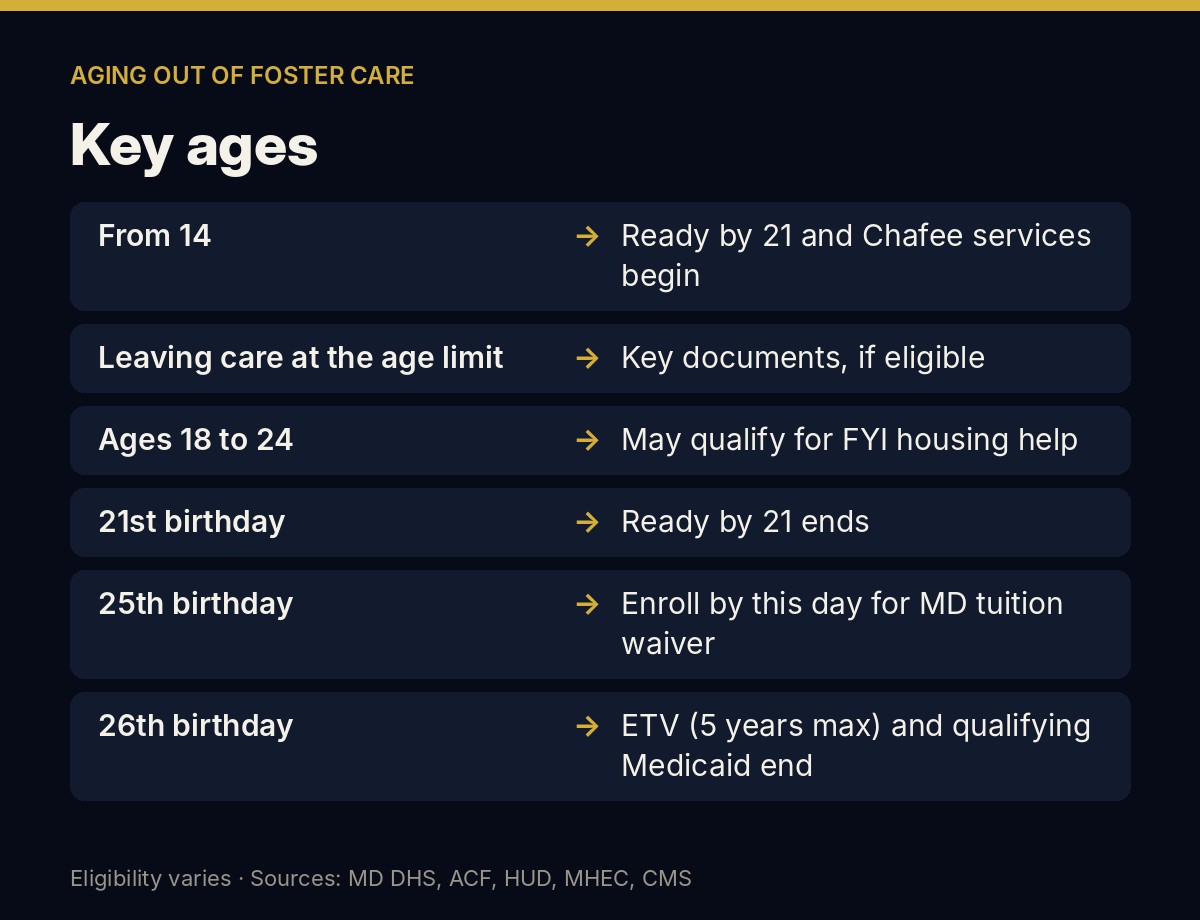
A timeline: key ages from 14 to the 26th birthday
The supports above kick in and end at different ages. Here’s how they line up, based on the sources in this guide. Details vary by state and by each young person’s history, so always confirm with the agency.
- Age 14: Maryland’s Ready by 21 begins for youth in foster care. Federal Chafee services are available to youth in foster care ages 14 and older.
- Leaving care at the age limit (18 or the state’s higher age): Eligible young people must receive key documents they qualify for, including proof of foster-care status, unless they were in care less than six months. Chafee services continue for young people in or formerly in foster care ages 18 to 21.
- Ages 18 to 24: Eligible young people may qualify for FYI housing assistance through participating agencies, depending on their history, housing risk and local availability.
- 21st birthday: Ready by 21, which runs from age 14, ends.
- Age 23: In some states, Chafee services extend to age 23.
- 25th birthday: In Maryland, eligible students must enroll on or before their 25th birthday to use the Tuition Waiver for Foster Care Recipients.
- 26th birthday: Education and Training Vouchers are available to eligible young people before their 26th birthday (five years maximum), and qualifying former-foster-youth Medicaid coverage lasts until the 26th birthday.
The takeaway: there’s a long window, and many young people don’t know everything they’re eligible for. Helping someone connect with their caseworker, Independent Living Coordinator or a financial aid office can unlock real resources.
Where community members fit in
Public programs provide structure, money and services. What they can’t easily provide is the everyday web of support that comes from people. Here’s how you can help.
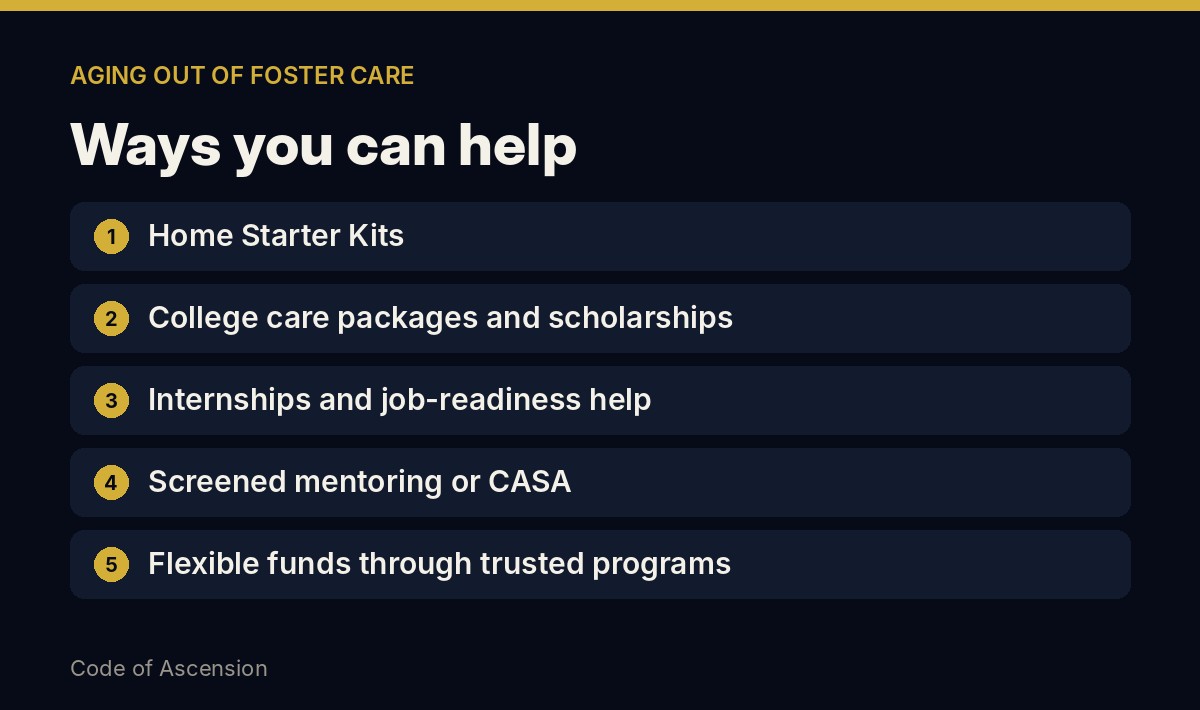
1. Help set up a first home
A first apartment needs a surprising amount of stuff: dishes, pots and pans, towels, sheets, a shower curtain, cleaning supplies, a few tools. DC’s Partners for Kids and Families publishes a Home Starter Kit list of what young people need.
How to help: – Donate items from a program’s list, new where the program asks for new. – Organize a Home Starter Kit drive with your workplace, faith community or friends, after confirming the program’s needs and delivery process. – Give money to a program that buys kits, so items can be matched to each young person.
2. Support college and training
Tuition waivers and vouchers help, but students also need laptops, books, dorm supplies, transportation and encouragement.
How to help: – Donate to college care packages through programs like DC’s PKF. – Fund or support scholarships run by established, verifiable organizations. Check them first using our guide, How to Evaluate a Child-Protection Organization Before You Give. – Volunteer with a mentoring or tutoring program that helps youth with applications, FAFSA and study skills.
3. Offer work experience
A first job, internship or job-shadowing day can make a real difference. It builds a résumé, a reference and a professional network.
How to help: – If you run a business, ask your local child welfare agency or Independent Living Coordinator whether there’s a way to offer internships, apprenticeships or interviews to young people in or leaving care. – If you’re an employee, ask your company whether it partners with youth employment programs. – Offer professional skills through an established program: mock interviews, résumé reviews, or workshops on budgeting, banking and credit.
4. Be a reliable adult, through a program
Ready by 21 names “permanent and supportive connections” as one of its five areas, and the Chafee program includes connections to caring adults. Relationships matter.
The right way to offer that as a community member is through an approved program, such as a mentoring organization, a CASA program or a foster care agency’s volunteer program. Programs screen volunteers, set contact rules and support both the volunteer and the young person. Follow their rules on contact, boundaries and communication.
Our guide What Does a CASA Volunteer Actually Do? covers one option. Ask your local CASA program whether it serves older youth and what volunteer roles are available.
5. Help with the practical stuff
Adult life involves a lot of paperwork and problem-solving. Through a program, volunteers can help young people with:
- Reading a lease or understanding tenant rights
- Opening a bank account and building a budget
- Understanding a credit report
- Getting to free tax-filing help
- Finding a doctor and using health coverage
- Getting copies of missing documents
Some people learned these things from family; others didn’t, and nobody should assume either way. Programs that offer this kind of help often need volunteers with everyday expertise.
Two ground rules. Identity documents, passwords, bank logins and financial information stay under the young person’s control; help them understand and organize it, but don’t hold it for them. And refer legal, tax and benefits questions to qualified services, such as legal aid, free tax-preparation sites and the agency that runs the benefit.
6. Give money where it’s flexible
Young people leaving care face unexpected costs: a security deposit, a car repair, a work uniform, a medical bill. Flexible funds through established programs can bridge those gaps.
Give through a program’s official donation channel, and check the organization first.
7. Advocate
You can also help at a policy level: learn how your state supports older youth, support organizations that work with young people with lived experience of foster care, and listen to young people themselves about what helps.
8. Remember milestones, through a program
Birthdays, graduations, a first apartment, a new job: milestones are when many young people lean on family. Programs that serve older youth sometimes collect birthday gifts, graduation support or holiday care packages. Ask your local program whether it runs anything like this, and give through it so the young person’s privacy is protected.
Questions to ask before you volunteer or give
Not every program is equally strong. Before you commit time or money, ask:
- Who does the program serve, and how does it connect with young people? Does it work with the local child welfare agency?
- How does it screen and train volunteers, and what are its rules on contact, boundaries and communication?
- How does it decide what young people need? Do young people have a voice in the program’s design?
- What happens to donated items or money? How are they matched to young people?
- How does it protect privacy? Does it have a clear consent process before sharing any young person’s story?
- Can it show its work? Look for public filings, clear reporting and independent reviews.
Our guide How to Evaluate a Child-Protection Organization Before You Give walks through each of these in more depth.
If you’re a foster or kinship caregiver of a teen
Caregivers of teens in care are in the best position to help with the transition, because they’re there every day. In Maryland, each young person’s Ready by 21 plan is developed with the youth, their local foster care worker and their team, so caregivers can ask how to be part of that conversation.
Practical ways caregivers can help:
- Ask about the transition plan early. Don’t wait until 17. Ask the caseworker what the plan includes and how you can support it.
- Help track down documents. Make sure the young person knows where their birth certificate, Social Security card, ID and health insurance information are, and that they’ll have copies when they leave care.
- Practice adult skills at home. Grocery shopping on a budget, cooking a few reliable meals, doing laundry, scheduling a doctor’s appointment, calling a customer service line.
- Talk about money. Help them open a bank account if they’re old enough and their plan allows it. Talk through paychecks, rent, bills and saving.
- Explore what comes next. College, training, an apprenticeship or a job. Visit a campus or a workplace together. Help them meet with a financial aid office about the tuition waiver and vouchers.
- Keep the door open. If your program allows it and the young person wants it, staying in touch after they leave can matter a great deal.
Skills worth building before leaving care
Whether you’re a caregiver, mentor or volunteer, these are the everyday skills that make the transition smoother. Programs often welcome volunteers who can teach them:
- Budgeting and tracking spending
- Banking, including how to avoid overdraft fees
- Understanding credit and checking a credit report
- Finding, applying for and keeping a job
- Searching for housing, reading a lease and knowing tenant rights
- Cooking, grocery shopping and basic home care
- Using health insurance and making appointments
- Getting around: public transit, a driver’s license, car basics
- Knowing who to call for help, including 2-1-1
Respect each young person’s choices
Young adults leaving care are adults. Good help respects that.
- Let them lead. Ask what they need rather than assuming.
- Respect privacy. Their history is theirs to share or not. Don’t publish identifying photos, names or stories, and follow each program’s confidentiality and consent rules.
- Be consistent. If you commit to something through a program, follow through. If your situation changes, communicate with the program rather than disappearing.
- Avoid pity. Young people leaving care are capable and resilient. They deserve opportunities and support, not sympathy alone.
- Don’t assume their story. Every young person’s history, family relationships and goals are different. Some stay close to birth family, some don’t. Some want college, some want a trade, some want to start working right away. Support the path they choose.
- Connect, don’t replace. Your role is to add support alongside their caseworker, Independent Living Coordinator and the people they already trust, not to take over.
A checklist for organizations and employers
If you lead a business, nonprofit or faith community, here are concrete ways to help at scale:
- Partner with your local child welfare agency or an established youth program.
- Offer paid internships or apprenticeships, with a supervisor trained to support new workers.
- Run an annual Home Starter Kit or college care package drive, coordinated with a program’s list.
- Offer free financial-literacy or job-readiness workshops through a program.
- Give employees paid volunteer time for screened mentoring programs.
- Fund flexible emergency support through a trusted program.
Pointing young people to help
If you know a young person who is in care or recently left care, these are good places to start:
- Their caseworker or Independent Living Coordinator. In Maryland, MyLife lists how to find local Independent Living Coordinators.
- Ready by 21 in Maryland, for youth in care from age 14 until their 21st birthday.
- The college financial aid office, about the Maryland Tuition Waiver for Foster Care Recipients and ETVs.
- Medicaid in their state, about coverage for qualifying former foster youth until their 26th birthday.
- 2-1-1, a free, confidential information and referral line for health and human services in every state.
A note from Code of Ascension
Every young person deserves people in their corner. Public programs build the floor. Community members, employers and organizations can help build the rest: a stocked kitchen, a first job, a reliable adult, a scholarship, an answer to a hard question.
Choose one way to help, do it through a program you trust, and keep showing up. A young person starting out on their own deserves to know that their community is behind them, not just for one season, but for the long run.
This guide is part of Compassion in Action, where Code of Ascension turns compassion into real-world action for children and young people.
Frequently asked questions
What does aging out of foster care mean? It means leaving the foster care system as a young adult because of age, rather than returning home, being adopted or moving to another permanent family arrangement. The federal Children’s Bureau counted 15,030 young people who left care through emancipation in federal fiscal year 2025 (preliminary).
What help is available for youth aging out in Maryland? Maryland’s Ready by 21 serves youth in foster care from age 14 until their 21st birthday with individualized transition plans. Maryland also offers a Tuition Waiver for Foster Care Recipients at public colleges for eligible students who enroll on or before their 25th birthday, and the MyLife website lists resources and contacts.
How much is an Education and Training Voucher? Through the federal Chafee program, agencies may award up to $5,000 per year per young person for college or training costs. Eligible young people can receive vouchers before their 26th birthday, for no more than five years, subject to state rules, funding and progress.
Can former foster youth get Medicaid? Qualifying former foster youth can get Medicaid until their 26th birthday; it isn’t automatic for everyone formerly in care. For young people who turned 18 on or after January 1, 2023, moving to another state no longer disqualifies them.
How can I help foster youth aging out? Donate to Home Starter Kits or college care packages, offer internships or job-readiness help, give flexible funds through established programs, or volunteer with a screened mentoring or CASA program.
About the author
Written by King for Code of Ascension’s Compassion in Action. This guide brings together the public sources linked below to help readers ask informed questions and find appropriate services. It is general education, not legal advice or a professional safeguarding assessment.
Sources
- AFCARS Dashboard, FFY 2025 (preliminary) (U.S. Children’s Bureau)
- Ready by 21 (Maryland Department of Human Services)
- MyLife (Maryland)
- John H. Chafee Foster Care Program for Successful Transition to Adulthood (U.S. Children’s Bureau)
- Tuition Waiver for Foster Care Recipients (Maryland Higher Education Commission)
- Former Foster Care Children Medicaid policy update (Jan. 30, 2024) (Centers for Medicare & Medicaid Services)
- Preventing Sex Trafficking and Strengthening Families Act, P.L. 113-183 (Child Welfare Information Gateway)
- Partners for Kids and Families (DC Child and Family Services Agency)
- Supports for youth transitioning from foster care (U.S. Children’s Bureau)
- Foster Youth to Independence (U.S. Department of Housing and Urban Development)
- Notice PIH 2026-19 (HUD)
- 42 U.S.C. § 675 (case-plan requirements, including documents at discharge)