

Many families have a plan for a fire: where the exits are, where to meet outside, who calls 911. A family safety plan applies the same idea to something just as important: helping protect children from sexual abuse.
The subject can feel uncomfortable, and it’s easy to assume it won’t touch your family. A family safety plan replaces that assumption with something practical. It sets shared rules, names trusted adults, opens the door to conversation and makes sure everyone knows where to turn for help.
This guide is built on the family safety plan framework from Stop It Now!, a national prevention organization, along with guidance from public agencies in Maryland and DC. It’s written for the adults in a child’s life: parents, grandparents, guardians, aunts and uncles, foster and kinship caregivers, and anyone who helps raise kids.
Quick Answer: protecting children is the job of adults. A safety plan gives children words and permission to speak up, but it doesn’t put the responsibility on them. Adults set the rules, model them, notice what’s happening and act.
Why a written plan helps
Stop It Now! describes a family safety plan as a way to create a home environment that better protects children from sexual abuse. A plan helps in a few specific ways:
- It makes expectations clear. When everyone knows the family’s rules on privacy and touch, a person who ignores them stands out.
- It removes guesswork in hard moments. If something feels wrong, you’ve already decided who to call.
- It makes conversation normal. Talking about body safety once, awkwardly, is less effective than talking about it regularly, calmly, as part of family life.
- It helps the whole family respond early. Clear boundaries make it easier to notice and address behavior that’s heading in the wrong direction, before it becomes harm.
A plan can’t guarantee safety. What it can do is make boundaries and help routes clearer, so adults act sooner. It doesn’t have to be formal. It can be a page on the refrigerator, a note on your phone or a set of agreements you talk through and revisit. What matters is that the adults agree on it and actually use it.
The six parts of a family safety plan
Stop It Now!’s framework has six parts. Here’s each one, with practical ways to put it into action.
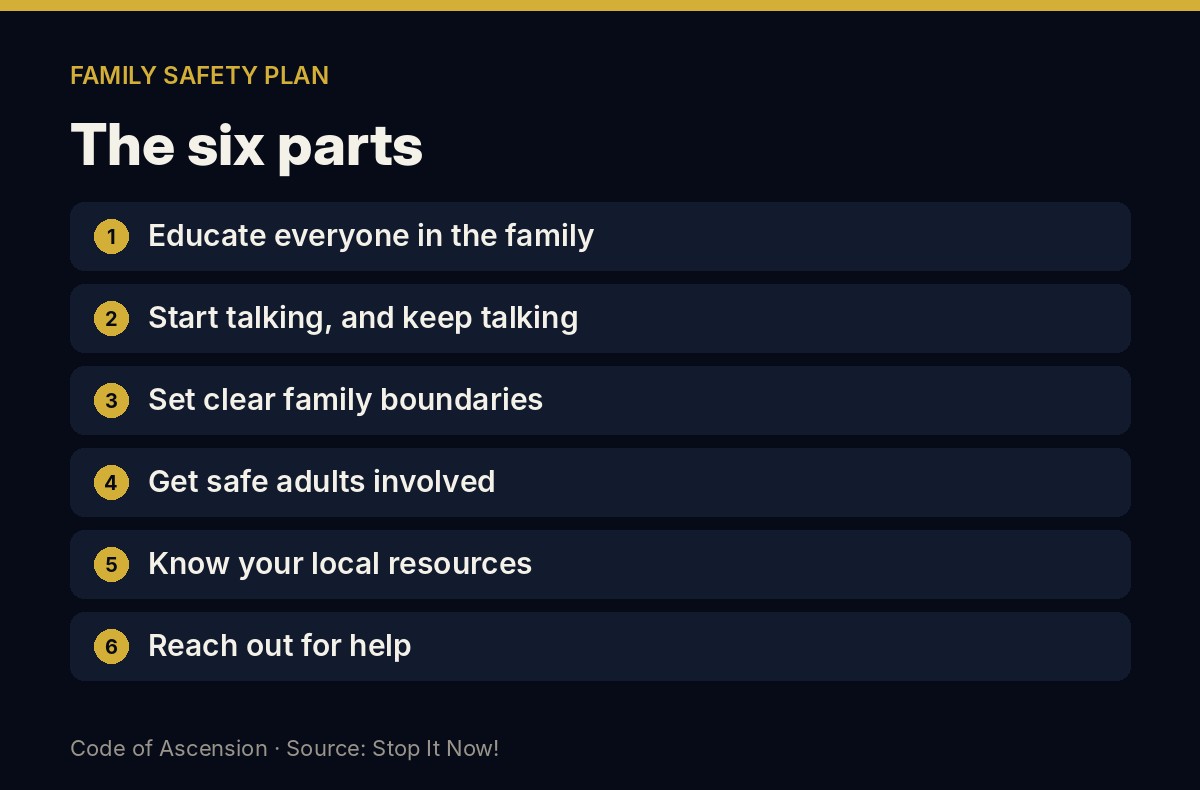
1. Educate everyone in the family
Start with the adults. Stop It Now! encourages families to learn what healthy sexual development looks like at different ages, which behaviors may be concerning, and the warning signs that a child may have been abused or that someone is behaving inappropriately with a child.
It also points out that abuse doesn’t always involve touch. In its words, “showing pornography to a child is abusive.”
For children, Stop It Now! recommends:
- Teaching the correct names for body parts. Using real words helps a child understand and describe what’s happening to their body.
- Teaching what to do if someone touches them sexually, in age-appropriate language.
- Teaching young children that “no one has the right to touch their private parts,” except for necessary hygiene, disability-related or medical care, and that they shouldn’t touch anyone else’s private parts.
That exception needs a fuller explanation than a single rule. Some children need help with bathing, toileting or dressing, and some need disability-related care or medical care. Explain it this way: when an adult helps with care, they do only what’s needed, they respect the child’s privacy as much as possible, and a parent or caregiver knows about it. The American Academy of Pediatrics describes caregivers helping with bathing or toileting and doctors checking a child’s health as OK touches, and advises teaching children to tell a trusted grown-up if anyone touches their private parts (AAP, HealthyChildren.org). A title alone, including doctor, coach or relative, doesn’t make touch OK.
Most important, a child can always tell a trusted adult about any touch that worried or confused them, including touch during care, and they won’t be in trouble for asking.
Put it into practice: – Choose one or two trusted resources and read them as adults first. – Agree as caregivers on the words you’ll use with your children. – Revisit the basics as kids grow. What a five-year-old needs is different from what a twelve-year-old needs.
2. Start talking, and keep talking
Stop It Now! encourages adults to lead conversations about the difference between healthy and abusive behavior, and to revisit the topic several times with children, teens and adults so the information sticks. It also suggests letting family members ask questions during these conversations or follow up privately later.
The goal isn’t one big talk. It’s many small ones, so the topic feels normal rather than scary.
Put it into practice: – Use everyday moments. Bath time, a TV show, a news story or a question from your child can all be natural openings. – Keep your tone calm. Children take their cues from you. If you’re relaxed, they’re more likely to come back with questions. – Make it clear they won’t be in trouble for telling you something, even if it involves breaking a family rule. – Include teens. Older kids need conversations about consent, online behavior and relationships, not just younger children.
3. Set clear family boundaries
This is the heart of the plan. Stop It Now! recommends establishing guidelines for privacy and behavior, discussing them with everyone in the family, modeling them yourself and sharing them with other adults who spend time with your children.
Some examples drawn from its guidance:
- A child who doesn’t want to hug can shake hands instead. Children shouldn’t be forced into physical affection to be polite.
- Children can say when they’re uncomfortable with a particular adult or older child, and a trusted adult will speak up for them. Stop It Now! gives the example of not allowing someone to have a child sit on their lap.
- Boundaries change as children grow. For example, knocking before entering an adolescent’s room.
Put it into practice. Here are some boundaries many families find useful. Choose the ones that fit your household and write them down:
- We use the correct names for body parts.
- Nobody, including family members, is required to hug or kiss anyone.
- We knock before entering bathrooms and bedrooms.
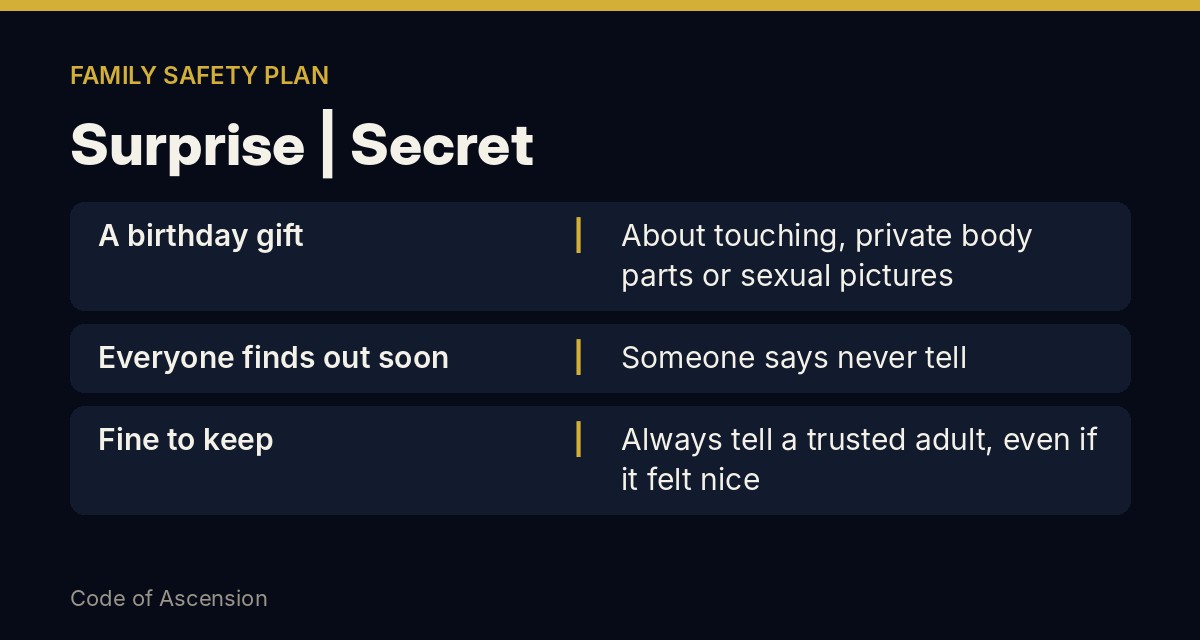
- Secrets about touching, private body parts or pictures of private parts always get told to a trusted adult, even if the secret felt special, fun or nice at the time. Surprises, like a birthday gift, are different because everyone finds out soon.
- Adults don’t ask children to keep secrets from their parents or caregivers.
- Older kids and adults respect younger children’s privacy and personal space.
- Screens and devices follow the family’s online rules, and kids can always show a trusted adult something that made them uncomfortable.
The secrets-versus-surprises distinction is worth spending time on. It gives children a simple rule that doesn’t depend on how something felt: a person who harms a child may make it feel special or pleasant, or may say it’s their special secret. Make sure children also hear this: if something already happened and they didn’t say no or didn’t tell right away, it’s still never their fault, and it’s never too late to tell.
Share the rules. Stop It Now! recommends sharing your family’s guidelines with other adults who supervise your children. That includes grandparents, babysitters, coaches and the parents of friends your kids visit. A short, friendly heads-up works: “We have a few family rules about privacy and touch. Here they are, so we’re all on the same page.”
4. Get safe adults involved
Stop It Now! recommends identifying at least one support person for each family member, so that no one is isolated. It notes that having someone to confide in helps children recover from stress, and that a “safe, responsible and consistent adult” is important for children and teens.
Put it into practice: – Help each child name two or three trusted adults they could go to, inside and outside the home: a grandparent, a teacher, a coach, a school counselor. – Make sure those adults know they’ve been chosen, and what to do if a child comes to them with a worry. – Remember the adults need support too. Each caregiver should have someone they can talk to.
Stop It Now! adds an important caution: if someone seems “too good to be true,” ask more questions. Even a close friend or relative may not be safe to trust with a child. That’s not a reason to be suspicious of everyone. It’s a reason to notice patterns: an adult who seeks time alone with one particular child, who ignores the family’s boundaries, or who showers a child with gifts and attention in ways that feel off.
5. Know your local resources
Stop It Now! recommends learning which agencies serve your area and who to contact to report known or suspected child sexual abuse, and keeping a list of phone numbers for advice and help.
Here’s a starter list for our area. Save these numbers in your phone and post them with your plan:
- Emergency: If a child is in immediate danger, call 911.
- Maryland: The Maryland Department of Human Services lists 1-800-91Prevent (1-800-917-7383) for reporting suspected child abuse or neglect.
- Washington, DC: The Child and Family Services Agency (CFSA) hotline is (202) 671-SAFE (202-671-7233), available 24 hours a day, seven days a week.
- Other states: Contact your state or local child protective services.
- Advice and support: Stop It Now! runs a confidential helpline at 1-888-PREVENT during set hours, plus chat and email, for anyone concerned about a child’s safety or someone’s behavior. Childhelp offers counselors by call or text at 1-800-422-4453.
Support lines and reporting are different. Stop It Now! and Childhelp can help you think a situation through, but a call to them does not replace a report to child protective services or the police. If you suspect abuse, report it to the agencies above.
In Maryland, the law requires anyone who has reason to believe a child has been abused or neglected to report it, with narrow exceptions. You don’t need proof to make a report. That’s what investigators are for.
6. Care enough to reach out for help
This last part is the hardest and the most important. Stop It Now! encourages families to:
- Talk with a family member whose sexualized behavior concerns you. It recommends its “Let’s Talk” guidebook for these conversations. This is for early concerns about behavior. If abuse may already have happened, don’t start with a conversation. Protect the child, report promptly and get professional guidance. Don’t investigate or arrange a confrontation yourself.
- Seek help if you’re worried about your own thoughts or feelings toward children. Stop It Now! notes that help is available, and its helpline takes these calls confidentially.
- Let family members know they can come to you about inappropriate behavior that has already happened, and that you love them and will help them get help.
Prevention isn’t only about strangers. Many families find that the hardest situations involve someone they know and love. A plan that makes room for honest, early conversations, before something turns into abuse, protects children and gives everyone the best chance of getting help.
Adjusting the plan as children grow
Stop It Now! notes that boundaries should change as children grow. Here’s a practical way to think about it by age. These are general suggestions, not rules; you know your children best.
Toddlers and preschoolers. Keep it simple and concrete. Use correct names for body parts during bath time and diaper changes. Practice “my body belongs to me” and the idea that a hug can be a high-five instead. Adults handle almost all of the supervision and boundary-setting at this age.
Early school age. Introduce the difference between secrets and surprises. Practice naming trusted adults together. Talk about what to do if someone asks them to keep a secret or makes them feel uncomfortable, and make clear they’ll never be in trouble for telling.
Preteens. Expand the conversation to online life: games, chats and apps. Talk about privacy, respectful friendships and what to do if someone asks for pictures or wants to talk privately. Respect their growing need for privacy by knocking, while keeping devices and online rules clear.
Teenagers. Talk about consent, healthy relationships and digital safety in a more adult way. Teens often turn to friends first, so help them know what to do if a friend tells them something worrying: tell a trusted adult. Keep the door open so they can come to you, even about something embarrassing.
At every age, the same message holds: adults are responsible for keeping children safe, and children can always come to a trusted adult.
Common worries about making a plan
“Won’t talking about this scare my kids?” Stop It Now!’s approach is calm, ordinary conversation, revisited over time. Children generally take their cues from adults. If you treat body safety like any other safety topic, such as crossing the street or what to do in a fire, it becomes normal rather than frightening.
“Will relatives be offended if I share our rules?” Some might feel awkward at first. Framing helps: these are your family’s rules for everyone, not accusations about anyone. Most adults who care about your children will respect them. If someone repeatedly ignores your boundaries, that’s important information too.
“We already trust everyone around our kids.” A plan isn’t about distrust. It’s about clarity. Stop It Now! points out that even a close friend or relative may not be safe to trust with a child, and that someone who seems “too good to be true” deserves more questions. Clear rules protect children without requiring you to suspect anyone.
“I don’t know enough to do this right.” You don’t need to be an expert. Start with the six parts above, use trusted resources, and call a helpline like Stop It Now! if you have questions. A simple plan you actually use is better than a perfect one you never start.
Situations worth planning for
A few everyday situations come up often enough to talk through ahead of time.
Babysitters and new caregivers. Share your family rules on day one, including privacy, bath and bedtime routines, screens and who’s allowed to visit. Let the caregiver know your children are taught they can tell you anything.
Sleepovers and visits. Before your child stays at someone else’s home, it’s reasonable to ask who will be there, who will supervise and what the plans are. Make sure your child knows they can call you to come home at any time, for any reason, with no questions asked in the moment.
Family gatherings. Big gatherings can mean less supervision, more adults and more unfamiliar faces. Agree among caregivers who’s keeping an eye on the kids, and remind children of the hug-or-high-five rule.
Programs and activities. Camps, teams, clubs and tutors should have their own safety rules. Our guide Before You Enroll: Child-Safety Questions to Ask a Camp, Club or Youth Program covers what to ask.
Blended, kinship and foster families. When new adults or children join a household, revisit the plan together. Clear, shared rules help everyone settle in and know what to expect.
Online safety belongs in the plan too
Stop It Now!’s framework doesn’t have a separate section on technology, but today’s family plan needs one. Children and teens can encounter inappropriate content and contact through games, apps and social media.
Practical steps many families use:
- Keep devices in shared spaces for younger children, especially at night.
- Know which apps and games your kids use, and who they can message.
- Make “show me” a safe, no-punishment rule. If something online made a child uncomfortable, they can show you without losing their device.
- Talk about requests for pictures or secrets. No trusted adult or friend should ask a child to send private pictures or keep online conversations secret.
- Know where to report. In the US, the NCMEC CyberTipline takes reports of online exploitation of children, online or at 1-800-843-5678.
What to do if something worries you
A plan is only useful if you act on it. If something concerns you:
- If a child is in immediate danger, call 911.
- If you suspect abuse, report it to child protective services or the police. You don’t need to be certain.
- If you’re unsure whether something is a concern, call a helpline like Stop It Now! for confidential advice.
- If a child tells you something, stay calm, listen, believe them, keep them safe and report it. Don’t promise to keep it secret.
- Follow your plan. Limit the person’s access to children while you get help, and lean on the safe adults you’ve already named.
Don’t try to investigate on your own or confront someone in a way that could put a child at risk. Let the professionals handle the investigation.
Keep the plan alive
A plan written once and forgotten won’t do much. A few habits keep it working:
- Review it every year, or when something changes: a new school, a new babysitter, a new partner, a move or a child entering their teens.
- Re-share it with new caregivers.
- Keep the conversations going. Short, regular check-ins work better than rare, big talks.
- Notice what’s working. If a child uses the plan, such as telling you about a confusing secret, thank them. It teaches them the plan is real.
- Check your numbers. Hotlines and helpline hours can change. Confirm your list when you review the plan, and update the copy on your phone and refrigerator.
- Ask your kids what they remember. A quick, relaxed “Who are your trusted adults?” or “What do we do about bad secrets?” shows you what’s sticking and what needs another conversation.
Make your own one-page plan
Here’s a simple template you can copy:
Our family’s safety plan
- Our words: We use the correct names for body parts.
- Our rules: (list your family boundaries)
- Secrets and surprises: Secrets about touching, private body parts or pictures always get told, even if they felt nice.
- Our trusted adults: (each child names two or three)
- Emergency: 911
- Report suspected abuse: our state abuse hotline (Maryland 1-800-91Prevent · DC (202) 671-SAFE) or the police
- Advice and support (not a report): Stop It Now! 1-888-PREVENT · Childhelp 1-800-422-4453
- Who we’ve shared this with: (grandparents, babysitters, coaches)
- Next review date: (pick one)
A note from Code of Ascension
At Code of Ascension, we write a lot about protection. This is protection in its most practical form: adults who agree on the rules, talk openly, know who to call and act when something feels wrong.
A plan won’t make any family risk-free. It makes the rules clearer, the help easier to find and the next step easier to take, and that’s worth starting today.
This guide is part of Compassion in Action, where Code of Ascension turns compassion into real-world action for children.
Frequently asked questions
What is a family safety plan? It’s a set of shared rules and resources a family agrees on to help protect children from sexual abuse. Stop It Now!’s framework covers educating everyone in the family, talking openly, setting clear boundaries, involving safe adults, knowing local resources and reaching out for help.
At what age should I start talking to my child about body safety? Stop It Now! recommends teaching young children the correct names for body parts and that no one has the right to touch their private parts except for necessary hygiene, disability-related or medical care, and that they can tell a trusted adult about any touch that worries them. Revisit the conversation as children grow, adjusting the details to their age.
What’s the difference between a secret and a surprise? A surprise, like a birthday gift, is something everyone finds out about soon. A secret about touching, private body parts or pictures of private parts should always be told to a trusted adult, even if it felt special or pleasant. It’s never the child’s fault, even if they didn’t say no or tell right away.
Who should I share my family’s safety rules with? Stop It Now! recommends sharing your guidelines with other adults who supervise or spend time with your children, such as relatives, babysitters, coaches and friends’ parents.
Where do I report suspected child abuse? In Maryland, call 1-800-91Prevent (1-800-917-7383). In DC, call (202) 671-SAFE (202-671-7233), 24/7. Elsewhere, contact your state or local child protective services. If a child is in immediate danger, call 911.
About the author
Written by King for Code of Ascension’s Compassion in Action. This guide brings together the public sources linked below to help readers ask informed questions and find appropriate services. It is general education, not legal advice or a professional safeguarding assessment.
Sources
- Tip Sheet: Create a Family Safety Plan (Stop It Now!)
- Get immediate help (Stop It Now!)
- Reporting suspected child abuse or neglect (Maryland Department of Human Services)
- Report child abuse and neglect (DC Child and Family Services Agency)
- Mandatory Reporting of Child Abuse and Neglect: Maryland (Child Welfare Information Gateway, May 2023)
- Childhelp National Child Abuse Hotline
- Sexual Behaviors in Young Children: What’s Normal, What’s Not? (American Academy of Pediatrics, HealthyChildren.org)
- NCMEC CyberTipline