
Understanding the CASA volunteer role starts with the people around a child. When a child is removed from home because of abuse or neglect, or a young person ends up in the court system for other reasons, a lot of adults get involved: social workers, lawyers, judges, foster parents, therapists, teachers. Each of them has a job, and many of them have a lot of cases.
A CASA volunteer is different. A CASA volunteer is an ordinary member of the community, trained and appointed by a judge, whose job is to get to know one child or sibling group and tell the court what that child needs. Many of the children served have experienced abuse or neglect; some programs, such as CASA for Children of DC, also serve young people involved in juvenile justice cases.
If you’ve wondered whether it’s something you could do, this guide covers what the role actually involves, who can apply, how training works, how much time it takes, and what to think about honestly before you sign up. It includes specific details for Prince George’s County, Maryland as a whole, and Washington, DC.
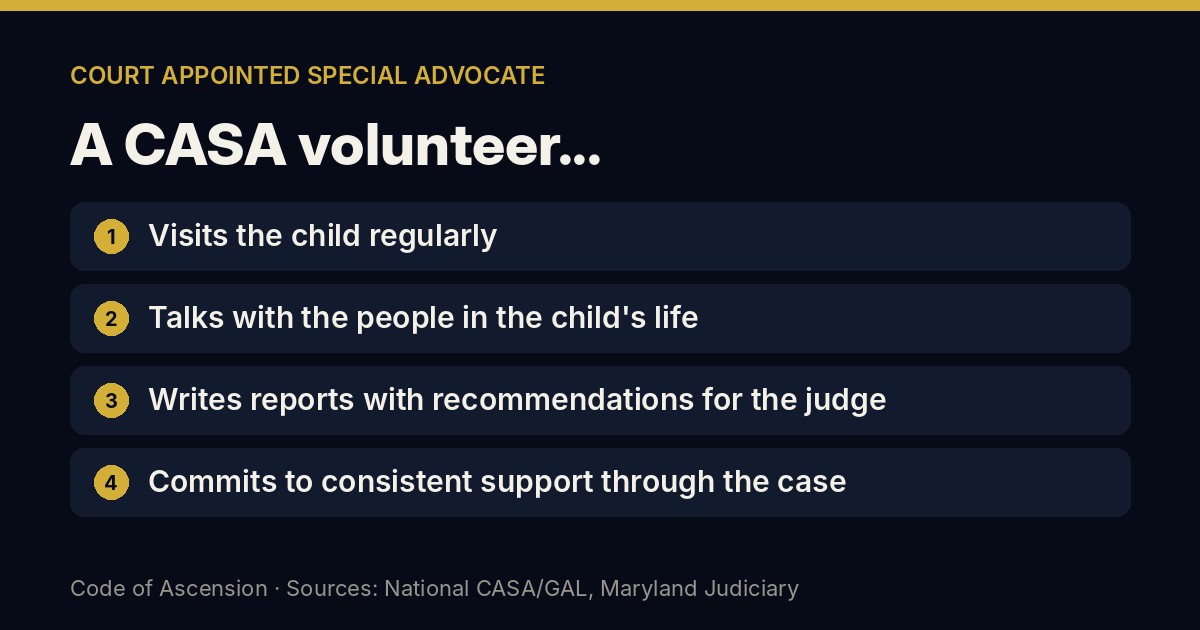
Quick Answer: CASA volunteers are trained, unpaid community volunteers appointed by judges to advocate for a child’s best interests in court. They visit the child, talk with the people in the child’s life, write reports with recommendations for the judge, and commit to consistent support through the case.
What “CASA” means
CASA stands for Court Appointed Special Advocate. In some places, similar volunteers are called guardians ad litem (GAL), though guardian ad litem roles vary by jurisdiction, and in some courts a GAL is an attorney rather than a volunteer.
Nationally, programs are connected through the National CASA/GAL Association for Children. According to National CASA/GAL, there are 890 state organizations and local programs in 48 states and the District of Columbia, with more than 79,000 volunteers nationwide. It also says each year its programs train more than 24,000 new community advocates.
What a CASA volunteer actually does
National CASA/GAL describes the core of the role this way: CASA/GAL volunteers “are appointed by judges to advocate for children’s best interests.” They work with child welfare professionals, educators and service providers so that judges have the information they need to make well-informed decisions.
The Maryland Judiciary’s annual report on CASA programs gives a clear picture of what that looks like in practice. In Maryland, the CASA volunteer is “considered a friend of the court” and is appointed at the judge’s discretion. Volunteers:
- Visit regularly with the child they’re assigned to.
- Meet the people in the child’s life, including family members and professionals such as social workers, therapists and teachers.
- Prepare written reports with recommendations about the child’s needs and future placement, which are submitted at court hearings.
- Attend hearings. In fiscal year 2025, Maryland volunteers attended 76% of the hearings for which they prepared a report.
National CASA/GAL adds two details that shape the whole experience:
- Programs aim for volunteers to stay on a case until it closes and the child has a safe, lasting home. That continuity is the goal; Maryland requires a commitment of at least one year.
- Each volunteer works with only one or two children or sibling groups at a time.
That second point is the heart of it. A social worker may carry many cases. A CASA volunteer focuses on one child or one set of siblings, which means they often notice things that busy systems miss: a school problem, a medical appointment that hasn’t happened, a relationship that matters to the child.
Where CASA fits in a court case
When a child welfare agency removes a child from home, the case goes to court. In Maryland, that’s the juvenile court. The judge makes decisions over time about where the child lives, what services the family receives and, eventually, what permanent plan makes sense, whether that’s returning home, living with relatives, adoption or another arrangement.
Those decisions happen across a series of hearings. At each one, the judge hears from the agency, the lawyers and others involved. When a CASA volunteer is appointed, their report adds something the court may not otherwise get: a steady, independent look at how this particular child is actually doing, from someone who has spent time with them and talked to the people around them.
That’s why consistency matters so much. A volunteer who has been there for every hearing can tell the judge what has changed since the last one, what’s working and what still isn’t.
What goes into a good report
CASA programs train volunteers on how to write reports for their court. In general, a useful report:
- Sticks to facts the volunteer observed or was told, and says where each piece of information came from.
- Covers the whole child: school, health, therapy, relationships, placement and what the child says they want.
- Separates the child’s wishes from the recommendation. A child’s wishes matter and should be heard. The volunteer’s recommendation is about the child’s best interests, which may or may not be the same thing.
- Makes specific recommendations, such as a needed evaluation, a sibling visit or a school change, rather than general concerns.
- Respects confidentiality and follows the program’s format and rules.
Your program will review your reports before they go to court. You won’t be on your own.
What a CASA volunteer doesn’t do
Understanding the limits of the role matters just as much.
- A CASA volunteer isn’t the child’s lawyer. The Maryland CASA Association is clear: “The CASA volunteer does not provide legal representation in the courtroom.” That’s the attorney’s job.
- A CASA volunteer isn’t a foster parent or caseworker. The volunteer doesn’t provide housing or direct the child welfare agency’s work. Their job is to gather information and advocate.
- A CASA volunteer doesn’t work alone. Local programs assign staff to supervise and support volunteers. Expect to work within your program’s rules on contact, confidentiality and reporting.
Who can become a CASA volunteer
Requirements are set by each local program, so check with the one near you. Here’s what the local programs in our area say.
CASA for Children of DC says:
- You must be at least 21 years old: “You must be at least 21 years of age to be considered as a CASA volunteer.”
- Applicants go through a comprehensive background check, covering criminal history, the child abuse registry and the national sex offender registry.
- You’ll complete a written application and provide at least three references who aren’t related to you.
- You’ll interview with program staff.
CASA of Prince George’s County says in its FAQ that applicants must be at least 21. It describes its process this way:
- Learn about the role, including an optional information session. The program says it holds bi-weekly information sessions for prospective volunteers.
- Complete the online application.
- Talk with a staff member by phone, followed by an in-person interview if there’s a fit.
- Attend pre-service training and complete background screening.
- Accept a case. Staff match volunteers using their interview, training and a case preference sheet.
Notice what isn’t on either list: a law degree, a social work background or experience in the court system. CASA is designed for community members. What programs look for is reliability, good judgment, comfort working with different kinds of people, and the ability to keep information confidential.
Training
CASA training is substantial, and that’s a good thing.
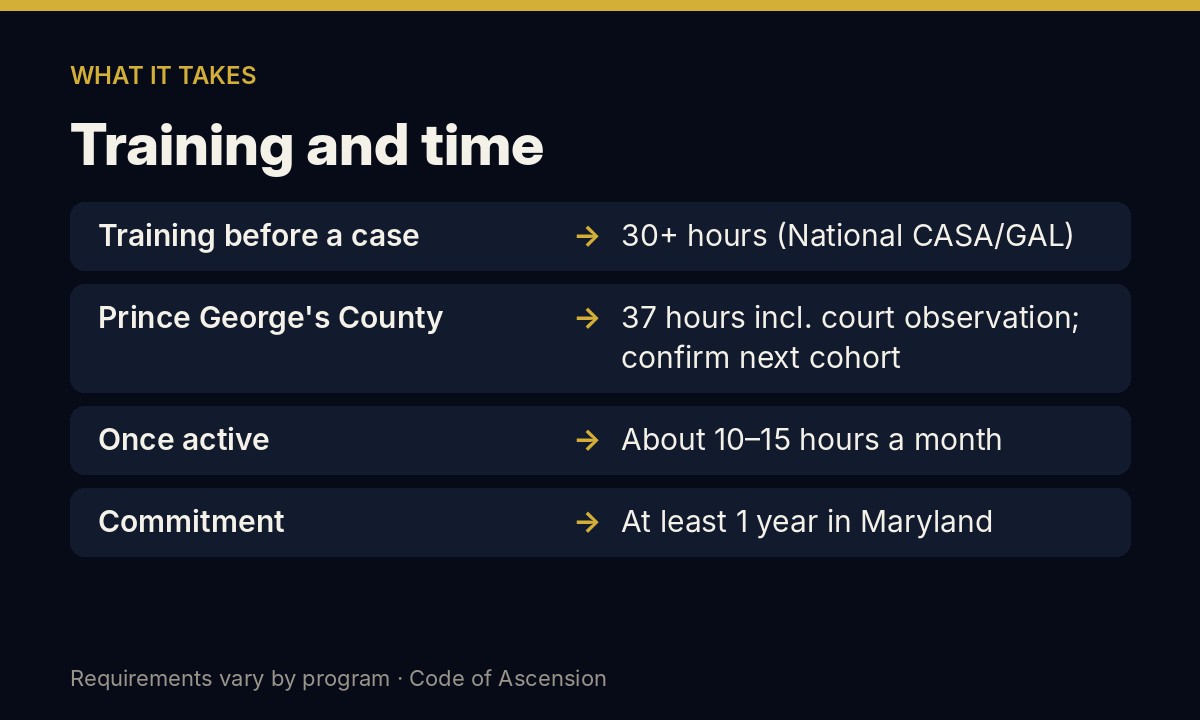
- Nationally: National CASA/GAL says volunteers complete more than 30 hours of training before working with a child, and 12 hours of continuing education each year.
- In Prince George’s County: CASA of Prince George’s County’s recruitment page describes a free 37-hour training that includes courtroom observation. Its other pages describe the hours differently (for example, 32 classroom hours in its FAQ), so confirm the details and the next training dates with the program.
- In Maryland overall: the Maryland Judiciary’s report lists 12 hours of in-service training per year as a requirement for local programs.
Training typically covers how the child welfare and court systems work, how to gather information and write reports, how to work with families from different backgrounds, and how trauma affects children. Expect it to be practical, and expect to learn a lot about your own community.
How much time does it take?
This is the question most people really want answered.
- Monthly hours: The Maryland CASA Association says, “Once initiated into the system, volunteers work about 10 hours a month, but time commitments vary.” CASA of Prince George’s County’s FAQ estimates 10 to 15 hours a month.
- Length of commitment: The Maryland Judiciary’s report lists a minimum service commitment of one year, and CASA of Prince George’s County’s FAQ says volunteers must commit at least one year after accepting a case. Programs aim for volunteers to stay with a case until it’s resolved, which can be longer.
- Court dates: Hearings happen during business hours. Ask your local program how often volunteers attend court and how much flexibility you’ll have.
The time is real, but it’s usually spread out: a visit here, a few phone calls there, a report before each hearing. Many volunteers have full-time jobs. Ask the program what a typical month looks like for its volunteers before you commit.
What a month might look like
Every case is different, and your program will set expectations for yours. But to make the time commitment concrete, here’s a hypothetical example of a month for a volunteer advocating for one child. It’s an illustration, not a schedule any program requires.
- Week 1: A visit with the child at their placement, an hour or so. You talk about school, what they’ve been doing and anything on their mind. Afterward, you write brief notes.
- Week 2: Phone calls or emails with the child’s social worker and teacher to check on a school issue the child mentioned. A short check-in with your CASA supervisor.
- Week 3: A second visit, maybe an outing if your program allows it, or a visit at school. You notice the child still hasn’t had a dental appointment that was supposed to be scheduled, and you follow up.
- Week 4: If a hearing is coming up, you draft your report, your supervisor reviews it, and you submit it on time. Then you attend the hearing.
Some months are lighter. Months with a hearing are heavier. That’s roughly how 10 to 15 hours a month can add up.
Questions to ask at an information session
If you go to an information session, bring a few questions. The answers will tell you a lot about whether the program is a good fit for you.
- How long do cases usually last here?
- How often do volunteers visit, and where do visits happen?
- How many hearings does a typical volunteer attend in a year, and what time of day are they?
- How much support do volunteers get from staff? Who do I call if something comes up?
- What does continuing education look like?
- Can I choose the age range of the children I work with?
- What happens if my life changes and I can’t continue?
- What do your volunteers say is the hardest part, and the most rewarding?
A good program will answer openly, including about the hard parts.
Do CASA volunteers get paid?
No. CASA volunteer positions are unpaid. National CASA/GAL describes them as trained community volunteers, and programs have paid staff who recruit, train and supervise them. One exception to note: Maryland’s FY2025 CASA report describes paid-advocate pilot programs in Cecil County, Prince George’s County and Baltimore City. Those are separate paid roles, not the standard volunteer position.
What volunteers do get is training, supervision and support. National CASA/GAL says that once you’re involved, “your program will support you every step of the way.”
CASA in Maryland and DC
Maryland at a glance
The Maryland Judiciary publishes an annual report on CASA programs. The Fiscal Year 2025 report, published in February 2026, shows:
- 14 local CASA programs, together serving 23 jurisdictions (every county except Garrett County).
- 1,123 volunteers served children during fiscal year 2025.
- 1,368 children were served by a volunteer advocate during the year.
- 634 volunteer applications were received, 468 prospective volunteers were interviewed and 305 new volunteers completed pre-service training.
- All local CASA programs were funded by the Maryland Judiciary, and programs must match 100% of the awarded funds.
Those numbers also tell a story. More children come into care than there are volunteers to serve them, so programs are always recruiting.
Prince George’s County
CASA of Prince George’s County is based in Riverdale. According to the Maryland CASA Association, the program has noted a need for more male volunteers: “Only 10% of our volunteers are men.”
- Website: pgcasa.org
- Phone: (301) 209-0491
- Email: volunteer@pgcasa.org
Elsewhere in Maryland
The Maryland CASA Association lists every local program in the state, from Montgomery and Howard counties to the Eastern Shore and Western Maryland.
Washington, DC
CASA for Children of DC runs several specialized programs for young people in the child welfare and juvenile justice systems.
- Website: casadc.org/volunteer
- Phone: 202-887-0007
- Email: volunteer@casadc.org
Anywhere else
Use National CASA/GAL’s find a CASA/GAL program page and choose your state.
Common myths about CASA
A few misunderstandings keep good people from applying, and a few others set the wrong expectations. Here’s what’s actually true.
“You need a legal background.” You don’t. CASA volunteers don’t provide legal representation; the child’s attorney does that. Programs train community members to gather information and write reports.
“You have to be a parent.” Neither the national organization nor the local programs in our area list parenthood as a requirement. What matters is that you’re an adult who can be reliable, respectful and observant.
“The CASA volunteer decides what happens.” The judge decides. A CASA volunteer gives the judge information and a recommendation. Sometimes the court follows it, sometimes it doesn’t. The volunteer’s job is to make sure the child’s needs are clearly in front of the court.
“You’ll be on your own.” You won’t. Local programs have staff who supervise and support volunteers, review reports and help when something comes up.
“It’s basically mentoring.” There’s overlap, because building a relationship with the child matters. But CASA is a court role with formal responsibilities: visits, interviews with the people in the child’s life, written reports and hearings. If you’re mainly looking to mentor, ask a local program what roles it offers, or look at mentoring programs too.
“It’s a quick volunteer gig.” It isn’t. Expect a substantial training, roughly 10 to 15 hours a month once you’re active, and at least a one-year commitment, with the goal of staying through the case.
What to think about before you apply
CASA is meaningful work, and it isn’t for everyone. That’s not a criticism of anyone. It’s just honest. Here are the questions worth asking yourself before you apply.
Can I commit for the long haul?
Cases can take longer than you expect, and consistency is the point. Maryland lists a one-year minimum commitment, and programs aim for volunteers to stay until the case is resolved. If you’re planning a move or a big life change soon, it may be better to help in another way for now and apply later.
Can I work within the system’s rules?
CASA volunteers see a lot of private information and work inside a court process. You’ll need to follow your program’s rules on confidentiality, contact with the child and family, and what goes into reports. Confidentiality also works in the other direction: relevant information may need to be shared with the court and the authorized case team, so volunteers shouldn’t promise a child absolute secrecy. You won’t always agree with every decision the court or agency makes. Your job is to give the judge good information and an honest recommendation, then keep showing up.
Can I handle hard stories?
Many children in CASA cases have experienced abuse or neglect. You’ll hear difficult things. Programs train and supervise volunteers for this reason. It’s worth thinking about your own support, too: people you can talk to (within confidentiality rules) and ways you recharge.
Can I be respectful of families?
Many children in care are eventually reunified with their families, and many families are dealing with poverty, addiction, mental illness or other hard circumstances. Good advocates focus on the child’s best interests without writing anyone off. Training covers this, but it starts with your own attitude.
Am I doing this for the child?
The best reason to become a CASA volunteer is because you want to help a specific child be seen and heard. If what you’re looking for is a résumé line or a feel-good story to share, another kind of volunteering may be a better fit. CASA is quiet work, and most of it never gets posted anywhere.
If you answered yes to most of these, an information session is a low-pressure next step. You can ask questions, hear from staff and decide from there.
Your next steps
If you’re ready to explore it, here’s a simple path:
- Find your local program. In Prince George’s County, that’s CASA of Prince George’s County. In DC, it’s CASA for Children of DC. Elsewhere in Maryland, use the Maryland CASA Association’s list. Anywhere else, use National CASA/GAL’s program finder.
- Attend an information session or call the program with your questions.
- Apply if it feels right. Expect an application, references, interviews and background checks.
- Complete pre-service training. Treat it as part of the decision, too. It’s a good time to make sure the role fits.
- Take your first case with your program’s support.
There’s no shame in stopping at any step. Learning about the role is useful even if you decide to help in a different way.
If CASA isn’t the right fit right now
There are many other ways to help children in care, and they all matter. You can:
- Donate to a CASA program. Programs need funding to recruit, train and supervise volunteers, and Maryland’s programs must match the grants they receive.
- Spread the word, especially if you know people who’d be strong advocates. Programs like Prince George’s County’s have said they need more men.
- Support foster families or children in care in other ways. Our guide, How to Help Children in Foster Care at Christmas and All Year, covers donating, mentoring, respite care and helping young people who are aging out.
- Check an organization before you give. See How to Evaluate a Child-Protection Organization Before You Give.
A note from Code of Ascension
We built Compassion in Action because caring about children means doing something useful for them. CASA is one of the most direct ways an ordinary adult can do that: one child, one case, one consistent voice in a system that can be overwhelming.
If you’re drawn to it, go to an information session. If you’re not, that’s fine too. Find the way to help that you’ll actually stick with.
This guide is part of Compassion in Action, where Code of Ascension turns compassion into real-world action for children.
Frequently asked questions
What does a CASA volunteer do for a child? A CASA volunteer gets to know the child, talks with the people in the child’s life, and writes reports with recommendations for the judge about what the child needs. Programs aim for continuity until the case closes; Maryland requires at least a one-year commitment.
Do CASA volunteers get paid? No. CASA volunteer positions are unpaid. Programs have paid staff who train and supervise volunteers, and Maryland has also piloted separate paid-advocate roles in a few jurisdictions.
What are the requirements to be a CASA volunteer? They vary by program. CASA for Children of DC and CASA of Prince George’s County both require volunteers to be at least 21. DC also requires a comprehensive background check, a written application with three non-relative references, and an interview with staff. Nationally, volunteers complete more than 30 hours of training before taking a case.
How many hours a week does CASA take? The Maryland CASA Association says about 10 hours a month once volunteers are active, and CASA of Prince George’s County estimates 10 to 15 hours a month. Maryland lists a minimum one-year commitment, and programs aim for continuity through the case.
Do I need legal experience to be a CASA? No. CASA volunteers don’t provide legal representation; that’s the attorney’s role. Programs train community members to do the work.
About the author
Written by King for Code of Ascension’s Compassion in Action. This guide brings together the public sources linked below to help readers ask informed questions and find appropriate services. It is general education, not legal advice or a professional safeguarding assessment.
Sources
- The CASA/GAL Model and Be a CASA volunteer (National CASA/GAL Association for Children)
- Fiscal Year 2025 Annual Report on Court-Appointed Special Advocate Programs (Maryland Judiciary, Administrative Office of the Courts, February 2026)
- Maryland CASA Association: FAQs and local CASA programs
- Become a Volunteer (CASA of Prince George’s County)
- Volunteer and Our programs (CASA for Children of DC)