
Child safety takes more than good intentions. Strong programs back them up with something more reliable: written rules, trained staff and a plan for what happens when something goes wrong.
You can’t see that from a brochure. You find it by asking.
This guide gives you the questions to ask before you enroll a child in a camp, sports team, club, tutoring program, faith-based youth group or any other program where adults spend time with kids. It explains what a strong answer sounds like and what should make you look closer. It’s built on guidance from the CDC, the U.S. Center for SafeSport, Stop It Now!, the American Camp Association and the Maryland Department of Health.
Quick Answer: a safe program can tell you, without getting defensive, how it screens adults, keeps one-on-one time visible, handles messaging with kids, trains its people and responds to concerns. If it can’t, keep looking.
Why asking matters
Keeping children safe is the responsibility of adults, not children. Stop It Now! makes the point directly in its guidance on program settings: clear rules on boundaries are “the responsibility of the staff not the children.”
That responsibility belongs to the program first. But parents, guardians and other caregivers are part of the system too. When families ask good questions, programs notice. It tells them people are paying attention, and it rewards the programs that do this well.
Asking isn’t an accusation. It’s the same thing you’d do before choosing a doctor or a school. A good program expects it and is usually glad to answer.
How to ask without it feeling awkward
A simple opener works: “Before we sign up, I like to ask every program a few questions about how you keep kids safe. Do you have a few minutes, or is there someone better to talk to?”
Ask for written policies when they exist. A handbook or code of conduct answers many of these questions at once, and a program that hands it over readily is showing you something good. If you’re comparing programs, ask each one the same questions so you’re comparing like with like. Take notes. Then decide with the whole picture in front of you, not just the first impression from a tour.
The one rule to understand first: visible and interruptible
If you remember one idea from this guide, make it this one.
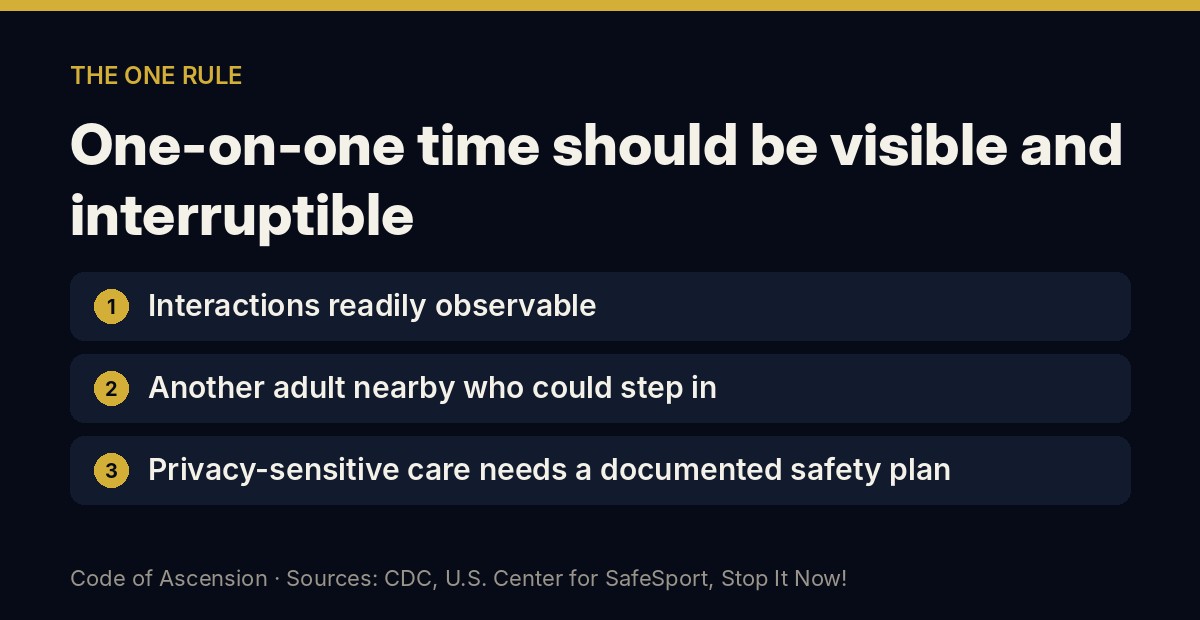
Stop It Now! calls adults being alone with children out of others’ sight or hearing the highest-risk situation in program settings. The CDC’s guide for youth-serving organizations recommends limiting one-on-one contact, ideally by keeping at least two adults present with youth.
Youth sports put it in a memorable phrase. The U.S. Center for SafeSport’s 2025 Minor Athlete Abuse Prevention Policies (MAAPP) apply to organizations in the U.S. Olympic and Paralympic Movement. Under MAAPP, covered one-on-one interactions between adult participants and minor athletes in the program must be “observable and interruptible,” subject to the policy’s defined exceptions. That means someone else can readily see what’s happening and could step in.
Outside that setting it isn’t a legal rule, but it’s a useful way to think about any program. It doesn’t mean a coach can never give individual feedback or a counselor can never comfort a homesick camper. It means those moments happen where they’re readily observable: in an open area, within sight of other staff.
Some situations need privacy for the child’s dignity, such as confidential health care, changing or help with personal care. Those aren’t open-door situations. They call for a documented safety plan instead: who provides the care, where, how it’s supervised and how families are informed.
Ask every program how it does this. Most of the other questions build on it.
The questions
Copy these into your notes app, or print this page and take it with you. You don’t need to ask every question in one sitting. Start with the ones that matter most for the program you’re considering.
1. Licensing and accreditation
Ask: – Is this program licensed or certified where that’s required? What is the license number? – Is it accredited by an outside organization? If not, why not? – Who oversees the program: a school, a league, a national organization, a faith community?
Why it matters: Licensing rules vary by state and by type of program. In Maryland, the Department of Health’s Youth Camps Program says it “regulates and licenses all youth camps in Maryland,” and certification requires substantial compliance with regulations covering criminal history checks for staff, health care, supervision ratios, safety procedures, incident reporting and facility maintenance. The department keeps a searchable database of licensed camps, and its Youth Camp Safety Advisory Council’s checklist suggests asking whether a camp is licensed and for its license number.
For camps, the American Camp Association (ACA) offers accreditation focused on health, safety and risk management, including how staff are screened and trained, staffing ratios, limits on one-on-one contact and supervision. Accredited camps are visited by a trained peer reviewer. ACA’s advice to parents is to ask whether a camp is accredited and, if it isn’t, to ask why not.
A strong answer: a clear yes with a license number you can check, or a clear explanation of why licensing doesn’t apply and who oversees the program instead.
Look closer if: the program is vague about who oversees it or can’t give you a license number when one is required.
2. Screening adults
Ask: – How do you screen staff and volunteers before they work with children? – Do you check references and do an interview, not just a background check? – Do volunteers go through the same screening as paid staff? – How often do you repeat background checks?
Why it matters: The CDC’s guide describes screening as several steps working together: a written application, a personal interview with scenario questions about boundaries, reference checks from varied sources, and a criminal background check. It also warns that a background check alone isn’t enough: “Criminal background checks will not identify most sexual offenders.”
That’s why the interview and references matter. A program that asks applicants how they’d handle a boundary situation learns things a records check never shows.
A strong answer: a description of the full process, including interviews and references, that applies to everyone who works with children.
Look closer if: the answer is “we do background checks” and nothing else, or if volunteers skip screening.
3. One-on-one time
Ask: – Can staff be alone with a child? If so, when, and how do you keep it visible and interruptible? – What’s your policy on closed doors and private rooms? – Are individual lessons, tutoring or training sessions open for parents to watch?
Why it matters: This is the visible-and-interruptible rule in practice. The CDC recommends clear sightlines, securing unused rooms and considering a no-closed-door policy, with planned exceptions for privacy-sensitive care. Under MAAPP, parents are allowed to watch their child’s individual training sessions, and parents must consent to individual sessions, transportation and lodging.
A strong answer: a specific policy, such as “individual sessions happen in the open gym with another coach present and parents are welcome to watch.”
Look closer if: staff routinely spend time alone with children behind closed doors, or if parents are discouraged from observing.
4. Messaging, texting and social media
Ask: – How do staff communicate with children outside the program: texts, apps, social media, direct messages? – Are parents or another adult copied on messages? – What platforms do staff use, and can parents see them?
Why it matters: A lot of contact between adults and kids now happens on phones. Clear rules here are one of the most useful protections a program can have.
The 2025 MAAPP sets a strong example. For organizations in the U.S. Olympic and Paralympic Movement, covered sport-related electronic communication between adult participants and minor athletes must include another adult: a parent or guardian, another adult family member, or another adult participant must be copied or included, even when the athlete starts the conversation. Private one-on-one messages without that additional adult are prohibited unless one of the policy’s defined exceptions applies, such as an emergency. A parent or guardian can request in writing that contact with their child stop, and both the organization and the adult participant must comply, except in an emergency. Covered organizations were required to implement these 2025 minimum standards by January 1, 2025, and their approved policies may be stricter.
The CDC guide also recommends that organizations restrict out-of-program contact and clarify when they’re responsible for youth.
A strong answer: “Staff communicate through our group app, and a parent or second adult is always included. No private messages.”
Look closer if: coaches or counselors text kids privately, follow them on personal accounts and message them there, or say “it’s fine, the kids like it.”
5. Bathrooms, changing and overnight trips
Ask: – How do you supervise bathrooms, locker rooms and changing areas? – For overnight trips or residential camps, who sleeps where? How are cabins or rooms supervised? – How do you handle transportation? Can a staff member drive a child alone?
Why it matters: The CDC’s guide asks organizations to plan for toileting, showering and changing clothes, including risks among youth themselves, and to define responsibilities for field trips, off-site activities and transportation.
MAAPP gives detailed examples. Locker rooms and changing areas must be monitored, children should have access to a private or semi-private changing area, and adults may not shower with minor athletes, with limited exceptions. The one-on-one rules still apply during organization-sponsored travel and lodging.
A strong answer: a specific plan for each situation, ideally written down.
Look closer if: the program hasn’t thought about it, or the answer depends on “using good judgment” rather than a policy.
6. Rules about touch and boundaries
Ask: – What kinds of touch are allowed between staff and children, and which aren’t? – Can a child say no to a hug or other touch? – Is there a written code of conduct for staff? Can I see it? – How do you handle situations between children, not just between adults and children?
Why it matters: Stop It Now! suggests asking what touches staff may give and when, which touches children may refuse, and whether the program actually follows its written rules. The CDC guide recommends that organizations define appropriate, inappropriate and harmful behaviors and address interactions among youth, not only adult-youth contact.
Stop It Now! also suggests asking how administrators would handle a specific scenario. Asking “what would you do if…” often tells you more than asking whether a policy exists.
A strong answer: a written code of conduct you’re welcome to read, and a clear description of how the program responds when someone breaks it.
Look closer if: there’s nothing in writing, or if a child’s “no” isn’t respected.
7. Training
Ask: – Do staff and volunteers get training on preventing abuse and on your policies? – How often? Who leads it? – Is there anything for parents or for the kids themselves?
Why it matters: The CDC says training should cover the organization’s policies, information about child sexual abuse, personal conduct and how to handle a disclosure, and that it should be “ongoing and not just a one-time event.” Stop It Now! suggests specialized training at least once a year for everyone who works with children.
For youth sports, the U.S. Center for SafeSport offers free, age-appropriate online training, and encourages families to take it too.
A strong answer: regular training for everyone, with refreshers, and something families can access.
Look closer if: training is a single video at hiring, or volunteers aren’t trained at all.
8. Reporting concerns
Ask: – If a parent, child or staff member has a concern, who do they tell? – What happens next? Do you report to authorities when required? – Is there someone outside the chain of command to go to?
Why it matters: The CDC guide recommends a clear reporting structure with direct-line and back-up options, following state law, and reporting suspected abuse to the authorities rather than investigating it internally. Its guidance to staff is plain: “Do not conduct your own investigation.”
For organizations in the U.S. Olympic and Paralympic Movement, the U.S. Center for SafeSport takes reports of abuse and misconduct. Suspected child abuse must also go promptly to the appropriate public authorities, such as child protective services or the police.
A strong answer: a named person, a backup option and a clear statement that suspected abuse is reported to the authorities.
Look closer if: the answer is “we handle things internally,” or if no one can tell you who to call.
9. Children with disabilities and specific needs
Ask: – How do your policies account for my child’s specific needs? – If my child needs help with toileting, dressing or feeding, who provides it and how is it supervised? – How can my child communicate a concern if they’re nonverbal, deaf or hard of hearing, or use a communication device?
Why it matters: Stop It Now! suggests asking whether staff understand risks for children with disabilities, and how policies reduce the risks tied to daily-living support, social isolation and communication barriers. A program that serves children with disabilities well will have thought about this in detail.
A strong answer: a specific plan for your child, developed with you.
Look closer if: the program hasn’t considered it or treats it as an afterthought.
10. Your involvement
Ask: – Can parents visit or watch at different times? – How will you keep me updated? – How do you want families to share information about their child?
Why it matters: Stop It Now! encourages parents to visit at varied times, get to know staff and other parents, watch how their child responds to different staff, and share what they know about their child.
A strong answer: the program explains how families can observe, including any sign-in, safeguarding and privacy rules for visitors, and how to reach staff.
Look closer if: families are discouraged from observing at all, or there’s no clear way to raise a question.
Extra questions for specific kinds of programs
The ten areas above apply almost everywhere. Some programs deserve a few extra questions.
Sports teams and clubs
- Is the club part of a national governing body in the U.S. Olympic and Paralympic Movement? If so, it must meet the 2025 MAAPP minimum standards, and its approved policy may be stricter. Ask for a copy.
- Who is allowed to give massages, stretching help or athletic-training treatment, and is a second adult present? Under MAAPP, a second adult must be in the room for massages and treatments.
- How are travel, hotel rooms and rides to games handled?
Overnight and residential camps
- What’s the counselor-to-camper ratio at night, not just during the day?
- How are cabins checked after lights out?
- How can my child contact me, and how will you contact me if something happens? Maryland’s camp checklist suggests asking how parents will be notified if a child becomes ill or injured.
Tutoring, lessons and online programs
- Where do sessions happen? In a shared space, a home or online?
- For online sessions, are they in a group, recorded, or open for a parent to join?
- Does the tutor or instructor have any way to contact my child privately outside the platform?
Online programs deserve the same visible-and-interruptible thinking as in-person ones. A group or recorded video session a parent can join is very different from a private chat app the family can’t see.
Faith-based youth groups and volunteer-run programs
- Do volunteers go through the same screening and training as staff?
- Who is responsible for youth activities, and who do volunteers report to?
- Are there written policies for retreats, lock-ins and trips?
Volunteer-run programs can be wonderful. Asking these questions kindly helps any program, staffed or volunteer, see where it can improve.
What a good program sounds like
When you ask these questions, pay attention to how the program responds, not just what it says.
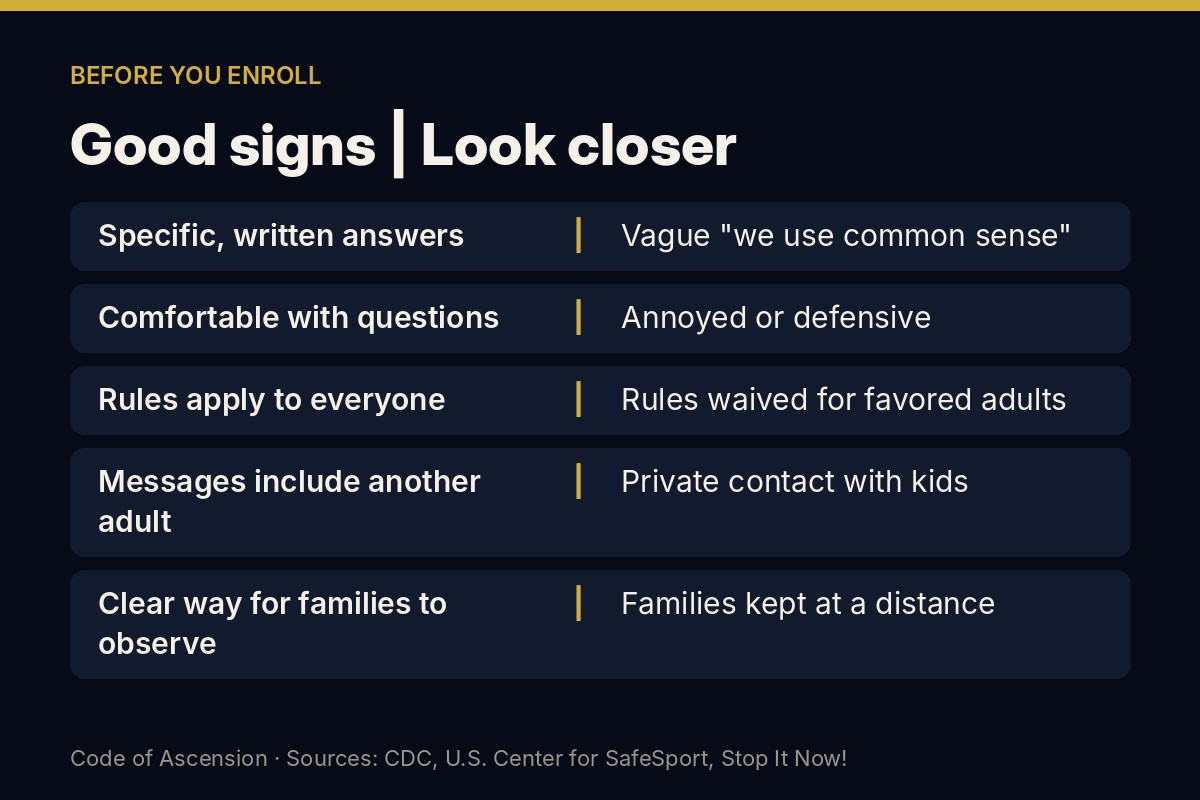
Good signs:
- Answers are specific and often written down.
- Staff are comfortable with the questions and may thank you for asking.
- Rules apply to everyone, including the popular coach and the founder’s friend.
- The program can tell you what it does when a rule is broken, not just what the rule is.
- There’s a clear way for families to observe, with sign-in and privacy rules explained.
Signs to look closer:
- Answers are vague, such as “we use common sense” or “we’re like a family here.”
- Staff seem annoyed or defensive.
- Rules are waived for favored adults. (Documented policy exceptions, like those MAAPP defines, are different.)
- Private contact between adults and kids is common or encouraged.
- Families are kept at a distance with no way to observe.
No single answer proves a program is safe or unsafe, and careful screening is one factor, not proof. Look at the answers together. If something feels off, you’re allowed to choose a different program, and you don’t owe anyone an explanation.
After you enroll
Asking before you enroll is a start. Staying connected keeps it working.
- Check in regularly. Stop It Now! suggests asking open-ended questions and some direct ones, like “Are you afraid of anyone?” and “Has anyone made you do anything you didn’t want to do?”
- Notice changes. Pay attention to how your child talks about particular adults or seems around them.
- Keep the messaging rule in mind. If an adult from the program contacts your child privately, ask the program about it.
- Speak up early. It’s easier to raise a small concern about a boundary than to wait until it becomes a big one.
If you’re worried about a child
If a child is in immediate danger, call 911.
To report suspected abuse or neglect, contact your state or local child protective services. In Maryland, the Department of Human Services lists the number 1-800-91Prevent (1-800-917-7383).
If you’re worried about someone’s behavior around children but aren’t sure what to do, Stop It Now! runs a confidential helpline at 1-888-PREVENT during set hours, plus chat and email. For organizations in the U.S. Olympic and Paralympic Movement, the U.S. Center for SafeSport takes reports of abuse and misconduct. That’s in addition to, not instead of, reporting suspected child abuse promptly to the appropriate authorities.
For donors and volunteers
These questions aren’t only for parents. If you’re thinking about volunteering with a youth program, or giving it money, the same questions tell you whether it takes safety seriously. Careful screening of volunteers is a good sign, though it’s one factor among several.
For a full method for checking a child-focused organization before you give, see How to Evaluate a Child-Protection Organization Before You Give. For ways to help children in care, see How to Help Children in Foster Care at Christmas and All Year.
This guide is part of Compassion in Action, where Code of Ascension turns compassion into real-world action for children.
Frequently asked questions
What questions should I ask a summer camp about safety? Ask whether the camp is licensed and accredited, how it screens staff, how it keeps one-on-one time visible, how staff communicate with campers, how bathrooms, cabins and transportation are supervised, how staff are trained and how concerns are reported. In Maryland, you can check a camp’s license in the Maryland Department of Health’s Youth Camps database.
Is a background check enough? No. The CDC says background checks should be one part of screening, not the only part, and that “Criminal background checks will not identify most sexual offenders.” Interviews and references matter too.
Is it OK for a coach to text my child? It depends on the program. For organizations in the U.S. Olympic and Paralympic Movement, the U.S. Center for SafeSport’s 2025 MAAPP requires covered sport-related electronic communication between adult participants and minor athletes to include another adult, such as a parent or guardian. Private one-on-one messages without that adult are prohibited unless a defined exception applies, such as an emergency, and a parent or guardian can request in writing that contact stop. For other programs, ask what their written policy is.
What does “observable and interruptible” mean? It’s a core rule in the U.S. Center for SafeSport’s 2025 MAAPP for organizations in the U.S. Olympic and Paralympic Movement: covered one-on-one interactions between adult participants and minor athletes must be readily observable, with someone able to step in, subject to defined exceptions. Other programs can use the same idea, with a documented safety plan for privacy-sensitive care.
How do I check if a camp is licensed in Maryland? Use the Maryland Department of Health’s Youth Camps searchable database, or call the department’s Center for Recreation and Community Environmental Health Services at 410-767-8417.
About the author
Written by King for Code of Ascension’s Compassion in Action. This guide brings together the public sources linked below to help readers ask informed questions and find appropriate services. It is general education, not legal advice or a professional safeguarding assessment.
Sources
- Tip Sheet: How to Protect Your Child from Sexual Abuse in Program Settings (Stop It Now!)
- Preventing Child Sexual Abuse Within Youth-serving Organizations: Getting Started on Policies and Procedures (2007) (CDC)
- 2025 MAAPP and MAAPP one-pager for parents (U.S. Center for SafeSport)
- 2025 MAAPP, full policy (PDF) and Report a concern (U.S. Center for SafeSport)
- The Most Important Question a Parent Can Ask: Is This Camp Accredited by the American Camp Association? (American Camp Association)
- Youth Camps and Youth Camps searchable database (Maryland Department of Health)
- How to Choose a Youth Camp (Maryland Youth Camp Safety Advisory Council)
- Reporting suspected child abuse or neglect (Maryland Department of Human Services)