
The holidays make people want to help. That’s a good instinct. But the most useful help for a child in foster care is the help that agencies actually asked for, delivered the way they asked for it, and remembered again in March, July and September, when nobody’s running a gift drive.
This guide covers both. First, how to help this Christmas, including two real programs right here in the DMV. Then the year-round options, from a one-time donation to becoming a court-appointed advocate, so the help keeps going after the decorations come down.
Quick Answer: call or check the page of the agency or program first, give what’s on their current list, and pick one year-round way to stay involved. Everything below is about doing that well.
Why this matters
Foster care isn’t a small corner of the country. According to the federal Children’s Bureau, 331,747 children were in foster care on September 30, 2025, the most recent preliminary national count. During federal fiscal year 2025 (October 1, 2024 to September 30, 2025), 175,008 children entered care and 169,927 left it. Of the children who left, 15,030 (9%) did so through emancipation, which usually means they aged out of the system as young adults rather than leaving to a permanent family.
Behind every one of those numbers is a young person with their own story. Some live with relatives, some with foster families and some in other placements. Many arrive with very little of their own. AdoptUSKids, a project funded by the federal Children’s Bureau, puts it simply: “Many children in foster care have very little to call their own.”
That’s the gap ordinary people can help close. And you don’t need to be a parent, a social worker or a millionaire to do it. In AdoptUSKids’ words: “You don’t have to work in child welfare or be a parent to help children in foster care.”
At Code of Ascension, we write a lot about protection: symbols, energy, intention. This is the practical side of the same idea. Protection for a child in care looks like a gift that fits, an adult who keeps showing up and a court that hears what that child actually needs.
Before you give anything: ask first
This is the single most important step, and it’s the one most people skip.
Foster care agencies and the nonprofits that support them work with real constraints. They have storage limits, privacy rules, specific age groups that get forgotten and lists of what they need right now. A garage full of well-meaning donations they didn’t ask for becomes their problem to sort, store or throw away.
So before you shop, collect or plan a drive:
- Check the program’s current list. Many agencies publish wish lists or registries. Those lists change, and they change for a reason.
- Ask about new versus gently used. Many programs accept only new items, especially clothes, shoes, toys and anything for babies. Don’t assume.
- Ask how and when to deliver. Some programs only accept drop-offs by appointment. Showing up unannounced with a trunk full of boxes can put staff in an awkward spot.
- Ask about deadlines. Holiday programs have cutoffs so gifts can be sorted and delivered on time. Each program sets its own dates, so confirm them directly instead of guessing.
- Respect privacy. Do not publish identifying photos, names, case details or stories. Follow the program’s confidentiality rules and its required consent process.
That might sound like a lot of homework for a holiday gift. It’s one phone call or one web page. And it’s the difference between help that lands and help that becomes clutter.
How to help this Christmas
In Washington, DC: Partners for Kids and Families
The DC Child and Family Services Agency (CFSA) runs a donation program called Partners for Kids and Families (PKF). CFSA describes it as “dedicated to providing children, youth, and families with essential resources and support” through community donations.
PKF lists a 2026 Holiday Gift Drive with several ways to take part:
- Sponsor a child or teen, or donate holiday gifts through PKF’s sign-up form.
- Sponsor a Thanksgiving meal for a family.
- Buy from the PKF Holiday Gift Drive 2026 Amazon Wish List, which ships directly to the program.
The PKF page doesn’t list a deadline for the holiday drive, so contact the program to confirm current dates before you buy. Drop-offs are by appointment only, Monday through Thursday, 9 a.m. to 3 p.m.
In Prince George’s County: ask the Department of Social Services
The Prince George’s County Department of Social Services (DSS) runs an annual Holiday Sharing Campaign, a broader family-support effort. According to the county, “We collect donations of food baskets during our annual Holiday Sharing Campaign, which runs from October-December.” It isn’t described as a foster-care-specific program.
To donate, the county asks you to contact its Office of Volunteer Services at 301-909-6330. The county also says it accepts new clothing, shoes and toys year-round. If you want your gift to reach children in foster care specifically, ask DSS what foster-care needs it has right now and how to give toward them.
Anywhere else: call your local agency
If you live outside DC and Prince George’s County, your county or state child welfare agency is the place to start. Many run their own holiday programs or partner with local nonprofits that do. If you’re not sure who to call, 2-1-1 is a free, confidential information and referral line that connects people to health and human services in every state.
Don’t forget the teenagers
When people picture a holiday gift drive, they often picture little kids. But teenagers and young adults are part of foster care too, and older youth are easy to overlook. DC’s PKF drive specifically invites people to sponsor a child or teen.
If a program lets you choose, consider choosing an older kid. Ask the program what teens on their list actually want or need. It’s often practical: clothes that fit their style, things for school or work, and items for their own space.
Running a holiday drive at work, church or school
A group drive can do a lot more than one person shopping alone. It works best when one person owns the plan from start to finish.
- Pick one program and call them first. Ask what they need, how many items they can take, whether items must be new, and the last day they can accept a delivery.
- Share their list, not your guesses. Post the exact items, sizes and quantities the program asked for. If they gave you a wish list or registry link, share that link.
- Set your own deadline a week before theirs. That gives you time to sort, count and fill gaps.
- Handle money carefully. Some people would rather give money than shop. Point them to the program’s official donation channel where possible. If you collect money yourself, get the program’s agreement first, keep a record of every dollar in and out, and tell the group what happened to any remainder.
- Book the drop-off. Confirm the date, time and place with the program, and bring a simple count of what you’re delivering.
- Close the loop. Tell everyone who gave what was delivered. People who see that their help landed are more likely to help again.
Keep the focus on the children, not the group. A drive that quietly meets a program’s real list is worth more than a big public event that delivers the wrong things.
Give in a way that respects the child
A gift is about the child, not the giver. A few habits keep it that way:
- Follow the list. If a wish list says size 10 sneakers, that’s what’s needed.
- Wrap only if asked. Some programs want gifts unwrapped so staff can check them. Ask.
- Skip the publicity. It’s fine to share that you donated. Do not publish identifying photos, names, case details or stories.
- Think beyond December. If you enjoyed helping, put a reminder in your calendar for spring. Needs don’t stop on January 1.
How to help all year
The holidays are a good start. The year-round options below are where the deeper impact is. They’re listed roughly from the smallest commitment to the largest, so pick the one that fits your life right now.
1. Donate the everyday things kids need
Children enter care at all hours, often with very little. Agencies keep stock on hand for those moments, and they need it replenished all year.
DC’s PKF program, for example, lists ongoing needs including:
- Luggage, in excellent condition
- Toiletry kits, with regular-size items preferred
- New clothes for children ages 5 to 12, through its Target registry drive
- Snack packs
- Sensory-friendly toys and adaptive equipment for children with disabilities, through an Amazon wish list
- School supplies, college care packages, Home Starter Kits, and support for prom, winter formals and enrichment activities
PKF also runs Donation Centers, open year-round, that provide clothing, toiletries, infant supplies and bedding.
Luggage shows up on more than one list for a reason. Missouri’s Children’s Division suggests organizing a luggage or backpack drive as one of its ways to help. A child moving between homes deserves a real bag to carry their things in.
2. Give money
Money isn’t the glamorous option, but it’s often the most flexible one. It lets an agency or nonprofit buy exactly what’s needed, in the right size, at the right time.
Missouri’s Children’s Division lists the kinds of things donated money can cover: glasses, shoes, clothing, school pictures, prom or graduation costs, sports gear and activities. Those are the small things that let a kid in care feel like every other kid at school.
DC’s PKF accepts online card donations and checks, and keeps a year-round Amazon gift list. Its page gives the exact payee and memo line for checks, so follow those instructions. Wherever you give, use the program’s official donation channel.
Before you give money to any nonprofit, take a few minutes to check it out. Our guide, How to Evaluate a Child-Protection Organization Before You Give, walks through what to look for, from its programs and safeguarding policies to its public filings.
3. Give your skills
Some of the most valuable donations aren’t things at all. AdoptUSKids lists offering free photography and videography services to adoption agencies, so children waiting for families are shown with high-quality images and video. Missouri’s Children’s Division mentions professional services like photography and hair styling.
Think about what you already do well:
- Photographers and videographers can help when the agency arranges it, with approved use of the images and secure handling of files.
- Stylists and barbers can help a kid feel confident before school photos, a court date or a dance.
- Designers, writers and web builders can help small nonprofits with flyers, newsletters and websites.
- Tutors and teachers can help with homework and test prep.
- Tradespeople can help foster families with home repairs or safety inspections.
Offer one clearly defined project with a start and an end. “I can redesign your donation flyer this month” is much easier for a busy organization to say yes to than “let me know if you ever need anything.”
4. Mentor or tutor
AdoptUSKids lists mentoring a child in foster care as one of its core ways to help, supporting a child of any age as a mentor or tutor. Missouri’s Children’s Division lists tutoring or mentoring youth too.
Mentoring is about consistency more than anything else. Every child’s history is different, and a mentor who shows up when they said they would, week after week, builds trust that matters more than any single activity.
Ask the program about its required ongoing commitment before you sign up. Mentoring programs screen and train their volunteers. Expect an application, a background check and some training, and treat that as a good sign. It means the program takes the children’s safety seriously.
5. Support foster families with respite care
Foster parents need breaks too. Respite care means providing short-term childcare so a foster family can rest, handle an emergency or simply recharge. AdoptUSKids describes respite providers as offering short-term childcare that gives caregivers temporary relief and supports family stability.
Respite care usually requires approval from the agency, including training and a background check, because you’ll be caring for children in the state’s custody. If you’re interested, ask your local agency how respite works in your area.
You can also support foster families in simpler ways. Missouri’s Children’s Division suggests donating items for foster families themselves, such as laundry supplies, bedding, toiletries and gift certificates for family outings. A foster family that feels supported is more likely to keep fostering.
6. Become a CASA volunteer
Court Appointed Special Advocates (CASA) are trained, unpaid community volunteers who speak up for children in court. Some places use volunteer guardians ad litem (GAL) in a similar role, but guardian ad litem roles vary by jurisdiction, and in some courts a GAL is an attorney. According to National CASA/GAL:
- Judges appoint CASA/GAL volunteers to advocate for a child’s best interests.
- Volunteers stay on a case until it closes and the child has a safe, lasting home.
- Each volunteer works with only one or two children or sibling groups at a time.
- Volunteers complete more than 30 hours of training before working with a child, plus 12 hours of continuing education each year.
National CASA/GAL says its programs train more than 24,000 new community advocates every year.
This is a real commitment, and it should be. But it may be one of the most direct ways an ordinary adult can change a child’s path through the system. In our area, CASA programs serve both Prince George’s County and DC. Local programs set their own requirements and schedules and hold information sessions. Use National CASA/GAL’s find a CASA/GAL program page and choose your state to find yours.
7. Become a foster (resource) parent
Not everyone can foster, and nobody should feel guilty if it isn’t right for them. But if you’ve ever wondered, it’s worth learning what’s involved.
In Prince George’s County, the Department of Social Services lists these requirements for resource (foster) parents:
- Be over 21 years old and a Prince George’s County resident
- Complete 27 hours of state-mandated pre-service training, which the agency offers for free
- Hold CPR and First Aid certification
- Have a sleeping space beyond a single bedroom
- Pass a fire inspection and a home sanitation inspection
- Get medical clearance
- Have a monthly source of income
- Pass a criminal and CPS background check
- Show proof of U.S. citizenship or permanent residency
- Be willing to work with families toward reunification
That last one matters. The goal of foster care is often for a child to return safely to their own family. Foster parents support that goal; they don’t compete with it.
The county also notes a need for families ready to welcome youth ages 12 to 20. To learn more, see the county’s resource parent page, call 301-909-2300 or email pgc.fosterparents@maryland.gov. In DC, contact CFSA at (202) 442-6100.
8. Help young people who are aging out
Every year, thousands of young people leave foster care as adults without a permanent family. Nationally, that was 15,030 young people in federal fiscal year 2025.
Turning 18 or 21 doesn’t mean someone is ready to handle rent, a lease, a job search, a car and college paperwork alone. Many young adults lean on family for that kind of help. Youth leaving care may not have the same support.
There are public supports. The federal Children’s Bureau points to Educational and Training Vouchers (ETVs), which are federally funded grants for current and former foster youth pursuing college or training. It also points to state independent living programs that help eligible youth prepare to live on their own. In Maryland, the Department of Human Services runs Ready by 21, which serves youth in foster care from age 14 until their 21st birthday. Each youth gets an individualized transition plan covering education and employment, financial empowerment, supportive connections, safe housing, and well-being.
Public programs can’t do everything. Here’s where community members come in:
- Home Starter Kits. DC’s PKF publishes a Home Starter Kit list of items for a young person’s first home.
- College care packages. Also on PKF’s list.
- Professional help. Mock interviews, résumé reviews, help opening a bank account, or an introduction to someone in your field.
- Internships and first jobs. If you run a business or can influence hiring, ask your local agency whether there’s a way to connect with youth preparing for work.
You don’t have to solve someone’s whole life. Being one reliable adult, connected through an approved program and following its contact rules, can matter a lot.
Pick one thing for this month
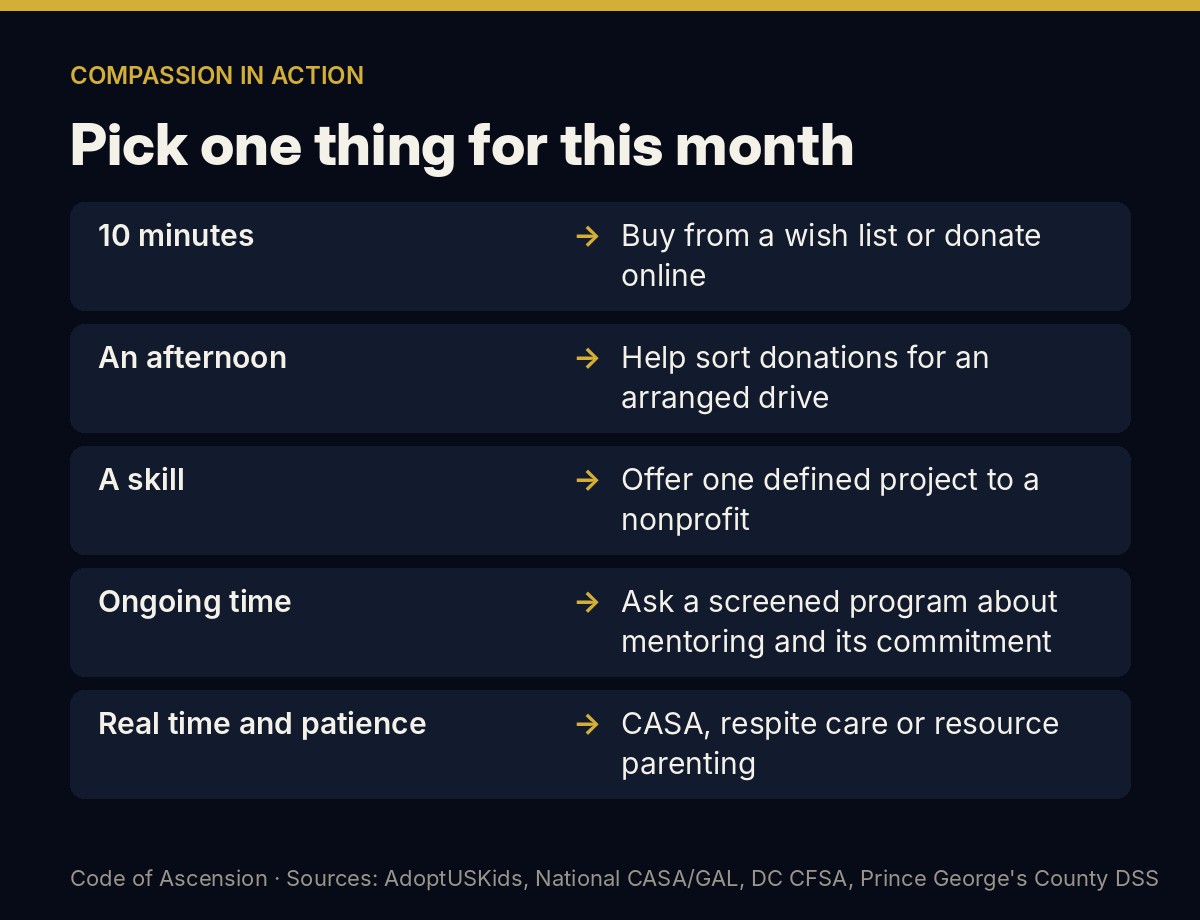
If all of that feels like a lot, start small. Here’s how the options compare.
| If you have… | Try this |
|---|---|
| 10 minutes | Buy one item from an agency wish list, or donate online |
| An afternoon | Help sort donations for a drive a program has already arranged |
| A skill | Offer one defined project to a local foster care nonprofit |
| Ongoing time | Ask a screened program about mentoring or tutoring and its required commitment |
| Real time and patience | Look into becoming a CASA volunteer, respite provider or resource parent |
The best option is the one you’ll actually follow through on. A small promise kept beats a big promise broken.
Mistakes to avoid
Good intentions sometimes go sideways. Watch out for these:
- Donating what wasn’t asked for. Used stuffed animals, worn clothes or random household items can end up as a burden. Check the list first.
- Showing up without an appointment. Many programs need to schedule drop-offs.
- Posting children’s photos or stories. Protect their privacy, even with good intentions.
- Only helping in December. Holiday donations are welcome, but needs continue all year.
- Promising more than you can give. If you start mentoring, be consistent. If your situation changes, communicate with the program rather than disappearing.
- Skipping the background check on yourself. If a program asks for one, that’s the system working. Be glad it does.
A note from Code of Ascension
Compassion is easy to feel and harder to organize. That’s why we built Compassion in Action: a place to turn good intentions into specific, useful steps for children.
If you only do one thing after reading this, make it a call or a click to a real program near you. Ask what they need. Then do that. And next spring, do it again.
This guide is part of Compassion in Action, where Code of Ascension turns compassion into real-world action for children.
Frequently asked questions
How can I help foster kids without fostering? Donate items or money to a foster care agency or a nonprofit you’ve checked, mentor or tutor through a screened program, offer a professional skill, support foster families with respite care, or volunteer as a court-appointed special advocate (CASA). AdoptUSKids lists mentoring, CASA, respite care, photography and donating supplies as ways to help.
How can I help foster kids at Christmas? Join a holiday drive run by your local child welfare agency or a partner nonprofit. In DC, CFSA’s Partners for Kids and Families lists a 2026 Holiday Gift Drive with child and teen sponsorships, Thanksgiving meals and an Amazon wish list. In Prince George’s County, the Department of Social Services runs a broader family-support Holiday Sharing Campaign from October to December; ask DSS about foster-care needs specifically. Confirm current needs and deadlines with each program before you buy.
What do foster kids need most? It depends on the program and changes over time, so check the agency’s current list. Common needs include luggage, toiletries, new clothing and shoes, school supplies and items for youth starting out on their own, such as home starter kits.
Do CASA volunteers get paid? No. CASA volunteers are unpaid, trained community volunteers appointed by judges. Guardian ad litem roles vary by jurisdiction; in some courts the GAL is an attorney. National CASA/GAL says volunteers complete more than 30 hours of training before working with a child, plus 12 hours of continuing education each year.
What happens when foster kids age out? Young people who leave care as adults can face housing, work and school on their own. Supports include federally funded Educational and Training Vouchers and state independent living programs. In Maryland, Ready by 21 serves youth in foster care from age 14 until their 21st birthday.
About the author
Written by King for Code of Ascension’s Compassion in Action. This guide brings together the public sources linked below to help readers ask informed questions and find appropriate services. It is general education, not legal advice or a professional safeguarding assessment.
Sources
- AFCARS Dashboard, FFY 2025 (preliminary, as of Feb 27, 2026) (U.S. Children’s Bureau)
- Partners for Kids and Families (PKF) (DC Child and Family Services Agency)
- How can I donate to the Department of Social Services? (Prince George’s County)
- Become a Resource (Foster) or Adoptive Parent (Prince George’s County DSS)
- Ways to help (AdoptUSKids)
- Other ways you can help (Missouri Department of Social Services, Children’s Division)
- The CASA/GAL Model (National CASA/GAL Association for Children)
- Supports for youth transitioning from foster care (U.S. Children’s Bureau)
- Ready by 21 (Maryland Department of Human Services)