
Choosing a child-protection organization deserves care. Wanting to protect children is one of the clearest callings a person can feel. It doesn’t need a reason, a sign or a big platform. It just needs somewhere good to go.
The hard part is choosing where. There are thousands of organizations that say they protect children. Some are large and well established. Some are small and stretched thin. A few are badly run. And occasionally, someone uses a child’s photo and a sad story to raise money that never reaches a child at all.
This guide walks through how to evaluate a child-protection organization before you give your money, your time or your skills. It covers what the organization actually does, how it keeps children safe inside its own programs, who leads it, how it handles money, whether it’s properly registered and what to do if something doesn’t sit right. It’s the same process we’re using to decide where Code of Ascension puts its own support.
Quick Answer: Start with the program: what the organization does, for which children, and how it knows it’s working. Then check its safeguarding: written policies, screening, training and a clear way to report concerns. Look at its leadership and board, read its financial filings on the IRS Tax Exempt Organization Search, and confirm any required state registration or understand the exemption that applies. Don’t judge it by its administrative costs alone. Take your time, pay by card or check, and walk away from pressure.
Why This Matters
Giving is an act of trust. When you hand over money or time, you’re trusting an organization to turn it into something real for a child who will never know your name.
That trust deserves a little homework. Not because most organizations are bad, but because good intentions on your side don’t guarantee good results on theirs. A few minutes of checking helps your compassion land somewhere you trust.
There’s a spiritual side to this too. Many traditions treat giving as energy you send out into the world. Directing that energy with care, rather than on impulse, is part of the practice. Discernment isn’t the opposite of compassion. It’s compassion with its eyes open.
Step 1: Understand What the Organization Actually Does
“Child protection” covers a lot of ground. Before anything else, get specific.
Read the mission, then look for the programs
The mission statement tells you what an organization hopes to do. The programs tell you what it actually does. Look on its website, annual report or impact page for concrete answers:
- Who it serves. Children of what ages? In which places? Children in foster care, children who have experienced abuse, families at risk, or the adults who work with children?
- What it does. Prevention education, counseling and therapy, advocacy in court, forensic interviews, crisis hotlines, shelter, training for adults or something else?
- How much it does. The number of children, families or adults reached in a year, and over what area.
Common types of child-protection work
Understanding the main types helps you match an organization to what you care about most.
- Prevention and education. Organizations that train parents, teachers, coaches and youth workers to recognize and prevent abuse before it happens.
- Child advocacy centers. These bring police, child protective services, prosecutors, medical teams and counselors together in one child-friendly place. The coordinated response aims to reduce how many times a child who has experienced abuse has to be interviewed. National Children’s Alliance accredits child advocacy centers in the United States.
- Court advocacy. Court Appointed Special Advocate (CASA) programs train volunteers to speak up for children in foster care during court cases.
- Hotlines and crisis support. Services that answer calls from children, parents and concerned adults and connect them to help.
- Treatment and healing. Counseling and therapy programs for children and families after abuse.
None of these is better than the others. Prevention stops harm before it starts. Advocacy and treatment help children recover. Pick the one that speaks to you.
Ask how it knows it’s working
A strong organization can tell you what changed because of its work, not just how busy it was. The BBB Wise Giving Alliance, which sets standards for charities, includes “measuring effectiveness” as one of its four standard areas, alongside governance, finances and fundraising.
Look for:
- Outcomes, not only activities. “We trained 400 teachers” is an activity. “Teachers we trained made more appropriate reports to child protective services” is closer to an outcome.
- Honest reporting. An organization that shares what isn’t working, and what it changed, is usually more trustworthy than one that only shares wins.
- An annual report or impact page that’s current.
Step 2: Check How It Keeps Children Safe
For child-protection work, this may be the most important step. An organization that works with children has to keep those children safe inside its own programs.
What good safeguarding looks like
In 2007, the US Centers for Disease Control and Prevention published guidance for youth-serving organizations on preventing child sexual abuse. It named six key components:
- Screening and selecting employees and volunteers.
- Establishing guidelines on interactions between people.
- Monitoring behavior.
- Ensuring safe environments.
- Responding to inappropriate behavior, breaches in policy, and allegations and suspicions of child sexual abuse.
- Training in child sexual abuse prevention.
Internationally, Keeping Children Safe publishes the International Child Safeguarding Standards, built around four areas: policy, people, procedures and accountability. In plain terms: a written commitment to keeping children safe, clear responsibilities for staff and volunteers, safeguarding built into everyday work, and regular review of whether it’s all working.
Questions to ask
You don’t need to be an expert. These questions are fair to ask any organization that works with children:
- Do you have a written child safeguarding policy, and can I read it? Many organizations publish it on their website.
- How do you screen staff and volunteers? Background checks, references and interviews are common.
- What training do staff and volunteers receive?
- Who is responsible for safeguarding? Is there a named person or team?
- How can someone raise a concern, and what happens next?
- How often do you review your policies?
A well-run organization will answer these calmly and clearly. It may even be glad you asked. If an organization working with children can’t explain how it keeps them safe, that tells you something.
If you plan to volunteer
If you’re offering your time, expect the organization to screen you, too. Background checks, training and supervision rules aren’t a sign they don’t trust you. They’re a sign they take children’s safety seriously. Be wary of any program that would let a new volunteer work alone with children without screening or training.
Step 3: Look at Leadership and Governance
A nonprofit corporation is accountable to a board of directors, whose job is to oversee the organization, including its finances, its leadership and its mission. Government programs and fiscally sponsored projects are overseen differently: a government program answers to its agency, and a fiscally sponsored project answers to its sponsoring nonprofit. Ask who provides oversight, and look there.
What to look for
- An independent board. The BBB Wise Giving Alliance standards call for a board “with a minimum of five voting members” and at least three evenly spaced meetings a year. A board made up mostly of the founder’s family, or that rarely meets, offers less oversight.
- Named leadership. You should be able to find who runs the organization and who sits on its board.
- Conflict-of-interest policy. Larger nonprofits report on governance policies in their annual Form 990 filing.
Founder-led organizations
Many excellent organizations were started by one person with a calling. That’s not a red flag on its own. What matters is whether the organization has grown the structure to match its size: a real board, clear policies and more than one person holding the keys.
Step 4: Read the Money Side Without Getting Lost
Finances matter, but they’re easy to misread. Here’s how to look at them sensibly.
Find the filings
Most US tax-exempt organizations file an annual information return with the IRS, the Form 990 or a shorter version. The IRS Tax Exempt Organization Search lets you check an organization’s “eligibility to receive tax-deductible charitable contributions,” look up its tax-exempt status and find filings including 990-series returns, 990-N e-Postcards, determination letters and the automatic revocation list.
If an organization says it’s a charity but doesn’t appear in the IRS search, ask why. Some groups, such as churches, aren’t required to file, but you should still be able to understand how they’re organized.
What to look at
- Total revenue and expenses. Is the organization’s size consistent with what it says it does?
- Program spending. The BBB Wise Giving Alliance standards say a charity should “spend at least 65% of its total expenses on program activities” and “no more than 35% of related contributions on fund raising.”
- Trends. Is revenue stable, growing or shrinking? Sudden big swings deserve a question.
- Leadership pay. Larger nonprofits report key salaries on the Form 990. Compare them with the organization’s size and region rather than in isolation.
Don’t judge by overhead alone
It’s tempting to pick the charity that spends the least on “overhead,” meaning administration and fundraising. But in 2013, the leaders of GuideStar, Charity Navigator and the BBB Wise Giving Alliance wrote an open letter to donors saying the overhead ratio “is a poor measure of a charity’s performance.” As they put it, “The people and communities served by charities don’t need low overhead, they need high performance.”
For child protection especially, some “overhead” is exactly what you want to fund: background checks, safeguarding training, supervision, data systems and qualified staff. An organization that starves those to keep its overhead low may be less safe, not more.
Use overhead as one signal among many. Pair it with what the organization achieves and how carefully it works.
Step 5: Check Registration, or the Exemption That Applies
Most US states require charities, or the professional fundraisers working for them, to register before asking for donations. But not every program follows the same rules. Government programs, such as a county child advocacy center, aren’t charities. A fiscally sponsored project runs under another nonprofit’s legal umbrella, so you’d check the sponsor. Some organizations are exempt from registration. The goal is to confirm any required registration, or understand the exemption that applies. The Federal Trade Commission points donors to their state charity regulator, which you can find through the National Association of State Charity Officials at nasconet.org.
In Maryland, the Secretary of State’s Charitable Organizations Division “annually registers, regulates and renews charitable organizations” that solicit contributions in the state. Its online Search Charity tool lets you confirm the current standing of a charitable organization. The division also publishes donor guidance on giving wisely.
If you live elsewhere, your state’s charity office or attorney general usually offers a similar search. If an organization isn’t listed, ask why. There may be a good reason, such as an exemption or fiscal sponsorship.
Step 6: Check Independent Reviews and Credible Concerns
Independent evaluators can save you time. The FTC notes that the BBB Wise Giving Alliance and CharityWatch “offer reports and ratings about how charitable organizations spend donations and how they conduct business.” Charity Navigator and Candid (which runs GuideStar) also publish profiles and financial data.
The FTC also suggests a simple step anyone can do: search the organization’s name plus words like “complaint,” “review,” “rating” or “scam.”
How to weigh what you find
- One bad review isn’t proof. Look for patterns and for credible sources, such as news reporting, court records or regulator actions.
- Look at how the organization responded. Every organization faces problems at some point. An honest public response, with changes made, is a good sign.
- Accreditation helps. For example, child advocacy centers can be accredited by National Children’s Alliance, and some state nonprofit associations offer their own accreditation programs. Accreditation means an outside body has checked the organization against a standard.
Step 7: Watch for Red Flags When Someone Asks You to Give
Most fundraising is honest. But scammers know that children’s causes move people, and they use that. The FTC’s guidance on donating safely highlights several warning signs:
- Pressure to give right now. The FTC says not to let anyone rush you. A real charity will still be there tomorrow.
- Vague, emotional claims without specifics about how your donation will be used.
- Requests for cash, gift cards or wire transfers. The FTC calls these “how scammers ask you to pay.” A credit card or check is safer.
- Names that sound almost like a well-known charity. Check the exact name and the website address.
- Photos of children used to tug at your heart, with no clear program behind them.
If something feels off, you don’t owe anyone an explanation. Close the page, hang up or say no, and give somewhere you’ve checked instead.
Questions to Ask Before You Give
If you’d like to contact an organization directly, these questions cover the essentials in one email:
- What are your main programs, and how many children or families did you serve last year?
- How do you measure whether your programs are working?
- Do you have a written child safeguarding policy I can read?
- How do you screen and train staff and volunteers?
- Where can I find your most recent annual report and Form 990?
- How will my donation be used?
You won’t always get a perfect answer to every question, especially from small organizations. What you’re looking for is openness. A clear, honest reply is a good sign. Silence or defensiveness is worth noting.
Giving Time and Skills, Not Just Money
Money matters, but it isn’t the only way to help. Many child-protection organizations need people as much as dollars.
- Volunteer programs. CASA programs, for example, train volunteers to advocate for children in foster care. Expect screening, training and a real time commitment.
- Skills-based help. Organizations often need help with design, writing, websites, photography, accounting or events. Offer one defined project with a clear scope and timeline rather than open-ended free work, so both sides know what to expect.
- Prevention training. Taking a recognized child-abuse-prevention training yourself can help you recognize concerns and respond more appropriately, whether you volunteer or not.
- Spreading accurate information. Sharing a trustworthy organization’s prevention resources can reach families who need them.
Whatever you offer, the same evaluation applies. Your time is a gift, too.
National or Local?
Child-protection organizations range from large national groups to small programs that serve one county. Both can be good choices, and each has trade-offs.
National organizations
Large national groups often run hotlines, produce training used across the country and shape policy. They usually publish detailed annual reports and are easy to look up on evaluator sites. Your gift joins a big pool, and you may not see its local effect.
Local organizations
A local child advocacy center, CASA program or family support group works with children in your own community. You can ask whether it holds public events or has approved volunteer opportunities. Smaller organizations may have fewer published reports, so you may need to ask more questions directly. Openness in answering is a good sign.
A balanced approach
Some people split their support: a national group for reach and a local one for connection. Others choose the cause first, such as prevention or court advocacy, and then find the best organization doing it. There’s no wrong answer, as long as you’ve checked the organization you choose.
A Worked Example
Say you want to support children in foster care in your county, and you find a local CASA program.
- The program. Its website explains that trained volunteers advocate for children in foster care during court cases, and its annual report says how many children it served last year.
- Safeguarding. You find a description of volunteer screening and training, and you email to ask whether it has a written child safeguarding policy you can read.
- Leadership. Its board members are listed, and the board includes people from outside the founding team.
- Money. You look it up on the IRS Tax Exempt Organization Search, confirm its status and read its latest Form 990 for revenue, expenses and program spending.
- Registration. You confirm its standing on your state’s charity search.
- Reviews. You search its name with “complaint” and “review” and find nothing concerning.
At that point you’ve done a solid check and can decide whether to give or volunteer. No check guarantees an outcome, but it gives you a clear basis for the decision. If any step raised a question you couldn’t get answered, you’d keep looking.
A Quick Note on Spiritual Practice and Real-World Safety
At Code of Ascension we write a lot about protection symbols, energy and intention. Those practices can hold real meaning, and many people find comfort and focus in them.
But for children, protection also has to be practical. A protection symbol doesn’t screen a volunteer. An intention doesn’t write a safeguarding policy. The most powerful thing a person with a protective heart can do is pair their inner practice with outer action: supporting organizations that do this work well, learning the signs of abuse, and speaking up through the right channels.
If You’re Worried About a Child Right Now
This guide is about choosing organizations to support. If you’re worried that a child is being harmed, don’t wait to research.
- If a child is in immediate danger, call 911.
- To report suspected abuse or neglect, contact your state or local child protective services. In Maryland, that’s the Maryland Department of Human Services at 1-800-91Prevent (1-800-917-7383).
- For support and guidance, the Childhelp National Child Abuse Hotline offers counselors by call or text at 1-800-422-4453. Childhelp says it “is not a reporting line and is not connected to 911 or emergency services,” but its counselors can talk through what you’ve seen and help you find the right reporting contact for your state.
- For online exploitation of a child, report to NCMEC’s CyberTipline or 1-800-843-5678.
- If you’re worried about someone’s behavior toward a child, including your own, Stop It Now! runs a free, confidential helpline at 1-888-PREVENT during set hours, with chat and email options; check its current hours.
A Simple Checklist Before You Give
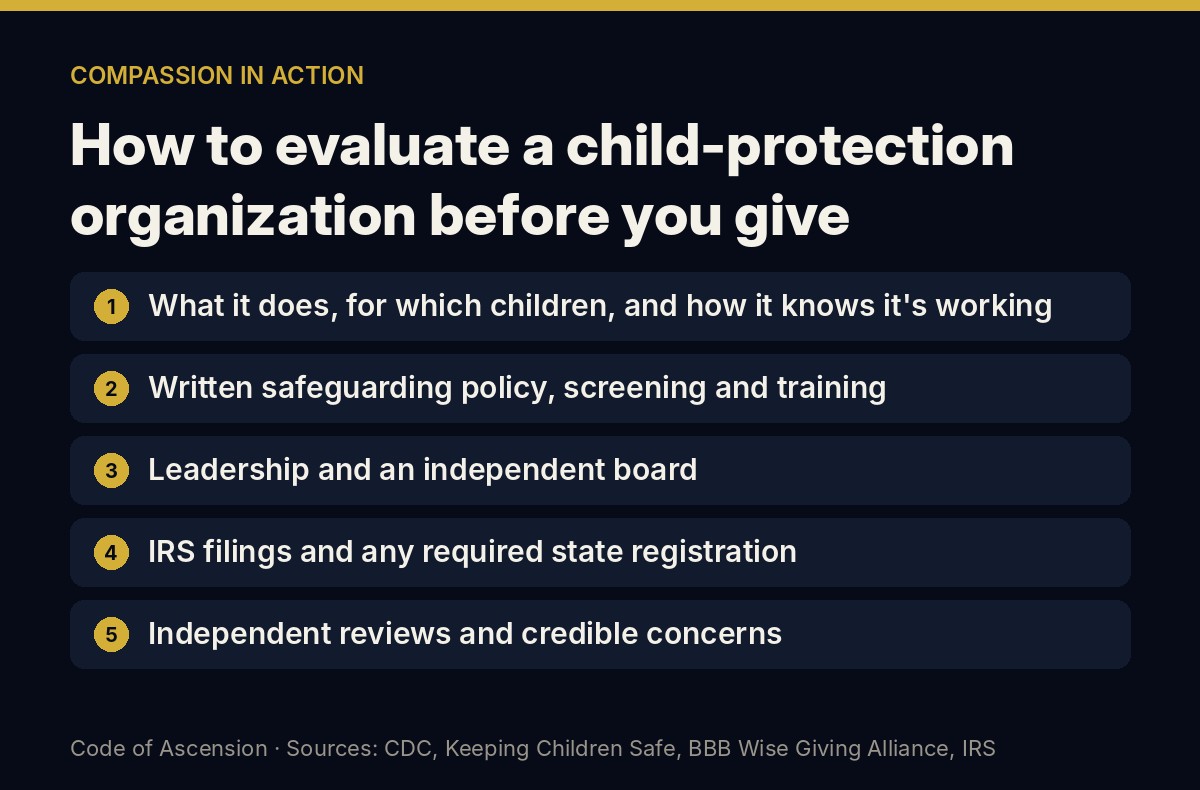
- What does the organization do, for whom, and how does it know it’s working?
- Does it have a written child safeguarding policy, screening and training?
- Who leads it, and does it have an independent board that meets?
- Is it listed on the IRS Tax Exempt Organization Search, and what do its filings show?
- Is it registered with your state’s charity regulator, or does an exemption apply?
- What do independent evaluators and credible sources say?
- Is anyone pressuring you, or asking for cash, gift cards or wire transfers?
How We’re Using This at Code of Ascension
We’re putting this checklist to work ourselves. Before Code of Ascension supports any child-protection organization, we’ll go through these same steps and share what we find on our Compassion in Action page. We’ll only list an action there once it has actually happened.
Compassion is the calling. Discernment is how you answer it well.
This guide is part of Compassion in Action, where Code of Ascension turns compassion into real-world action for children.
Frequently asked questions
How do I know if a child-protection charity is legitimate? Check its programs and safeguarding policy, look it up on the IRS Tax Exempt Organization Search, confirm any required state registration (or the exemption that applies) and read independent reviews. Be wary of pressure, vague claims and requests for cash, gift cards or wire transfers.
Is a low overhead ratio a sign of a good charity? Not on its own. In 2013, the leaders of GuideStar, Charity Navigator and the BBB Wise Giving Alliance said the overhead ratio is a poor measure of performance. For child protection, spending on screening, training and supervision is part of doing the work safely.
What should a child-protection organization’s safeguarding policy include? CDC guidance for youth-serving organizations names six components: screening staff and volunteers, guidelines for interactions, monitoring behavior, safe environments, responding to concerns and allegations, and training in prevention.
How do I check if a charity is registered in Maryland? Use the Maryland Secretary of State’s Search Charity tool, linked from the Charitable Organizations Division page, to confirm an organization’s current standing.
About the author
Written by King for Code of Ascension’s Compassion in Action. This guide brings together the public sources linked below to help readers ask informed questions and find appropriate services. It is general education, not legal advice or a professional safeguarding assessment.
Sources
- Preventing Child Sexual Abuse Within Youth-Serving Organizations (CDC, MMWR, June 15, 2007) (government)
- International Child Safeguarding Standards (Keeping Children Safe) (international standards body)
- BBB Standards for Charity Accountability (BBB Wise Giving Alliance) (charity evaluator)
- Tax Exempt Organization Search (IRS) (government)
- Donating Safely and Avoiding Scams (FTC) (government)
- The Overhead Myth open letter (GuideStar, Charity Navigator, BBB Wise Giving Alliance) (charity evaluators)
- Charitable Organizations Division (Maryland Secretary of State) (government)
- Reporting Suspected Child Abuse or Neglect: Local Offices (Maryland DHS) (government)
- Childhelp National Child Abuse Hotline (national hotline)
- Get Immediate Help (Stop It Now!) (prevention helpline)
- CyberTipline (National Center for Missing & Exploited Children) (national reporting system)