
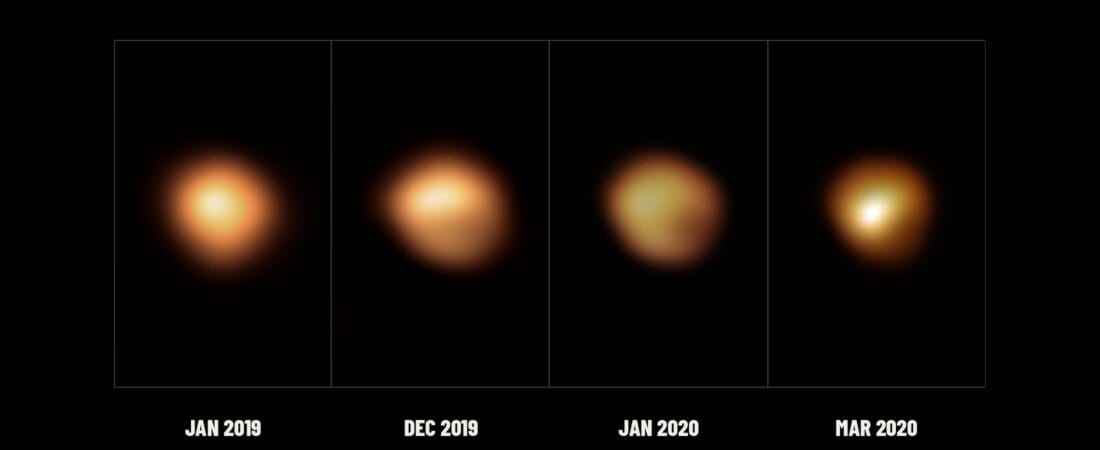
In late 2019, Betelgeuse, one of the brightest stars in the night sky, started to fade. It didn’t happen over centuries. It happened over a few months, and people could see the change with their own eyes. The internet asked the obvious question: was Betelgeuse about to explode?
It wasn’t. But since then, this red supergiant in Orion has done almost everything except behave. It threw off a chunk of its own surface heavier than our Moon. Radio images taken more than seven years apart show a bright region in nearly the same place, suggesting a surprisingly persistent hot spot. And images taken with ESO’s Very Large Telescope in December 2024, released in July 2026, give what ESO calls the strongest evidence yet for a companion star that astronomers had suspected for about a century.
This guide covers what Betelgeuse is, what caused the Great Dimming, what ALMA saw on its surface, how the companion was found, and when the star might finally explode. As always in Code of Ascension’s Science & Discovery hub, we keep three things separate: what has been observed, what has been inferred or modelled, and what is still open. 🔭
Quick Answer: What Is Happening to Betelgeuse?
Quick Answer: Betelgeuse is a red supergiant about 700 times wider than the Sun, roughly 550–700 light-years away in Orion. In 2019–2020 it lost about two-thirds of its visible brightness because it blasted off part of its surface, which cooled into a dust cloud that blocked its light. ALMA images taken more than seven years apart show a bright region in nearly the same place, suggesting a surprisingly persistent hot spot. VLT images from December 2024, released in July 2026, give the strongest evidence yet of a faint companion star, named Siwarha. Betelgeuse will eventually explode as a supernova, but NASA’s estimate is about 100,000 years from now, and the timing is uncertain. It is not expected to threaten life on Earth.
Watch the documentary
Dark Cosmic Insights’ 8-minute deep dive tells the same story with real telescope footage from ESO, ALMA and NASA’s Hubble. Animations and artist’s concepts are labeled on screen.
In this article
What Is Betelgeuse?
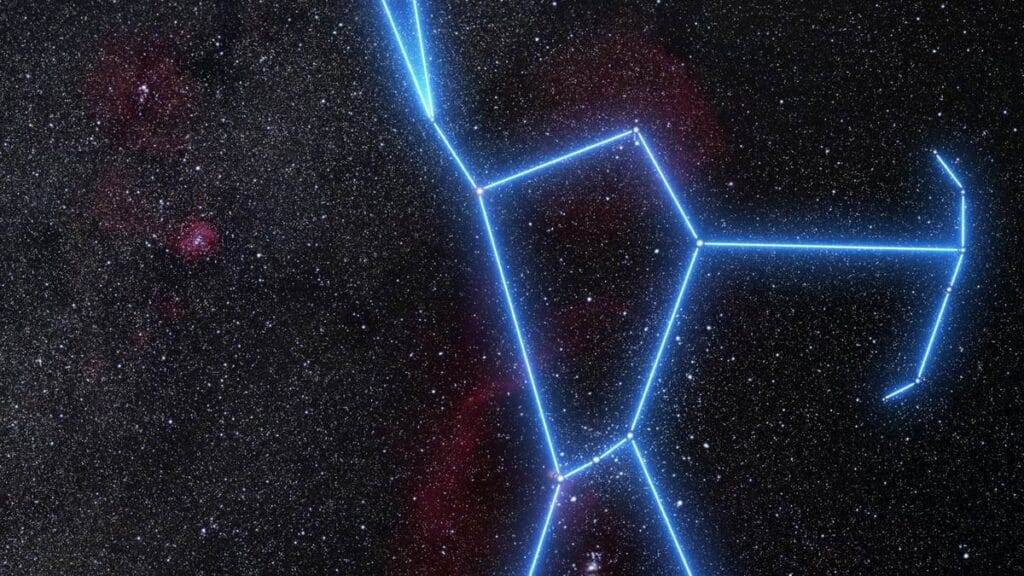
Betelgeuse is a red supergiant, a massive star near the end of its life. Look at Orion on a winter evening and you’ll find it marking the hunter’s shoulder: a bright, orange-red point that stands out clearly from blue-white Rigel at the opposite corner. Here are the basics, mostly from NASA:
| Betelgeuse at a glance | |
|---|---|
| Type | Red supergiant (semiregular variable star) |
| Size | About 700 times the Sun’s diameter |
| Mass | About 15 times the Sun’s mass |
| Age | Roughly 10 million years (the Sun is about 4.6 billion) |
| Surface temperature | About 3,300°C, cooler than the Sun’s ~5,500°C |
| Total luminosity | On the order of 100,000 times the Sun’s, depending on the adopted distance (Joyce et al.) |
| Distance | Roughly 550–700 light-years (estimates vary; ~650 is a common middle value) |
| Location | Orion’s shoulder; Bayer designation Alpha Orionis |
How big is Betelgeuse, really?
Put Betelgeuse where the Sun is and its surface would reach well past the orbit of Mars. Earth would be inside the star. Some estimates stretch its radius out toward Jupiter’s orbit, but red supergiants have no crisp edge. Their outer layers fade gradually into space, and Betelgeuse’s measured size changes over time, so every number comes with a range.
Young, huge and in a hurry
Ten million years sounds ancient. For a star it’s a toddler. Our Sun is close to 5 billion years old and is only about halfway through its life. Massive stars live fast. They burn through their fuel quickly, swell into supergiants and finally collapse. Betelgeuse is already in that last chapter.
Why is it called Betelgeuse?
The name is usually traced to the Arabic yad al-jawzāʾ, often translated as “the hand of al-Jawzāʾ,” a giant figure in the sky. Medieval scholars copying the name into Latin garbled it, and “Betelgeuse” is the descendant of that mistake. You’ll hear it said several ways. BEET-el-jooz and BET-el-jooz are both common, and astronomers use both.
The COA Betelgeuse Evidence Map
Betelgeuse headlines often blur what was seen, what was inferred and what is still a guess. This Code of Ascension reference sorts the biggest claims by how solid they are.
| Claim | What we know | Status | Key source |
|---|---|---|---|
| It dimmed sharply in 2019–2020 | Down to about 36% of normal visible brightness by February 2020; back to normal by April 2020 | Observed | ESO; NASA |
| Dust caused the dimming | A surface mass ejection cooled into dust that blocked part of the starlight | Observed + modelled | ESO; NASA/Hubble |
| The ejected mass | Several times the Moon’s mass; roughly 400 billion times a typical solar CME | Estimated | NASA/Hubble |
| A long-lived hot spot | A bright region in nearly the same place in images taken more than seven years apart | Observed at two epochs; persistence suggested | ALMA; Dent et al. |
| A companion star | Faint companion imaged by VLT/SPHERE (Dec 2024 data, July 2026 release); wake seen in Hubble data | Strong evidence; confirmation pending | ESO; NASA |
| The companion’s mass | ~1.6 Suns (Gemini team) vs ~2–3 Suns (VLT team) | Early estimates differ | Science News; ESO |
| When it will explode | NASA estimate: about 100,000 years | Model estimate; uncertain | NASA |
| Danger to Earth | Not expected to threaten life on Earth | Expert consensus | NASA; Chandra |
“Betelgeuse isn’t one mystery. It’s a dying star that keeps giving us new ones.”
Status key: Observed = seen directly; Estimated/Modelled = derived from observations or simulations; Open/Pending = no settled answer yet.
Cite this framework: Code of Ascension, “The COA Betelgeuse Evidence Map,” codeofascension.com/betelgeuse/
People Have Been Watching Betelgeuse for 2,000 Years
Betelgeuse’s strangeness isn’t new. It’s one of the most-watched stars in history.
- 2nd century: The astronomer Ptolemy described its color with a Greek word that suggests pale yellow to light orange. NASA notes this may mean the star wasn’t as red back then.
- 1603: Johann Bayer labeled it Alpha Orionis, the “alpha” star of Orion, even though we now know Rigel usually outshines it.
- 1836: Astronomer John Herschel recorded that its brightness changes. He probably wasn’t the first to notice. NASA points out that Aboriginal oral traditions may describe the variability much earlier.
So when Betelgeuse started fading in 2019, people paid attention.
The Great Dimming of 2019–2020
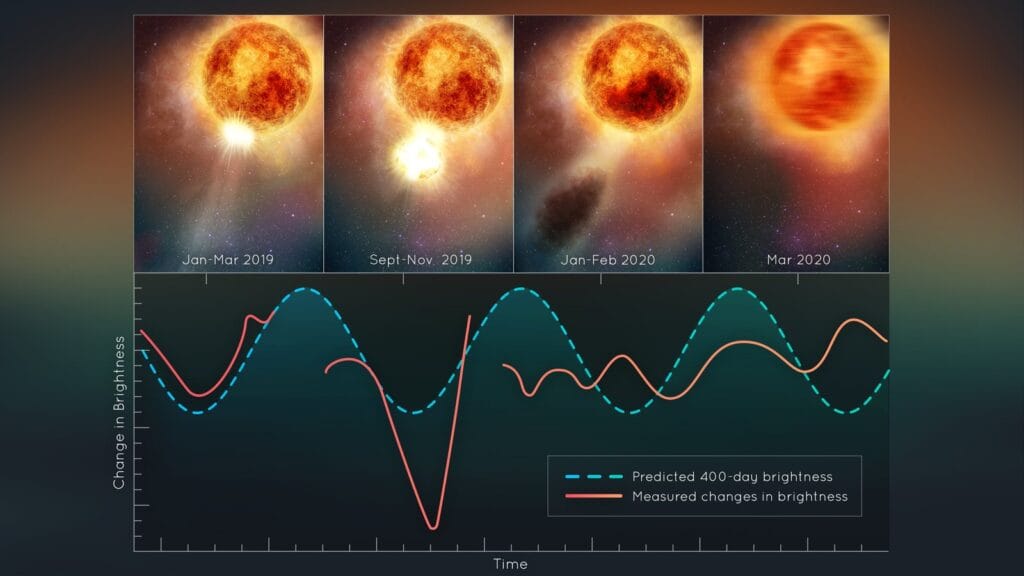
Betelgeuse has always flickered. Its brightness rises and falls on a rhythm of about 400 days, a pulsation astronomers have tracked for roughly two centuries. It also has a longer cycle of about six years, which we’ll come back to.
At the end of 2019, it dropped far below its normal dip. By February 2020, it was at about 36% of its normal visible brightness (ESO). It had lost about two-thirds of its visible brightness, and the change was easy to see with the naked eye. Was this the final countdown to a supernova?
Astronomers photographed the surface of another star
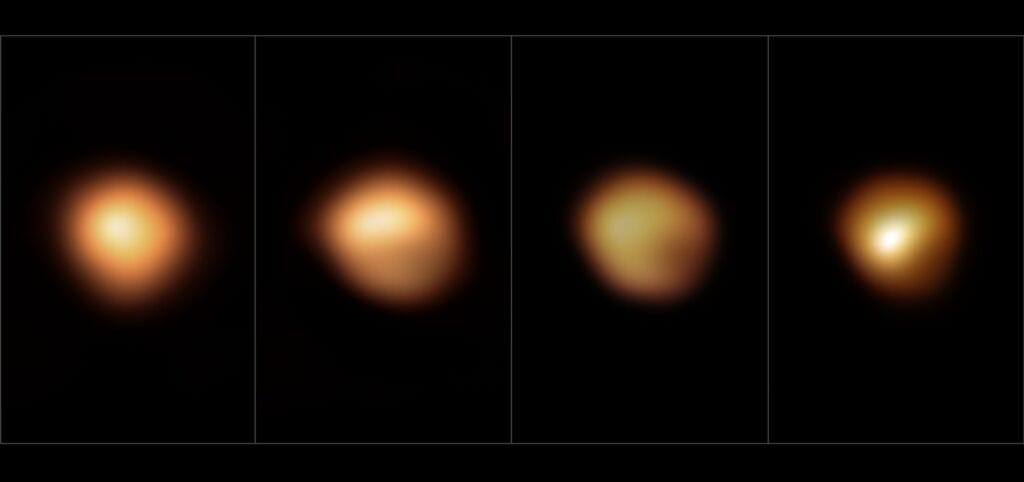
To find out, astronomers did something remarkable. They took pictures of the star’s surface. Betelgeuse is so large and so close that a handful of telescopes can resolve it as a disc instead of a point of light. Using the SPHERE instrument on ESO’s Very Large Telescope, a team led by Miguel Montargès compared Betelgeuse in January 2019 with Betelgeuse in December 2019.
Its apparent shape had changed. The southern half looked much darker.
What caused the Great Dimming?
Hubble’s ultraviolet data, along with the VLT images, told the rest of the story (NASA, ESO):
- Betelgeuse blasted off a piece of its own surface. Astronomers call it a surface mass ejection. The ejected material weighed several times as much as our Moon. NASA compares it to roughly 400 billion times the mass of a typical coronal mass ejection from our Sun.
- The material cooled into dust as the gas drifted away from the star.
- The dust formed a veil that blocked part of Betelgeuse’s light from reaching Earth.
In other words, Betelgeuse didn’t start to explode. It hid behind its own smoke. NASA describes this as never before seen in a normal star. A convective plume of hot gas, helped along by the star’s pulsation, is a likely driver, but the exact trigger is still being studied.
Back to normal, with a broken rhythm
By April 2020, Betelgeuse’s visible brightness was back to normal. Something stayed disrupted for a while, though. Its steady 400-day pulsation seemed to vanish, at least temporarily, as if the star had shaken itself so hard its rhythm went quiet.
A Hot Spot That Seems to Stay Put
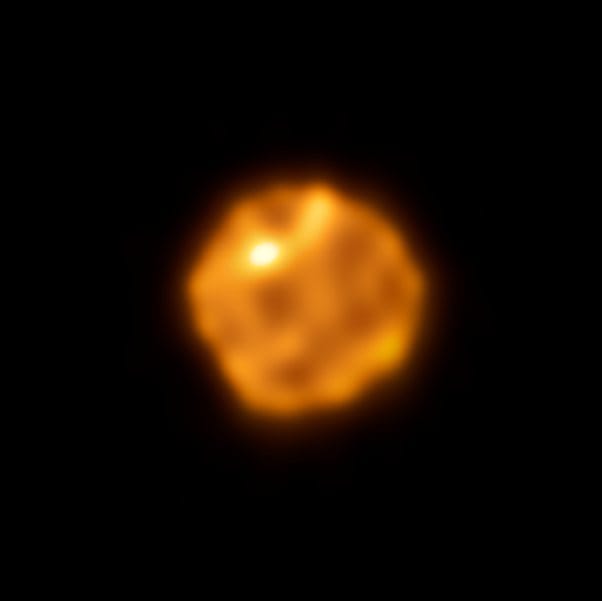
The dimming raised a bigger question: what is actually happening on Betelgeuse’s surface? To answer it, astronomers turned to ALMA, the Atacama Large Millimeter/submillimeter Array, a giant array of radio antennas high in Chile’s Atacama Desert. In 2023, using its longest-baseline, sharpest setting, ALMA mapped Betelgeuse at a resolution of about 7 milliarcseconds (ALMA Observatory).
A boiling star
A star like Betelgeuse is constantly boiling. In a process called convection, giant bubbles of hot gas rise from deep inside, hit the surface, cool and sink again. On Betelgeuse, a single convection cell can be enormous.
ALMA found the outer atmosphere averaging about 2,300 K, with at least two hotter regions. The brightest was up to about 800 degrees hotter than the gas around it. (A temperature difference is the same in kelvin and Celsius, so that’s roughly 800°C.) That part was expected.
Seven years apart, nearly the same place
The surprise came from comparing the result with older ALMA data. Images taken more than seven years apart show a bright region in nearly the same place, suggesting a surprisingly persistent hot spot (Dent et al.). If it really persisted that long, it would outlast what current models predict for convective features on a star that’s supposed to be churning nonstop.
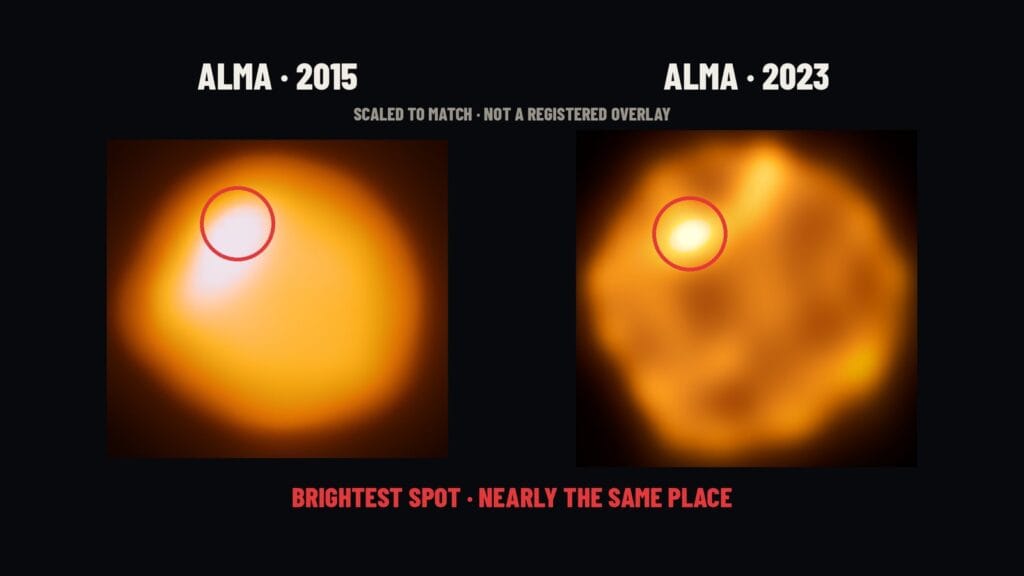
What could hold a hot spot in place? One idea under study is that something nearby is shaping the star. The ALMA team notes that the hot spot’s orientation may relate to a suspected close companion, but no direct connection has been established. That brings us to the strangest part of the story.
Betelgeuse’s Hidden Companion: Siwarha
A century-old suspicion
For decades, astronomers noticed a second, slower cycle in Betelgeuse’s brightness, lasting about six years (roughly 2,100 days) (NASA). The 400-day pulse couldn’t explain it, and some astronomers suspected a companion star circling the giant. The problem: Betelgeuse is so bright that anything next to it would be lost in the glare.
Predicting where to look
In 2024, two studies predicted when the companion should reach its widest apparent separation from Betelgeuse as seen from Earth, the best moment to spot it. That date was December 2024 (ESO).
The evidence arrives
- 2025: A team using the Gemini North telescope in Hawaiʻi reported a possible faint companion and proposed the name Siwarha, meaning “her bracelet,” a nod to Betelgeuse’s own name (Science News).
- January 2026: Using Hubble and ground-based telescopes, Andrea Dupree’s team at the Center for Astrophysics | Harvard & Smithsonian traced Siwarha’s wake, a trail of denser gas through Betelgeuse’s enormous outer atmosphere that appears just after the companion passes in front of the star. “It’s a bit like a boat moving through water,” Dupree said (NASA).
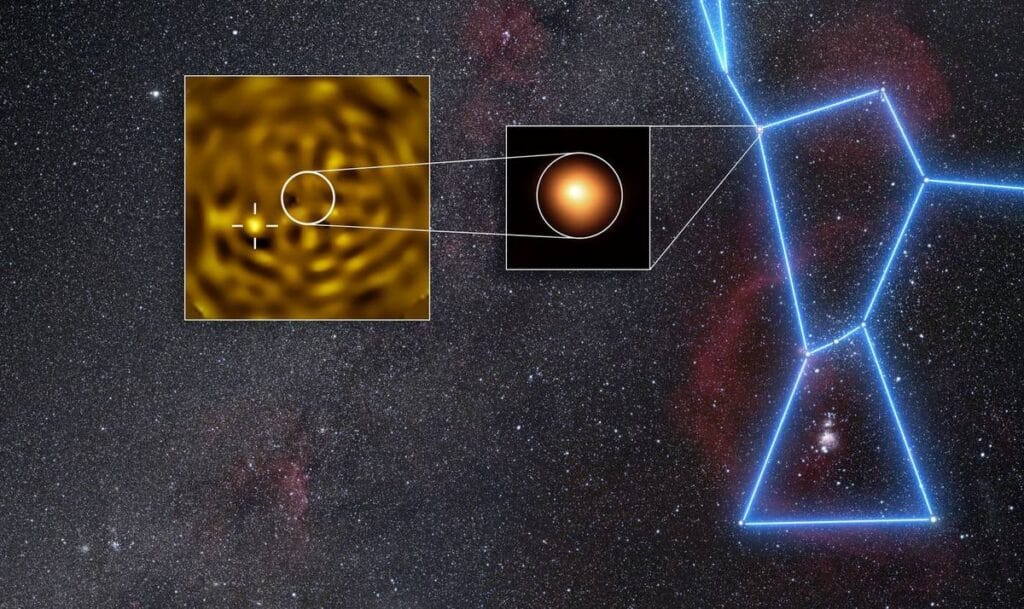
- July 2026: ESO released VLT/SPHERE images taken in December 2024. Using advanced image processing originally developed to find exoplanets, astronomers separated a faint signal from Betelgeuse’s glare where the companion was predicted to be. ESO calls it the strongest evidence yet that Betelgeuse has a companion.
How big is Siwarha?
Early estimates differ, which is normal for a brand-new detection:
- The Gemini team estimated about 1.6 times the Sun’s mass.
- The VLT result points to roughly two to three times the Sun’s mass, heavier than expected. “Because it is more massive than predicted, we see it!” said lead author Miguel Montargès.
Either way, Siwarha is tiny and faint next to a 15-solar-mass supergiant, and it orbits within Betelgeuse’s extended outer atmosphere.
What happens next
Astronomers plan to observe again when the companion reaches the other side of the star, around 2027, to confirm it. As Montargès put it, there’s “very little space left for doubt.” The companion also changes the story of how Betelgeuse dies. Models suggest tidal interactions could shrink the orbit and bring the companion into Betelgeuse within roughly 10,000 years (Goldberg et al.), and astronomers are asking whether Siwarha could shape the star’s final explosion.
When Will Betelgeuse Explode?
One day, it will. When Betelgeuse finally runs out of fuel, its core is expected to collapse and the star will go supernova. NASA’s estimate is that this is not likely for about another 100,000 years, though the exact timing is uncertain (NASA).
What will the supernova look like from Earth?
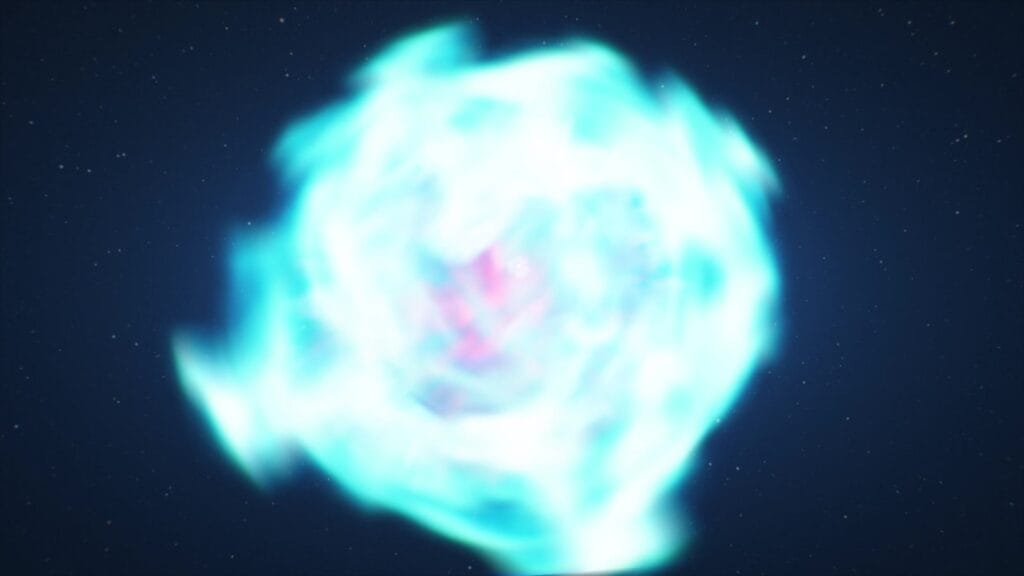
It would be unforgettable. One set of simulations suggests Betelgeuse could shine about as bright as a half Moon, bright enough to see during the day for about a year (Astronomy). Then it would slowly fade, and Orion would lose its shoulder.
It would also be closer than any supernova in recorded history. SN 1006, one of the closest ever recorded, was about 7,000 light-years away (NOIRLab). Betelgeuse is roughly ten times closer.
What will be left behind?
Either a neutron star or a black hole, depending on how much material survives the explosion.
Is Betelgeuse dangerous to Earth?
No. Betelgeuse’s supernova is not expected to threaten life on Earth (NASA). We’d get the light show without the damage.
Why Betelgeuse Matters
The Great Dimming wasn’t the end. It was a preview of how alive, and how strange, a dying star can be.
Betelgeuse is one of the only stars where astronomers can watch a red supergiant’s surface change in real time. They’ve seen it blow off a chunk of itself and hide behind its own dust. They’ve seen a bright region that seems to persist for years. And they’ve found strong evidence of a companion moving through its outer atmosphere. Each of those observations feeds into models of how massive stars live and die.
So next time you see Orion, find that red star on its shoulder. You’ll know it’s anything but ordinary.
Betelgeuse FAQ
Is Betelgeuse going to explode soon?
Probably not. Betelgeuse isn’t expected to go supernova for roughly another 100,000 years, based on NASA’s estimate, and the exact timing is uncertain. The 2019–2020 Great Dimming was caused by dust from a surface mass ejection, not by an approaching explosion.
Why did Betelgeuse get dimmer in 2019?
Betelgeuse blasted off a huge piece of its surface, several times the mass of our Moon. The material cooled into a dust cloud that blocked part of the star’s light. By February 2020 it was at about 36% of its normal visible brightness. By April 2020 it was back to normal.
Does Betelgeuse have a companion star?
Very likely. VLT/SPHERE images taken in December 2024 and released by ESO in July 2026 give what ESO calls the strongest evidence yet for a faint companion, named Siwarha. Earlier hints came from Gemini North and Hubble. Astronomers plan to confirm it with new observations around 2027.
What does Siwarha mean?
Siwarha means “her bracelet,” a reference to Betelgeuse’s name, which is traced to an Arabic phrase about the hand of a giant figure in the sky.
How far away is Betelgeuse?
Roughly 550 to 700 light-years. Estimates vary, and about 650 light-years is a common middle value. The light you see tonight left the star around the Middle Ages.
Could the Betelgeuse supernova hurt Earth?
It is not expected to threaten life on Earth. When it explodes, one set of simulations suggests it could look about as bright as a half Moon and be visible in daylight for about a year.
How big is Betelgeuse compared with the Sun?
About 700 times wider. If it replaced the Sun, its surface would reach well past the orbit of Mars, and Earth would be inside it.
How do you pronounce Betelgeuse?
Both BEET-el-jooz and BET-el-jooz are widely used.
Keep exploring: more evidence-backed space and science stories live in Science & Discovery. Watch the full Betelgeuse documentary on Dark Cosmic Insights.
Take a cosmic break: explore the Cosmic Calm coloring book.
Sources and Image Credits
- NASA: What Is Betelgeuse? Inside the Strange, Volatile Star
- NASA Hubble: Betelgeuse slowly recovering after blowing its top
- ESO eso2003: Betelgeuse’s surface before and during the dimming
- ESO eso2109: Mystery of Betelgeuse’s dip in brightness solved
- ALMA Observatory: Betelgeuse’s hot spot · Dent et al. (arXiv 2608.19339)
- Joyce et al.: Standing on the Shoulders of Giants (Betelgeuse’s mass, radius and distance)
- Science News: Betelgeuse’s companion star revealed in new images
- NASA Hubble: wake of Betelgeuse’s elusive companion star
- ESO eso2611: strongest evidence yet that Betelgeuse has a companion
- Goldberg et al.: Radial velocity and astrometric evidence for a close companion to Betelgeuse
- Astronomy: When Betelgeuse goes supernova, what will it look like from Earth?
- NOIRLab: SN 1006, the brightest stellar event in recorded history
- Chandra: supernova X-rays and planetary danger zones
Images: ESO and ALMA images are licensed CC BY 4.0; credits appear under each image. NASA/ESA imagery is used under NASA media guidelines and does not imply endorsement. Featured image: VLT/SPHERE images by ESO/M. Montargès et al., date labels by Dark Cosmic Insights (CC BY 4.0).
About The Author
Author: King | Founder of Code of Ascension
King is the founder of Code of Ascension, a spiritual education platform focused on consciousness, symbolism, manifestation, nervous system awareness, and hidden patterns of reality. Through Code of Ascension, he explores ancient wisdom and modern insights to help others awaken, align, and ascend.
Keep Ascending 🚀