
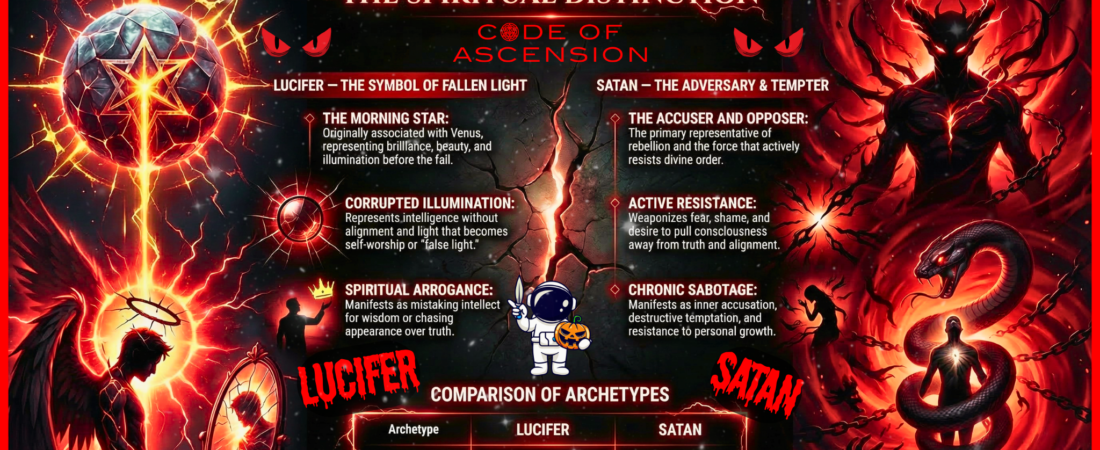
Lucifer vs Satan is one of the most misunderstood topics in spiritual symbolism, biblical interpretation, and esoteric thought. While many people use the names interchangeably, Lucifer and Satan do not always mean exactly the same thing.
But the deeper you study the subject, the more interesting it gets.
Above is a visual breakdown of Lucifer vs Satan to help simplify the symbolic and spiritual distinctions discussed throughout this article.
This Lucifer vs Satan infographic highlights the contrast between fallen light, ego inflation, temptation, and adversarial resistance.
Lucifer vs Satan: What Is the Difference?
The truth is that Lucifer and Satan are not always presented in exactly the same way, especially when you compare classical mythology, biblical interpretation, Christian tradition, and esoteric symbolism. That distinction matters, because once you understand it, you begin to see how much of spiritual language is shaped by translation, symbolism, doctrine, and collective conditioning.
If you have already explored deeper symbolic ideas through topics like Baphomet meaning or The Archons explained, this topic fits right into that same rabbit hole of hidden meanings, duality, power, and spiritual interpretation.
Lucifer vs Satan in Spiritual Symbolism
At the simplest level, Lucifer is often associated with the idea of the morning star, the bringer of light, brilliance, pride, illumination, or fallen splendor. In classical mythology, Lucifer referred to the morning star, Venus at dawn. Later, in Christian tradition, that name came to be associated with Satan before the fall.
Satan, on the other hand, is more directly connected with the role of the adversary, accuser, tempter, or oppositional force. In biblical and Christian usage, Satan becomes the primary representative of evil, temptation, and rebellion against divine order.
So while many people use the names interchangeably, the deeper distinction looks more like this:
- Lucifer = the image of fallen light, pride, brilliance, beauty, rebellion, or corrupted illumination
- Satan = the adversarial force, accuser, deceiver, tester, or tempter
In many Christian traditions, those figures are merged into one identity. But symbolically and historically, the layers are more complex than most people realize.
Lucifer vs Satan Comparison
Lucifer vs Satan is a comparison many people search when trying to understand spiritual symbolism, biblical interpretation, and esoteric meaning. The Lucifer vs Satan debate has lasted for centuries because the two names are often used interchangeably, even when they carry different symbolic layers.
Why Lucifer vs Satan Is So Often Confused
Part of what makes Lucifer vs Satan so confusing is that religion, pop culture, and occult discussion often merge the two into one figure. But when you study Lucifer vs Satan more carefully, you begin to see a distinction between fallen light, adversarial force, ego, temptation, and symbolic rebellion.
Why This Topic Matters Spiritually
This is not just a word game.
Understanding the difference between Lucifer and Satan matters because it changes how you interpret:
- spiritual rebellion
- false light vs. true light
- temptation and ego
- shadow work
- pride, seduction, and illusion
- the difference between awakening and deception
A lot of people are not destroyed by obvious darkness.
They are misled by beautiful distortion.
That is what makes this topic powerful. In many spiritual frameworks, the danger is not always something ugly and obvious. Sometimes it appears as something intelligent, charismatic, glamorous, seductive, or “enlightened” on the surface. That theme connects strongly with deeper esoteric discussions around duality and inversion, which is also why posts like Abraxas explained resonate so much with people exploring hidden symbolism.
For a mainstream reference point, Britannica notes that Lucifer originally referred to the morning star and later came to be treated in Christian tradition as Satan before his fall, while Satan is more broadly treated as the adversarial figure associated with evil and the devil.
1. Lucifer as the Symbol of Fallen Light
One of the reasons Lucifer fascinates people is because the image carries a paradox.
Lucifer is not usually imagined as crude, chaotic, or obviously broken. Instead, the image often represents:
- beauty without humility
- intelligence without alignment
- brilliance without surrender
- light that becomes self-worship
That is why Lucifer symbolism can be so psychologically powerful. It points to the part of consciousness that becomes intoxicated with its own glow.
This is where the lesson becomes personal.
Lucifer is not just a character “out there.” Symbolically, Lucifer can represent the part of the self that says:
- “I don’t need higher truth.”
- “I will be my own god through ego alone.”
- “Power matters more than wisdom.”
- “Image matters more than essence.”
That is where false light begins.
And honestly? That’s why this topic hits so hard in modern culture. We live in a world full of performance, branding, vanity, imitation, and spiritual cosplay 😮💨🚀
2. Satan as the Adversary, Tempter, and Opposer
Satan’s symbolism is usually more direct.
Satan is commonly framed as the adversary—the force that resists, accuses, tempts, distorts, and pulls consciousness away from truth. Britannica’s overview of Christianity and the origin of evil notes that in the Bible, especially the New Testament, Satan comes to appear as a representative of evil.
In this sense, Satan symbolizes:
- opposition to divine order
- temptation through weakness
- accusation and condemnation
- manipulation through fear or desire
- spiritual resistance
While Lucifer often evokes the image of corrupted light, Satan evokes the function of active opposition.
That is why, in a symbolic reading, you could say:
- Lucifer corrupts through pride
- Satan attacks through opposition
One seduces.
One resists.
One glamorizes the fall.
One weaponizes it.
3. Why People Blend Lucifer and Satan Together
There are a few reasons this confusion became so common.
Christian tradition merged them
Over time, Christian interpretation strongly fused the image of Lucifer with Satan, especially through later theology, literature, and teachings. Britannica explicitly notes that in Christian times, Lucifer came to be regarded as the name of Satan before his fall.
Popular culture flattened the symbolism
Movies, sermons, internet content, horror themes, and social media clips tend to collapse nuance into one dramatic figure.
People prefer one villain instead of layered symbolism
It is easier to teach a single evil figure than to explain the difference between:
- adversary
- deceiver
- fallen light
- accuser
- dragon
- devil
- tempter
But spiritually, those distinctions can matter a lot.
4. The Esoteric Reading: False Light vs. True Illumination
This is where the topic gets especially interesting for a Code of Ascension audience.
In esoteric interpretation, Lucifer is sometimes used less as a literal being and more as a symbol of misused illuminationor light severed from Source.
That does not automatically make every use of the term “Lucifer” identical across all occult or spiritual systems. Different traditions handle the name very differently. But the bigger lesson still stands:
Not all light is truth.
Not all knowledge is wisdom.
Not all awakening is alignment.
Some forms of “illumination” inflate the ego instead of freeing the soul.
That is why discernment matters so much in spiritual work. If you are exploring deeper hidden patterns, it also helps to study related symbolic frameworks like pineal gland activation and Baphomet meaning, because both topics force you to look beyond surface-level fear and into the mechanics of symbolism itself.
5. What Most People Get Wrong About Lucifer and Satan
Mistake 1: Assuming every tradition means the same thing
Not every spiritual, literary, religious, or occult source uses the terms in the exact same way.
Mistake 2: Treating symbolism like it has no real-life application
This topic becomes highly practical when you realize Lucifer and Satan can also represent inner patterns:
- pride
- deception
- rebellion
- temptation
- self-sabotage
- false guidance
Mistake 3: Thinking darkness always looks dark
Sometimes the most dangerous energy is the one that looks polished, persuasive, and enlightened on the surface.
That’s a shadow-work lesson, not just a theology lesson.
If this kind of self-inquiry is calling you, the Shadow Code Journal is a natural next step. It’s designed to help uncover hidden patterns, emotional triggers, and repressed aspects of the self—the exact territory where symbolic topics like this become personal transformation work, not just theory. Your own shadow journal emphasizes uncovering repressed qualities, triggers, and subconscious patterns as part of healing and self-understanding.
Lucifer, Satan, and the Shadow Self
A deeper spiritual reading asks a harder question:
Where do these energies show up in us?
Not in a fear-based way.
Not in a melodramatic “everything is demonic” way.
But in an honest way.
Lucifer energy in the psyche may look like:
- spiritual arrogance
- obsession with image
- mistaking intellect for wisdom
- rejecting humility
- being seduced by power, status, or superiority
Satan energy in the psyche may look like:
- inner accusation
- destructive temptation
- chronic resistance to growth
- sabotage, division, and confusion
- feeding off fear, shame, or hopelessness
That is why this topic is ultimately about discernment.
The real question is not just:
“Who are Lucifer and Satan?”
The deeper question is:
“What forces am I entertaining in my own consciousness?”
Whew. That one will preach a little 😮💨🔥
A Simple Practice for Discernment
Here is a powerful reflection you can use today:
- Write down where you may be chasing appearance over truth.
- Ask yourself where pride may be blocking deeper alignment.
- Notice where temptation, fear, or self-sabotage keeps repeating.
- Replace drama with discernment.
- Choose truth over performance for the next 7 days.
This kind of spiritual clarity becomes even stronger when you combine study with reflection, journaling, and nervous-system grounding. If you need support there too, you may also want to read how to reset your nervous system in 5 minutes.
Related Reading
If this topic resonates, keep exploring here:
- Baphomet meaning
- The Archons explained
- Abraxas explained: the hidden power and union of opposites
- Pineal gland activation
Free Resource
Want a deeper reset after going down this rabbit hole?
Grab the Cosmic Calm Reset Freebie for a softer integration point after intense spiritual and symbolic work. Your master link bank lists this as the default healing/reset freebie.
FAQ
Is Lucifer the same as Satan?
In many Christian traditions, yes—they are treated as the same being. But historically and symbolically, the meanings developed through different layers, and Lucifer originally referred to the morning star before being strongly linked to Satan in later Christian tradition.
What does Lucifer mean spiritually?
Spiritually, Lucifer is often interpreted as a symbol of fallen light, corrupted brilliance, pride, ego, or illumination disconnected from humility and Source.
What does Satan mean spiritually?
Satan is commonly understood as the adversary, tempter, accuser, or oppositional force that pulls consciousness away from truth, order, and alignment.
Why do people confuse Lucifer and Satan?
Because Christian tradition, literature, and popular culture frequently merged them into one figure, which flattened the distinction between symbolic layers.
How can this topic help spiritual growth?
It helps develop discernment. It teaches you to question false light, ego inflation, temptation, fear, performance, and deception—both in the world and within yourself.
Final Thoughts
Ultimately, the Lucifer vs Satan question is really a question of discernment, symbolism, and spiritual awareness.
The deeper you understand the symbols shaping consciousness, the more power you have to stop being ruled by surface appearances.
If you’re ready to go deeper into your own hidden patterns, start with the Shadow Code Journal, which is built around uncovering triggers, shadow traits, and subconscious programming.
Then keep exploring, keep discerning, and keep ascending. 👑✨